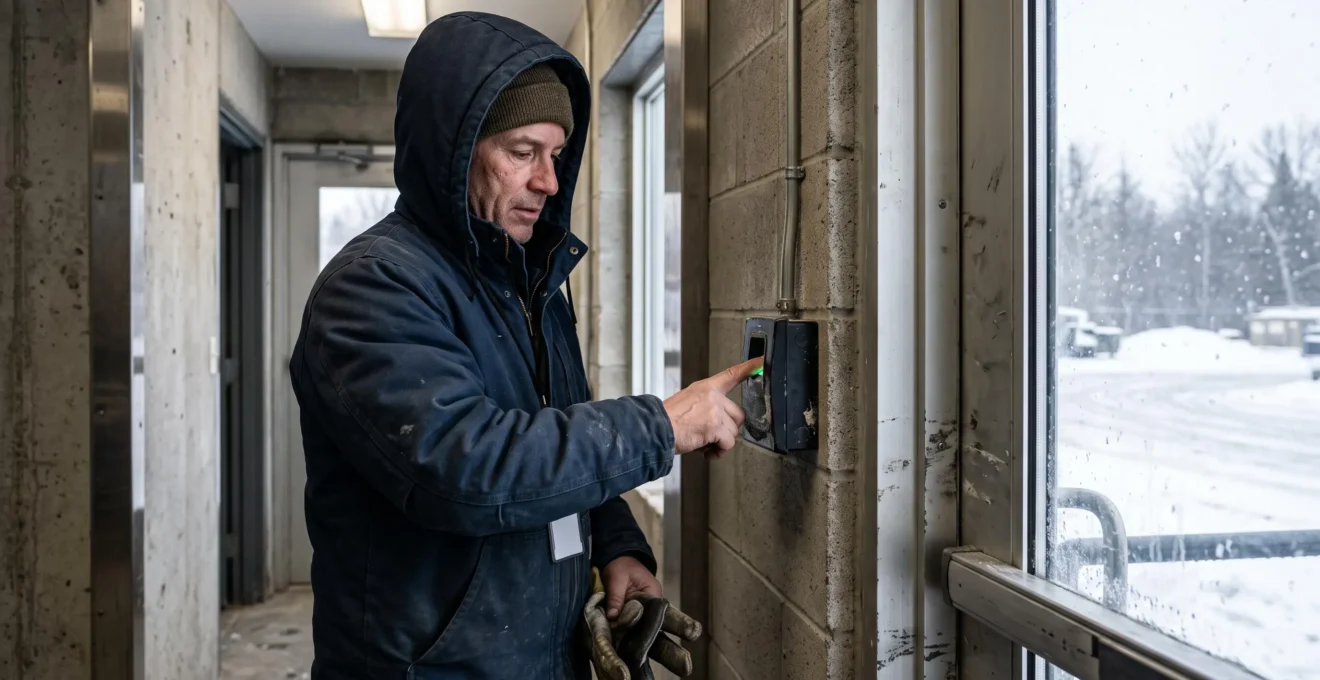
Biometric readers can strengthen access control at Canadian data centres, industrial plants, laboratories and other restricted workplaces. But a fingerprint or facial recognition device is not automatically more secure than a well-managed credential system. Its effectiveness depends on the people using it, the environment surrounding the entrance, its resistance to impersonation and the protections applied to employee information.
Consider an industrial entrance where workers arrive wearing insulated gloves, or an outdoor facial recognition terminal exposed to snow and changing light. A technology that performs accurately in a controlled demonstration may become an operational obstacle during a busy shift change. Repeated failures can also encourage unsafe access practices.
Canadian employers face another consideration: biometric information is sensitive and difficult to replace if compromised. Before purchasing hardware, they need to establish whether the security benefit justifies collecting it, determine which privacy laws apply and verify that less intrusive alternatives cannot adequately address the risk.
Biometric access control: what Canadian employers should know
- Match the reader to working conditions. Gloves, damaged skin, protective equipment and harsh lighting can undermine authentication performance.
- Evaluate security beyond matching accuracy. Presentation attack detection, reliable fallback procedures and physical entrance controls are essential.
- Establish privacy safeguards before enrolment. Canadian requirements vary by jurisdiction, employer type and the personal information being processed.
- Why Do Fingerprint Readers Struggle With Gloves and Damaged Skin?
- How Can Canadian Employers Enrol Staff in Biometric Access Systems Responsibly?
- Fingerprint or Facial Recognition Readers for Industrial Entrances?
- Why Basic Fingerprint Sensors Need Presentation Attack Detection
- When Should Biometric Readers Be Cleaned and Performance-Tested?
- Why Do Biometric Systems Sometimes Reject Legitimate Users?
- PIPEDA or Provincial Privacy Laws: Which Rules Apply to Canadian Businesses?
- How Reliable Is Biometric Verification for Protecting Restricted Facilities?
Why Do Fingerprint Readers Struggle With Gloves and Damaged Skin?
Fingerprint readers depend on capturing distinguishable patterns of ridges and valleys on a finger. Gloves obstruct that information, while cuts, calluses, moisture and damaged skin can make the captured pattern difficult to compare with an enrolled reference. These are predictable limitations of fingerprint authentication, particularly in industrial workplaces where hands are routinely exposed to demanding conditions.
During enrolment, a fingerprint system captures biometric characteristics and converts selected features into a reference template. Many matching systems use minutiae, including ridge endings and bifurcations. When a worker later touches the sensor, the system attempts to compare the new capture with the enrolled reference.
A conventional fingerprint reader cannot reliably perform that comparison through an ordinary opaque work glove. Even after removing the glove, the condition of the worker’s skin can affect image quality.
Canadian working environments introduce several practical challenges:
- Cold and dry skin: Winter conditions can reduce the quality of contact or ridge capture, depending on the sensor.
- Temporary injuries: Cuts, abrasions or damaged fingertips may interfere with previously enrolled features.
- Occupational wear: Repeated friction, calluses or scarring can make reliable enrolment and matching more difficult.
- Moisture and contamination: Wet fingers, industrial residue or dirty sensor surfaces can reduce capture consistency.
Temporary and persistent problems call for different responses. Minor changes in skin condition may justify cleaning the sensor, adjusting finger placement or trying another enrolled finger. Persistent scarring or occupational damage may require a different biometric method or a non-biometric access procedure.
Before purchasing fingerprint-only equipment, security managers should determine how frequently employees wear gloves, whether removing them creates a safety issue and how many workers experience recurring fingerprint recognition problems.
There is also a security consequence beyond inconvenience. Employees delayed repeatedly at an entrance may begin following colleagues through controlled doors or leaving doors open. An access reader that cannot accommodate normal work practices can therefore undermine the perimeter it was intended to protect.
A fingerprint reader is most suitable where usable fingerprints can be captured consistently without disrupting safe working practices. Where that assumption does not hold, alternative authentication should be considered before installation.
How Can Canadian Employers Enrol Staff in Biometric Access Systems Responsibly?
Responsible biometric enrolment begins before an employee places a finger on a sensor or looks into a camera. Canadian employers should establish a legitimate security purpose, assess necessity and proportionality, explain how personal information will be processed and identify the applicable legal basis. A usable non-biometric alternative, appropriate retention limits and documented deletion procedures are important safeguards.
Biometric enrolment is different from issuing a conventional access card. A lost card can be cancelled and replaced. A person’s underlying fingerprint or facial characteristics cannot be changed in the same way.
The Office of the Privacy Commissioner of Canada addresses these risks in its guidance for processing biometrics for businesses. Its guidance emphasizes appropriate purposes, meaningful consent where required, limited collection, safeguards, transparency and retention controls.
Employers should first ask whether the proposed reader is necessary for the protected area. A restricted research laboratory may present different risks from a standard administrative office. If access cards combined with effective physical controls adequately manage the risk, collecting biometric information may be difficult to justify.
When biometric technology is warranted, a defensible enrolment process should address the following elements:
- Informed participation: Explain the purpose, data collected, processing arrangements, significant risks and available rights. Document the applicable consent or other lawful basis.
- Real alternatives: Evaluate a card, PIN or supervised verification procedure that allows employees to perform their duties without unnecessary disadvantage.
- Data minimization: Confirm whether the system stores mathematical templates, original samples or both, and whether raw captures are deleted when no longer necessary.
- Storage controls: Determine whether templates remain on an employee-controlled credential, on a local reader or in a centralized database.
- Lifecycle management: Define authorized access, retention periods, deletion triggers and procedures for employee departure or withdrawal where applicable.
Employment introduces a particular difficulty for consent. Employees may feel that refusing biometric collection could affect their job, even when participation is described as optional. The presence of a functional alternative helps address that concern, although it does not automatically resolve every legal question.
A separate written consent record can provide useful evidence of communication and participation where consent is the appropriate legal basis. It should not be presented as a universally mandatory solution or as a substitute for compliance with provincial employment rules.
Template storage deserves particular scrutiny. Mathematical representations are generally preferable to unnecessarily retaining raw fingerprint or facial images, but templates are still sensitive biometric information. Depending on their design, they may be vulnerable to misuse, linkage or reconstruction-related attacks. Vendors should explain template protection, encryption, access controls and whether compromised templates can be replaced or rendered unusable.
Communication should remain practical. Employees need to know which department administers the system, who can inspect access records, whether any supplier receives their information and how to request access, correction or deletion where applicable.
The strongest enrolment arrangement is one that employees can understand and administrators can demonstrate, not merely a signed form kept on file. These requirements should influence reader and software selection from the beginning.
Fingerprint or Facial Recognition Readers for Industrial Entrances?
Neither fingerprint nor facial recognition is universally better for industrial entrances. Fingerprint readers can struggle with gloves, damaged skin and contamination, while facial systems can be affected by face coverings, protective equipment, camera placement and lighting. Canadian employers should select a modality using their actual entrance conditions, workforce requirements, security risks and privacy obligations.
For an indoor entrance where workers have clean, uncovered hands, a fingerprint reader may provide consistent verification. At a winter loading dock where employees wear insulated gloves and carry equipment, the same technology may slow access considerably.
Facial recognition removes the need to touch a sensor, but introduces another set of dependencies. Safety glasses, helmets, hoods, respirators and changing illumination may affect image capture. Outdoor cameras may also encounter glare, snow accumulation and challenging backlighting.
The practical differences are best evaluated against the facility’s operating conditions.
| Selection factor | Fingerprint readers | Facial recognition readers |
|---|---|---|
| Gloves and hand protection | Conventional readers generally require exposed fingers. | Hands can remain covered, subject to other equipment constraints. |
| Skin damage | May reduce capture quality or matching consistency. | Generally avoids hand-related capture problems. |
| Helmets, masks and hoods | Usually do not obstruct the fingerprint itself. | May obscure facial features needed for comparison. |
| Touch and hygiene | Many installations require shared surface contact. | Can support contactless capture. |
| Environmental sensitivity | Finger condition and sensor contamination matter. | Lighting, camera visibility and facial occlusion matter. |
| Shift-change throughput | Depends on capture quality and time needed to present a finger. | Depends on positioning, recognition performance and traffic management. |
| Privacy considerations | Collects sensitive fingerprint-derived information. | Collects sensitive facial information and may raise additional surveillance concerns. |
A controlled pilot should reproduce actual working conditions rather than relying solely on vendor demonstrations. Test readers with representative protective equipment, including winter clothing, and during busy arrival periods. Record successful attempts, retries and assisted entries.
Organizations should also evaluate how the technology is perceived. Facial recognition may create concerns about employee tracking or wider surveillance. A system designed only to verify a claimed identity should not quietly expand into continuous monitoring or identification of everyone approaching an entrance.
Some suppliers offer readers supporting several biometric modalities. Such devices can improve flexibility in suitable configurations, but they can also increase enrolment complexity and the amount of sensitive information collected. Using two modalities should not be the default if one modality plus a non-biometric fallback meets the security requirement.
Environmental compatibility determines whether employees can use a reader reliably. The next consideration is whether the reader can distinguish legitimate biometric presentations from deliberate attempts to impersonate an authorized person.
Why Basic Fingerprint Sensors Need Presentation Attack Detection
Basic fingerprint sensors may match a captured pattern without adequately establishing whether it came from a live, authorized person’s finger. Presentation attack detection evaluates signs that a biometric sample is artificial or otherwise suspicious. For high-security entrances, this protection matters because ordinary matching accuracy does not demonstrate resistance to deliberate impersonation attempts.
A presentation attack involves placing an artificial or manipulated biometric characteristic before a sensor to influence authentication. In a fingerprint system, this could involve a fabricated replica. Facial recognition systems face related threats involving photographs, displays or more sophisticated presentation methods.
The key distinction is between recognizing a pattern and assessing whether its presentation is authentic. A matching algorithm may recognize expected characteristics while a separate detection capability evaluates evidence of spoofing.
Different sensor designs can support different defenses. Capacitive readers measure electrical characteristics associated with finger contact. Ultrasonic approaches use acoustic measurements, while multispectral designs capture information using different wavelengths or imaging conditions. Additional software and hardware techniques may assess presentation characteristics.
However, none of these technology labels establishes a fixed security ranking. Actual resistance depends on the complete sensor, processing software, test conditions and attack materials considered.
The NIST Special Publication 800-63B on authentication and biometric performance distinguishes biometric matching errors from presentation attack resistance. Within its digital authentication framework, it requires presentation attack detection for facial recognition and recommends it for fingerprint and iris recognition.
Those provisions are valuable technical references, but they are not universal legal requirements for biometric door readers installed in Canadian workplaces.
For procurement, the relevant questions are more specific than whether a reader advertises liveness detection:
- Which presentation attack materials and methods were included in testing?
- Were results independently evaluated or measured solely by the manufacturer?
- Which error metrics were reported, and under what operating conditions?
- Does the tested firmware match the version being purchased?
- How does the system respond when presentation attack detection is uncertain or unavailable?
Testing terminology also matters. An ordinary false match rate is not the same as an attack presentation acceptance measure. Buyers should request clearly defined metrics rather than assuming an impressive matching figure proves spoof resistance.
Hypothetical procurement scenario: two restricted entrances
A company is considering biometric readers for a routine equipment storage room and a highly restricted data centre entrance. Both devices advertise similar fingerprint matching accuracy, but only one supplier provides documented presentation attack testing.
The company should evaluate the consequences of unauthorized access at each location and define appropriate anti-spoofing requirements. The higher-consequence entrance warrants stronger supporting evidence and layered physical controls. This scenario illustrates a risk-based decision, not a measured result for any particular commercial product.
For particularly sensitive facilities, a controlled security assessment can test the actual purchased equipment against defined attack scenarios using authorized personnel and documented procedures. Such testing should remain within the organization’s approved security assessment scope.
Even a well-tested reader needs secure installation, firmware management and ongoing monitoring. Presentation attack resistance is one part of maintaining a trustworthy access-control system, not a replacement for physical security.
When Should Biometric Readers Be Cleaned and Performance-Tested?
Biometric readers should be cleaned and performance-tested according to manufacturer instructions, usage intensity, environmental exposure and observed failure trends. There is no universal cleaning interval appropriate for every Canadian workplace. Facilities should establish an initial maintenance schedule, monitor recognition performance and increase inspection frequency when contamination, physical damage or repeated authentication failures appear.
A reader installed inside a clean administrative corridor will generally face different maintenance demands from one beside a dusty production area or an entrance exposed to winter residue.
Fingerprint sensors can accumulate skin oils, dirt and other contaminants. Facial recognition equipment can be affected by dirty camera surfaces, condensation or changes to the surrounding lighting. Physical wear can also interfere with reliable operation.
Rather than assigning the same maintenance interval to every device, facility managers should create a baseline and track performance over time. Useful operational indicators include:
- Rejected attempts involving verified authorized users.
- Repeated attempts before successful authentication.
- Reader outages and communication errors.
- Requests for supervised or alternative access.
- Changes in processing time during shift changes.
These records should be limited to what is necessary for security and maintenance. Aggregated operational measures may answer many performance questions without exposing identifiable employee movement histories.
Maintenance must also include physical inspection. Loose mounting, damaged cables, unauthorized changes or evidence of tampering require attention. Cleaning alone cannot resolve a faulty electronic component or compromised installation.
Testing during quiet periods is insufficient when an entrance serves a large shift change. A device may authenticate one person successfully while causing delays when many employees arrive in quick succession. Performance testing should therefore include representative traffic levels and normal protective equipment.
Security teams should verify what happens when power, connectivity or reader functionality fails. Door behavior must be coordinated with life-safety requirements, emergency egress and the facility’s approved access-control design. A biometric malfunction should not create an uncontrolled entrance or obstruct safe evacuation.
Maintenance records provide evidence of whether the equipment remains suitable for the workplace. When rejection rates rise despite cleaning and repair, the next step is to investigate enrolment quality, user interaction and matching configuration.
Why Do Biometric Systems Sometimes Reject Legitimate Users?
Biometric systems reject legitimate users when a new capture differs sufficiently from the enrolled reference to fall below the configured matching threshold. Poor enrolment, changes in appearance or skin condition, unsuitable lighting, sensor contamination and inconsistent user positioning can all contribute. Repeated rejection is a diagnosable performance problem, not necessarily evidence that the employee is using the system incorrectly.
Biometric measurements naturally vary between attempts. The same finger may contact a sensor at a different angle, and a face may appear different because of lighting, camera position or protective equipment.
Recognition systems use decision thresholds to determine whether a comparison should be accepted. Those thresholds create a trade-off between two important error categories:
- False match or false acceptance: Depending on the metric and test configuration, a system incorrectly matches or authenticates an unauthorized person.
- False non-match or false rejection: A legitimate person’s biometric presentation fails to produce the expected match or authentication.
These metrics are related but not always interchangeable. False match rate and false non-match rate describe biometric comparison behavior under defined conditions, while operational false acceptance and false rejection can depend on the wider system and its workflow.
Increasing the strictness of a matching threshold may reduce some incorrect matches but increase legitimate-user rejections. Relaxing it can improve convenience while introducing different security risks.
For sensitive facilities, threshold selection should be a documented risk decision involving security and operations teams. It should not be left unquestioned at a vendor default.
The investigation of recurring legitimate-user failures can follow a practical sequence:
- Confirm that the affected employee remains authorized and identify the nature of the failed attempt.
- Review original enrolment quality and whether the stored reference remains suitable.
- Check positioning, lighting, skin condition and relevant protective equipment.
- Inspect and test the reader to identify environmental or hardware problems.
- Re-enrol the employee when justified, or provide an appropriate alternative verification method.
Patterns across a workforce are particularly important. If failures consistently affect staff using particular protective equipment, working under poor lighting or experiencing certain skin conditions, the issue may reflect system design rather than individual behavior.
Where authorized and necessary, employers can compare aggregated rejection trends across locations, shifts and working conditions. Such reviews should avoid unnecessary collection of sensitive health or demographic information.
Persistent access difficulties may also raise workplace accessibility and accommodation concerns. A functioning fallback procedure should allow affected employees to enter securely without repeated embarrassment, unnecessary delay or pressure to disclose medical details.
Accurate diagnosis improves both employee experience and security. However, technical improvements must be implemented within the legal framework governing biometric information and workplace monitoring.
PIPEDA or Provincial Privacy Laws: Which Rules Apply to Canadian Businesses?
Canadian biometric workplace privacy requirements depend on the employer’s jurisdiction, sector and processing activities. PIPEDA applies to employee personal information in federally regulated private-sector organizations, while Alberta, British Columbia and Quebec have their own general private-sector privacy legislation. Provincially regulated workplaces elsewhere require a more specific assessment rather than assuming PIPEDA automatically governs all employee biometric records.
The Personal Information Protection and Electronic Documents Act, commonly called PIPEDA, establishes federal private-sector privacy rules within its statutory scope. Its application to employee information is particularly relevant to federally regulated organizations, including banks, telecommunications companies, airlines and certain transportation businesses.
The Office of the Privacy Commissioner of Canada explains this jurisdictional framework in its summary of PIPEDA requirements.
Alberta, British Columbia and Quebec have substantially similar general private-sector privacy legislation. The relationship between federal and provincial rules depends on the activity and legal circumstances, including whether information is processed within or across provincial boundaries.
Public-sector workplaces follow other applicable privacy statutes. Collective agreements, employment obligations and human rights requirements may also affect a deployment.
Quebec warrants particular attention because of its specific biometric framework. The Commission d’accès à l’information du Québec describes obligations to disclose processes that capture biometric characteristics or measurements for identity verification. Creation of a biometric database must be disclosed at least 60 days before that database enters service.
This distinction matters: notification of a biometric identity-verification process and advance disclosure of a biometric database are related but different obligations. The 60-day requirement should not be described as applying identically to every individual reader installation.
Quebec’s regulator also addresses express consent, necessity, proportionality and alternative identification methods. Employers operating in the province should review the Quebec privacy regulator’s official biometrics requirements before deployment.
Across jurisdictions, a practical compliance review should establish the applicable obligations before employees are enrolled.
Five actions to document before deploying biometric access readers
- Determine legal jurisdiction: Record the employer’s province, regulatory sector, applicable privacy legislation and any identified notification requirements. Deliverable: a jurisdiction and obligations summary.
- Justify the collection: Identify the restricted area, security threat, proposed biometric method and reasons less intrusive measures may be insufficient. Deliverable: a documented necessity and proportionality assessment.
- Define employee participation: Specify the applicable lawful basis, information provided to employees and working non-biometric alternative. Deliverable: an enrolment notice and alternative access procedure.
- Verify information safeguards: Document data types, template storage, supplier access, security controls, retention periods, deletion triggers and breach response responsibilities. Deliverable: an approved data-handling and lifecycle record.
- Authorize implementation: Complete applicable privacy review, required notifications and outstanding legal checks before activating the system. Deliverable: a dated deployment approval record.
Biometric templates remain personal information even when the system does not retain recognizable fingerprint or facial photographs. Employers must also consider how information is protected against unauthorized access, improper secondary use and security incidents.
If a biometric database is compromised, the underlying characteristics cannot simply be replaced like an access card. Technical safeguards such as restricted access, appropriately protected templates and cancellable template designs can help reduce consequences, but do not eliminate privacy risk.
Getting the legal basis wrong can create regulatory complaints, investigations, employee grievances and reputational damage. Consent alone does not necessarily make collection reasonable or proportionate, particularly where the employment relationship limits meaningful choice.
When jurisdiction, consent or an alternative lawful basis is uncertain, qualified Canadian privacy-law advice is appropriate before implementation. Once the legal foundation is established, the final purchasing decision should focus on the security performance of the complete access system.
Key takeaways before selecting a biometric access system
- Define the actual threat and consequence of unauthorized entry before deciding whether biometric verification is justified.
- Require evidence of matching performance, presentation attack resistance and operational reliability under the site’s working conditions.
- Treat privacy safeguards, accessibility, emergency access and physical entrance controls as part of the security design rather than optional additions.
How Reliable Is Biometric Verification for Protecting Restricted Facilities?
Biometric verification can provide valuable assurance that an access attempt involves an enrolled person, but its reliability depends on more than recognition accuracy. Secure deployments combine appropriate matching thresholds, presentation attack resistance, equipment availability, manageable rejection rates and physical entrance controls. Biometrics are strongest as one component of layered protection, not as a standalone guarantee against unauthorized entry.
A reader with excellent laboratory matching performance may be unsuitable if employees cannot use it reliably with their normal protective equipment. Similarly, a reader resistant to common spoofing attempts does not prevent an unauthorized person from following an employee through an open door.
For procurement, reliability should be evaluated across four connected dimensions:
- Matching performance: How consistently does the system distinguish authorized from unauthorized biometric presentations under defined conditions?
- Attack resistance: What evidence demonstrates protection against relevant presentation attacks and other authentication threats?
- Operational availability: Does the equipment remain functional during normal traffic, environmental changes and foreseeable technical disruptions?
- Entrance protection: Does the wider facility design reduce tailgating, door propping and other routes around the reader?
Vendors should provide model-specific test reports rather than a single accuracy percentage. Relevant measurements include false match and false non-match rates, operational rejection results and separately evaluated presentation attack performance.
These figures must be interpreted with the correct test conditions and definitions. Laboratory measurements may not predict performance at an industrial entrance exposed to damaged skin, PPE, weather and concentrated traffic.
NIST’s digital authentication framework provides useful examples of measurable biometric performance requirements, but its numerical thresholds should not be treated as mandatory standards for all Canadian physical access-control installations.
A realistic evaluation should therefore include representative users, entrance conditions and operational scenarios. Security teams can establish internal acceptance criteria based on the consequences of unauthorized access and the disruption caused by legitimate-user rejection.
Physical design is equally important. Depending on the security risk, supporting measures may include monitored doors, anti-passback controls, supervised access points or controlled-entry vestibules. None of these features should be installed without considering accessibility, emergency egress and applicable building and life-safety requirements.
Biometric verification also does not independently establish that an employee remains authorized to enter a particular zone. The access-control platform must continue managing privileges, employee departures, temporary permissions and credential revocation.
Finally, an employer should be able to demonstrate that the deployment remains necessary. If operational evidence shows that a less intrusive access method achieves the required protection, the continued collection of biometric information deserves reassessment.
The practical next step is to prepare a site-specific requirements document covering threats, reader performance, employee working conditions, privacy obligations and fallback procedures. Compare suppliers against those documented requirements, then validate the preferred equipment through a controlled pilot before authorizing full deployment.
Can a Canadian employer require biometric access for every employee?
There is no single rule that makes mandatory biometric access lawful for every Canadian employer. The answer depends on the applicable legislation, the employer’s sector, the necessity and proportionality of collection, the lawful basis for processing and relevant employment obligations. Quebec has specific biometric requirements, including obligations concerning alternative identification methods. Employers should obtain jurisdiction-specific advice before making biometric participation compulsory.
Are biometric templates safer than storing fingerprint photographs?
Templates can reduce exposure associated with retaining raw biometric images, especially when unnecessary original captures are deleted and templates are appropriately protected. However, templates are still sensitive personal information. Their security depends on design, storage, access restrictions and protection against misuse or compromise. They should never be assumed impossible to reconstruct, link or exploit.
Can biometric access equipment work when the internet is unavailable?
Some biometric access systems can perform verification locally, while others depend on networked controllers, servers or remote services. Offline operation is therefore a product-specific capability, not a universal biometric feature. Buyers should confirm which authentication functions remain available during a network outage, how access events are handled and whether emergency operation follows the facility’s approved security and life-safety design.
Should high-security facilities combine biometric readers with access cards?
Combining a biometric factor with a separately controlled credential can be appropriate when the threat assessment supports stronger authentication. However, the additional equipment and complexity should deliver a measurable security benefit. A card can also serve as an alternative access method where biometrics cannot be used, although an alternative procedure is not automatically equivalent to two-factor authentication.
What should happen to biometric information when an employee leaves?
Access privileges should be revoked promptly, and biometric information should be handled according to the documented retention schedule and applicable legal requirements. The organization should determine which templates, stored samples and associated records must be deleted, whether suppliers hold copies and how deletion is verified. No single retention period applies universally to all Canadian workplace biometric systems.