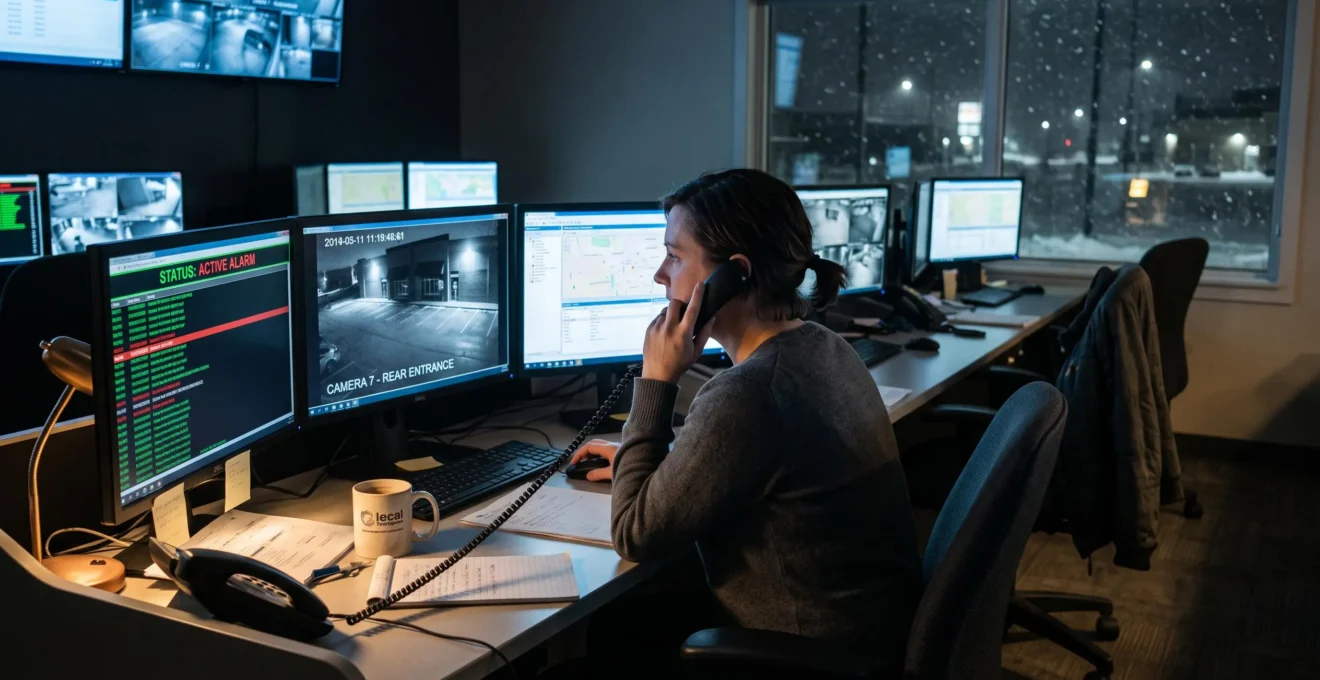
An intrusion alarm can detect an unexpected entry, but detection alone does not establish whether a crime is occurring. A security camera can show what happened, but footage provides limited immediate protection if nobody receives or reviews it. Integrating surveillance and intrusion detection connects these functions into a coordinated response process.
When a door contact, motion detector or other sensor activates, an integrated system can associate the signal with relevant video, send an alert to an authorized person or monitoring station, and preserve evidence for subsequent investigation. The effectiveness of this process depends on verification procedures, reliable communications, backup power and clear response responsibilities.
For Canadian property owners, local police dispatch policies add another consideration. A security alert does not necessarily qualify for police attendance without supporting information. Video verification, monitoring procedures and the distinction between ordinary intrusion alerts and emergency signals can therefore influence whether an alarm results in a practical response.
Integrated surveillance and intrusion alarms: essential points
- Alarm sensors identify potential intrusions, while linked cameras help verify what caused an activation before escalation.
- Response reliability depends on monitoring arrangements, synchronized recordings, functioning communications and backup power.
- Canadian property owners should confirm local police dispatch requirements and protect surveillance footage through appropriate access and retention controls.
- Why Do Unverified Intrusion Alerts Create False Dispatch Problems?
- How Can You Link Alarm Events to Recorded Security Video?
- Self-Monitored Systems or Professional Monitoring for Small Businesses?
- The Backup Power Mistakes That Leave Alarm Systems Inactive During Outages
- When Should You Test Cameras and Alarms After Electrical Work?
- Why Poorly Calibrated AI Video Analytics Misclassifies Routine Activity
- Why Must Monitoring Operators Verify Certain Intrusion Alerts Before Dispatch?
- How Can Property Managers Access Live and Archived Security Footage Securely?
Why Do Unverified Intrusion Alerts Create False Dispatch Problems?
Unverified intrusion alerts create false dispatch problems because an activated sensor does not necessarily indicate criminal activity. If police attend an alarm caused by an employee, equipment malfunction or environmental disturbance, emergency resources are used unnecessarily. Canadian police services may therefore require independent verification before dispatching officers, while local permit and false-alarm rules can create additional administrative or financial consequences.
The distinction is fundamental: an alarm activation reports a sensor event; a verified intrusion provides additional evidence supporting a suspected break-in. A motion detector cannot independently determine whether movement came from an intruder or an authorized person.
When an alarm reaches a monitoring station, an operator must interpret the signal according to the applicable procedure. Depending on available information and local policy, the station may contact designated keyholders, review camera footage, assess additional sensors or request police attendance.
The Toronto Police Service‘s alarm response FAQ explains that verified response was introduced on September 10, 2018. Its accepted verification methods include video, audio, multiple-zone activations and eyewitness confirmation.
Toronto’s published historical figures also illustrate the problem: the police service reported that false alarm activations reached 97% of alarm activations in the period discussed. That figure describes historical Toronto experience, not a current national Canadian false-alarm rate.
Property owners can assess their systems by identifying which detection zones have meaningful verification capabilities.
| Signal type | Verification potential | Practical limitation |
|---|---|---|
| Single door contact | Low without additional evidence | An open door does not establish unauthorized entry. |
| Motion detector with linked video | Video can provide visual context | The camera must cover the relevant location and remain operational. |
| Two distinct detection zones | May satisfy applicable multiple-zone criteria | Correlated activations must be interpreted correctly. |
| Audio verification | May support assessment of suspicious activity | Audio quality, context and applicable privacy requirements matter. |
| Eyewitness confirmation | Can provide direct supporting information | Reports depend on witness reliability and timely communication. |
Multiple activations also require context. For example, one moving object might activate overlapping detectors without establishing independent evidence of an intrusion. Systems should distinguish related signals from separate indications of suspicious activity rather than automatically treating every additional activation as proof.
False-alarm fees and permit rules vary by municipality. In Calgary, published police guidance states that certain alarms may not qualify for dispatch and that false-alarm penalties apply to the licensed alarm company requesting attendance. Any subsequent customer charges depend on the applicable arrangements. Owners should not assume that Toronto, Calgary and Vancouver follow identical procedures.
Effective intrusion protection begins with a reliable method of confirming events. Linking detection signals to recorded security video provides one way to supply that context without relying exclusively on sensor data.
How Can You Link Alarm Events to Recorded Security Video?
Alarm events can be linked to security video through an integration between the intrusion control panel, video management software and compatible cameras or recorders. When a sensor activates, the system creates an event record associated with relevant footage. Pre-event recording, synchronized timestamps and protected clip retention help operators verify activity and investigators reconstruct what happened.
An integrated system does more than send a camera notification. It connects an identifiable alarm zone, event time and recording source so the person reviewing the alert can locate the correct footage without searching through hours of video.
For example, an alarm triggered at a rear loading door can automatically bookmark footage from the camera covering that entrance. When pre-event buffering is enabled, the recording may include activity before the sensor activation. This earlier footage can reveal how someone approached, whether a door was forced or whether an authorized employee was present.
Post-event recording provides additional context, including the direction of movement and whether anyone remained on the property.
Compatibility and time synchronization are essential. An alarm panel and video recorder from different manufacturers may require supported software integrations, event interfaces or additional hardware. Compatibility should be confirmed for the exact equipment models and software versions, rather than assumed from product branding.
Clocks must also agree. If the alarm records an activation at one time and the video recorder uses a different clock, the associated clip may show the wrong moment. Synchronizing devices to a reliable time source, with the correct time-zone settings, helps preserve an accurate event sequence.
Monitoring integrations generally use one of two approaches. Some automatically deliver selected clips or images with an event; others require an operator to open the relevant camera or retrieve a recording manually. Automatic delivery can remove a retrieval step, but the actual response depends on network performance, clip availability and operator workflow.
In Canada, recording and retaining footage also create privacy responsibilities. The Office of the Privacy Commissioner‘s private-sector video surveillance guidelines recommend limiting camera coverage to legitimate purposes, securing recordings, restricting access and retaining footage only as long as necessary.
The federal guidance addresses overt private-sector surveillance of the public; it does not comprehensively govern employee monitoring. PIPEDA and relevant provincial legislation must be assessed according to the organization and its activities. Cameras should avoid unnecessary capture of neighbouring properties, sidewalks and private spaces.
Retention settings should distinguish routine footage from clips preserved for a documented investigation or claim. A recording that is automatically overwritten before authorized personnel review it cannot fulfil its evidentiary purpose.
Five checks for reliable alarm-to-video integration
- Map detection zones to cameras: Produce a zone-to-camera register identifying which footage supports each alarm.
- Confirm equipment interoperability: Record the supported integration method and relevant firmware or software versions.
- Synchronize clocks: Save a test event showing matching alarm and video timestamps.
- Test event retrieval: Trigger an authorized test alarm and verify that the correct pre-event and post-event footage can be retrieved.
- Document retention and access: Produce an approved schedule identifying retention periods, authorized users and evidence-preservation procedures.
Once the technical connection works, the next decision is operational: who will assess the linked footage and take responsibility when an intrusion alert arrives outside business hours?
Self-Monitored Systems or Professional Monitoring for Small Businesses?
Self-monitoring gives business owners direct control over security alerts but requires someone to review and respond whenever an event occurs. Professional monitoring assigns initial alarm handling to a monitoring station operating under defined procedures. The better choice depends on staffing, overnight risk, verification capabilities, insurance requirements and whether the arrangement can support an appropriate emergency response.
A self-monitored system typically delivers notifications to an owner’s phone or another designated device. This can be sufficient for some businesses when responsible personnel are consistently available and able to assess footage.
However, receiving an alert at 3 a.m. is not equivalent to verifying an intrusion. A missed notification, an unavailable manager or limited camera access can interrupt the response.
Professional monitoring transfers initial alert handling to trained operators, but it does not automatically guarantee police attendance. Operators still follow contractual procedures and applicable local dispatch rules.
The distinction becomes clearer when different business environments are compared.
| Business situation | Self-monitoring considerations | Professional monitoring considerations |
|---|---|---|
| Retail store with regular staff | Staff can review alerts during working hours, but overnight responsibility needs assignment. | Can provide an after-hours escalation process without depending on in-store employees. |
| Warehouse without overnight staff | An unavailable keyholder may leave events unverified. | Operators can assess supported alarm signals and contact designated responders. |
| Small office with shared responsibility | Notifications may be missed when several people assume someone else is responding. | A documented response hierarchy can establish who is contacted and when. |
Self-monitoring has lower recurring service costs in some configurations, but operational responsibilities remain. Owners must account for staff availability, training, communication failures and the consequences of delayed event assessment.
Professional monitoring introduces recurring charges and contractual obligations, with service scope varying by provider. Certain systems may offer monitoring only during selected periods or combine professional assessment with designated keyholder escalation.
Insurance deserves separate attention. Commercial insurers may specify alarm or monitoring conditions in a policy, but monitoring does not automatically produce a premium discount or guarantee claim acceptance. Owners should obtain written confirmation from their insurer before relying on a proposed arrangement.
When comparing Canadian providers, request documentation of the monitoring centre’s applicable certification, including whether a ULC-related listing is claimed and precisely what it covers. The UL Solutions‘ central station certification program describes operational assessment and recurring auditing for its UL Listed program. That US-centred program description should not be confused with proof of Canadian ULC certification.
Ask providers who reviews video, how multiple alarms are correlated, what happens if the first keyholder cannot be reached, and which responsibilities remain with the property owner. A certification claim alone does not answer these operational questions.
The chosen model remains dependent on equipment availability. Even an experienced monitoring operator cannot assess an intrusion if an electrical outage disables the cameras or prevents alarm signals from leaving the property.
The Backup Power Mistakes That Leave Alarm Systems Inactive During Outages
Backup power problems can disable an otherwise functional alarm system when batteries are degraded, communications equipment lacks backup power or surveillance devices depend on unprotected circuits. An alarm panel may remain armed while its router, camera recorder or network switch shuts down. Reliable intrusion response therefore requires backup protection across the entire detection, communication and verification chain.
This distinction matters during Canadian winter storms and other prolonged electrical outages. An alarm that sounds locally but cannot transmit an event may not reach its monitoring station. A system that sends a signal but loses video may be unable to provide visual verification.
Three common mistakes deserve attention:
- Depending on an aging battery: A battery may still power a panel briefly while providing substantially less operating time than expected.
- Protecting only the alarm panel: The modem, router or network equipment may lose power even though intrusion sensors remain active.
- Overlooking surveillance loads: Cameras, PoE switches, network video recorders and local storage may use separate power supplies or circuits.
Communication design also matters. A cellular backup path can provide redundancy when a primary internet connection becomes unavailable, but its operation depends on the communicator, power supply, cellular service and system configuration.
A meaningful backup-power test should therefore examine the entire system under a controlled loss of mains electricity. This should be arranged with qualified personnel and, where applicable, the monitoring company to prevent unintended emergency dispatch.
A practical test sequence is to confirm that the alarm panel remains active, check that its communication path continues transmitting, verify that relevant cameras and recorders remain operational, and obtain confirmation that the monitoring station receives the test signal.
The test should also establish whether the available battery capacity supports the property’s required operating period. Battery condition cannot be assessed reliably from a status light alone. Replacement decisions should follow the manufacturer’s specifications, battery age, measured condition and operating environment.
Test records are useful for identifying deterioration between maintenance visits. Seasonal checks are particularly relevant when equipment operates in spaces exposed to temperature fluctuations or when a property has experienced repeated power interruptions.
Backup-power planning should cover the physical infrastructure that keeps alarms connected, not simply the components marketed as part of the security system.
Electrical work can introduce similar disruptions even when a building never experiences a prolonged outage. This makes post-maintenance verification an important part of keeping surveillance and detection systems dependable.
When Should You Test Cameras and Alarms After Electrical Work?
Cameras and intrusion alarms should be tested immediately after electrical work that could affect their power, network connections, wiring or configuration, and before the property returns to normal security operation. A second check after the first overnight operating cycle can help identify intermittent faults. Testing should cover individual detection zones, recording functions, communications and monitoring-station signal receipt.
Electrical work can change security-system behaviour without producing an obvious fault indication. Circuits may be rerouted, devices may restart, connectors may loosen and equipment settings may change after power restoration.
A panel displaying an armed status does not establish that every protected door or movement zone is reporting correctly. Similarly, a camera showing a live image may not be recording or preserving footage.
Before work begins, the owner or responsible manager should coordinate with the electrician and alarm provider. Useful preparation includes documenting existing faults, capturing the current zone map and identifying which devices must be temporarily disconnected.
After work is complete, the verification process should include:
- Checking panel status, power supply and existing fault indicators.
- Walk-testing affected motion detectors and door contacts using the manufacturer’s approved procedure.
- Confirming that panel zone labels correspond to the correct physical locations.
- Reviewing each affected camera’s field of view, image quality and recording status.
- Testing signal transmission and confirming receipt with the monitoring station where applicable.
- Checking linked alarm footage and restoring normal monitoring arrangements.
Testing needs to reflect the actual scope of the electrical work. Replacing a nearby outlet and rewiring the security equipment may create different risks, but both require confirmation that affected components still function.
Where appropriate, a further inspection after overnight operation can identify faults associated with scheduled functions, recording cycles, intermittent communications or equipment that behaves differently under load.
Documenting the pre-work condition and subsequent tests also helps clarify responsibility if a fault appears later. Records should identify the work performed, affected equipment, test results, unresolved issues and the person responsible for corrective action.
Security-system servicing should be coordinated with the monitoring provider so testing does not accidentally generate unnecessary emergency calls.
Once hardware and communications are confirmed, attention should turn to detection accuracy. In systems using artificial intelligence, reliable equipment does not necessarily mean that every automated interpretation of movement is correct.
Why Poorly Calibrated AI Video Analytics Misclassifies Routine Activity
Poorly calibrated AI video analytics can mistake routine activity for suspicious behaviour because detection rules and classification thresholds do not adequately reflect the monitored environment. Shadows, vehicle headlights, animals, vegetation and legitimate visitors may generate false alerts. Excessively restrictive settings create the opposite problem: genuine intrusions may go undetected, reducing the system’s usefulness for event verification.
AI-enabled cameras may classify objects or apply behavioural rules such as intrusion-zone crossing and loitering detection. These functions depend on camera position, image conditions, configured detection areas and the software’s classification capabilities.
For example, a delivery driver waiting near a loading entrance might satisfy an overly broad loitering rule. A moving shadow could also be interpreted incorrectly by a system affected by changing illumination.
Canadian seasonal conditions introduce additional challenges. Snow glare, changing daylight hours, low sun angles and winter precipitation can alter the appearance of a monitored scene. A camera configured successfully during summer daylight may behave differently during winter darkness.
There are two important types of classification error:
- False positives: Ordinary activities are flagged as potential threats, increasing unnecessary notifications and review work.
- False negatives: Relevant intrusions are missed, potentially because detection thresholds or exclusion zones suppress the activity.
Reducing sensitivity may lower false alerts, but it can also reduce the detection of genuine activity. Calibration should therefore consider both error types rather than focusing exclusively on nuisance notifications.
A structured review begins with a representative sample of recorded events, including legitimate activity and controlled test scenarios. The property manager or security technician can categorize misclassifications by camera, lighting condition, event type and time of day.
Settings can then be adjusted systematically. Detection zones should focus on genuine security boundaries, sensitivity should reflect the camera’s environment, and activity rules should distinguish routine access from suspicious behaviour where the technology permits.
After adjustment, the same operating conditions should be tested again to determine whether unwanted alerts decrease without losing relevant detections. A short period with few alerts is not enough to establish accuracy unless the system has also been exposed to representative activity.
Calibration is necessarily site-specific. A parking area, narrow corridor and warehouse entrance present different visual environments and should not automatically share the same analytics settings.
Recorded outcomes should inform periodic recalibration following camera repositioning, lighting changes, landscaping modifications or major seasonal transitions.
For a monitored installation, analytics performance affects more than the property owner’s notifications. False classifications may increase operator workload, while missed activity can deprive the operator of evidence needed to assess a genuine incident.
AI-generated alerts should therefore be treated as information to assess, not automatic confirmation of criminal activity. The monitoring operator’s procedures determine how that information contributes to a possible emergency dispatch.
Why Must Monitoring Operators Verify Certain Intrusion Alerts Before Dispatch?
Monitoring operators must verify certain intrusion alerts because local police response procedures may require supporting evidence before officers are dispatched. The operator evaluates incoming signals, checks available verification information and follows the applicable escalation protocol. Verification helps distinguish routine or accidental activations from credible threats, although panic, hold-up and duress alarms may follow different emergency procedures.
This requirement affects decisions made inside the monitoring station. When an ordinary burglary signal arrives, the operator first identifies the protected premises, alarm type and reporting zone. The station’s software and procedures determine which additional information can be examined.
That information may include simultaneous or sequential sensor activations, linked footage, audio verification or communications from an authorized person at the property.
Operators must also consider local police policy. Calgary Police Service‘s published alarm guidance, for example, states that single-zone activations and certain other alarm categories may not qualify for dispatch.
The same Calgary guidance requires alarm companies to attempt contact with at least two keyholders before requesting police attendance. This demonstrates why a response hierarchy is an operational requirement rather than merely a list of telephone numbers.
Toronto’s verified-response policy accepts several methods of corroboration, but these local police procedures should not be interpreted as a single nationwide rule.
The distinction between monitoring-station operating standards and police dispatch eligibility is also important. Certification may assess aspects of a monitoring provider’s facility and operation, while police services determine their own attendance criteria.
A Canadian provider claiming ULC-related certification should be able to identify the applicable standard, scope of listing and current status. Property owners should request verification rather than assuming that a certified station can automatically secure police dispatch for every alarm.
Before signing a monitoring agreement, useful questions include whether operators receive alarm-linked clips automatically, how they handle unavailable video, what constitutes sufficient verification, which keyholders are contacted and how dispatch decisions are documented.
Emergency signals require special consideration. Panic, hold-up and duress alarms are intended for situations where ordinary verification steps may be inappropriate or unsafe. Toronto Police Service distinguishes panic alarms from ordinary burglary activations, and Calgary identifies panic, hold-up and distress signals as priority categories.
These distinctions mean that response procedures must be configured by alarm type and local requirements, not applied indiscriminately to all signals.
A dependable response process also requires controlled access to the footage that operators and property managers use. The final consideration is how to make recordings available to authorized people without exposing tenants, staff or visitors unnecessarily.
Key takeaways before choosing a footage access system
- Grant access according to operational responsibility, not simply because someone works at the property.
- Protect evidentiary recordings with individual accounts, access logs and controlled exports.
- Choose remote-access and retention arrangements that reflect the applicable Canadian privacy framework and the property’s actual monitoring needs.
How Can Property Managers Access Live and Archived Security Footage Securely?
Property managers can access live and archived security footage securely through a video management platform that provides encrypted remote connections, individual accounts, role-based permissions and activity logging. Cloud-hosted access and properly configured VPN connections are common architectural options. The appropriate design depends on the property’s size, recording location, operational responsibilities and applicable Canadian privacy requirements.
For a single commercial property, authorized managers may connect to a local video recorder through a secured network connection. For multi-site operations, a centralized management platform may simplify access while keeping permissions separate for each location.
Cloud services can reduce some remote-access administration requirements, but they introduce dependencies on the provider’s infrastructure, subscription arrangements and data-handling practices. An on-site recorder accessed through a VPN offers another control model, but it requires appropriate network maintenance and security expertise.
Neither architecture is automatically secure. Configuration, updates, account management and the protection of stored recordings remain decisive.
A role-based structure should distinguish who can view cameras, review historical footage, export recordings or manage system settings.
| User role | Appropriate access | Recommended restriction |
|---|---|---|
| Property manager | Relevant live views and authorized historical footage | Access limited to managed properties and documented purposes |
| On-site employee | Selected live cameras needed for assigned duties | No unrestricted historical search or recording exports |
| Security operator | Views and clips required for event verification | Permissions limited to assigned monitoring responsibilities |
| External investigator or insurer | Specific recordings disclosed through an authorized process | No standing access to the complete surveillance system |
| System administrator | Configuration and account administration | Privileged access separately controlled and audited |
Individual accounts are preferable to shared credentials because access logs can then associate actions with a specific user. This is especially important when footage is exported for an investigation or insurance claim.
Two-factor authentication should be enabled where supported. Former employees and contractors should have their access revoked promptly, while default installer credentials and residual accounts from previous service providers should be reviewed and removed or secured.
Physical protection also matters. A network recorder left in an accessible utility room may be vulnerable to theft, tampering or accidental disconnection even when its remote login is well protected.
For Canadian multi-unit properties, privacy considerations extend beyond cybersecurity. Cameras should generally be positioned to support legitimate security purposes in appropriate common areas while avoiding unnecessary intrusion into private residential spaces.
Clear notices, limited collection, documented access permissions and defined retention schedules help establish appropriate governance. Specific obligations vary according to province, property type and the applicable legal framework.
Requests from police, insurers or tenants should be reviewed under applicable privacy law rather than handled through unrestricted sharing. Depending on the circumstances, disclosure may require legal authority, consent or another valid basis. Exports should preserve relevant metadata and avoid unnecessary disclosure of other identifiable individuals.
Managers should maintain an audit trail identifying who retrieved a recording, when it was accessed, why it was needed and to whom it was disclosed. The retention period for ordinary footage should be distinguished from recordings preserved for a documented legal or investigative purpose.
A practical next step is to request a joint system assessment from the alarm installer, video provider and monitoring company. The assessment should demonstrate a complete test event—from sensor activation through video verification, authorized notification and evidence retrieval—while documenting the applicable police response procedures and privacy controls.
Can existing security cameras be connected to a new intrusion alarm system?
Often, but integration depends on the capabilities of the existing cameras, recorder, alarm panel and software. A compatible event interface or integration service may allow alarms to identify or retrieve corresponding video. Before purchasing equipment, request a demonstration using the actual models and verify that event timestamps, recording retrieval and remote access operate correctly.
Will a verified alarm guarantee police attendance in Canada?
No. Verification can help an alarm satisfy applicable police response criteria, but dispatch remains subject to local policies and operational decisions. Toronto and Calgary publish their own procedures, including rules distinguishing ordinary intrusion signals from emergency alarms. Property owners should confirm the requirements of the police service responsible for their address.
Can security cameras continue recording when the internet connection fails?
Some systems can continue recording to local storage without internet access, provided the cameras, recorder and necessary network equipment remain powered and connected locally. Remote viewing, cloud storage and monitoring-station access may be interrupted. Testing should confirm which functions continue during both an internet outage and a mains power failure.
How long should a Canadian business retain security footage?
There is no single universal retention period suitable for every Canadian business and surveillance purpose. The applicable privacy framework generally requires retention to be justified by a legitimate need. Businesses should establish a documented schedule, securely delete recordings that are no longer required and preserve relevant evidence when a legitimate investigation or legal obligation calls for it.
Should surveillance video be stored locally or in the cloud?
Both approaches can support integrated security. Local storage can maintain recording during some internet outages, while cloud storage may support centralized access and off-site preservation. The decision should consider connectivity, backup power, access controls, storage costs, data location, provider security and applicable privacy obligations. Some properties benefit from a combination of local recording and carefully controlled off-site storage.