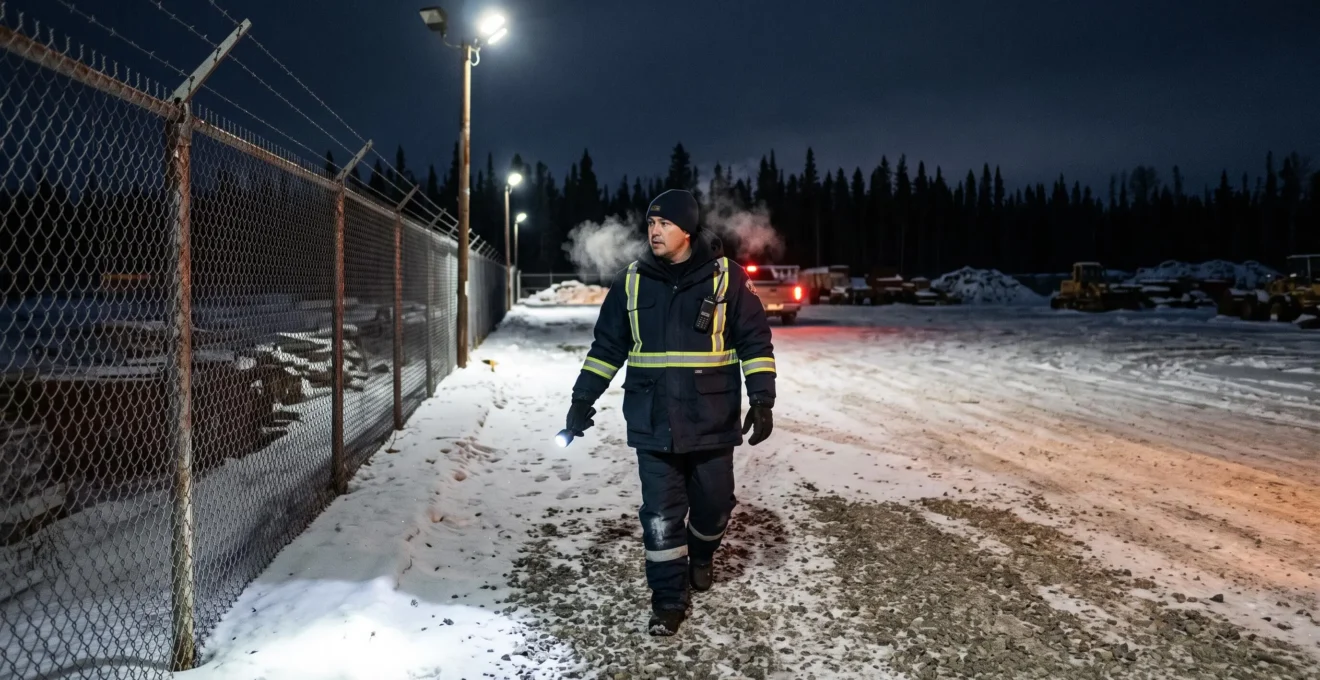
When a perimeter alarm activates at a Canadian industrial or commercial facility, the monitoring operator should identify the triggered zone, assess the available evidence and initiate the site’s approved response procedure. The immediate priority is to distinguish environmental interference from a potentially genuine intrusion without exposing security personnel to unnecessary danger.
Outdoor detection systems operate under difficult conditions. Wind can disturb fence-mounted sensors, snow can change barrier geometry, and wildlife can activate motion detection. However, an apparently routine alarm may also indicate attempted entry, damaged equipment or deliberate interference. Dismissing it without verification creates a preventable security gap.
An effective response depends on coordinated monitoring, clear escalation criteria, trained guards and reliable communication with mobile patrols. Canadian facilities must also account for provincial security practices, winter access restrictions and the limitations of remote locations.
The following operational framework explains how to classify alerts, select an appropriate response, examine recurring activations and maintain perimeter protection across individual sites or multiple properties.
Perimeter alarm response: operational priorities
- Verify the event: identify the sensor zone and compare camera footage, available detection signals and environmental conditions before making a dispatch decision, unless the approved procedure requires immediate escalation.
- Protect personnel: communicate with supervision, maintain safe observation positions and avoid unnecessary confrontation with suspected intruders.
- Close the incident: document the evidence, inspect suspicious or recurring activation patterns and correct any confirmed detection or communication failures.
- Why Do Weather and Wildlife Trigger Outdoor Perimeter Alarms?
- How Should Guards Respond to a Perimeter Alarm at an Isolated Site?
- Automatic Patrol Dispatch or Human Verification After a Fence Alarm?
- The Perimeter Alarm Configuration Errors That Delay Intrusion Response
- When Should Security Teams Inspect a Boundary After Repeated Alarm Activations?
- How Can You Assess Fence Weak Points on a Large Property?
- Why Must Monitoring Operators Verify Certain Intrusion Alerts Before Dispatch?
- How Can Mobile Patrol Vehicles Secure Multiple Properties Efficiently?
Why Do Weather and Wildlife Trigger Outdoor Perimeter Alarms?
Weather and wildlife trigger outdoor perimeter alarms because detection equipment responds to physical changes rather than identifying criminal intent directly. Wind can vibrate fencing, temperature changes can affect infrared detection, and animals can disturb protected zones. The appropriate response is to compare each activation with environmental conditions, sensor behaviour and previous events before classifying its likely cause.
Different technologies produce different activation signatures. Fence-mounted vibration sensors respond to movement transmitted through the fence structure. Strong wind, loose fence components, vegetation contact and snow accumulation may produce signals that resemble deliberate interference. Excessive sensitivity increases nuisance activations, while insufficient sensitivity can reduce intrusion detection.
Outdoor passive infrared sensors detect changes in thermal radiation. Rapid temperature variations, moving warm objects and certain environmental conditions can affect their operation. Infrared beam systems have different limitations, including reduced reliability in fog, heavy precipitation and snow.
The RCMP Security Fencing Considerations Guide identifies temperature variation, wind, snow and terrain as significant considerations when selecting and configuring perimeter detection equipment.
Canadian seasonal conditions complicate classification. Freeze-thaw cycles can alter fence tension, while accumulated snow can change the effective height and accessibility of a barrier. Deer, coyotes, bears and raccoons may also interact with fences or detection areas, although species-specific activation patterns must be established from actual site observations rather than assumed.
A practical triage grid helps operators organize that evidence:
| Observed pattern | Possible explanation | Operator verification |
|---|---|---|
| Repeated fence vibrations during strong wind | Environmental fence movement | Compare wind conditions, camera footage and affected zones. |
| Activation near a snow-covered fence section | Snow loading, movement or altered detection geometry | Review recent weather and inspect when safe. |
| Isolated motion event near vegetation | Wildlife or moving vegetation | Check available video and historical patterns. |
| Sequential activations across adjacent zones | Possible movement through the perimeter | Prioritize verification and escalation under site procedures. |
These observations are indicators, not proof. A genuine intruder may enter during a storm or exploit an area with frequent wildlife activations. Operators should therefore document the evidence supporting a nuisance classification and retain the ability to escalate unresolved alarms.
Unmanaged nuisance alarms can gradually reduce operator vigilance. Accurate classification protects both response resources and the credibility of alerts that require urgent attention.
How Should Guards Respond to a Perimeter Alarm at an Isolated Site?
At an isolated facility, guards should acknowledge and record the alarm, identify its location, attempt available remote verification and notify the designated supervisor or dispatcher before approaching a potentially affected area. Any physical inspection must follow the site’s approved procedure, preserve communication and maintain a safe withdrawal route. Personal safety takes priority over protecting property.
Remote Canadian facilities create additional response challenges. A triggered zone may be far from the guard station, cellular coverage may be unreliable, and winter conditions can slow movement across yards, access roads or industrial compounds. Guards should know the site’s emergency routes, communication limitations and backup procedures before an incident occurs.
The Ontario security guard study guide emphasizes personal safety, communication, established procedures and objective incident reporting. It also explains that alarm response responsibilities vary according to the employer and assigned duties. This provincial guidance should not be treated as a uniform national legal requirement.
The following sequence is a recommended site-level operating procedure, not a mandatory Canada-wide protocol:
- Acknowledge the alarm. Record the activation time, zone identifier, alarm category and monitoring system status.
- Attempt remote verification. Review the associated camera feed and available sensor information without delaying any emergency action required by the site plan.
- Notify supervision. Communicate the location, initial evidence, communication availability and intended next action.
- Approach only when authorized and safe. Use a route that preserves visibility and withdrawal options. Do not enter an area where a suspected intruder could trap or confront the guard.
- Report and escalate. Communicate observations, request assistance when necessary and preserve the incident record.
If a crime is witnessed or confirmed, Ontario’s training guidance directs guards to contact police and withdraw to observe from a safe distance. Facility procedures should similarly distinguish observation and reporting duties from any intervention that could endanger personnel.
Five-point isolated-site alarm response checklist
- Acknowledge the signal and create a timestamped incident entry identifying the affected sensor zone.
- Review available cameras and detection signals, recording the verification method and result.
- Contact the designated supervisor or dispatcher and record the notification status.
- Conduct only an authorized, safe observation or inspection and document the perimeter conditions observed.
- Complete an incident report with the classification, escalation decision and outstanding corrective actions.
Documentation should distinguish confirmed observations from assumptions. An unavailable camera, for example, must be recorded as a verification limitation rather than evidence that no intrusion occurred.
The completed record also helps monitoring supervisors determine whether a mobile patrol should be dispatched immediately, after verification or as part of a subsequent inspection.
Automatic Patrol Dispatch or Human Verification After a Fence Alarm?
Automatic dispatch prioritizes mobilization speed, while human verification can reduce unnecessary patrol callouts by checking whether an alarm warrants a physical response. The correct choice depends on asset criticality, intrusion risk, available evidence and responder travel time. Neither method should be applied universally: dispatch thresholds must be documented for each site’s threat profile and operational requirements.
Automatic dispatch sends a patrol or initiates a predefined response as soon as qualifying detection criteria are met. It can reduce the delay between detection and mobilization, but repeated nuisance activations may consume patrol capacity and generate unnecessary travel.
Under verification-first dispatch, an operator reviews camera footage, related sensor activity and relevant site information before authorizing a response. This provides an opportunity to identify environmental interference while escalating credible intrusion indicators.
Verification is not guaranteed to reduce every cost or improve every outcome. Its value depends on camera availability, operator competence, assessment speed and the quality of the site’s detection configuration.
| Facility scenario | Preferred assessment approach | Operational consideration |
|---|---|---|
| Zone with frequent documented environmental activations | Verification first | Reduce unnecessary mobilization without automatically dismissing repeated alerts. |
| Critical asset exposed to a credible intrusion threat | Consider immediate response under predefined criteria | Evaluate the consequences of delay and available responder capacity. |
| Facility with reliable camera coverage | Video-supported verification | Review the affected area promptly before dispatch authorization. |
| Site without usable camera coverage | Sensor correlation and escalation rules | Multiple zone activations may strengthen suspicion but cannot independently confirm intrusion. |
The decision involves three competing priorities: response speed, cost per mobilization and the likelihood of failing to act on a genuine threat. A facility containing critical equipment may reasonably choose a more conservative dispatch threshold than a lower-risk storage yard with frequent environmental alarms.
Sensor-zone correlation can support decisions where video is unavailable. However, two adjacent activations are not necessarily independent evidence: severe weather can affect neighbouring zones simultaneously.
Operators should also record why each dispatch was authorized or declined. Without this feedback, automatic mobilization may repeatedly address symptoms without identifying the underlying detection problem.
Whichever strategy is adopted, its effectiveness depends on correct sensor coverage, reliable communication and current escalation contacts.
The Perimeter Alarm Configuration Errors That Delay Intrusion Response
Perimeter alarm configuration errors delay intrusion response when sensors generate excessive nuisance alerts, leave detection gaps or route notifications to the wrong personnel. Common problems include inappropriate sensitivity, poor zone positioning, incomplete sensor correlation and outdated emergency contacts. Facilities should review these settings after physical site changes, seasonal transitions or unexplained changes in activation behaviour.
Excessive sensitivity is frequently mistaken for stronger protection. In practice, a fence-mounted sensor configured too aggressively may generate repeated activations from ordinary fence movement. Conversely, reducing sensitivity without validation can create an opportunity for genuine interference to go undetected.
Detection gaps are another concern. Equipment positioned without accounting for slopes, drainage channels, vegetation and changes in ground elevation may provide incomplete coverage. Line-of-sight technologies are particularly dependent on suitable terrain and placement.
Sensor locations should follow a route-based assessment of likely approaches rather than simply distributing equipment along the most visible sections of fencing. Gates, utility penetrations, culverts and access points deserve explicit consideration.
Configuration also extends beyond physical sensors. If a monitoring account contains obsolete telephone numbers, unclear authority levels or incorrect zone descriptions, an operator may receive an alarm promptly but struggle to initiate an effective response.
Canadian winter conditions introduce additional failure modes. Snow accumulation may change detection geometry or create accessible routes over barriers. Temperature fluctuations can affect mechanical tension, and power or heating failures may compromise equipment when travel conditions already make response difficult.
Configuration audits should therefore cover four areas:
- Detection integrity: sensitivity, sensor alignment, fence tension and verified coverage.
- Zone logic: correct alarm labels, correlation rules and camera associations.
- System resilience: equipment power, backup arrangements and communication availability.
- Response routing: updated contacts, notification order and dispatch authorization criteria.
A practical audit should be triggered whenever construction, vegetation clearing, fence repair or access modifications alter the protected area. Reviews after seasonal changes and unexplained alarm patterns are also appropriate. The interval is a site-specific management decision, not a universal Canadian statutory schedule established by the available guidance.
Testing should confirm that detection equipment produces the expected notification and that operators can identify the correct physical zone. A functioning sensor is insufficient if its alarm points responders toward the wrong location.
When activations persist after configuration checks, the issue may require a physical boundary inspection rather than another adjustment to the monitoring software.
When Should Security Teams Inspect a Boundary After Repeated Alarm Activations?
Security teams should inspect a boundary when repeated activations form an unexplained pattern, indicate possible equipment deterioration or suggest interference with perimeter protection. Multiple alarms from one zone, sequential activations or unusual time-of-day patterns warrant assessment against historical records. The decision should reflect site risk and evidence, because no universal repeated-alarm count establishes when every Canadian facility must inspect.
Repeated alarms are not simply a volume-management problem. Their distribution can reveal distinct operational concerns. One zone activating during windy conditions may indicate a loose component. Activations spreading across neighbouring zones may reflect environmental effects, movement along the fence or possible deliberate testing of the detection system.
Similarly, alarms recurring at particular hours may correlate with wildlife movement, routine vehicle activity or human behaviour. Operators should examine the context before assigning a cause.
A physical inspection should evaluate:
- Fence tension, damaged mesh and stability at post bases.
- Loose or displaced detection brackets and associated hardware.
- Vegetation, accumulated debris and objects contacting the fence.
- Exposed, damaged or disconnected sensor cables and conduits.
- Cut marks, damaged locks, repositioned components or other possible tampering evidence.
Safety procedures should govern the timing and location of any inspection. Potentially active intrusion scenes should not be approached merely to resolve an uncertain alarm classification.
Evidence of tampering, suspicious activity or a failure affecting a critical asset should be escalated to the designated supervisor or facility owner. Police involvement should follow the nature and urgency of the suspected incident and applicable local response procedures. Suspected criminal activity should not be treated as routine maintenance.
Each inspection should end with a documented outcome. A zone may be cleared following identification of a credible nuisance cause, assigned a hardware repair, flagged for configuration changes or escalated for further investigation.
An unresolved activation pattern must remain visible in the incident-management process. Closing individual alerts without correcting their source leaves the same uncertainty for the next shift.
Findings from these inspections should also inform the broader assessment of weak perimeter segments, particularly on extensive properties where uniform monitoring coverage is difficult.
How Can You Assess Fence Weak Points on a Large Property?
Fence weak points on a large property should be assessed by dividing the perimeter into segments and evaluating each segment’s exposure, terrain, observation coverage and proximity to important assets. The objective is to identify where an intruder could approach or cross with limited detection and determine whether existing safeguards adequately address that risk.
A long fence does not provide identical protection along its entire length. Terrain, visibility, access routes and nearby assets change the consequences of intrusion from one segment to another.
Start by creating a perimeter map that identifies gates, drainage channels, utility crossings, tree lines, changes in elevation and areas beyond reliable camera observation. Divide the boundary into manageable zones using these features rather than distance alone.
Each zone can then be evaluated against three operational criteria:
- Exposure: available approach routes, concealment and ease of access from surrounding areas.
- Detection: camera visibility, sensor coverage, lighting and environmental limitations.
- Consequence: assets, infrastructure and operational activities that could be affected by unauthorized entry.
For example, a fence segment beside a wooded drainage corridor may have restricted visibility and challenging sensor coverage. A highly visible gate may still present a separate vulnerability through damaged locking hardware or access-control failures.
A verification walk can reveal conditions that are difficult to identify from the facility interior. Where legally permitted and operationally safe, an assessment from outside the boundary can examine approach visibility, concealment and accessible fence components. Low-light observations and post-seasonal inspections may reveal issues missed during a daylight survey.
The assessment must not create an unsafe situation or involve unauthorized access to neighbouring property.
For every identified weakness, the facility should select a documented treatment: improve detection, add camera observation, repair the barrier, adjust patrol coverage or formally accept the remaining risk through its established approval process.
The resulting record should identify the segment, deficiency, responsible decision-maker and agreed treatment. A list of weaknesses without assigned decisions provides little operational protection.
These findings should be reflected in monitoring instructions so operators understand which alarm zones require particular attention and why.
Why Must Monitoring Operators Verify Certain Intrusion Alerts Before Dispatch?
Monitoring operators verify intrusion alerts to determine whether available evidence justifies dispatching security personnel or requesting police assistance. Verification can distinguish credible intrusion indicators from environmental interference, technical faults or inconclusive signals. However, it must not delay emergency action when predefined criteria require an immediate response. The applicable dispatch requirements depend on the provider, jurisdiction and site agreement.
Three separate decisions are involved in alarm handling: receiving the event, assessing the evidence and authorizing a response. An alarm notification confirms that a detection system generated a signal; it does not independently establish that an unauthorized person entered the property.
Verification may rely on live or recorded camera images, correlated sensor activations or direct information from personnel at the facility. These forms of evidence carry different levels of certainty.
For example, a camera showing a person crossing a protected boundary offers more direct evidence than two fence vibration alerts. Correlated sensor signals may still be valuable, but environmental conditions can sometimes affect multiple zones.
The United Kingdom’s NPSA guidance on perimeter intrusion detection systems describes the importance of alarm verification, CCTV coverage and managing nuisance activations. Its technical recommendations are relevant to system design, but they do not constitute Canadian dispatch law or establish one mandatory verification rule for all Canadian monitoring providers.
Verification has its own failure modes. Camera feeds may be unavailable, views may be obstructed, or the assessment may consume time during a genuine intrusion. Operators need escalation rules for these circumstances rather than treating missing evidence as a negative finding.
Strong indicators such as visible unauthorized entry, credible reports from personnel or unusual multi-zone activity may justify urgent dispatch according to the approved risk-based response plan. Multiple sensor activations alone do not automatically prove deliberate intrusion.
Police alarm-response requirements can also differ between jurisdictions. Facility managers should confirm the applicable local policy and monitoring contract rather than assuming that every unverified alarm receives the same police priority.
Every verification outcome should be logged with the information reviewed, the decision reached and the person or role authorizing dispatch. This makes later incident review and improvement possible.
Verification becomes most effective when its results are communicated immediately to mobile responders who know the affected zone and the site’s access procedures.
Key takeaways before coordinating mobile patrols
- Patrol capacity must reflect travel distances, credible alarm demand and the response commitments made to each facility.
- Unpredictable patrol patterns can strengthen deterrence, but they do not replace continuous monitoring or guaranteed emergency availability.
- Monitoring operators and patrol drivers must share accurate zone information, verification findings and escalation instructions.
How Can Mobile Patrol Vehicles Secure Multiple Properties Efficiently?
Mobile patrol vehicles can protect multiple properties by combining varied inspection routes, risk-based dispatch priorities and centralized electronic monitoring. Efficient deployment depends on realistic travel distances, seasonal road conditions, contractual response commitments and reliable communication. A patrol vehicle should not be assigned more facilities than it can reasonably support under the expected alarm workload and available backup arrangements.
Mobile patrol coverage serves a different purpose from continuous on-site guarding. A patrol vehicle moves between locations, conducts physical checks and responds to qualifying incidents. Between visits, electronic detection and monitoring provide information about events that would otherwise remain unobserved.
Predictable patrol schedules can allow unauthorized individuals to anticipate periods without a visible security presence. Ontario’s security guard training guidance therefore recommends varying patrol routes and timing. Variation should remain compatible with safety requirements, required inspections and contractual commitments.
Property allocation must account for more than the number of stops per shift. Travel time, the complexity of each site, anticipated alarm frequency, access restrictions and the time required to investigate incidents all influence realistic coverage.
Canadian winter conditions make this calculation particularly important. Snow, ice, limited visibility and difficult rural access can reduce vehicle mobility and lengthen the time needed to reach a triggered zone. Backup arrangements should address periods when the primary patrol unit is unavailable.
A practical multi-property model combines three service functions:
| Service function | Primary purpose | Coverage limitation |
|---|---|---|
| Physical patrol visits | Observe site conditions, check designated access points and identify visible deficiencies. | Protection is intermittent between visits. |
| Alarm-response dispatch | Send an available unit to assess a qualifying activation. | Arrival depends on location, availability, access and conditions. |
| Electronic monitoring | Receive alerts, review evidence and coordinate escalation. | Effectiveness depends on detection coverage, system availability and response procedures. |
The RCMP Fundamentals of Detection Systems in Physical Security emphasizes documented operating procedures, trained security personnel, escalation contacts and layered protection. It also places preservation of life and personnel safety ahead of property protection.
To coordinate a dispatch, the monitoring operator should provide the patrol driver with the facility identifier, activated zone, alarm time, verification findings, access instructions and known hazards. The driver should acknowledge the assignment and report observations through the established communication channel.
A patrol arriving without reliable zone information may waste valuable time examining the wrong part of a large boundary. Consistent incident records allow monitoring personnel, guards and supervisors to work from the same operational picture.
Facility managers should review their patrol agreements, monitoring instructions and zone maps together, then conduct a practical alarm-response exercise to confirm that each participant knows when to act, what information to exchange and how to close the incident.
Should every perimeter alarm result in a police call?
No. The appropriate response depends on the evidence, severity of the incident, site procedures and applicable local police alarm-response policies. Confirmed criminal activity, immediate threats or other emergencies should be escalated according to the relevant emergency procedure. Unverified or environmentally caused activations may instead require monitoring, security dispatch or technical investigation.
What should an operator do if the camera associated with a triggered zone is offline?
The operator should record that video verification is unavailable, review any other valid detection signals and follow the site’s escalation rules. Missing video does not mean the alarm is false. The camera failure should also be reported for corrective action because it reduces the facility’s ability to evaluate subsequent events.
Does a second sensor activation confirm a real intrusion?
Not necessarily. Two or more activations may increase concern, particularly when they are sequential and consistent with movement across the property. However, wind, precipitation and other disturbances can affect several detection zones. Operators should examine timing, sensor type, environmental conditions and available video before determining the appropriate escalation.
How should a security team handle an alarm that cannot be conclusively classified?
The event should remain documented as unresolved, with the available evidence and verification limitations clearly recorded. The operator should follow the site’s risk-based escalation procedure, which may include supervisor review, patrol dispatch or inspection. Lack of confirmation should not automatically be interpreted as absence of an intrusion.
When should perimeter alarm response procedures be tested?
Facilities should establish a risk-based exercise schedule and reassess procedures after significant system, personnel or site changes. Testing can confirm that alarms identify the correct zones, notifications reach authorized contacts and responders understand their responsibilities. The RCMP’s 2025 detection-systems guidance recommends rehearsing security response procedures, including scenarios involving intruder alarms, without prescribing one universal testing frequency for all private Canadian facilities.