High-security facilities face a fundamental challenge: the people most capable of disrupting sensitive operations often already possess legitimate access. In Canadian data centres, research laboratories and corporate facilities, authorized employees, contractors and partners may encounter critical infrastructure, valuable intellectual property or sensitive information as part of routine work.
Effective protection therefore requires more than hardened entrances and electronic badges. Organizations must control what authorized individuals can do, establish independent approval for consequential actions, monitor unusual activity and promptly withdraw permissions that are no longer necessary.
A defensible security architecture combines physical protection, role-based permissions, individual accountability, supervised maintenance and documented response procedures. These safeguards should reflect the consequences of unauthorized activity, the operational need for rapid intervention and applicable Canadian contractual or regulatory obligations.
The objective is not to make every room equally restrictive. It is to establish proportionate, verifiable safeguards around the assets and operations whose compromise would cause the greatest harm, while preserving safe evacuation and reliable facility operations.
Essential safeguards for sensitive Canadian facilities
- Control trusted access: assign individual, least-privilege permissions and review them whenever responsibilities change.
- Protect critical operations: combine restricted zones, dual authorization, monitored entrances and supervised contractor activities according to risk.
- Maintain accountability: record attributable access events, investigate anomalies and periodically recertify permissions and exceptions.
- Why Are Insider Threats Difficult to Detect in Sensitive Facilities?
- How Can Dual Authorization Protect Sensitive Equipment Rooms?
- Mantraps or Guarded Vestibules for Restricted Data Centre Entrances?
- Why Unsupervised Maintenance Creates Risks in Secure Technical Rooms
- When Should Sensitive Facilities Introduce Enhanced Security Procedures?
- Physical Barriers or Electronic Permissions for Research Laboratories?
- Why Do Shared Security Accounts Make Incident Attribution Difficult?
- How Can Canadian Organizations Structure Access Permissions by Employee Role?
Why Are Insider Threats Difficult to Detect in Sensitive Facilities?
Insider threats are difficult to detect because authorized personnel can enter restricted areas and interact with sensitive systems without triggering conventional perimeter alarms. Malicious activity may resemble legitimate work, while careless behaviour or compromised credentials can produce similar warning signs. Detection therefore depends on understanding authorized behaviour, identifying deviations and continuously verifying access privileges.
An insider threat does not necessarily involve a deliberately hostile employee. The Canadian Centre for Cyber Security guidance on insider threats identifies both intentional and unintentional threats involving people with authorized access to organizational information or infrastructure.
In practice, facility operators should distinguish three exposure patterns:
- Malicious insiders: individuals deliberately misusing legitimate permissions to remove information, manipulate equipment or bypass safeguards.
- Unintentional insiders: authorized personnel creating exposure through mistakes, procedural shortcuts or inappropriate information handling.
- Compromised access: credentials or trusted personnel being exploited through theft, deception or social engineering.
These scenarios require different responses. A hostile actor may deliberately conceal actions, whereas a distracted technician may repeatedly violate procedures without recognizing the consequences. Training alone cannot address intentional misuse, and surveillance alone cannot eliminate human error.
Perimeter security also has a structural limitation. Once an employee successfully authenticates, a conventional access system may treat subsequent activity as legitimate. Detecting abuse requires a baseline of expected locations, working hours, tasks and privilege levels.
For instance, an approved technician entering a server room during a scheduled maintenance window presents a different risk signal from the same person accessing an unrelated equipment room after hours without an assigned task. Neither event automatically proves wrongdoing. The distinction creates a reason for proportionate verification.
A particularly important exposure is the trusted access gap: the period between granting permissions and reviewing or removing them after the underlying business need changes. This is a practical risk-management description, not a formally defined Canadian regulatory term.
Organizations can audit that gap by comparing access-control records with human resources data, contractor registers, project assignments and termination records. Each permission should have a responsible owner, a documented purpose and an identifiable review event.
Canadian organizations handling government-specified information should also determine whether contractual requirements or applicable security frameworks introduce additional expectations. General government cybersecurity guidance does not automatically impose identical controls on every private facility.
Once the limitations of trusted access are understood, the next priority is preventing any one individual from independently carrying out the most damaging operations.
How Can Dual Authorization Protect Sensitive Equipment Rooms?
Dual authorization protects sensitive equipment rooms by requiring two independently authorized individuals to approve a designated entry or high-impact operation. This reduces reliance on a single person’s credentials and judgment. It is particularly appropriate where an action could cause severe disruption, expose highly sensitive assets or become difficult to reverse once completed.
The mechanism is often described as two-person integrity. Depending on system design, it can apply to entry into a controlled room, execution of a privileged command or authorization of a sensitive operational change.
The Canadian Centre for Cyber Security access-control catalogue addresses dual authorization for designated privileged actions and recognizes rotation of approvers as a possible safeguard against collusion.
Applying the same principle to physical room entry is a separate facility-design decision. The most useful approach is to classify specific assets and actions instead of requiring two people for every routine visit.
The following decision grid is an illustrative risk-assessment tool, not a mandatory Canadian classification standard.
| Risk condition | Typical activity | Suggested access treatment |
|---|---|---|
| Limited impact, readily reversible | Routine inspection in a controlled technical corridor | Individual authorized access with event logging |
| Significant impact, reversible through established recovery | Non-emergency changes to supporting equipment | Individual access with documented change approval; consider dual authorization for selected actions |
| Severe impact, difficult recovery | Disabling critical infrastructure or retrieving highly sensitive assets | Dual authorization with independent identities and recorded purpose |
| Immediate threat to personnel or safety | Emergency intervention requiring prompt action | Safety-governed emergency procedure with subsequent review |
Impact severity, reversibility and concentration of privilege should drive classification. A person who can independently access a critical room, change system settings and remove sensitive media presents a different exposure from someone permitted to perform a narrowly defined inspection.
Electronic access-control systems may enforce two distinct credential presentations within a defined authorization window. More advanced designs can associate the event with a work order, require separate approval roles and retain evidence of both decisions.
In older facilities using mechanical locks, equivalent governance may involve individually assigned keys, separately controlled key custody, a documented two-person opening procedure and a signed access register. These procedural arrangements provide less automatic enforcement and require closer supervisory oversight.
Dual authorization also has a behavioural weakness: colleagues can collude or routinely approve requests without meaningful verification. Rotating eligible approver pairs, recording individual decisions and examining repeated approval patterns can help identify these problems.
Approval requirements must not obstruct emergency actions necessary to protect life or respond to immediate hazards. Emergency exceptions need predefined authority, appropriate safeguards and retrospective scrutiny.
Even a carefully governed two-person rule cannot prevent unauthorized individuals from following an approved employee through a poorly controlled entrance. Physical entry design must reinforce the authorization model.
Mantraps or Guarded Vestibules for Restricted Data Centre Entrances?
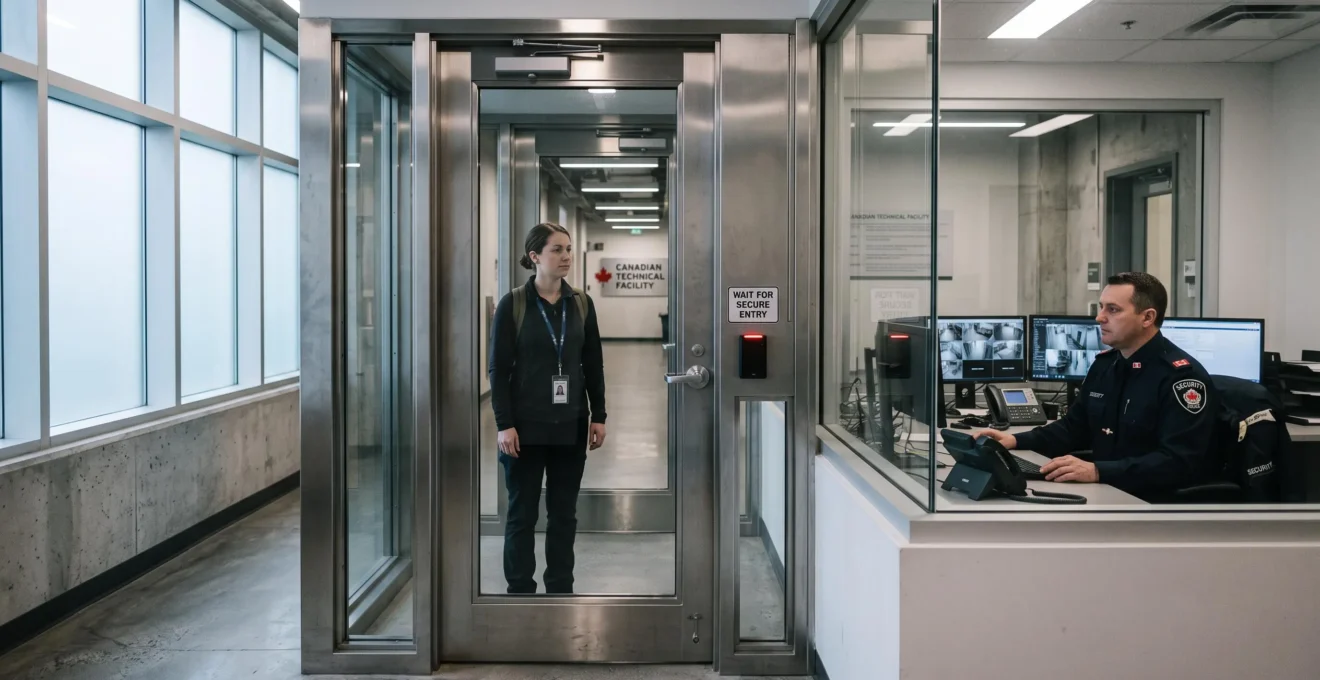
Mantraps and guarded vestibules address different aspects of restricted data centre entry. An interlocked mantrap mechanically controls passage between doors, while a guarded vestibule adds human observation and judgment. The appropriate choice depends on tailgating exposure, expected entry volume, staffing requirements and the facility’s emergency-egress obligations. High-consequence entrances may benefit from combining both approaches.
An interlocked mantrap generally uses two controlled doors arranged so that entry through the second is restricted until the first has closed. Its protective value depends on the entire configuration, including credential validation, door monitoring and any occupancy-detection measures.
A guard can assess circumstances that a conventional badge system may not interpret: a visitor without the required escort, an employee appearing under duress or an unusual equipment movement during an otherwise authorized entry.
Neither approach guarantees that only one person enters. Interlocked doors alone do not establish single-person occupancy unless the system includes effective detection and enforcement measures.
| Criterion | Interlocked mantrap | Guarded vestibule |
|---|---|---|
| Tailgating resistance | Controls door sequencing; stronger single-person enforcement requires appropriate occupancy detection | Relies on guard observation, intervention procedures and physical configuration |
| Throughput | Potential delays from sequential door operation and individual authentication | Can accommodate variable flows but depends on verification workload and staffing |
| Detection capability | Can flag configured door, credential and access-sequence anomalies | Can assess unusual behaviour, escort concerns and contextual discrepancies |
| Operational dependency | Requires maintained hardware, software and fail-safe design | Requires trained personnel, continuous coverage where necessary and clear escalation authority |
For facilities with frequent authorized movement, a hybrid arrangement may be appropriate: an electronically interlocked entrance with individual authentication, supported by a staffed checkpoint or remote video-verification capability for exceptions.
Important design questions include whether both doors independently authenticate entrants, how anti-passback rules behave during interrupted passage, and what happens when a door sensor fails.
Anti-passback logic can help identify inconsistent credential movements, but it does not independently verify a person’s identity or prevent credential sharing. Similarly, a door-held-open alarm has limited value without an assigned response process.
Operators should test scenarios such as a propped inner door, simultaneous entry attempts, a failed reader and an interrupted power supply. Testing should establish whether the entrance preserves necessary security functions without trapping occupants.
Canadian building, fire and occupational safety requirements are decisive constraints. Applicable rules depend on jurisdiction, building classification and the specific installation. Security teams must obtain competent code and fire-safety review before implementing interlocks or locking arrangements.
Safe and reliable emergency egress takes precedence over entrance restrictions. The operational design must also account for emergency responders and authorized maintenance personnel.
The entrance becomes effective only when the activities occurring beyond it are similarly controlled, particularly contractor maintenance in critical technical spaces.
Why Unsupervised Maintenance Creates Risks in Secure Technical Rooms
Unsupervised maintenance creates security exposure because technicians may need direct physical access to critical equipment, network interfaces and infrastructure controls. Broad contractor permissions can allow activities beyond the approved repair. Without supervision, defined work scope and post-intervention verification, unauthorized modifications may be difficult to distinguish from legitimate maintenance.
Data centre and laboratory maintenance frequently requires access to environmental controls, electrical distribution equipment, communications infrastructure and other systems essential to facility operations.
External technicians may be unfamiliar with an organization’s security rules, while internal personnel may assume that anyone carrying an approved maintenance badge is permitted to work throughout a technical area.
Particular risks include introducing unauthorized devices, altering configurations, accessing exposed interfaces or unintentionally interrupting critical systems. These possibilities warrant a preventive maintenance-control process; they do not mean every maintenance intervention is suspicious.
The Canadian guidance on protecting specified information in non-government systems addresses maintenance-personnel authorization, supervision of personnel without sufficient authorization, physical-access monitoring and temporary credentials.
Its application depends on the relevant government-specified information and contractual requirements. Organizations outside that scope may still use the principles as a risk-based design reference.
A practical supervision protocol connects each intervention to a defined work order, approved technician, restricted location and authorized activity. Permissions should be activated for the necessary work period and withdrawn afterward.
Escorted access may be necessary where personnel have not received the required authorization. Video monitoring can provide additional evidence, where appropriate and lawfully implemented, but should not be assumed to replace physical supervision in every high-risk activity.
After the intervention, the facility owner should verify the work against the original scope. Depending on the assets involved, this could include checking cabinet seals, accessible ports, panel closures, connected devices and recorded configuration changes.
This post-maintenance check is a recommended facility procedure rather than a universally prescribed Canadian requirement. It should be adapted to equipment sensitivity and maintenance risk.
Operational continuity remains important. An overly restrictive policy can delay essential HVAC, electrical or cooling repairs. Pre-vetted suppliers, agreed response arrangements and approved maintenance windows can reduce that conflict.
For emergency repairs, define a separate controlled process that identifies who may authorize entry, how activity will be observed and which verification steps must follow stabilization.
These practices should not remain isolated operating rules. Changes in facility activity and accumulated access exceptions determine when the entire security architecture needs reassessment.
When Should Sensitive Facilities Introduce Enhanced Security Procedures?
Sensitive facilities should introduce enhanced security procedures when the consequences of unauthorized access exceed the protection provided by existing controls. Significant incidents, new contractual obligations, expanded sensitive operations and changes in threat exposure are practical triggers. Periodic access reviews should also reveal gradual control deterioration before a serious incident forces corrective action.
A facility does not necessarily need dual authorization, guarded entrances or extensive monitoring in every room from its first day of operation. Controls should evolve according to the assets protected and the credible consequences of compromise.
However, relying exclusively on fixed annual reviews can leave important changes unaddressed. Specific events should trigger immediate reassessment:
- A security incident, unexplained access event or significant near-miss.
- Introduction of sensitive research, new critical systems or additional high-value assets.
- New government, critical-infrastructure or customer security requirements.
- A material change in operational threats, contractor arrangements or facility occupancy.
- Evidence that access exceptions, unused credentials or incomplete access records are accumulating.
This accumulation of unresolved exceptions can be described as security debt. A temporary contractor badge remains active, a transferred employee keeps access to a former department, or an emergency bypass becomes an accepted routine.
Each isolated exception may appear manageable, yet the combined effect weakens least privilege and makes the facility harder to audit.
An illustrative three-tier maturity model can help determine the next investment. It is an operational planning tool rather than a formal Canadian certification scheme.
| Maturity tier | Typical safeguards | Primary limitation or next priority |
|---|---|---|
| Tier 1: Basic controlled access | Individual badges, conventional locked rooms and basic entry records | Limited differentiation between routine and high-consequence activity |
| Tier 2: Risk-zoned protection | Restricted zones, least-privilege permissions, selected dual authorization and supervised high-risk work | Needs consistent exception governance, monitoring and access recertification |
| Tier 3: Integrated high-assurance operations | Coordinated physical and system controls, attributable event review, governed exceptions and tested response procedures | Requires continuing operational assurance rather than one-time installation |
The facility’s required maturity level should follow a documented consequence assessment. Loss of sensitive research or interruption of essential infrastructure may justify tighter safeguards than access to an ordinary support space.
Access recertification is a practical checkpoint. Managers and asset owners should confirm whether each individual still needs current permissions, whether exceptions remain justified and whether security responsibilities are adequately assigned.
Five actions for reviewing high-security facility access
- Inventory sensitive zones and assets: produce a zone register identifying protected equipment, information and accountable owners.
- Export current access permissions: generate a dated list of active individual, contractor and administrative credentials by zone.
- Validate business necessity: obtain documented approval or removal decisions from the relevant operational owner for each permission.
- Review elevated access and exceptions: create an exception register showing purpose, authorizer, expiry condition and required corrective action.
- Verify remediation: retain a completed change log, evidence of revoked permissions and a scheduled date or event for the next review.
Cost and operational burden must remain visible in these decisions. Additional staffing, delayed entry and maintenance constraints can be justified where risk reduction is proportionate, but indiscriminate deployment creates unnecessary friction.
Research laboratories illustrate why this assessment must consider both physical assets and information access, rather than treating all sensitive rooms as interchangeable.
Physical Barriers or Electronic Permissions for Research Laboratories?
Research laboratories generally need both physical barriers and electronic access permissions because the controls address different risks. Hardened entrances and secure storage impede unauthorized physical entry, while individually assigned permissions determine who may enter and provide records for review. The appropriate combination depends on research sensitivity, portable assets, collaborator access and safety requirements.
Physical barriers can protect equipment, samples and spaces even when an electronic credential is unavailable or a system is offline. Examples include controlled doors, secured cabinets, appropriate glazing and protected storage enclosures.
Electronic controls serve a different purpose: they authenticate credentials, enforce defined permissions, restrict access periods and record events. They also make authorization changes more manageable when researchers, students or external collaborators move between projects.
Neither category should be treated as a complete substitute for the other.
Canada’s research security guidance emphasizes identifying risks associated with sensitive research, organizational partnerships, personnel, information and physical infrastructure. The appropriate safeguards depend on the activity and its exposure.
Laboratory operators should evaluate several distinguishing conditions:
- Asset portability: small samples, portable drives or removable research media may require secured storage and traceable handling beyond room-level access.
- Research sensitivity: valuable intellectual property and potentially controlled technologies may justify additional segregation and authorization.
- Personnel turnover: students, visiting researchers and project collaborators may require frequent changes to access permissions.
- Emergency safety: evacuation, emergency equipment access and laboratory-specific hazards must be considered during door and lock design.
- Applicable obligations: research funding, export controls, biosafety requirements and partnership conditions may create distinct compliance considerations that need separate verification.
One recurring operational weakness occurs when equipment deliveries or transfers require a controlled door to remain open. Similar conditions arise during specimen movement and extended experiments.
A strong electronic authentication system cannot prevent unauthorized passage if the door is deliberately propped open and no effective response follows.
Facilities can address this exposure through approved transfer windows, monitored door-open exceptions, designated escorts and alarms linked to operational response procedures. These measures must not interfere with required emergency egress.
For sensitive research, access records should identify the individual credential holder, event time and controlled location. Recording the purpose through a work order, reservation or authorized research assignment can improve investigative value.
A purpose field for every laboratory entry is a risk-based design recommendation, not a universal obligation established by Canadian research security guidance.
Records also require appropriate security, retention and privacy governance. Facility operators should collect information proportionately and verify applicable legal, institutional and contractual requirements.
That traceability is compromised, however, when several people operate under the same electronic identity or physical credential.
Why Do Shared Security Accounts Make Incident Attribution Difficult?
Shared security accounts make incident attribution difficult because access records identify a credential or account rather than the specific person who used it. Investigators may establish that a room was opened or a privileged command executed without reliably determining the responsible individual. This undermines accountability, incident reconstruction and evidence of compliance with access-control commitments.
The problem applies to shared physical badges, common door PINs, administrative logins and generic maintenance credentials.
Consider a hypothetical facility in which several night-shift technicians use one shared equipment-room badge. Following an unexplained infrastructure change, the access-control system shows that the badge entered the room. Unless independent evidence reliably identifies the user, the log cannot establish who physically entered.
The account may document a sequence of events, but an account identifier is not proof of individual identity when credentials are shared.
This distinction matters during internal investigations. Security teams may need additional video, shift records or witness evidence to establish individual involvement. Such evidence can be incomplete or inconclusive.
Shared accounts can also complicate personnel accountability, contractual assurance and the documentation available during legal or insurance reviews. They do not automatically invalidate proceedings or insurance coverage; those consequences depend on the relevant circumstances and governing terms.
Organizations frequently retain shared credentials for operational convenience. Shift workers may need rapid handovers, contractors may rotate between assignments, or administrators may consider individual accounts difficult to provision.
Those operational problems should be solved through identity administration rather than credential sharing.
Appropriate countermeasures include individually assigned credentials, role-based access profiles, controlled handover procedures and prompt removal of access when responsibilities end.
A remediation program should begin with an inventory of shared credentials across physical and digital systems, including emergency accounts and legacy equipment.
Next, classify each credential by the sensitivity of the assets it can reach. Replace shared access first where it permits critical operations or access to highly sensitive information.
Where a legacy system cannot immediately support individual credentials, compensating controls may include documented credential checkout, supervised use and independently recorded operator identity. These measures reduce uncertainty but do not provide equivalent assurance to genuine individual authentication.
Emergency or technical accounts that cannot be eliminated need narrowly defined ownership, protected credential storage and event review. They should not become routine substitutes for named-user access.
The long-term objective is to eliminate ordinary human use of shared credentials wherever technically feasible, while formally governing unavoidable exceptions.
Individual identity establishes who performed an action; the next governance question is whether that person should have been authorized to perform it at all.
Key takeaways before restructuring access permissions
- Design permissions around documented responsibilities and sensitive assets, not organizational seniority or accumulated historical access.
- Separate everyday authorization from temporary elevated privileges, and ensure temporary permissions have enforceable expiry conditions.
- Connect personnel changes, physical access-control administration and incident records so authorization can be demonstrated and reviewed.
How Can Canadian Organizations Structure Access Permissions by Employee Role?
Canadian organizations can structure facility access through role-based access control (RBAC), assigning permissions to defined job functions rather than making unrelated decisions for each individual. Every role should receive only the zones and system capabilities required for its responsibilities. Temporary elevated permissions should be separately approved, time-limited and recorded, with access promptly adjusted when employment or assignments change.
RBAC provides a practical way to operationalize least privilege across data centres, laboratories and sensitive corporate premises.
For example, an HVAC technician may require regular access to designated mechanical spaces without needing routine permission to enter network administration areas. A research scientist may require access to a specific laboratory and assigned storage areas, but not to unrelated restricted projects.
These permissions should follow the person’s legitimate work requirements, not simply their department name or employment status.
A practical implementation sequence begins by inventorying controlled zones, sensitive systems and the physical assets within them. Each zone must have an accountable owner capable of approving access.
Next, catalogue actual job functions, including operational personnel, security staff, maintenance teams, visiting researchers and contractors. Define permission profiles around the recurring activities those functions require.
Each individual can then receive one primary role profile, with any legitimate additional responsibilities granted through separately documented assignments or temporary exceptions. This prevents complex employees from being forced into an inaccurate single-function permission model.
Permanent permissions and temporary elevated privileges should be governed differently.
| Control element | Routine role-based access | Temporary elevated access |
|---|---|---|
| Purpose | Recurring responsibilities | Specific exceptional task or assignment |
| Authorization | Approved role and zone membership | Separate approval linked to documented business need |
| Duration | While the role remains justified | Defined period or event with enforced expiry |
| Monitoring | Routine access-event review | Targeted monitoring and examination of privileged activity |
| Removal | Role change, departure or recertification decision | Automatic expiry or withdrawal following completion |
Access governance must also be integrated with the employment lifecycle. Hiring should initiate an approved role assignment; transfers should remove outdated permissions as new ones are established; departures should trigger prompt credential revocation.
This joiner-mover-leaver process is particularly important where building access, laboratory authorization and information-system permissions are administered by different teams.
Role definitions should be reviewed when operations change, not just when personnel leave. A new project, facility expansion or revised contractor arrangement may alter which permissions remain appropriate.
For Canadian operators handling government-specified information under applicable contractual arrangements, documented access authorization, account management and physical-access monitoring can also support security-assurance obligations.
Organizations should avoid assuming that adoption of RBAC alone establishes regulatory compliance. Actual obligations depend on the nature of the information, governing agreements, sector and jurisdiction.
Governance becomes stronger when physical and logical access records can be correlated without creating unnecessary surveillance. A centralized review process can help distinguish an authorized work order from activity inconsistent with an individual’s assigned responsibilities.
Appropriate privacy assessments, access to audit records and retention rules should accompany monitoring arrangements.
A successful implementation produces a clear permission matrix identifying each role, its approved zones, the authorizing owner and the circumstances requiring review. Temporary access records should preserve the requested purpose, approval, expiry and eventual closure.
These records make incident investigation more focused and provide management with a defensible explanation of who was authorized to reach particular assets at a given point in time.
For the next facility security review, select the highest-consequence zone, verify every active individual permission against a documented job requirement, identify any shared or excessive access and prioritize corrections before extending the same method across the remaining facility.
Does every Canadian high-security facility legally require dual authorization?
No universal Canadian requirement establishes dual authorization for every restricted room. Specific obligations depend on the facility, applicable legislation, contracts and security requirements. Dual authorization is a risk-based safeguard particularly relevant to designated high-impact actions, but it must be compatible with emergency and safety procedures.
Can video surveillance replace an escort for external maintenance personnel?
Not automatically. Video monitoring can provide evidence of activity, but it may not prevent unauthorized physical intervention or satisfy an applicable supervision requirement. The decision should consider personnel authorization, equipment sensitivity, monitoring effectiveness, contractual obligations and privacy requirements.
How should facilities handle access during an emergency?
Emergency procedures should preserve life safety, evacuation and necessary response capabilities. Security restrictions must be designed around applicable building and fire safety requirements. Where emergency access exceptions are necessary, organizations should define authorized procedures and review the actions afterward without delaying urgent protective intervention.
Should biometric authentication be mandatory in sensitive facilities?
Biometric authentication is one possible access-control measure, not a universal requirement. Its suitability depends on asset sensitivity, identity-assurance needs, operational conditions, privacy obligations and system resilience. Individual badges, appropriately configured additional authentication and supervised procedures may be more proportionate in some environments.
What evidence should a facility retain to demonstrate effective access governance?
Useful evidence includes approved role definitions, permission records, access-change approvals, individual entry logs, temporary-access expiry records, maintenance authorizations, exception registers and documented access reviews. Retention periods, access restrictions and disclosure arrangements should reflect applicable legal, contractual, security and privacy requirements rather than an assumed universal retention schedule.