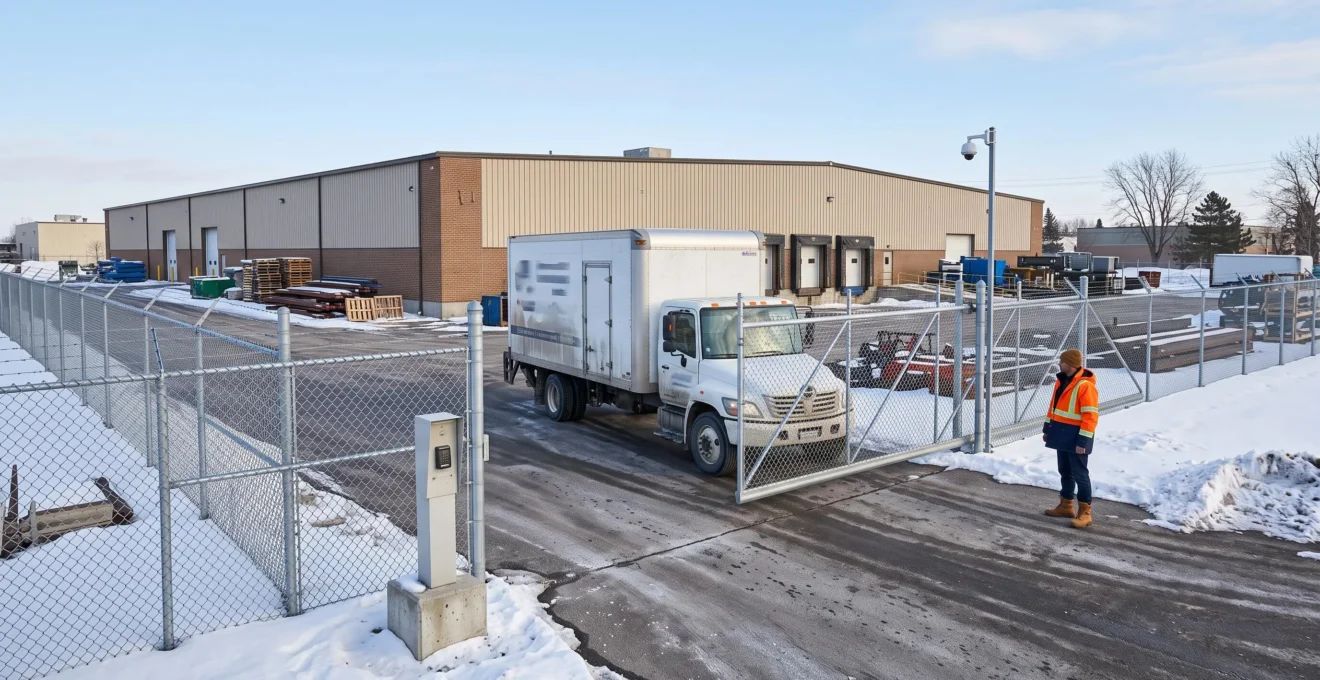
Securing a commercial or industrial property begins well before an unauthorized person reaches a building. A well-designed physical perimeter establishes where access is permitted, makes suspicious approaches easier to detect and creates time for an appropriate security response. Yet a barrier that interferes with employees, deliveries or emergency access can create operational problems and encourage unsafe workarounds.
For Canadian property managers, effective perimeter security depends on more than installing taller or stronger fencing. Sightlines, fence condition, controlled gates, seasonal ground movement and winter maintenance all influence how reliably a boundary performs. The objective is to discourage unauthorized crossing while preserving efficient, predictable access for legitimate users.
A practical approach evaluates each part of the property according to its exposure, the assets behind it and the site’s ability to identify and respond to incidents. Physical barriers, surveillance, lighting and access procedures then work together rather than functioning as independent measures.
Physical Perimeter Security: Essential Decisions
- Assess fence sections, sightlines and transition points according to intrusion risk, detection coverage and response capability.
- Choose fencing and gates that accommodate Canadian winter conditions without compromising authorized vehicle, pedestrian or emergency movement.
- Combine physical barriers with maintenance, controlled entry procedures and reliable incident-response responsibilities.
- Why Do Poor Sightlines Make Property Boundaries Easier to Breach?
- How Can You Assess Fence Weak Points on a Large Property?
- Steel Fencing or Anti-Climb Mesh for Snow-Prone Properties?
- Why Unsecured Delivery Gates Undermine an Otherwise Protected Boundary
- When Should Canadian Properties Inspect Fences After Freeze-Thaw Cycles?
- The Security Gaps That Expose Industrial Sites During Winter Shutdowns
- Motion-Activated Lights or Warning Signs for Dark Property Entrances?
- How Can Canadian Businesses Implement Access Control Systems Without Disrupting Daily Operations?
Why Do Poor Sightlines Make Property Boundaries Easier to Breach?
Poor sightlines make property boundaries more vulnerable because vegetation, structures, equipment and terrain can conceal unauthorized approaches. Even a structurally sound fence provides limited early warning if security personnel or cameras cannot observe someone moving along it. Effective perimeter protection therefore requires visibility from relevant monitoring positions, not simply an unobstructed view of the main entrance.
On commercial properties, visual obstructions often develop gradually. Parked trailers occupy previously open areas, shipping containers become permanent storage, and vegetation grows into camera coverage zones. Each change may create a concealed approach route where an intruder could reach the barrier without being noticed.
Importantly, visibility across a property is not the same as visibility along its boundary. A manager standing near the entrance may see the warehouse and central yard clearly while having no view of a rear fence corner behind a retaining wall.
The UK’s National Protective Security Authority identifies vegetation, terrain features and long perimeter distances as considerations in integrated protection. Its NPSA guidance on security fences and gates also emphasizes connecting physical barriers with detection, surveillance and response arrangements. These are useful technical principles, not Canadian regulatory requirements.
A practical sightline assessment examines three viewpoints:
- Public approaches: Determine whether landscaping or structures conceal movement toward vulnerable sections.
- Authorized entrances: Check what security personnel can observe while processing vehicles or visitors.
- Monitoring positions: Review whether cameras or designated observation points cover fence corners, elevation changes and adjoining structures.
At each viewpoint, consider whether an approaching person would remain observable long enough for the site’s actual detection, verification and response arrangements to operate. A short glimpse on a camera is not equivalent to reliable detection if nobody is monitoring or reviewing the footage when it matters.
Privacy adds another design consideration. Solid panels may prevent passersby from viewing outdoor inventory, but they can also prevent cameras or patrols from verifying activity on the opposite side. Transparent fencing, strategic screening and appropriately positioned cameras can balance these competing needs.
Once concealed approaches are identified, the next task is determining which sections of the boundary warrant corrective work first.
How Can You Assess Fence Weak Points on a Large Property?
Assess fence weaknesses on a large property by dividing the perimeter into numbered sections and evaluating each section’s physical condition, exposure, monitoring coverage and response requirements. Prioritize defects according to the likelihood of unauthorized access and its potential consequences, rather than appearance alone. This produces a documented maintenance and security plan instead of an undifferentiated list of repairs.
Begin by using a site plan to divide the fence into manageable sections. Boundaries may be defined by corners, changes in elevation, neighbouring land uses, access gates or transitions between different fence constructions.
For each section, examine:
- Barrier condition: Damaged mesh, corroded supports, loose connections, unstable posts and unexpected ground clearance.
- Approach exposure: Adjacent public routes, concealed areas, neighbouring activities and equipment that could facilitate unauthorized crossing.
- Detection and response: Camera coverage, available monitoring, alarm arrangements and the practicality of reaching the location.
- Protected assets: Equipment, materials, utilities or operational areas that could be affected if the boundary were crossed.
Particular attention should go to interfaces where fencing meets a building, retaining wall, drainage feature, utility corridor or uneven ground. A fence panel can remain undamaged while an opening beside its termination point permits bypass.
Risk ranking should reflect both exposure and consequences. For example, a hypothetical remote fence section adjacent to critical electrical equipment might deserve faster intervention than a visibly bent panel in an already monitored, low-consequence area. The decision depends on the ability to detect and respond, not simply the distance from the main building.
A consistent assessment register makes these decisions traceable. Record the section identifier, date, photograph, observed problem, security implication, proposed action, responsible person and follow-up status. Distinguish immediate exposures requiring temporary protection from deterioration suitable for scheduled maintenance.
Five Actions for a Documented Perimeter Assessment
- Divide the property boundary into numbered sections and produce an annotated perimeter plan.
- Walk each section and record dated photographs of defects, interfaces and obstructions in an inspection register.
- Check observation and detection coverage and produce a section-by-section list of monitoring gaps.
- Rank recorded vulnerabilities according to exposure, consequences and response capability, producing a prioritized corrective-action list.
- Assign an owner, action and review date to each finding, creating a follow-up record that can be verified during the next inspection.
The register should be updated when site operations change, not only when physical damage occurs. Relocated storage, temporary construction and new vehicle routes can change a section’s security exposure without altering its structural condition.
With those priorities established, fence construction can be selected according to the particular security and environmental conditions of each area.
Steel Fencing or Anti-Climb Mesh for Snow-Prone Properties?
Neither conventional steel fencing nor anti-climb mesh is automatically the best choice for a snow-prone Canadian property. Anti-climb mesh is a steel fencing configuration designed to limit usable handholds and footholds, while conventional steel barriers vary considerably in construction. Selection should consider climbing resistance, corrosion protection, visibility, snow accumulation, foundations and the site’s maintenance capabilities.
The distinction is not simply one material versus another. Vertical-bar steel fencing, welded mesh and other metal security barriers have different geometries, connections and support systems. Small-aperture anti-climb mesh can make it harder to obtain a secure grip or foothold, but its protective performance also depends on panel rigidity, fastening arrangements, frame construction and installation quality.
Canadian winter conditions introduce an additional vulnerability: snow can reduce the effective height of a fence. Plowed snow beside a boundary may create an elevated approach surface, making even a relatively tall barrier easier to cross.
Snow drifting near corners, retaining walls and enclosed service yards deserves particular attention. Snow-storage and plowing plans should preserve both the intended barrier function and practical access for inspection and maintenance.
The main design trade-offs can be summarized as follows.
| Selection criterion | Conventional steel security fencing | Anti-climb mesh fencing |
|---|---|---|
| Climbing resistance | Depends on bar spacing, horizontal members, geometry and available footholds. | Close apertures can restrict usable grips and footholds when correctly specified. |
| Visibility | Open-bar designs can provide clear observation through the boundary. | Mesh density and viewing angle can affect visual clarity and camera performance. |
| Snow accumulation | Snowbanks can compromise effective height regardless of metal strength. | Also vulnerable to snowbanks reducing effective height. |
| Maintenance | Inspect joints, supports, corrosion and alignment. | Inspect panels, fastening systems, supports and deformation. |
| Suitable applications | Depends on site exposure, surveillance needs and barrier design. | Worth evaluating where restricting climbing opportunities is a defined objective. |
The fence foundation is equally important. Frost-related ground movement can affect posts, alignment and clearance beneath the barrier. Transport Canada‘s advisory circular on soil properties and frost effects identifies frost-susceptible soil, moisture and freezing conditions as factors associated with frost heave.
That document concerns aerodrome pavement engineering, not fence construction. Its explanation of ground behaviour supports the need for site-specific assessment but does not establish fence footing depths or an installation specification.
Before choosing a system, obtain project-specific information about soil conditions, drainage, corrosion exposure, snow-removal routes and required access. Where persistent ground movement is likely, foundation design should be evaluated by an appropriately qualified professional.
Proposed fence heights, configurations and additional security features must also be checked against applicable municipal bylaws, provincial requirements and any property-specific restrictions. No single fence-height rule can be assumed to apply across Canada.
Even a well-designed perimeter will have operational openings, which makes the security and reliability of delivery gates particularly important.
Why Unsecured Delivery Gates Undermine an Otherwise Protected Boundary
Delivery gates can undermine a protected perimeter because they create regularly used openings through which unauthorized people or vehicles may enter without damaging the fence. A gate that remains open, fails to latch or permits uncontrolled movement can defeat otherwise effective boundary protection. Secure delivery operations therefore require controlled authorization, reliable closure verification and procedures that accommodate legitimate traffic.
Unlike a fence panel, a vehicle gate is intentionally opened throughout the working day. Its exposure increases when delivery schedules are unpredictable, drivers arrive before authorization or several vehicles are processed in succession.
A useful distinction is between forced entry and unauthorized entry through normal operations. Stronger fence panels do little to prevent someone from following an authorized vehicle through a gate that has not yet closed.
The NPSA’s guidance on perimeters and checkpoints identifies tailgating, deception, bypass and tampering among the threats that access-point design should consider. It also emphasizes authorized movement, delivery procedures, surveillance and emergency arrangements.
Where site space and traffic conditions permit, an external waiting area allows arriving trucks to stop without occupying the controlled opening. Drivers can receive authorization before the gate opens, rather than waiting inside an exposed entrance.
A controlled entry sequence should establish:
- How the driver requests access and how authorization is confirmed.
- When the gate may open and how pedestrians remain separated from vehicle movements.
- How the vehicle’s passage is confirmed without assuming that everyone nearby is authorized.
- Who verifies gate closure and secure latching before normal monitoring resumes.
A gate appearing closed does not necessarily mean it is secure. A misaligned latch, obstruction or faulty position sensor may prevent it from reaching the intended state. Sites using automated gates should test their actual closure-confirmation arrangements rather than relying on a visual indication alone.
Mechanical configuration also affects operations. Sliding gates require sufficient lateral space and appropriate management of tracks or operating components where present. Swinging gates require clearance for their movement. Snow, ice, drainage and vehicle turning paths can affect either configuration, depending on the design.
Truck dimensions, pedestrian routes, emergency-service access and safe failure procedures must be included in the selection process. A gate should not be secured in a way that prevents required emergency egress or creates an unsafe operating condition during a malfunction.
Gate inspections should also form part of seasonal perimeter maintenance, especially where snow and ground movement may affect alignment or operation.
When Should Canadian Properties Inspect Fences After Freeze-Thaw Cycles?
Canadian properties should inspect perimeter fencing when significant thawing, refreezing, snowmelt or visible ground movement creates a credible risk of damage. There is no universal post-thaw inspection interval suitable for every site. Timing should reflect local weather, soil susceptibility, fence construction, previous defects and the consequences of an undetected security opening.
Repeated freezing and thawing can affect ground conditions surrounding posts and foundations. Where soil is susceptible to frost movement and moisture is present, seasonal movement may alter fence alignment or the clearance beneath the barrier.
After a significant weather event, managers should look for changes rather than relying only on obvious breakage. Warning signs include tilted posts, uneven ground clearance, displaced or exposed foundations, stretched mesh, loosened connections and gates that no longer align correctly.
It is also important to distinguish structural defects from detection problems. A post that moves may weaken the physical fence, while shifted equipment, damaged cabling or an obstructed detection zone may compromise alarm performance even when the fence remains continuous.
A two-stage inspection is practical where snow obscures the fence base. The initial assessment identifies visible movement, damage and urgent exposure. A follow-up examination takes place when conditions permit proper observation of posts, foundations, connections and ground clearance.
Critical openings may require temporary access restrictions, additional monitoring or another suitable protective measure until permanent repairs can be completed safely. Temporary controls should have an assigned owner and a clear condition for removal.
Repeated seasonal repair in the same location warrants closer investigation. A post that tilts after successive thaws may indicate an underlying drainage, soil or foundation issue rather than an isolated maintenance defect.
Comparing dated photographs and inspection records can reveal recurring movement. Where that pattern suggests a structural problem, a qualified professional can assess whether drainage improvements or foundation redesign are appropriate.
This approach becomes particularly important when a property operates with reduced staffing during extended winter shutdowns.
The Security Gaps That Expose Industrial Sites During Winter Shutdowns
Winter shutdowns can expose industrial sites to security gaps because reduced staffing removes much of the routine observation that occurs during normal operations. Outdoor materials, equipment and utility infrastructure may remain accessible, while snow can conceal defects or obstruct patrol routes. A secure shutdown therefore requires perimeter readiness checks, temporary access controls and a realistic incident-response plan.
Normal industrial activity provides opportunities to notice unexpected movement, damaged fencing or an unsecured gate. When employees and delivery traffic disappear, these informal observations also decline. Existing cameras and alarms may continue operating, but their effectiveness depends on whether alerts are received, verified and acted upon.
Shutdown preparation can introduce additional exposures. Temporary contractor entrances may remain active, construction barriers may not be fully restored, and equipment staged near the fence may create unintended crossing opportunities.
Before reducing operations, property managers should review:
- Temporary openings: Confirm that construction entrances, removable panels and provisional gates have been secured or assigned appropriate controls.
- Contractor access: Review which permissions remain necessary and when they should expire.
- Outdoor storage: Identify equipment or materials positioned near the perimeter that could assist unauthorized crossing.
- Winter accessibility: Verify that essential inspection routes, gates and response access remain usable under expected snow conditions.
- Alert handling: Confirm who receives, assesses and escalates an alarm when regular site personnel are absent.
The most consequential weakness may be an operational mismatch: a detection system reports activity but no authorized responder is available. The shutdown plan should therefore identify responsible contacts, verification arrangements and escalation procedures appropriate to the site’s risk and staffing.
Access permissions and alarm records also need attention during reopening. Temporary contractor privileges should be reconciled with current work requirements, outstanding security incidents reviewed, and perimeter defects addressed before unrestricted operations resume.
Where a boundary has been temporarily modified, reopening checks should confirm that its intended security function has been restored, including gates, connections, monitoring and access procedures.
For sites that remain active overnight or partially staffed, appropriate entrance lighting and clear access restrictions become another part of dependable perimeter protection.
Motion-Activated Lights or Warning Signs for Dark Property Entrances?
Motion-activated lighting and warning signs serve different security purposes at dark property entrances. Lighting improves visibility and can assist personnel or cameras in assessing activity, while signs communicate access restrictions and expectations. Neither replaces a physical barrier or controlled entry procedure. Where entrances are poorly illuminated and access restrictions are unclear, combining both measures may be appropriate.
Lighting is most useful when illumination supports a defined operational task. A camera may need sufficient light to capture usable images, while an employee approaching a gate may need to distinguish authorized vehicles from unexpected movement.
Warning signs serve a communication function. They can identify private property, direct visitors to the proper entrance and make restrictions explicit. However, a sign cannot detect someone crossing a boundary or verify whether a vehicle has permission to enter.
Public Safety Canada‘s Community Security Program eligibility and funding guide recognizes lighting, fencing, gates and physical access-control equipment among eligible security-improvement categories. It also identifies visibility and natural surveillance as relevant environmental design considerations. The document describes a specific funding program, not a universal security standard for Canadian properties.
The choice between these entrance measures depends on the operating environment:
| Consideration | Motion-activated lighting | Warning signs |
|---|---|---|
| Primary function | Illuminate activity and assist observation. | Communicate boundaries and access conditions. |
| Monitoring contribution | May improve visual verification if positioned and configured correctly. | Does not provide detection or visual verification. |
| Operational limitations | Unwanted activation, glare, reflected light and exposure changes. | Limited usefulness where signs are obscured or unreadable. |
| Best application | Entrances where visibility is needed during low-light conditions. | Locations requiring clear, accurate access instructions. |
Snow-covered surfaces can reflect light and create glare. Fixtures aimed toward roads or neighbouring properties may also produce unwanted effects, while frequent activation by authorized nighttime activity can reduce the usefulness of motion events as security indicators.
Test lighting from the actual camera and observation positions during representative conditions. A brightly illuminated entrance may still produce unusable footage if the light points into the lens or leaves the relevant approach area in shadow.
Where both measures are installed, position signs so approaching users can understand the instructions before reaching the controlled entrance. Messages should accurately describe the site’s restrictions and installed security measures, without making unsupported surveillance claims.
Once the perimeter can discourage, reveal and communicate unauthorized access, the final challenge is making authorized movement secure without creating unnecessary operational delays.
Key Takeaways Before Implementing Access Control
- Access permissions should reflect actual operational roles, including the different requirements of employees, visitors, contractors and delivery drivers.
- Gate capacity, traffic flow and winter reliability should be tested before expanding electronic access controls across a property.
- Every new control requires clear responsibility for permissions, exceptions, failures and incident escalation.
How Can Canadian Businesses Implement Access Control Systems Without Disrupting Daily Operations?
Canadian businesses can implement access control without disrupting daily operations by mapping legitimate movement first, then introducing security measures in phases. Each user group needs an appropriate authorization process, while entrances must retain sufficient capacity for normal traffic and emergency requirements. Testing gate operation, credential handling, failure procedures and staff responsibilities before wider deployment reduces the risk of operational workarounds.
Start with the perimeter assessment rather than the access-control hardware catalogue. Identify where employees, visitors, delivery vehicles, maintenance contractors and emergency responders need to enter, and what level of authorization each movement requires.
Different user groups should not automatically share the same procedure. Employees may use assigned credentials, visitors may require individual approval, and delivery drivers may need time-limited access coordinated with receiving personnel.
Authorization should be based on operational need, with responsibility assigned for issuing, modifying and withdrawing permissions. Temporary access must have a defined process for review so that obsolete privileges do not remain active indefinitely.
A phased deployment allows managers to test assumptions without changing every entrance simultaneously. Begin with a representative gate or operating period and observe actual entry conditions before expanding the system.
During the pilot, evaluate:
- Whether authorized credentials are recognized consistently under normal operating conditions.
- Whether vehicles can queue safely without blocking public roads, essential internal routes or emergency access.
- How unexpected visitors and early delivery arrivals are handled.
- Whether pedestrians remain separated from vehicle movements where required.
- Whether gates operate reliably during representative winter conditions.
- Whether rejected credentials and abnormal access events reach an assigned person for review.
Technology also requires governance. Permission changes, temporary credentials, event reviews and alarm escalation should each have a defined owner. A system that records unauthorized attempts but produces no timely operational response provides incomplete protection.
Business continuity must be addressed before commissioning. Test appropriate responses to power loss, communications failure, damaged credentials and mechanical gate faults. Emergency egress, manual operation and responder access must comply with applicable local requirements and be validated under realistic conditions.
Staff training is part of acceptance. Employees and contractors need to know how to request access, report faults and handle exceptional situations without bypassing security measures. A gate that repeatedly creates excessive delays may encourage informal practices that weaken the intended control.
After deployment, review entry delays, unresolved exceptions, repeated failures and unauthorized access attempts. These observations help determine whether changes to operating procedures, equipment configuration or staffing are required.
Canadian businesses should verify applicable municipal and provincial rules, property conditions, accessibility obligations and fire or life-safety requirements with the appropriate authorities and qualified professionals before final commissioning. Security design must not compromise required emergency movement.
The practical next step is to select one operational entrance, document its legitimate users and traffic patterns, and conduct a controlled access-security pilot with measurable acceptance criteria. This establishes a basis for improving boundary protection while preserving the movements the property needs to function.
Does every Canadian commercial property need a security fence?
No universal requirement for all Canadian commercial properties is established by the sources used here. Whether fencing is appropriate depends on the property’s security risks, local requirements, land-use restrictions and operational needs. Managers should verify applicable municipal bylaws and any property-specific obligations before planning construction.
Can security cameras replace a physical perimeter fence?
Cameras and fences perform different functions. Surveillance can support observation, verification and incident investigation, while a physical barrier defines and restricts crossing points. Their value depends on integration with monitoring and response arrangements. A camera does not physically prevent crossing, and a fence does not independently confirm an intrusion.
Should a damaged perimeter fence section remain open until permanent repairs are possible?
A security-significant opening should be assessed promptly. Depending on the exposure, temporary measures may include restricting nearby access, securing the affected area or increasing appropriate observation until permanent repairs are feasible. The selected measure should be safe, documented and reviewed until the original boundary protection is restored.
What records should property managers retain after perimeter inspections?
A practical inspection record includes the date, fence-section identifier, photographs, observed defects, assessed security implications, corrective actions, assigned responsibility and verification of completion. Weather conditions and recurring ground movement can also be recorded where relevant. This creates an audit trail for maintenance decisions and helps identify repeated vulnerabilities.
How can a property maintain security when an automated entrance gate loses power?
The appropriate response depends on the gate design, emergency-access requirements and applicable safety rules. Managers should establish and test a documented failure procedure addressing safe egress, authorized manual operation, protection against unintended entry and notification of responsible personnel. Backup power or another continuity measure may be evaluated where operational risk justifies it, but no configuration should be assumed suitable for every site.