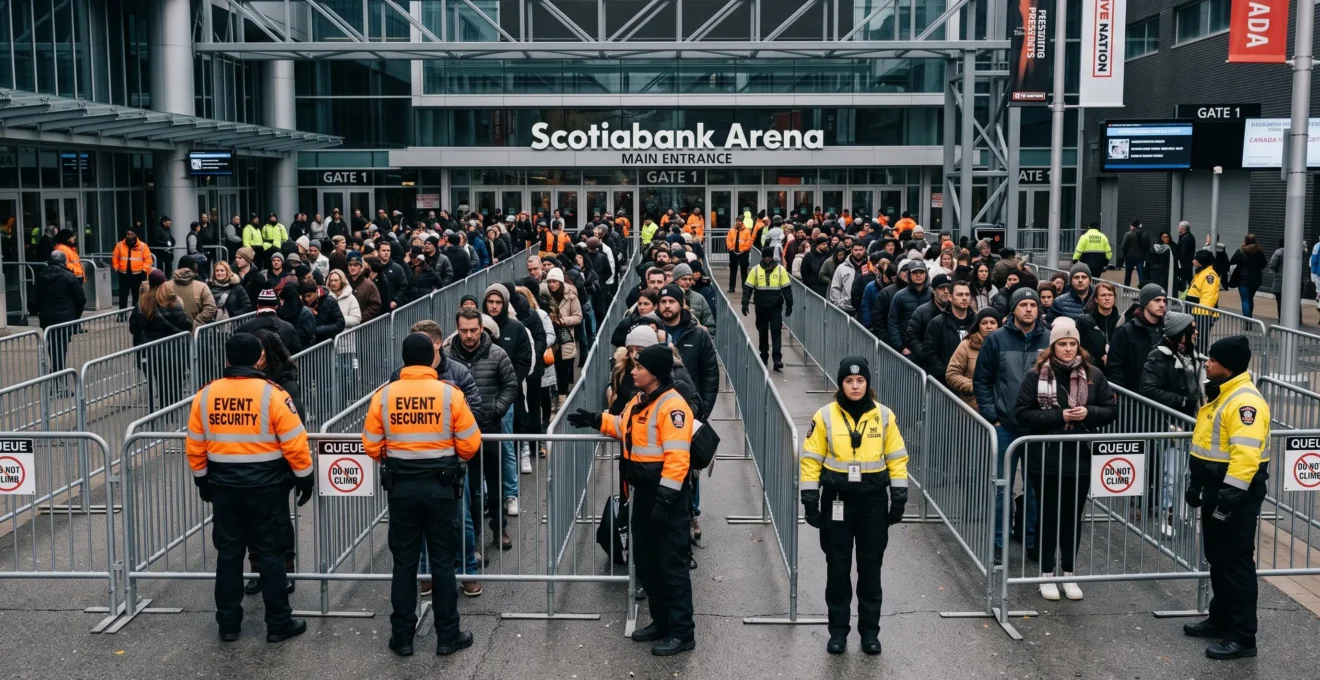
Preventing dangerous crowd congestion at busy Canadian venues requires more than deploying additional security personnel at entrances. Organizers must manage how visitors arrive, where they wait, how they move through access points and how quickly they can leave. A safe crowd-management strategy combines suitable entrance and exit layouts, monitored occupancy, organized queues, trained personnel and clear procedures for responding to changing conditions.
These responsibilities become particularly important during major festivals, concerts, sporting events and indoor public gatherings. Transit-related arrival peaks, restricted access points, winter weather and limited circulation space can all increase operational pressure. A queue that appears manageable from a distance may already be developing unsafe conditions near a gate or inside a narrow passage.
Canadian event organizers should therefore assess crowd-density risks before opening, establish measurable admission and intervention procedures, and coordinate security teams with venue management and emergency services. The objective is not simply to move visitors faster. It is to maintain controlled movement without allowing pressure to accumulate in any part of the venue.
Key Crowd Safety Priorities
- Design entrances, queues and circulation routes to prevent bottlenecks and dangerous crowd compression.
- Monitor arrival rates, occupancy and exit capacity, with predefined procedures for adjusting or temporarily stopping admission.
- Combine appropriately trained security personnel, clear communication and rehearsed emergency arrangements.
- Why Do Narrow Entry Points Create Dangerous Crowd Pressure at Large Events?
- How Can Organizers Set Up Safe, Flow-Managed Queues Outside Festival Entrances?
- Timed Entry or Multiple Gates: Which Is Better for High-Attendance Canadian Events?
- The Exit Route Mistakes That Increase Evacuation Risks at Indoor Events
- When Should Event Security Temporarily Stop Admission at a Crowded Venue?
- How Can Guards Calm an Agitated Visitor Without Increasing Tension?
- When Should a Commercial Building or Venue Add a Second Security Officer?
- What Training Should Security Personnel Have for High-Risk Canadian Venues and Events?
Why Do Narrow Entry Points Create Dangerous Crowd Pressure at Large Events?
Narrow entry points create dangerous crowd pressure when the number of arriving visitors exceeds the rate at which people can pass through the available opening. Fences, ticket scanners, temporary barriers and door frames can progressively restrict movement, turning an ordinary queue into a compression zone. Once movement becomes restricted near the front, pressure can build behind the blockage and affect people who cannot see what is happening ahead.
The problem is partly geometric. A large outdoor waiting area may gradually narrow into a single gate, forcing visitors into a smaller space. If arrivals continue at a higher rate than the entrance can process, the queue grows and density increases near the access point.
Research published in the Journal of The Royal Society Interface examined crowd behaviour in front of entrance bottlenecks through controlled experiments involving 479 participants. The researchers investigated how corridor width, barriers, visitor motivation and queue organization influence movement. Their findings demonstrate why entrance geometry and crowd behaviour must be considered together rather than treating access control as an isolated staffing issue.
Organizers and security supervisors should watch for several warning signs:
- Increasing density: People are becoming progressively closer together near the entrance, with less freedom to change direction.
- Irregular surges: The queue moves forward in sudden waves instead of maintaining a relatively controlled progression.
- Involuntary leaning: Visitors are pushed forward or sideways without choosing to move.
- Restricted mobility: Individuals have difficulty turning, stepping away or maintaining their balance.
- Visible distress: Attendees communicate that they cannot move freely or are experiencing uncomfortable pressure.
These indicators should prompt immediate assessment rather than waiting for an incident. There is no universal numerical density threshold supplied by the Canadian Centre for Occupational Health and Safety (CCOHS) for every event configuration. Assessment must account for the venue, the crowd profile and the specific circulation conditions.
Adding security personnel to a single narrow entrance does not automatically resolve the underlying problem. Staff can monitor movement, communicate instructions and adjust admission procedures, but they cannot compensate indefinitely for inadequate access geometry or a queue layout that directs excessive pressure toward one opening.
Canadian winter events require additional attention. Heavy coats, winter footwear and reduced mobility can affect the space people need to move comfortably. Organizers should consider these conditions when assessing entrances and designing temporary waiting areas.
Experimental findings from the Royal Society study on crowd behaviour at entrance bottlenecks reinforce the importance of evaluating passage width, barriers and queue arrangements together. Its controlled experimental results are informative, but they do not establish a universal entrance-width requirement for Canadian festivals.
The central operational principle is to prevent pressure from accumulating before it becomes difficult to control. A well-designed entrance should support predictable movement, provide sufficient waiting space and allow security personnel to recognize deteriorating conditions early.
How Can Organizers Set Up Safe, Flow-Managed Queues Outside Festival Entrances?
Organizers can establish safer festival queues by separating visitor flows into clearly defined lanes, providing sufficient holding areas and monitoring how quickly arrivals accumulate. Barriers should guide visitors without forcing them into restrictive funnels, while signage and staff should make the progression toward admission understandable. The objective is to absorb arrival fluctuations without transferring excessive pressure directly to the entrance.
Queue planning should begin with an assessment of the expected arrival pattern and the processing capacity of the admission system. Ticket scanning, identity checks, security screening and bag inspections may each affect how quickly visitors pass through the gate. A queue that appears adequately sized during normal arrivals may become unsafe when several transport services deliver large groups simultaneously.
Separate lanes can help organize visitors and reduce disorder, particularly where different ticket categories or screening requirements apply. However, lane separation must not create narrow convergence points. Each transition should be assessed to ensure that barriers, signage and equipment do not restrict movement unnecessarily.
The HSE guidance on crowd controls at events recommends considering phased arrivals, overflow areas, additional routes and coordination with transport providers. Although this is UK guidance rather than Canadian regulation, its operational principles provide useful reference points for event planning.
Effective queue monitoring should include several indicators:
- Queue growth rate: Whether the waiting line is expanding faster than admission can reduce it.
- Density near the gate: Whether the front of the queue is becoming increasingly restricted.
- Arrival spikes: Whether public transit schedules, event programming or headline performances are generating concentrated demand.
- Available holding space: Whether visitors can wait without obstructing public sidewalks, emergency access or surrounding transport infrastructure.
- Weather exposure: Whether cold, rain, snow, darkness or slippery surfaces are introducing additional hazards.
A useful operational comparison is between the incoming visitor rate and the admission throughput rate. If arrivals consistently exceed the number of people admitted over the same period, the waiting population will increase. This relationship helps supervisors recognize when additional measures are required, although it does not replace a formal assessment of safe density and holding-area capacity.
For example, an event expecting a concentrated arrival before a headline performance should not wait until the queue reaches the entrance perimeter before adjusting its operation. Organizers can prepare additional designated waiting areas, adjust screening arrangements where permitted, deploy staff to decision points and coordinate with transport providers.
Outdoor Canadian events also need to account for secondary hazards. A queue extending onto a busy street, an icy pedestrian route or an exposed waiting area can create risks even when the entrance itself remains controlled. Darkness and poor weather can make signs less visible and complicate communication.
Queue management should therefore be treated as part of the venue’s wider crowd-management plan rather than as a temporary arrangement installed immediately before opening.
Five Actions to Verify Queue Safety Before Opening
- Map every entrance and queue lane, producing an annotated site plan showing barriers, screening points and pedestrian routes.
- Identify expected arrival peaks and admission throughput constraints, documenting the assumptions in an arrival-management assessment.
- Inspect holding areas and overflow routes, producing a site inspection record covering available space and surrounding access.
- Define observable congestion warning signs and escalation responsibilities, recording them in the security briefing.
- Inspect weather exposure, lighting and signage, producing a completed pre-opening safety checklist.
Even well-designed queues can experience unpredictable arrival surges. Organizers should therefore consider whether distributing visitors across several access points or introducing timed admission would provide better control over the event’s particular attendance pattern.
Timed Entry or Multiple Gates: Which Is Better for High-Attendance Canadian Events?
Timed entry and multiple gates address different aspects of crowd congestion. Timed entry distributes arrivals across scheduled periods, while multiple gates distribute visitors across physical access points. Neither approach is universally safer. The appropriate choice depends on the venue layout, expected arrival patterns, screening requirements, available staffing and the ability to manage visitors who arrive outside their assigned time.
Timed entry can improve predictability when organizers need to manage a high volume of visitors within a limited admission period. Visitors receive allocated arrival windows, allowing the event team to anticipate demand and prepare screening resources accordingly.
However, scheduled admission does not eliminate congestion. Visitors may arrive early to avoid missing their time slot, gather around the entrance immediately before a popular admission window or arrive late after experiencing transport delays. People without reservations may also create additional pressure if the event permits access subject to availability.
For timed entry to work safely, organizers must establish appropriate arrival windows, communicate expectations clearly and provide designated waiting arrangements for early arrivals. The admission system should also be capable of responding to delays without creating a second queue at the entrance.
Multiple gates distribute physical demand across different parts of a venue. This approach can be particularly useful when the site has several suitable access points and visitors can be directed toward them without creating confusing or conflicting pedestrian movements.
However, opening more gates increases operational requirements. Each access point may require screening equipment, trained personnel, communication procedures and appropriate emergency arrangements. Organizers must also ensure that visitors are not redirected toward a gate that cannot safely accommodate their arrival volume.
| Decision criterion | Timed entry | Multiple gates |
|---|---|---|
| Primary mechanism | Distributes arrivals across scheduled periods. | Distributes visitors across physical access points. |
| Arrival predictability | Can improve planning when visitors follow assigned windows. | Depends on how visitors are distributed between entrances. |
| Infrastructure requirements | Requires a reliable booking and admission process. | Requires suitable additional access points and screening arrangements. |
| Staffing requirements | Requires staff to manage scheduled arrivals and exceptions. | Requires operational coverage at each active gate. |
| Main congestion risk | Clustering around popular time slots and early arrivals. | Uneven gate usage or bottlenecks at individual entrances. |
| Operational flexibility | Depends on the ability to accommodate late or unscheduled visitors. | Depends on available infrastructure and the ability to redistribute flows. |
A hybrid approach may be appropriate where the venue has several suitable entrances and attendance naturally peaks at predictable times. Organizers can distribute visitors across multiple gates while using soft arrival windows to reduce concentrations immediately before major performances.
The decision should consider:
- The number and location of suitable entrances.
- The expected proportion of visitors arriving within short periods.
- Security screening and ticket-validation requirements.
- Staff availability at every active access point.
- Whether pedestrian routes allow visitors to reach alternative gates safely.
- The impact of delays, early arrivals and visitors without scheduled reservations.
Major events in Toronto, Montreal and Vancouver may experience concentrated arrival patterns associated with public transit and event schedules. These patterns should inform planning, but organizers must assess each venue individually rather than assuming that a configuration suitable for one location will work elsewhere.
Once admission has been organized, the same level of attention must extend to departures. A venue can manage entry successfully and still expose visitors to serious risks if its exit routes cannot accommodate an emergency movement.
The Exit Route Mistakes That Increase Evacuation Risks at Indoor Events
Indoor event evacuation risks increase when exit doors, corridors and final routes do not support continuous movement toward a safe destination. An exit may appear sufficiently wide while the corridor beyond it is narrower, obstructed or poorly organized. Organizers must therefore assess the complete evacuation route, not simply count the number of doors or rely on their nominal dimensions.
One common planning mistake is creating a route that narrows immediately after a large exit. Visitors may pass through the door successfully but encounter a bottleneck in the adjoining corridor, vestibule or exterior passage. This can reduce effective evacuation throughput and create pressure at precisely the location where people need to move away from danger.
Another serious problem is allowing commercial or operational activities to interfere with emergency circulation. Coat checks, merchandise stands, temporary furniture and equipment can occupy valuable space near exits. Locked or obstructed egress routes create an even more direct hazard.
Organizers should also assess conflicting movement. Security personnel, emergency responders and venue staff may need to enter an affected area while attendees are attempting to leave. Without defined routes and coordination procedures, opposing movements can obstruct one another.
Exit planning must distinguish between theoretical capacity and practical performance. The number of available doors does not automatically demonstrate that the entire evacuation route can accommodate the expected occupant load under real operating conditions.
Egress capacity ≥ occupant load
The Canadian Centre for Occupational Health and Safety states that evacuation capacity should be at least equal to the permitted occupant load. The applicable occupant load and requirements depend on local building and fire codes.
For Canadian indoor venues, winter operations introduce another important consideration. Attendees may gather around vestibules, coat storage facilities and entrances to retrieve belongings. These activities can interfere with circulation and reduce the space available for emergency movement.
Organizers should evaluate whether coat-check arrangements, waiting areas and merchandise installations obstruct designated routes or encourage visitors to congregate near exit doors. Winter clothing and footwear may also affect walking speed and mobility, making clear and unobstructed routes particularly important.
Exit routes should be inspected before the event and evaluated from the perspective of an attendee who may be unfamiliar with the building.
- Walk through every designated exit route, including the corridors and exterior areas beyond the doors.
- Verify that doors and pathways remain accessible and that temporary installations do not obstruct circulation.
- Check emergency signage from normal attendee viewing positions.
- Identify decision points where visitors may hesitate or choose the wrong direction.
- Confirm where security personnel will stand to guide movement without blocking evacuation routes.
Walkthroughs and rehearsals should involve venue management, security supervisors and relevant emergency personnel. The objective is to verify that the planned arrangements remain workable under actual event conditions, not merely that an evacuation diagram exists.
Even when exit arrangements are adequate, congestion inside a venue can deteriorate quickly as attendance increases. Organizers therefore need predefined criteria for temporarily controlling or stopping admission before permitted capacity or safe circulation conditions are compromised.
When Should Event Security Temporarily Stop Admission at a Crowded Venue?
Event security should temporarily stop admission when occupancy approaches the approved capacity, critical circulation areas become unsafe or entry conditions deteriorate to the point that continued arrivals could increase crowd pressure. The decision should follow predefined operational triggers established before the event. Waiting until a visible incident occurs can leave insufficient time to manage the waiting crowd and protect visitors already inside.
Admission control must consider more than the total number of tickets sold. A venue may remain below its permitted occupant load while experiencing dangerous congestion around a particular entrance, corridor, viewing area or internal access point.
Conversely, an apparently manageable entrance queue does not demonstrate that the venue has sufficient remaining capacity. Security supervisors should have access to reliable occupancy information and understand how the event’s admission process communicates with the venue’s overall capacity-management arrangements.
Useful reasons to consider an admission pause include:
- Occupancy approaching the approved limit established for the venue.
- Increasing density around critical internal circulation areas.
- Restricted access to exits or emergency routes.
- Irregular crowd surges near an entrance or screening point.
- A developing incident that affects the safety of visitors entering the venue.
- Loss of reliable occupancy monitoring or communication needed to make safe admission decisions.
There is no universal numerical suspension threshold established by the CCOHS guidance in the supplied source material. Event organizers should determine appropriate triggers through venue-specific risk assessment and applicable building, fire and operational requirements.
When admission is paused, security teams must manage the external queue as carefully as the crowd inside. Simply closing the entrance can transfer pressure from the venue to the waiting area, particularly when visitors continue arriving from nearby transit stations or public streets.
A controlled admission hold should involve several coordinated actions:
- Communicate the admission pause clearly and consistently to visitors waiting outside.
- Direct arrivals toward designated holding areas rather than allowing them to press against the gate.
- Monitor queue density and identify any developing congestion outside the venue.
- Coordinate with venue management and, where appropriate, transport operators and emergency services.
- Keep emergency access routes clear throughout the pause.
Communication is especially important when visitors have been waiting for an extended period. Uncertainty can increase frustration and encourage people to move toward the entrance in an attempt to obtain information. Staff should provide accurate updates without promising an admission time that has not been confirmed.
Resuming admission also requires a controlled process. Supervisors should verify that the original cause of the pause has been addressed, confirm available capacity and authorize a gradual restart. Monitoring should continue during re-entry to ensure that internal congestion does not return.
Staff should also receive a short operational briefing explaining why admission was stopped and what conditions must remain under control. This prevents inconsistent decisions between different gates or security teams.
Admission decisions also depend on the behaviour of visitors around the entrance. An individual confrontation can attract attention, disrupt queue movement and create additional pressure, making professional de-escalation an important part of the overall safety response.
Key Decisions Before Deploying Event Security
- Define the crowd-management tasks that must be performed simultaneously at entrances, internal circulation areas and exits.
- Match security coverage to the actual workload and the consequences of leaving any critical area unmonitored.
- Verify that every assigned security professional has appropriate provincial qualifications and event-specific operational preparation.
How Can Guards Calm an Agitated Visitor Without Increasing Tension?
Security guards can calm an agitated visitor by communicating calmly, maintaining appropriate personal space, avoiding unnecessary physical contact and offering clear choices instead of issuing aggressive ultimatums. At a crowded event, de-escalation is also a crowd-safety measure: an escalating confrontation near an entrance can attract an audience, interrupt movement and contribute to wider congestion.
A guard should begin by assessing the immediate environment. A disagreement at an isolated information point presents different crowd-management challenges from a confrontation occurring directly beside a busy ticket checkpoint. If people begin gathering around the interaction, the situation may affect the surrounding queue even when the original disagreement is relatively minor.
Effective communication should focus on reducing tension rather than winning an argument. Guards should use a controlled tone, short explanations and respectful language. Allowing visitors to explain their concerns can help identify whether the problem involves ticket access, waiting times, prohibited items or a misunderstanding about event procedures.
Positioning is equally important. The guard should avoid unnecessarily blocking the visitor’s movement or adopting a threatening stance. Maintaining a suitable distance and allowing room for the individual to respond can help prevent the interaction from becoming more confrontational.
Where possible, the conversation should be redirected away from the main pedestrian flow. This reduces the audience effect and prevents other visitors from gathering around the incident. However, relocation should never obstruct emergency routes or create another congestion point.
Practical de-escalation techniques include:
- Use a calm and consistent speaking pace.
- Maintain non-threatening body language and appropriate personal space.
- Listen without interrupting unnecessarily.
- Explain available options clearly and respectfully.
- Avoid humiliating or challenging the visitor in front of an audience.
- Request supervisory support when the situation exceeds the guard’s authority or ability to manage safely.
Guards must also recognize when communication alone is no longer sufficient. Threatening behaviour, physical aggression, an immediate risk of injury or a rapidly deteriorating situation may require a different response. The guard should follow the established escalation procedure, notify a supervisor and coordinate the protection of surrounding visitors.
Where an incident affects a crowded access point, another staff member may need to redirect pedestrian movement while the incident itself is managed. These responsibilities should be assigned in advance rather than improvised during a developing emergency.
In Canada, security personnel must operate within the legal authority and licensing requirements applicable to their province or territory. General communication and de-escalation competencies should be reinforced through event-specific briefings and practical preparation. A guard’s authority should never be assumed to extend beyond applicable law or assigned responsibilities.
De-escalation is only one element of effective security coverage. The broader question is whether the available personnel can manage visitor behaviour, access control, internal circulation and emergency responsibilities at the same time.
When Should a Commercial Building or Venue Add a Second Security Officer?
A commercial building or venue should add a second security officer when one person cannot safely manage all critical responsibilities at the same time. This often occurs when access control, internal crowd monitoring, incident response and evacuation support require simultaneous attention. The decision should therefore reflect operational workload and the consequences of leaving an area unmonitored, not simply the total number of visitors.
A single officer may be sufficient for a small, predictable environment with limited access requirements. However, the situation changes when visitor arrivals become concentrated, circulation areas become busy or multiple access points need active supervision.
For example, an officer positioned at the entrance may need to validate access, communicate with visitors and observe the developing queue. That same person cannot continuously monitor internal density, check exit accessibility and respond to an unrelated incident elsewhere in the building.
The resulting coverage gap creates a single point of failure. If the officer becomes occupied with one confrontation, the remaining venue may temporarily lose active security observation.
Adding another officer can allow responsibilities to be divided more realistically:
- Access-control position: Supervises admission, screening procedures and queue conditions.
- Internal monitoring position: Observes circulation, identifies congestion and reports developing hazards.
- Incident coordination: Allows personnel to support an emerging incident without automatically abandoning every other critical position.
- Evacuation support: Helps maintain visibility and communication around designated movement routes, according to the venue’s emergency plan.
The actual deployment will depend on the site’s layout and risk assessment. Two officers may still be insufficient for a large venue with several entrances, multiple occupied floors or complex evacuation arrangements. Staffing should be determined by the number and importance of simultaneous duties, rather than applying a universal staff-to-visitor ratio that is not established by the supplied sources.
Venue managers should pay particular attention to peak arrival and departure windows. A building that operates safely with one officer during ordinary business hours may need additional coverage during a public event, seasonal promotion or unusually concentrated visitor period.
Operational considerations include:
- The number of active entrances and exits.
- The frequency and intensity of visitor arrivals.
- The need to monitor internal circulation and restricted areas.
- The likelihood of simultaneous incidents or assistance requests.
- The evacuation responsibilities assigned to security staff.
- The ability to maintain communication between positions.
Canadian property managers must also consider the applicable provincial licensing requirements for security work, together with their operational responsibilities and staffing budgets. Understaffing may create significant exposure when essential crowd-safety tasks cannot be performed consistently.
Additional staffing should not be treated as a substitute for better infrastructure. Two officers cannot eliminate a dangerous bottleneck caused by an inadequate entrance or a blocked evacuation corridor. Personnel, physical layout and operational procedures must work together.
Once the staffing structure has been established, managers must verify that personnel possess the qualifications and practical competencies required to perform their assignments safely and consistently.
What Training Should Security Personnel Have for High-Risk Canadian Venues and Events?
Security personnel working at high-risk Canadian venues should hold the qualifications and licences required in the applicable province or territory and receive additional preparation for the specific crowd-management responsibilities assigned to them. Standard security training and licensing provide an important baseline, but they do not automatically demonstrate practical competence in congestion recognition, admission control, evacuation support or large-event communication.
Canada does not operate under one universally applicable provincial security-worker licensing framework. Requirements vary according to jurisdiction, and event organizers should verify the qualifications of personnel working at the actual event location.
British Columbia provides a specific example. Its government identifies Basic Security Training as one route toward a full security guard licence, alongside other recognized qualifications and pathways. The requirements and recognition arrangements described for British Columbia should not be assumed to apply identically in Ontario, Quebec, Alberta or other jurisdictions.
The British Columbia government security worker training requirements provide the relevant provincial information for organizers and security employers operating in that jurisdiction.
Beyond licensing, crowd-focused preparation should address the practical challenges personnel may encounter during a major event.
- Density recognition: Identifying restricted movement, increasing crowd pressure and other early warning signs.
- Entry-flow management: Understanding queue arrangements, admission procedures and the importance of avoiding bottlenecks.
- Exit-route awareness: Knowing designated evacuation routes, critical circulation areas and appropriate staff positions.
- Communication: Reporting congestion, coordinating with supervisors and delivering clear instructions during admission holds.
- De-escalation: Managing visitor disagreements without unnecessarily increasing tension around crowded areas.
- Incident escalation: Recognizing the limits of individual authority and knowing when to request additional support.
Operational readiness also requires preparation at the venue itself. A qualification obtained in a classroom does not necessarily demonstrate familiarity with a particular building, festival layout or emergency procedure.
Before opening, organizers should conduct a site-specific briefing that explains the event’s crowd-management plan and assigns responsibilities clearly.
Each security professional should understand:
- Which entrance, exit or circulation zone they are responsible for monitoring.
- Who receives reports of increasing congestion or unsafe conditions.
- Which supervisor can authorize changes to admission procedures.
- How to communicate a temporary admission pause.
- Where to direct visitors during an evacuation or emergency movement.
- How their responsibilities interact with venue management and emergency services.
Walkthroughs should allow staff to inspect their assigned positions, identify potential bottlenecks and understand how visitors will move through the site. Where appropriate, exercises should test communication and coordination between entrance personnel, internal monitoring teams and supervisors.
Coordination is particularly important during a developing incident. A guard who independently redirects visitors without understanding the wider evacuation plan may unintentionally send them toward another congested area. Security personnel must therefore operate within a shared management structure rather than treating each position as an isolated responsibility.
Organizers should document qualifications, briefing attendance, assigned roles and completed operational exercises. These records help demonstrate that personnel were selected and prepared for the responsibilities associated with the event.
Training arrangements must also reflect the applicable legal and regulatory framework. The British Columbia requirements provide a provincial example, not a complete statement of Canadian security licensing rules.
For Canadian event planners and venue operators, the next step is to review the site’s specific risks, verify applicable provincial requirements and ensure that every security assignment supports the event’s overall crowd-management plan. A safer event is built through preparation, coordinated decisions and continuous observation before congestion becomes an emergency.
What is the first warning sign of dangerous crowd congestion?
Increasing density combined with restricted movement is an important early warning sign. Irregular surges, involuntary leaning, difficulty changing direction and visible distress indicate that the crowd may be experiencing unsafe pressure. Security supervisors should investigate these conditions immediately rather than waiting for a fall or other incident.
How can event organizers calculate whether an entrance can handle expected attendance?
Organizers should assess expected arrival patterns against the actual admission throughput, considering ticket validation, security screening and the physical configuration of the entrance. They must also evaluate queue growth, available holding areas and crowd density. The supplied CCOHS guidance does not provide a universal quantitative formula for calculating entrance throughput, so a site-specific assessment is necessary.
Is timed entry safer than allowing visitors to arrive whenever they want?
Timed entry can make arrivals more predictable, but it does not automatically eliminate congestion. Visitors may arrive early, cluster around popular admission windows or experience transport delays. Its effectiveness depends on suitable arrival intervals, clear communication, holding arrangements and the venue’s ability to manage exceptions.
When should security stop admitting visitors even if the venue has not reached full capacity?
Admission may need to be paused when a critical circulation area becomes dangerously congested, access to emergency routes is compromised or a developing incident makes continued arrivals unsafe. Total occupancy is only one consideration. Organizers should establish venue-specific intervention criteria before opening and manage the external queue throughout any admission hold.
Do Canadian security guards need specialized crowd-management certification?
Licensing and training requirements depend on the province or territory where the security work takes place. The supplied sources do not establish one universal Canadian crowd-management certification requirement. Nevertheless, organizers should verify applicable licensing conditions and ensure that guards receive operational preparation covering density recognition, admission procedures, evacuation support, communication and incident escalation.