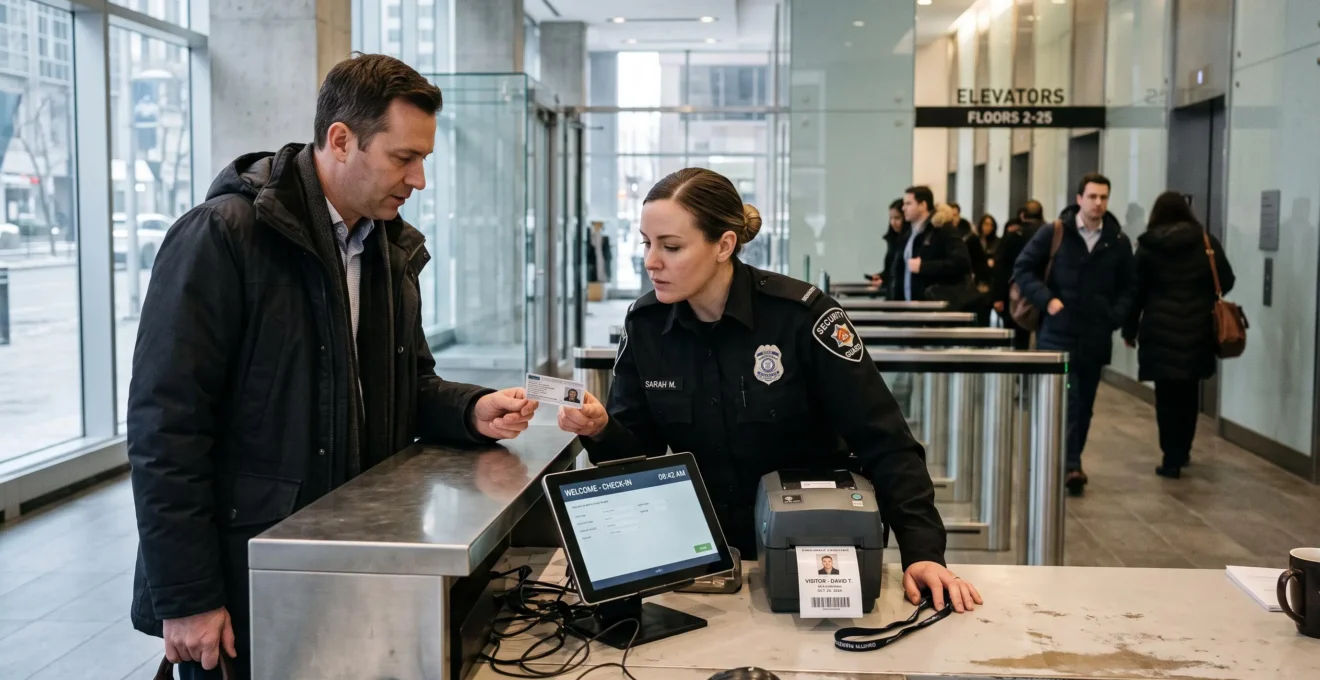
A visitor arrives for a scheduled meeting at a Canadian office. The receptionist recognizes the host’s name, finds the appointment and issues a badge. But has anyone confirmed that the person standing at the counter is the individual expected?
Effective workplace identity verification answers three separate questions: who is this person, are they authorized to enter, and which areas may they access? Treating those questions independently helps security teams avoid both unauthorized entry and unnecessary delays for legitimate employees, contractors and guests.
The practical approach is to complete predictable checks before arrival, match credentials to people at the entrance, and apply additional verification only where risk justifies it. Reception staff should have clear procedures, defined escalation paths and access to current authorization records rather than improvising decisions during busy periods.
Canadian privacy requirements also influence how verification operates. More information is not automatically better security. Organizations need proportionate collection practices, controlled retention and procedures adapted to the laws governing their activities.
Workplace identity verification: essential decisions
- Confirm the individual behind a credential, not merely whether a badge or access code works.
- Pre-register expected visitors and contractors, then match their identities against approved access records at arrival.
- Apply stronger controls to sensitive areas while limiting personal information collection and retaining records only as justified.
- Why Is an Employee Badge Alone Sometimes Insufficient to Confirm Identity?
- How Can Security Staff Verify Contractors Before Granting Site Access?
- Photo ID Checks or Electronic Identity Verification for Office Visitors?
- The Personal Information Collection Mistakes to Avoid at Security Desks
- When Should Security Officers Reverify Identity Before Sensitive-Area Entry?
- Escorted Access or Temporary Visitor Passes for Corporate Buildings?
- How Can You Assign Unique IDs to Short-Term Contractors?
- How Can Canadian Organizations Structure Access Permissions by Employee Role?
Why Is an Employee Badge Alone Sometimes Insufficient to Confirm Identity?
An employee badge is insufficient when the security system confirms possession of a credential without confirming who holds it. A functioning card may establish that an access token is recognized, but it cannot independently prove that the person presenting it is the authorized employee. Higher-risk areas therefore need additional identity assurance.
The critical distinction is between identity verification, credential authentication and access authorization. Identity verification connects a person to an established identity. Authentication checks a credential or factor associated with that identity. Authorization determines whether the person may enter the requested area.
Public Services and Procurement Canada‘s Contract Security Manual expressly distinguishes identification from access authorization and recognizes that additional procedures may be necessary to verify identity. Its requirements concern organizations operating within the relevant federal contract security framework, not every private office in Canada.
In practice, a badge-only system cannot reliably distinguish the legitimate credential holder from another person using a borrowed, lost or improperly transferred card. Even a technically successful authentication event may therefore leave uncertainty about the individual involved.
The appropriate verification method depends on the environment:
| Access situation | Potential verification approach | Important limitation |
|---|---|---|
| Ordinary employee entrance | Assigned badge with monitored entry controls | Badge possession alone does not establish identity |
| Unfamiliar employee requesting replacement access | Identity confirmation through an approved internal process | Familiarity or verbal claims should not replace verification |
| Restricted records or equipment area | Badge plus an independently verified additional factor | Additional factors must be appropriate to the risk and privacy context |
| Entrance vulnerable to tailgating | Controlled passage, observation and exception handling | A valid credential does not establish who accompanied its holder |
A separate concern is the quality of the audit trail. A door-control system records credential use, not necessarily the identity of the person who physically crossed the threshold. If badges are shared or misused, investigators may incorrectly associate access events with legitimate credential owners.
Adding extensive personal data collection is not the automatic solution. The organization should first improve credential assignment, entry supervision, identity matching and exception management.
Once security teams establish what a badge can and cannot prove, they can apply the same logic to contractors whose credentials and employment relationships are managed partly outside the organization.
How Can Security Staff Verify Contractors Before Granting Site Access?
Security staff should verify contractors through a documented process that starts before arrival. A designated sponsor confirms the engagement and requested access, the contractor’s identity is checked through an approved method, and reception matches the arriving individual to the authorized record. Higher-risk assignments require additional employer confirmation and periodic status reviews.
The main efficiency improvement comes from separating administrative preparation from physical entry. When contractor details, expected dates, site permissions and approval owners are established beforehand, front-desk staff need only resolve discrepancies rather than reconstruct the entire engagement.
A contractor verification workflow
- Confirm sponsorship. Identify the employee or department responsible for the contractor and verify the business purpose of the visit.
- Register the engagement. Record the authorized organization, named contractor, permitted dates, assigned work areas and relevant approval status.
- Complete appropriate identity checks. Use an approved verification channel before arrival where feasible, avoiding unnecessary storage of identification documents.
- Match the person at entry. Compare the arriving contractor with the approved identity record and verify that the engagement remains active.
- Issue restricted access. Activate an individually assigned credential for the approved period and locations.
The amount of verification should match the assignment. A supervised technician entering a public-facing meeting area presents a different exposure from a maintenance contractor working without supervision near critical equipment or restricted records.
Divide responsibility between the contractor’s employer and the host
The contracting company can attest that an individual is assigned to the project and meets relevant contractual requirements. The hosting organization remains responsible for deciding whether that person should enter its premises and which permissions to grant.
A useful authorization record identifies the company providing the worker, the responsible internal sponsor, the verification status, the approved access scope and the expiry date. That record can preserve accountability without duplicating every document held by the contractor’s employer.
Reverification is especially relevant when an access badge is renewed, a contractor moves to another assignment, the sponsor changes or a significant absence creates uncertainty about current authorization. These are proposed operational triggers rather than universal Canadian legal deadlines.
Once contractor authorization is confirmed, the next decision is whether physical documents, electronic credentials or a combination will provide the most efficient visitor entry process.
Photo ID Checks or Electronic Identity Verification for Office Visitors?
Manual photo ID inspection is often suitable for offices with relatively few visitors and a need for direct identity assessment. Electronic verification can simplify recurring or pre-registered arrivals, particularly where visitor volumes are high. A hybrid system is frequently practical, provided the organization evaluates accuracy, exceptions, privacy and actual processing requirements.
Manual checks allow a trained receptionist to compare the individual with an identification photograph and investigate inconsistencies immediately. However, visual inspection does not automatically establish that a document is genuine, and results depend on staff training and the procedure used.
Electronic visitor systems may use pre-registration records, mobile passes, QR codes or other credentials. These features can help retrieve approved visit details, but a valid QR code is not inherently proof of the presenter’s identity. Electronic document authentication and biometric comparison are separate capabilities that should not be assumed to exist in every visitor management product.
| Decision factor | Manual photo ID inspection | Electronic verification |
|---|---|---|
| Visitor processing | Direct inspection at reception | Potentially faster retrieval of pre-approved visits |
| Unscheduled visitors | Can investigate during a live interaction | May require registration and manual exception handling |
| Accuracy | Depends on document inspection and staff competence | Depends on system capabilities, identity binding and configuration |
| Audit records | Manual sign-in or restricted administrative log | Potentially structured electronic event history |
| Privacy exposure | Can avoid document storage when inspection alone suffices | Depends on which fields, images and histories are retained |
| Operational resilience | Requires available and trained personnel | Requires system availability and an appropriate fallback procedure |
Electronic systems do not necessarily collect more personal information. A minimally configured digital system may store less than a paper process that photocopies identification documents. Conversely, platforms that retain identity images, scanned documents and extensive visit histories create additional privacy and security considerations.
Organizations should test both ordinary and exception scenarios before selecting a method. A pre-registered visitor with a valid credential is different from an unexpected guest whose sponsor cannot be reached.
A hybrid process can let expected visitors complete administrative registration in advance while retaining a staffed identity check for exceptions, sensitive visits and uncertain matches.
Whichever method is selected, the information collected at reception must be proportionate to a clearly defined purpose.
The Personal Information Collection Mistakes to Avoid at Security Desks
Canadian security desks should avoid collecting identification information without a defined necessity, copying complete documents by default, keeping visitor photographs indefinitely, or retaining access records without a documented purpose. A privacy-conscious process identifies what must be collected, who may use it, how it is protected and when it should be deleted.
Privacy protection begins with the difference between inspecting information and storing it. A security officer may need to examine a photo ID to compare a visitor’s appearance with an approved record without necessarily retaining an image of the document.
The Office of the Privacy Commissioner of Canada‘s PIPEDA fair information principles address purpose identification, limited collection, consent subject to applicable exceptions, safeguards, accountability and retention limits.
These principles do not establish a universal prohibition on identification photocopies or a single mandatory visitor-record retention period. They require organizations within their scope to justify how information is handled.
Separate security purposes before deciding what to collect
Visitor registration may support several distinct activities: confirming an appointment, verifying identity, authorizing restricted-area entry and accounting for people during an evacuation. Each purpose should be documented rather than treated as blanket permission to gather additional personal information.
For example, an emergency occupancy list may require a person’s name and presence status, but that does not automatically justify retaining a copy of their driver’s licence. A sensitive facility may have different documented requirements, depending on its actual obligations and risks.
Five actions to audit reception-desk privacy practices
- Inventory collected fields: produce a complete list of visitor data captured in forms, devices, logs and security software.
- Assign a purpose to every field: create a collection-purpose matrix identifying why each piece of information is necessary.
- Document applicable requirements: prepare a privacy applicability note identifying the relevant legal framework and authorized collection practices.
- Define access and retention: approve a record schedule identifying authorized users, safeguards, deletion triggers and applicable exceptions.
- Verify the actual workflow: complete a reception-desk test showing that notices, collection settings and deletion procedures match the approved policy.
Canadian jurisdiction and cloud-provider considerations
Privacy obligations are not identical across Canada. Alberta, British Columbia and Quebec have comprehensive private-sector privacy laws recognized as substantially similar to PIPEDA for certain activities. Federal requirements may still apply depending on the organization and transaction.
The Privacy Commissioner’s explanation of provincial laws that may apply instead of PIPEDA provides the jurisdictional starting point. Applicable requirements must be assessed for the particular workplace rather than assumed from its address alone.
For cloud-based visitor systems, security and privacy reviews should establish data hosting locations, international transfers, subcontractor access, deletion capabilities and contractual safeguards. There is no universal Canadian requirement that every private-sector visitor record remain on Canadian servers.
Properly controlled information makes subsequent access decisions more trustworthy without creating an unnecessarily extensive repository of personal identities.
When Should Security Officers Reverify Identity Before Sensitive-Area Entry?
Security officers should reverify identity when an individual’s established identity or authorization no longer provides sufficient assurance for the requested entry. Relevant triggers include more sensitive destinations, credential irregularities, changed job responsibilities, expired approvals and unexplained access anomalies. The verification method should match the consequences of an incorrect entry decision.
Identity verification at the main entrance does not guarantee that every later access attempt remains appropriate. An employee may be authorized for general offices but not for a records archive, server room or controlled laboratory.
The practical question is whether the existing credential and current authorization provide enough confidence for the particular area at that moment.
Use layered checks rather than repeating the entire process
A useful model separates ordinary workplace access from sensitive-area entry:
- General entrance: verify the assigned credential and resolve exceptions using the established workplace procedure.
- Controlled work zone: confirm that the person’s current access authorization covers that particular area.
- Highly sensitive area: require an appropriately independent additional factor or authorized escort where justified.
- Exceptional or suspicious attempt: suspend the entry decision while a designated officer confirms identity and authorization.
Additional verification could involve a PIN, a separately authenticated credential, a supervisor’s confirmation or a documented escort procedure. Biometric verification requires particular consideration of necessity, proportionality, accuracy and applicable privacy obligations.
These controls should not be presented as universally mandated for every Canadian workplace. Their suitability depends on organizational risk, contractual obligations and applicable law.
The relevant technical principle also appears in NIST SP 800-171 Revision 3 physical access security requirements, which address authorization, physical access monitoring, access records and visitor escorting in a defined United States government-information security context. The publication offers a technical reference, not Canadian legislation.
Verify that the control actually operates
A security audit should compare sensitive-zone entry events with the required verification procedure. Sampling can establish whether the necessary authorization existed, whether the additional check was performed and how exceptions were handled.
Reviewers should distinguish between a log showing that a credential opened a door and evidence demonstrating that the required identity check actually occurred.
When the access request involves someone without permanent employee privileges, the organization must also decide whether ongoing supervision or a restricted temporary credential is the safer arrangement.
Escorted Access or Temporary Visitor Passes for Corporate Buildings?
Escorted access is generally appropriate when a visitor needs direct supervision, has limited familiarity with the premises or will enter particularly sensitive areas. Temporary passes can be suitable for authorized visitors who require predictable, independently managed movement. The choice depends on risk, visit frequency, available supervision and the restrictions built into the credential.
An escort arrangement assigns responsibility for the visit to an identified employee. A temporary pass instead relies more heavily on the accuracy of the authorization process and the physical and technical restrictions attached to the credential.
Neither arrangement eliminates all risks. Escorts can become distracted or unavailable, while a temporary credential can be lost, retained beyond its intended use or presented by someone other than its assigned holder.
| Illustrative situation | Suggested arrangement | Control to verify |
|---|---|---|
| One-time visitor attending a confidential meeting | Named escort | Escort remains responsible through visit completion |
| Recurring approved contractor in designated office areas | Restricted temporary pass | Current sponsor, valid dates and permitted zones |
| Delivery personnel entering a controlled receiving area | Supervised access or escort | Movement limited to the delivery purpose |
| Contractor requiring occasional restricted-area access | Restricted pass with escort for sensitive entry | Additional authorization at the restricted boundary |
These examples are suggested policy choices, not mandatory classifications under Canadian law. Workplaces should consider specific operational and contractual requirements.
Combine limited credentials with supervision when necessary
A time-limited, zone-restricted visitor pass can reduce the burden of continuous escorting without granting unrestricted movement. Where building systems support it, passes can limit elevator destinations, access periods and approved entrances.
The configuration should reflect the real visit. A contractor authorized to work on one floor does not automatically need access to other tenants’ spaces or restricted equipment rooms.
Escort arrangements also need monitoring. Reception should know who accepted responsibility, whether the visitor is expected to remain on-site, and what to do if the designated escort becomes unavailable.
Overdue visit alerts and documented check-out procedures can support follow-up. The resulting records should remain proportionate to operational and privacy requirements.
For organizations that depend on a rotating contractor workforce, the next requirement is a credential that belongs to one individual and does not remain active beyond the authorized engagement.
How Can You Assign Unique IDs to Short-Term Contractors?
Assign each short-term contractor an individual identifier linked to an approved identity, sponsoring organization, access scope and engagement period. The associated credential should expire or be revoked when authorization ends. Shared identifiers should be avoided because they weaken accountability and make it difficult to attribute access events to a specific individual.
The identifier should represent the contractor’s authorized access record, not simply a reusable physical badge. This distinction matters when plastic cards are collected and reissued to different people.
A practical contractor record can contain a system-generated unique ID, the individual’s necessary identifying details, the responsible vendor and sponsor, approved locations, activation date, expiry condition and credential status.
The organization should distinguish the permanent technical identifier of a record from the temporary validity of its associated access permission. An expired credential must not remain usable merely because its underlying record still exists.
Manage the full credential lifecycle
- Create: generate an individual record after identity and sponsorship checks are completed.
- Approve: obtain authorization from the designated access owner for the requested areas and period.
- Activate: issue a credential bound to that individual and the approved access permissions.
- Update: modify permissions when the project, dates or authorized duties change.
- Close: revoke access, recover reusable physical items where practical, and apply the approved retention or deletion schedule.
When contractor populations change frequently, connecting contractor management records with physical access control can reduce manual updates. Approved changes to engagement status can trigger credential provisioning, permission adjustments or revocation.
Such integrations should validate the originating record and require the appropriate approvals. Automation must not grant access solely because an unverified contractor profile has been created.
Organizations should also define what happens when physical badges are not returned. A missing card should be disabled, even if the system already shows the associated engagement as closed. Card recovery and electronic revocation are complementary controls.
Records supporting incident investigation and accountability may need to remain available for an appropriately justified period, while unnecessary identification copies or expired administrative details should not be retained indefinitely.
Individual identifiers become most useful when they connect to a wider permissions framework that governs employees and contractors consistently across the workplace.
Key takeaways before structuring workplace permissions
- Confirm identity and authorization as separate decisions, then connect them through controlled individual access records.
- Design permissions around approved duties, locations and time periods rather than granting broad building access by default.
- Make employment changes, contractor departures and exceptional access requests trigger timely permission reviews.
How Can Canadian Organizations Structure Access Permissions by Employee Role?
Canadian organizations can structure workplace access through role-based access control, or RBAC, by mapping employee responsibilities to the physical areas required for their work. Each access role should have an identified approval owner, defined permissions and a review process. Changes in employment or duties should trigger prompt access reassessment.
Identity verification establishes who an individual is. Role-based access control determines which resources and locations that verified individual may access. A reliable security program connects those decisions rather than treating credential issuance and permission assignment as unrelated administrative tasks.
Build a physical access permission matrix
Start by inventorying the building’s relevant zones and identifying who has authority to approve entry into each one. Map job functions to actual operational needs, including whether access is permanent, scheduled or temporary.
The following example is hypothetical and should be adapted to the specific organization.
| Role | Ordinary office areas | Restricted records room | Technical equipment room |
|---|---|---|---|
| Reception employee | Authorized | Not authorized by default | Not authorized by default |
| Records administrator | Authorized | Authorized for assigned duties | Not authorized by default |
| IT infrastructure technician | Authorized | Not authorized by default | Authorized for assigned duties |
| Temporary facilities contractor | Limited to approved work areas | Requires separate approval | Requires separate approval |
Approval owners should document the business justification for exceptions. If a temporary project requires broader access, those additional permissions should have an identifiable end condition rather than becoming part of the employee’s permanent role.
Connect permissions to employment changes
The highest-priority administrative triggers include departures, internal transfers, new appointments, changed responsibilities and completed projects. An individual who changes roles should not automatically retain every permission from the previous position.
A coordinated HR, facilities and security workflow can notify the responsible access owner when an event requires review. For contractors, the corresponding notification may originate from the vendor-management process.
Periodic reviews remain useful for identifying accumulated privileges, but they should complement event-driven updates rather than replace them.
Role permissions also support privacy safeguards. Restricting physical entry to spaces containing personal information can reduce exposure, alongside appropriate digital access controls, staff procedures and other security measures.
For applicable Canadian privacy frameworks, access restrictions should reflect the sensitivity of the information and the organization’s documented purposes. RBAC is a technical and organizational method for implementing proportionate restrictions; it is not, by itself, a universal statutory requirement that every workplace use a particular access control architecture.
Make access decisions auditable without collecting unnecessary data
A useful access review should be able to establish the verified individual, the permissions granted, the approving authority and the relevant validity period. Security teams should also be able to identify when access was changed or revoked.
This does not require retaining every possible identity attribute. The record should contain the information necessary to support authorization, accountability and applicable obligations, protected by safeguards appropriate to its sensitivity.
The next practical action is to select one sensitive area, document who currently has entry rights, compare those permissions with actual job responsibilities, and correct any unjustified access. That review provides a manageable starting point for consistent, privacy-conscious identity and access management throughout the workplace.
Can a Canadian employer require visitors to show government-issued photo identification?
An organization may establish identification procedures appropriate to its premises, but its authority and collection practices depend on the applicable legal framework, operational purpose and circumstances. Asking to inspect an identification document is different from requiring a copy. Organizations should assess necessity, provide appropriate notice and consider suitable alternatives where required.
How long should a Canadian office retain visitor sign-in records?
There is no single retention period applicable to every Canadian workplace visitor log. The organization should identify the purposes of the records, applicable legal and contractual requirements, and the period genuinely necessary for those purposes. Certain government contract security contexts have specific requirements, which should not be generalized to ordinary offices.
What should reception do when an expected visitor arrives without acceptable identification?
Reception should follow an approved exception procedure rather than bypass identity checks. Depending on site policy and risk, this may involve contacting the verified sponsor, using an approved alternative method of identity confirmation, arranging supervised access or declining entry until authorization can be established. The decision and any necessary exception record should be proportionate to the circumstances.
Can organizations use biometric identity checks at workplace entrances?
Biometric verification requires careful assessment because biometric information can be highly sensitive. Organizations should determine whether the method is necessary and proportionate, identify the applicable privacy requirements, evaluate less intrusive alternatives, and establish safeguards and retention procedures before implementation. Consent and other legal considerations depend on the relevant jurisdiction and circumstances.
Who should approve emergency access to a restricted workplace area?
An organization should designate authorized decision-makers and escalation procedures before emergencies occur. Its policy can distinguish life-safety response from ordinary operational exceptions, identify what verification remains feasible and establish how emergency access is documented and reviewed afterward. Site-specific emergency obligations and safety procedures take precedence over an improvised reception-desk decision.