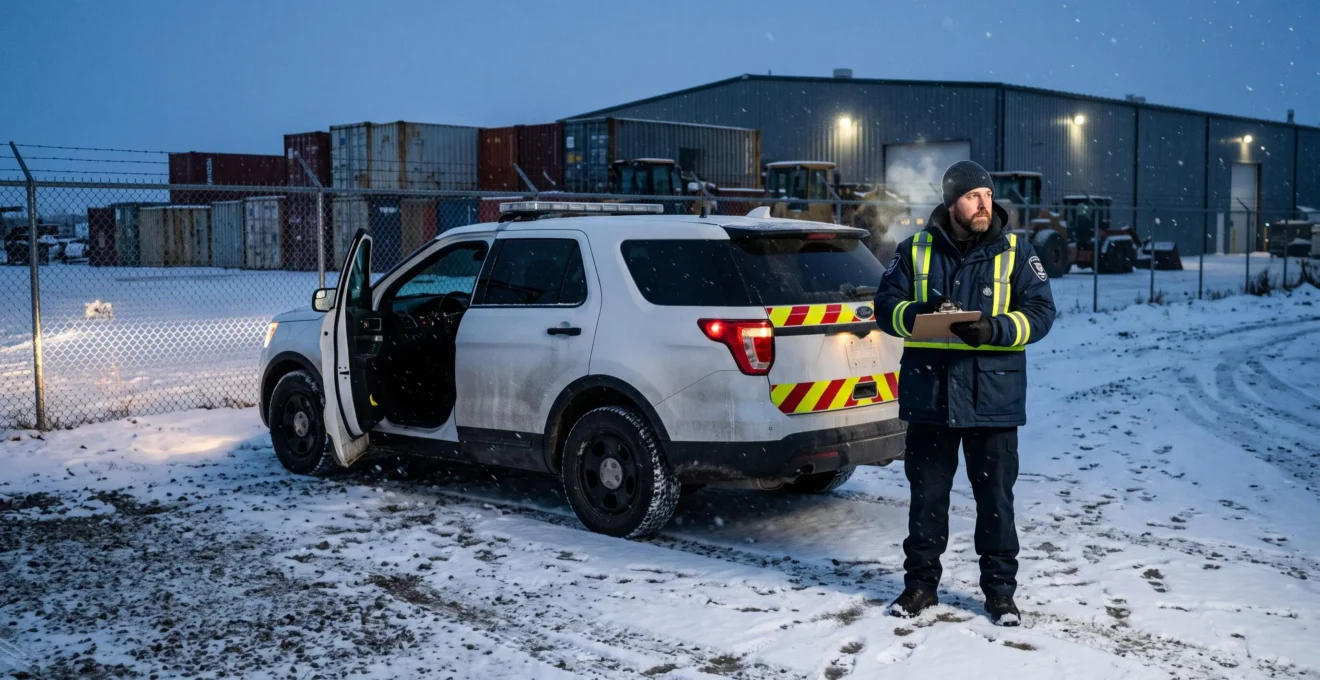
Mobile patrol vehicles can secure multiple properties efficiently when routes reflect actual site risks, realistic travel times and the limits of periodic security checks. For Canadian security contractors and property managers, effective coverage requires more than assigning a vehicle to a list of addresses. Each location needs a suitable visit frequency, achievable response arrangements and verifiable inspection procedures.
The central challenge is balancing geographic efficiency with security effectiveness. A patrol vehicle may cover several industrial facilities during one shift, but travelling between properties creates unavoidable periods without physical observation. Winter road conditions, inaccessible gates, mechanical failures and predictable schedules can further compromise the service.
A dependable mobile guarding operation therefore combines geographic clustering, risk-weighted scheduling, unpredictable inspection times, appropriate vehicle selection and automated patrol verification. Isolated or particularly vulnerable properties may also need remote monitoring or fixed guarding. The objective is not simply to maximize the number of properties visited, but to deliver measurable coverage that corresponds to each site’s exposure.
Mobile patrol coverage: essential operating principles
- Calculate actual unobserved intervals and travel-dependent response times before committing to patrol frequencies.
- Build routes around site risk, geographic proximity, seasonal access conditions and contingency capacity.
- Combine randomized inspections with checkpoint verification and monitoring systems that reveal missed or incomplete visits.
- Why Do Long Travel Distances Reduce Mobile Patrol Response Reliability?
- How Can You Plan Mobile Patrol Routes Across Industrial Properties?
- SUVs or Standard Patrol Cars for Canadian Winter Security Routes?
- Why Poor Winter Vehicle Preparation Can Interrupt Security Coverage
- How Can GPS Patrol Logs Verify Site Visits Without Excessive Administration?
- Why Do Isolated Worksites Face Longer Security Response Delays?
- Risk-Weighted Checks or Fully Random Patrols for Industrial Facilities?
- How Can Randomized Security Checks Reduce Predictable Patrol Vulnerabilities?
Why Do Long Travel Distances Reduce Mobile Patrol Response Reliability?
Long travel distances reduce mobile patrol response reliability because officers cannot physically inspect a property while driving between locations. Longer routes increase the time between observations and the delay before an officer can reach an incident. Even an optimized schedule cannot eliminate these gaps; dependable coverage requires measuring them against each property’s security risks.
The distinction between a scheduled patrol and continuous protection is fundamental. A warehouse assigned three inspections during a shift receives three planned opportunities for direct observation, not uninterrupted guarding. Between visits, an incident may remain undetected unless another monitoring system generates an alert.
Unobserved time should be calculated for each property using the departure and next arrival timestamps. The interval between completed inspections represents a period without direct patrol observation, although cameras, alarms or on-site personnel may provide additional coverage.
Travel time also affects alarm response. An officer may be nearby on paper but physically committed to another property, separated by an industrial highway or delayed by difficult site access. Driving time estimates should therefore represent operating conditions rather than ideal routes.
Canadian geography makes this particularly important. Industrial properties may be distributed across urban outskirts, rural roads and isolated industrial corridors. Snowfall, freezing rain and limited winter road maintenance can increase travel times, making a nominal route schedule unreliable.
Consider a hypothetical patrol assignment where an officer leaves a site at 01:00 and returns at 04:00. That property experiences a three-hour interval without direct patrol observation. If a security incident begins shortly after departure, the next scheduled inspection might occur well after the event. An alarm could shorten detection time, but the officer would still need to travel back.
A practical assessment starts by mapping every property, recording actual visit durations and estimating travel times under ordinary and adverse conditions. Managers can then identify where the longest intervals exceed the client’s agreed tolerance.
Properties requiring faster intervention may need a shorter patrol loop, another assigned vehicle, remote monitoring or fixed security personnel. Travel efficiency cannot substitute for sufficient response capability.
Once realistic coverage limits are known, the next decision is how to organize industrial properties into routes that minimize unnecessary travel without making patrol activity predictable.
How Can You Plan Mobile Patrol Routes Across Industrial Properties?
Plan industrial mobile patrol routes by grouping properties according to geographic proximity and security risk, then assigning visits within realistic operating windows. High-risk facilities should receive stronger coverage during vulnerable periods, while lower-risk sites can be grouped into efficient travel loops. Route designs must also account for access restrictions, inspection durations and unpredictable visit timing.
Begin with two separate maps: a geographic map of the properties and a risk map identifying their most important vulnerabilities. Geographic clustering reduces unnecessary driving, while risk classification determines how frequently each site should be inspected.
For example, a distribution centre with valuable inventory and exposed loading bays may justify more frequent checks than an enclosed equipment storage yard with effective intrusion detection. However, a nearby lower-risk property should not automatically receive priority simply because it is convenient to visit.
Conventional delivery-routing software generally optimizes distance, time or stop order. Security patrols require additional constraints because a perfectly repeated route becomes observable. A practical approach is to develop two or three feasible route templates, vary the order of compatible site visits and randomize exact arrival times within agreed limits.
These templates are operational options, not a scientifically established optimal number. They should be tested against actual road conditions, contractual inspection requirements and staffing capacity.
Industrial properties also demand accurate estimates of on-site work. Driving through the front entrance is not equivalent to inspecting rear loading docks, outdoor storage or a distant perimeter fence. Site plans should specify which checkpoints require walking, which areas can be observed from a vehicle and which gates are usable overnight.
Before activating a route, confirm that guards can perform every inspection without administrative delays. The operational file should contain current gate credentials, authorized key procedures, emergency contacts and instructions for inaccessible areas. Sensitive access information should be stored securely rather than exposed in ordinary route documents.
Five steps to produce an executable patrol route
- Map all assigned properties and driving connections; produce a georeferenced site and route map.
- Classify each property by exposure, asset importance and incident history; produce a documented site-risk register.
- Record required inspection points, access constraints and realistic visit durations; produce a site-specific patrol instruction sheet.
- Build and test alternate route sequences under normal and adverse conditions; produce approved route templates with expected operating windows.
- Assign backup coverage, escalation contacts and missed-visit procedures; produce a dispatch contingency matrix.
Once deployed, compare completed visits with the route assumptions. Repeated late arrivals, inaccessible checkpoints or excessive driving indicate that the assignment needs redesign rather than simply demanding faster driving from officers.
Even an effective route can fail if the assigned vehicle cannot handle its most difficult access road, making fleet selection a central part of coverage planning in Canada.
SUVs or Standard Patrol Cars for Canadian Winter Security Routes?
SUVs are generally better suited to patrol routes that regularly involve deep snow, uneven industrial yards or poorly maintained access roads, while standard patrol cars may be suitable for reliably cleared urban routes. Neither vehicle type guarantees winter reliability. The appropriate choice depends on actual ground clearance, tires, drivetrain, maintenance and the worst access conditions encountered.
Fleet selection should start with route requirements rather than a preference for one vehicle category. A sedan may perform efficiently across paved commercial properties but become unsuitable when the same route includes an unplowed rural access road.
The following comparison identifies the practical trade-offs without assuming every SUV or sedan has identical specifications.
| Patrol requirement | SUV | Standard patrol car |
|---|---|---|
| Unplowed industrial access | Potential advantage from higher ground clearance, depending on model | May encounter clearance limitations in accumulated snow or rutted yards |
| Cleared urban routes | Capable, but additional vehicle size may offer little operational benefit | Often a practical choice for paved, regularly maintained roads |
| Extreme-cold starting | Depends on battery condition, engine, preparation and maintenance | Depends on the same factors; body style alone is not decisive |
| Fuel expenditure | Requires model-specific fuel-consumption and route-cost comparison | May offer lower consumption, depending on the vehicle selected |
| Marked patrol visibility | Potentially prominent vehicle profile | Visibility depends on markings, placement and lighting |
| Equipment capacity | May accommodate more winter and emergency equipment | Suitable when equipment requirements fit available storage |
The weakest access point on the route should influence the vehicle decision. A route that includes several accessible warehouses and one snowbound worksite is not reliable if the assigned car cannot reach that final location.
Winter tires and vehicle preparation matter more than choosing a larger vehicle without evaluating its actual equipment. In Québec, winter tires are generally required from December 1 to March 15 for motor vehicles registered in the province, subject to specified exceptions and vehicle classifications. Operators should consult the Québec government’s winter tire requirements when assessing their fleet.
Requirements differ across jurisdictions, so a provider operating in multiple provinces must verify the rules applicable to each vehicle and route rather than assume one national requirement.
Cold-weather starting systems, manufacturer-approved block-heater use and prolonged stationary operation should be addressed through vehicle-specific procedures. Extended idling is not a universal substitute for preventive maintenance and may introduce fuel, environmental or operational concerns.
A mixed fleet can be appropriate for contractors managing both urban and rural contracts. Assigning suitable vehicles to geographic route clusters may avoid using more expensive equipment where its capabilities are unnecessary, while keeping difficult sites accessible.
Vehicle suitability is only the first requirement. Preventive inspections and replacement arrangements determine whether the selected fleet can consistently complete those winter routes.
Why Poor Winter Vehicle Preparation Can Interrupt Security Coverage
Poor winter vehicle preparation can interrupt security coverage because a vehicle breakdown may prevent every remaining inspection on its assigned route. A weak battery, unsuitable tires or mechanical fault can turn one missed checkpoint into multiple service failures. Preventive maintenance and backup dispatch arrangements are therefore necessary to protect patrol continuity during Canadian winters.
Mobile guarding depends on a functioning transport system. If one vehicle services several properties, a failure early in the shift can affect every subsequent stop unless another patrol unit is available to take over.
The resulting coverage gap may be larger than the original mechanical problem. A vehicle that cannot start at shift change delays deployment before the first inspection. A vehicle stranded between remote sites may create additional risks for the officer while dispatch attempts to arrange assistance.
According to Transport Canada‘s winter vehicle preparation recommendations, cold-weather readiness includes attention to batteries, charging systems, brakes, lighting, tires and other mechanical components. Transport Canada recommends winter windshield washer fluid suitable for temperatures in the -40°C range and at least 4 mm of winter-tire tread for safer winter driving; these are safety recommendations, not universal statutory minimums.
For security contractors, the operational application is to verify vehicle readiness before deployment and maintain records of defects, repairs and corrective actions.
Patrol-specific winter preparations should cover starting reliability, fuel availability, visibility equipment, traction, roadside recovery supplies and communications. Remote routes also require a way to contact dispatch if ordinary cellular service is unavailable. The communication method must be tested for the intended operating area.
Contingency dispatch deserves equal attention. A supervisor should know which alternate vehicle or officer can take over, which properties require priority intervention and how affected clients will be informed. An unavailable backup should never be treated as guaranteed coverage.
Contracts should describe how patrol interruptions are reported and handled. A mechanical failure does not automatically determine contractual liability, but the actual service obligations, notification requirements and applicable legal framework matter when visits are missed.
To identify recurrent problems, classify vehicle-related missed checkpoints separately from routing, staffing and site-access exceptions. Reviewing the resulting operational records across a winter season can help determine whether fleet maintenance, replacement capacity or route redesign deserves investment.
Reliable vehicles make inspections possible; the next challenge is proving which inspections actually occurred and identifying service exceptions without overwhelming supervisors with paperwork.
How Can GPS Patrol Logs Verify Site Visits Without Excessive Administration?
GPS patrol logs can verify mobile security activity by automatically recording vehicle locations, arrival times and checkpoint events. Geofencing confirms that a patrol vehicle entered a defined area, while NFC or QR checkpoints provide additional evidence of specific on-site inspections. Exception-based reporting allows supervisors to investigate missed or incomplete visits without manually reviewing every routine patrol record.
Patrol verification should distinguish three operational events: arriving at a property, reaching required inspection points and completing the assigned security observations. These events are related but not interchangeable.
A vehicle entering a GPS geofence demonstrates proximity to the site within the limitations of location accuracy. It does not prove that an officer checked the rear gate, inspected an exposed storage compound or walked a required section of perimeter fencing.
Checkpoint-based verification adds more precise evidence. A recorded NFC tap or QR scan can associate a timestamp with a specific inspection location. The validity of that evidence still depends on the checkpoint’s physical placement, the officer’s conduct and the integrity of the system.
For management purposes, the most useful report is often the exception list rather than a chronological record of every location event. Supervisors should be able to identify missing checkpoints, incomplete inspections, unusual dwell times and visits outside agreed operating windows.
The same underlying records can serve client transparency, operational oversight and incident investigation. Clients can receive summaries of completed contractual visits, managers can review service exceptions, and authorized investigators can examine preserved records when an incident raises questions about patrol activity.
However, detailed tracking also creates employee privacy obligations. The Office of the Privacy Commissioner of Canada‘s workplace privacy guidance identifies company-vehicle location tracking as a form of employee monitoring. Employers should establish appropriate purposes, limit unnecessary collection, provide suitable notice and restrict access to personal information in accordance with applicable laws.
Verification systems should not reward checkpoint collection at the expense of observation. An officer who scans every tag without assessing the surroundings may satisfy an activity metric while failing the underlying security task.
Reports should therefore incorporate qualitative information when relevant, such as identified hazards, unusual activity, photographs collected for legitimate operational purposes and follow-up actions. Dwell-time data can flag anomalies but cannot independently establish inspection quality.
Accurate patrol records become particularly important when properties are isolated and response delays can result from detection, travel and access problems occurring together.
Why Do Isolated Worksites Face Longer Security Response Delays?
Isolated worksites face longer security response delays because incidents may take longer to detect, responders must travel farther and site access can be more complicated. Remote Canadian industrial, agricultural and resource-sector properties may have limited nearby activity, unreliable communications or difficult road conditions. Mobile patrols alone cannot eliminate these obstacles without suitable detection and response arrangements.
A useful way to evaluate response capability is to separate the process into three components:
Total response interval = detection delay + travel delay + site-access delay.
This is an operational planning model rather than a universal emergency-response standard. Depending on the organization, it may also be necessary to account for alarm verification, dispatch processing or officer availability as distinct stages.
Detection can be the largest uncertainty at an unattended remote property. A break-in may occur without nearby residents, employees or passing traffic noticing it. Even a patrol vehicle stationed within a reasonable driving distance cannot respond to an event that has not been detected or reported.
Travel adds another variable. Mining operations, pipeline construction areas, agricultural facilities and remote equipment yards may be far from a security contractor’s patrol base or the nearest available police resources. Distances, road access and responder availability must be checked individually rather than inferred from the location of a town or detachment.
Finally, the officer may encounter locked gates, snow-obstructed entrances, large internal road networks or access-control procedures that delay arrival at the relevant part of the property.
Different safeguards address different stages. Remote video analytics, monitored alarms and permitted audio intervention may improve detection or verification. Cellular or satellite communication can support alarm transmission where suitable infrastructure exists. A strategically located patrol base or second vehicle may reduce travel time.
Site-specific assessment should score each location against three dimensions: detection capability, distance from usable response resources and access complexity. The resulting assessment should identify both the expected operating conditions and credible adverse scenarios.
For high-consequence sites, the provider and client should agree on what constitutes an acceptable response window before selecting a mobile-only security model. Where that window cannot be met, remote monitoring or fixed guarding may be required.
Once the minimum response capability is established, patrol resources can be distributed according to site risk rather than divided equally or assigned through unrestricted random scheduling.
Risk-Weighted Checks or Fully Random Patrols for Industrial Facilities?
Risk-weighted patrols are generally more suitable when industrial properties have identifiable differences in exposure, asset value and incident patterns. Fully random visits reduce scheduling predictability but may leave critical locations unchecked during vulnerable periods. A hybrid approach combines guaranteed minimum coverage for high-risk windows with randomized inspection timing and additional checks where operational capacity permits.
The decision is not simply between strict scheduling and unpredictability. Industrial security requires both adequate attention to known vulnerabilities and enough variation to avoid easily observed routines.
A fully random system may distribute inspections unpredictably across properties without respecting their different security needs. A high-value loading yard could consequently receive insufficient attention during a period associated with recurring losses, while lower-risk sites receive additional visits.
Conversely, a rigid risk-weighted timetable may concentrate resources appropriately but expose predictable gaps if guards repeatedly arrive at exactly the same time.
The preferred operating model is therefore risk-weighted scheduling with controlled randomization.
Risk assessments should consider documented incident history, asset concentrations, exposed access points, site layout and periods of limited staff activity. These factors help determine the minimum coverage requirement for each property and time window.
The practical model has two layers:
- Anchor coverage: Contractually required visits or checks assigned to defined risk periods, with clear completion expectations.
- Variable coverage: Additional inspections or shifts in visit timing within permitted windows, subject to staffing, travel and higher-priority obligations.
For example, a hypothetical industrial contractor might require at least one inspection within an identified overnight risk window, while varying the actual arrival time from shift to shift. Additional visits could be assigned elsewhere based on current alerts or available patrol capacity. The example illustrates the scheduling principle rather than a validated optimal frequency.
The contract should distinguish minimum guaranteed visits from discretionary supplemental checks. Clients should know which commitments are fixed and which timing variations are intentional, without receiving advance details that unnecessarily expose future patrol movements.
Operational review should incorporate incidents, attempted intrusions, near misses, missed checkpoints and changes in site use. These findings can justify a revised risk assessment and updated patrol allocation.
Risk weighting establishes where patrol attention is most important; deliberate randomization determines how that attention can be delivered without producing an unnecessarily exploitable routine.
Key takeaways for patrol scheduling
- Define minimum inspection obligations before introducing unpredictable arrival times.
- Keep route variation within achievable travel, staffing and site-access constraints.
- Use verified patrol records and incident trends to evaluate whether scheduling changes preserve coverage.
How Can Randomized Security Checks Reduce Predictable Patrol Vulnerabilities?
Randomized security checks reduce predictable patrol vulnerabilities by making it harder for observers to anticipate when officers will arrive, which route they will take or which access point they will inspect first. Effective randomization changes patrol timing and sequencing without sacrificing required visit frequency, high-risk coverage, incident response or the ability to verify completed inspections.
When a patrol vehicle follows the same route at nearly identical times each night, its movements may become observable. Someone familiar with those movements could identify periods when a particular loading area or gate is less likely to be inspected.
Predictability can arise from several seemingly minor habits: arriving at the same minute, using one entrance, checking checkpoints in an identical sequence or always visiting properties in the same order.
Randomization is intended to reduce those regular patterns. It does not require operating without a plan.
Security managers can introduce variation through several complementary techniques:
- Change visit order among compatible properties while preserving required inspections.
- Vary arrival times within approved coverage windows rather than using fixed clock times.
- Alternate authorized gates or approaches when site layouts and access procedures permit.
- Change patrol starting points or assign different suitable vehicles where operationally justified.
- Use incident information to adjust additional patrol checks without displacing higher-priority obligations.
These practices align with the principle in ProtectUK’s official guidance that patrols should be regular but unpredictable. The guidance also emphasizes risk assessment, documented procedures, defined responsibilities and supervision. It does not establish a particular randomization algorithm or quantify crime reduction for Canadian industrial facilities.
Operational accountability must remain intact. GPS and checkpoint records should verify whether the contracted inspections occurred, even when their precise order and timing varied. Supervisors should review exceptions and distinguish authorized variation from genuinely missed service.
Client communication matters because irregular arrival times may otherwise appear to indicate poor discipline. Explaining that inspections occur within agreed windows, rather than at publicly predictable moments, helps establish appropriate expectations while preserving sensitive scheduling information.
Randomization also has important limits. It cannot compensate for too few visits, excessive travel distances, failed alarms or inaccessible sites. Individuals with legitimate long-term access may possess information that patrol timing alone cannot address. Strong access control, internal reporting procedures and appropriate monitoring remain necessary.
The objective is unpredictability within a reliable security framework, not randomness for its own sake. Contractors should measure whether all minimum coverage obligations remain achievable and whether operational records reveal new gaps after schedules are varied.
The practical next step is to audit one representative patrol cluster: map its travel and inspection times, confirm each property’s minimum coverage, identify repeated timing patterns and test a controlled randomized schedule against the existing service commitments.
How many properties can one mobile security vehicle patrol during a shift?
There is no universal property count that guarantees reliable coverage. Capacity depends on driving distances, inspection durations, site-specific risk, required visit frequency and available contingency resources. Calculate the total route workload and each property’s unobserved intervals before deciding how many contracts one vehicle can reasonably service.
Should a mobile patrol contractor guarantee a maximum response time?
Any response commitment should reflect verified operating capability and specify the conditions under which it applies. Factors include alarm notification, vehicle availability, driving conditions and site access. Contractors should distinguish planned patrol frequency from incident-response obligations and document how exceptions or extraordinary conditions are handled.
What information should clients receive in a mobile patrol report?
A useful report identifies completed visits, relevant checkpoint activity, security observations, incidents, missed inspections and corrective actions. Reporting should be detailed enough to demonstrate service performance while avoiding unnecessary disclosure of sensitive future routes or employee-location information.
Can remote cameras replace mobile security patrols at industrial properties?
Remote cameras can support detection and verification, but they do not automatically replace physical inspection or on-site intervention. Whether monitoring is sufficient depends on camera coverage, alarm handling, site vulnerabilities and required response capabilities. A combined approach may be appropriate when a property is geographically isolated or requires both remote observation and periodic physical checks.
How often should mobile patrol routes be reassessed?
Routes should be reassessed whenever incidents, access conditions, property occupancy, seasonal hazards or contractual requirements materially change. Periodic operational reviews can also identify repeated missed checkpoints, unexpected travel delays and opportunities to adjust coverage. The review interval should reflect the risk profile and operating agreement rather than an assumed universal standard.