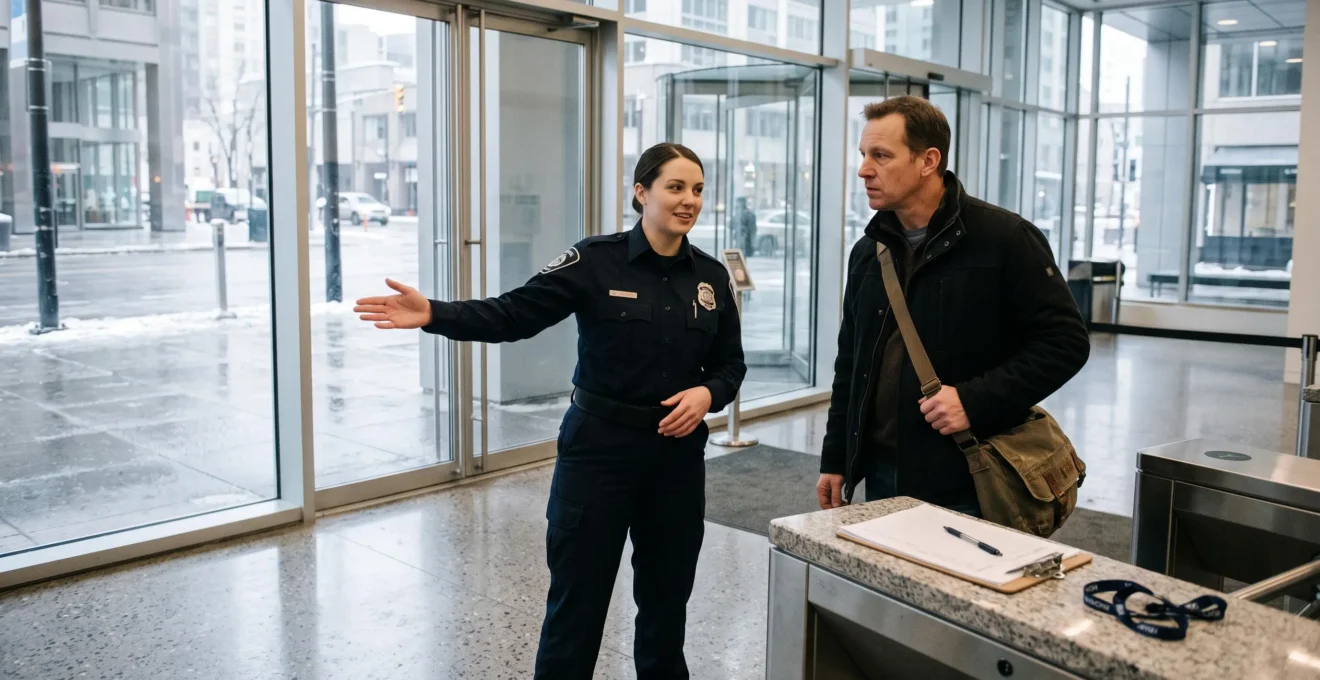
A visitor refuses an access check. Their voice rises, nearby customers begin watching, and a routine security interaction starts becoming unpredictable. The guard must maintain the site’s rules without turning a disagreement into a physical confrontation.
Effective security de-escalation depends on recognizing tension early, communicating without unnecessary provocation, maintaining safe positioning and knowing when to request assistance. It does not mean surrendering access-control responsibilities or accepting threats. It means choosing responses that reduce the likelihood of violence while protecting everyone involved.
For Canadian security personnel, these skills must also operate within workplace safety procedures, property rules and the limited legal authority available to private security guards. The appropriate response differs between a frustrated customer, an intoxicated visitor, a threatening individual and a dangerous crowd.
The central skill is recognizing when dialogue remains useful and when safety requires distance, backup or emergency intervention.
Security de-escalation: essential principles
- Use calm, respectful language, acknowledge concerns and offer reasonable choices without compromising safety or access rules.
- Watch for escalating threats, maintain personal space and request assistance before an interaction becomes unmanageable.
- Recognize the limits of private security authority in Canada and prioritize safe disengagement when physical danger develops.
- Why Can Authoritative Language Escalate Tension at Security Checkpoints?
- How Can Guards Calm an Agitated Visitor Without Increasing Tension?
- Verbal Aggression or Imminent Threat: When Should Guards Seek Backup?
- The Body Language Mistakes That Can Intensify Security Confrontations
- When Should Security Guards Disengage and Request Additional Assistance?
- When Should Event Security Temporarily Stop Admission at a Crowded Venue?
- Why Does Situational Awareness Matter for Guards Working Alone?
- What Can Security Officers Legally and Practically Do at Canadian Commercial Properties?
Why Can Authoritative Language Escalate Tension at Security Checkpoints?
Authoritative language can escalate checkpoint confrontations because people may interpret abrupt commands as threats to their independence or dignity. This can provoke psychological reactance: resistance to an instruction perceived as unnecessarily controlling. Security guards can reduce that reaction by explaining requirements, offering limited choices and maintaining clear boundaries without making the interaction a contest of authority.
A uniform, identification badge and assigned checkpoint role already establish a guard’s position. Repeating that authority through raised volume, commands or public correction may increase resistance rather than improve cooperation.
The distinction is between authority of position and authority of conduct. A guard can maintain firm access rules while speaking respectfully and providing a clear reason for the requested action.
For example, consider a visitor who objects to an identity verification procedure at a Canadian office tower. The guard cannot necessarily waive the building’s security policy, but can change how the requirement is communicated.
| Potentially escalating statement | More constructive alternative |
|---|---|
| « You need to step aside now. » | « I need to check this. Could you step over here with me? » |
| « You cannot enter. Those are the rules. » | « Entry requires authorization. I can explain how to have your access confirmed. » |
| « Stop arguing with me. » | « I understand you disagree. Let me explain what I can do next. » |
| « Show me your identification immediately. » | « This entrance requires identification verification. Are you able to provide it? » |
These alternatives work by separating the requirement from the person’s emotional reaction. They offer a way to cooperate without requiring the visitor to admit defeat in front of others.
Small choices can be especially useful: a person might wait near a reception desk or contact their host, provided both options comply with site policy. A choice should never imply that a mandatory check is optional.
Firm directions remain appropriate when immediate safety is at risk. A visitor approaching a hazardous area may need an unmistakable instruction to stop. Similarly, an individual who has been lawfully directed to leave may need a clear explanation of the boundary and consequences of refusing.
Even then, firm language need not be insulting, sarcastic or personally threatening. The objective is to convey urgency without adding unnecessary hostility.
Once a guard establishes a respectful boundary, the next challenge is listening to someone who remains frustrated despite understanding the rule.
How Can Guards Calm an Agitated Visitor Without Increasing Tension?
Security guards can calm an agitated visitor by acknowledging the person’s frustration, asking a simple question, listening without interruption and identifying one practical next step. This structured approach helps visitors feel heard while allowing guards to retain control of access requirements and safety boundaries. It is appropriate only while communication remains safe.
An agitated visitor may be upset about a denied entrance, a delayed appointment, a lost item or a perceived unfair decision. The visible argument is not always the underlying concern.
Effective de-escalation begins by identifying that concern without agreeing to behaviour that violates site rules.
A practical conversation follows four stages:
- Acknowledge the concern. Say, « I can see this delay is frustrating, » without assuming the person is justified in every demand.
- Ask one open question. Try, « What were you expecting to happen when you arrived? » Avoid several rapid questions that resemble an interrogation.
- Reflect the main issue. For example, « You were told your appointment was confirmed, but your name isn’t on the visitor list. »
- State one next step. Explain, « I can contact reception to check whether your host can authorize entry. »
Each stage addresses a different source of agitation: feeling dismissed, misunderstood or trapped without an acceptable next action.
This approach uses tactical empathy: recognizing the person’s perspective without adopting their demands or abandoning security responsibilities. Allowing someone a reasonable opportunity to explain an issue may reduce repeated objections, although listening alone cannot guarantee de-escalation.
Guards should avoid phrases such as « Calm down, » « That’s not my problem » or « There is nothing I can do. » These statements may sound dismissive, particularly when a visitor already feels unfairly treated.
Instead, explain the boundary alongside an available action: « I cannot authorize entry myself, but I can contact the person responsible. »
Polite, service-oriented communication is particularly relevant in Canadian commercial and public-facing environments, where visitors may expect staff to provide explanations rather than commands alone. Expectations vary between individuals, however, and guards should not assume that every visitor responds identically.
Active listening also needs boundaries. If the person repeatedly interrupts, threatens others or becomes physically aggressive, continuing the conversation indefinitely is not a safety strategy.
The Canadian government’s Employment and Social Development Canada‘s sample workplace violence prevention policy recommends remaining calm, acknowledging anger, respecting personal space and ending interactions when problematic behaviour persists. It is an illustrative workplace policy rather than a universal security operating standard.
When listening and explanation fail, the guard must determine whether the interaction remains a verbal disagreement or has developed into a credible safety threat.
Verbal Aggression or Imminent Threat: When Should Guards Seek Backup?
Security guards should request backup when aggressive behaviour becomes harder to control, threats become credible, several people are involved or safe observation of the site is compromised. Shouting and insults do not automatically establish imminent violence. Physical intimidation, threatened assault, weapons or rapidly deteriorating conditions justify a more urgent response, potentially including police intervention.
The essential distinction is between verbal aggression and indicators of physical danger. A visitor who complains loudly may still respond to communication. Someone who repeatedly closes distance, threatens injury or attempts to strike another person presents a different level of risk.
The Canadian Centre for Occupational Health and Safety explains in its information on workplace violence warning signs that possible indicators include escalating threats, clenched fists, pacing, aggressive gestures and violations of personal space.
These are contextual warning signs, not a validated formula for predicting violence. An isolated gesture, disability-related movement, distressed expression or raised voice should not automatically be interpreted as a threat.
A useful operational distinction is:
| Observed situation | Appropriate initial response |
|---|---|
| Raised voice, complaints or insults without threatening conduct | Maintain distance, listen, explain boundaries and monitor changes. |
| Repeated threats, aggressive advances or several participants joining the confrontation | Request assistance early, reposition safely and prepare to disengage. |
| Attempted assault, credible weapon threat or immediate danger to a person | Prioritize escape and protection, contact 911 when appropriate and follow emergency procedures. |
Before deciding whether to continue speaking, a guard should consider several practical factors: the number of agitated people, the availability of colleagues, possible weapons, signs of impairment, access to safe exits and whether the interaction prevents monitoring the assigned post.
None of these factors should be interpreted through stereotypes. Decisions must rest on observable conduct, the surrounding circumstances and the site’s risk assessment.
Early backup requests are professional risk management. They create additional observation capacity, provide potential witnesses and reduce the pressure on one guard to resolve every situation alone.
A concise radio report should follow the employer’s communications protocol and identify the location, observed behaviour, requested assistance and immediate hazards. For example: « Control, west entrance. One visitor making repeated threats and approaching staff. Request supervisor and second guard. »
Use designated discreet communications when available, but do not delay emergency assistance in an attempt to avoid alarming bystanders. Where there is an immediate threat to life or safety, contacting 911 may be more appropriate than relying exclusively on internal reinforcement.
Guards should not wait for a weapon to appear or an assault to occur before escalating an internal request. Conversely, reporting ordinary frustration as an imminent attack can lead to unnecessary intervention.
Recognizing threats is only one part of that judgment. Guards must also consider whether their own nonverbal behaviour is unintentionally making the encounter more confrontational.
The Body Language Mistakes That Can Intensify Security Confrontations
Security guards can unintentionally intensify confrontations through aggressive-looking posture, unnecessary crowding, pointing, prolonged staring or physically blocking a person’s route. A more constructive stance keeps hands visible, preserves reasonable personal space and avoids movements that could be interpreted as preparation for physical force. Body language must remain consistent with calm verbal communication.
During stressful exchanges, people interpret more than words. The position of a guard’s shoulders, hands, feet and body relative to the nearest exit may influence whether the interaction feels cooperative or threatening.
Common mistakes include:
- Standing squarely face-to-face: this can resemble a challenge rather than a conversation, particularly at close range.
- Resting hands on the belt or hips: depending on context, the gesture may appear confrontational or suggest preparation for enforcement.
- Pointing at the person: repeated finger pointing can turn an explanation into an accusation.
- Crossing arms tightly: this may communicate defensiveness, disapproval or unwillingness to listen.
- Standing over a seated visitor: unnecessary height and proximity differences may make the person feel cornered.
These signals are not universally interpreted the same way. The purpose of posture adjustments is to avoid introducing preventable tension, not to diagnose a visitor’s mental state from isolated gestures.
A practical non-threatening security stance involves standing at a slight angle, keeping hands relaxed and visible, maintaining stable footing and allowing sufficient conversational distance. Eye contact should demonstrate attention without becoming an extended stare.
Positioning is equally important. A guard should generally avoid trapping someone between a wall and a security desk or needlessly standing across the person’s only available exit.
Taking a controlled step back can reduce crowding while improving the guard’s reaction time. Where possible, guards should retain awareness of their own escape route and avoid entering isolated spaces simply to continue a disagreement.
Nearby cameras may provide useful documentation, but moving toward a camera must never take priority over reaching a safer position. Guards should also avoid treating surveillance coverage as a substitute for direct assistance.
Stress can create a mismatch between speech and movement. A guard may say, « I’m here to help, » while gripping a belt, pacing, leaning forward or repeatedly stepping into the visitor’s space.
A brief self-check can help: Are both hands visible? Is the stance balanced? Is the person being crowded? Does the guard still have a safe route away from the interaction?
There is no universally safe distance suitable for every venue or confrontation. Layout, accessibility needs, possible weapons and surrounding pedestrian traffic all affect positioning decisions.
If a person continues advancing or directing hostility at the guard despite these adjustments, maintaining the conversation may become less important than creating distance.
When Should Security Guards Disengage and Request Additional Assistance?
Security guards should disengage when attempts to calm a confrontation are failing and continued contact increases the risk of harm. Persistent threats, attempted physical engagement, repeated invasion of personal space or escalating fixation on the guard are warning signs. Disengagement means ending direct contact safely while following reporting, observation and emergency-response duties where feasible.
There is an important distinction between withdrawing from an unsafe conversation and abandoning security responsibilities.
Disengagement is a tactical safety decision. It may involve stepping away, moving behind a secure access point, transferring communication to a supervisor or contacting police.
The guard may remain responsible for communicating hazards, monitoring the situation from a safe position and assisting arriving responders. Those tasks must never require remaining within immediate danger.
Warning signs that support disengagement include:
- Threats becoming more specific or personally directed.
- Repeated attempts to strike, grab, corner or physically confront staff.
- Escalating behaviour despite reasonable communication attempts.
- The person pursuing the guard as the primary target of aggression.
- Loss of safe exit access or control of the surrounding environment.
A concise exit statement may be sufficient: « I cannot continue this conversation while you are threatening staff. I am stepping away and requesting assistance. »
If making that statement increases immediate risk, leaving without further explanation may be safer.
Canadian private security guards are not police officers merely because they wear a uniform. Their authority depends on applicable laws, property authorization and specific circumstances. They do not possess a general power to use force whenever someone refuses a request.
Nor does Canadian law establish an absolute rule that every guard has no duty to intervene. Employment responsibilities, applicable occupational safety requirements and particular legal circumstances can matter. The priority is choosing an authorized, proportionate response that does not unnecessarily expose people to harm.
After safely disengaging, the guard should follow the employer’s incident-response process and preserve an objective account of what occurred.
Five actions for a controlled security disengagement
- Identify the trigger: note the observable threat or behaviour that made continued contact unsafe. Deliverable: a specific incident description rather than a subjective label.
- Move to safety: use an available retreat route without pursuing or unnecessarily cornering the person. Deliverable: confirmation of a safer observation or reporting position.
- Notify the designated contact: relay the location, behaviour, immediate hazards and assistance required. Deliverable: a recorded radio or communications notification where the system permits.
- Monitor without re-engaging: observe relevant movements or risks to others only while safe to do so. Deliverable: an accurate timeline of subsequent events.
- Complete the handover: provide factual details to the supervisor, responding police or designated incident manager. Deliverable: an incident report identifying observations, actions and available evidence.
Reports should distinguish direct observations from witness statements and assumptions. Relevant details may include the sequence of threats, attempts to de-escalate, approximate times, radio notifications and the location of any authorized surveillance footage.
Where injury or ongoing danger is involved, emergency response and medical assistance take priority over paperwork.
The same prevention principle extends beyond individual confrontations: managing the environment can sometimes prevent a dangerous interaction from beginning.
When Should Event Security Temporarily Stop Admission at a Crowded Venue?
Event security should temporarily stop admission when continued entry could worsen dangerous crowding, obstruct emergency exits or expose attendees to uncontrolled pressure. Warning signs include unsafe queue overflow, congestion inside entrance areas and people being pushed involuntarily. Admission should resume only when designated event personnel confirm that entry can proceed safely under the venue’s operating procedures.
At concerts, sporting events and other crowded Canadian venues, confrontations may develop from environmental conditions rather than deliberate misconduct.
Long waits, unclear instructions, crowding at barriers and movement restrictions can turn ordinary frustration into disputes. As crowd density rises, individuals may also lose the ability to move independently, making the situation a potential physical hazard.
Admission control is therefore a preventive safety measure, not simply a ticket-processing function.
Potential triggers for an admission pause include:
- Queues overflowing into roads, emergency access lanes or other unsafe areas.
- Exit routes becoming obstructed by arriving attendees.
- People being compressed against doors, railings or queue barriers.
- Uncontrolled crowd movement inside an entrance lobby.
- Attendees showing signs of involuntary movement or difficulty escaping crowd pressure.
These situations should be evaluated against the venue’s crowd-management plan and current observations. A venue can present dangerous congestion in one localized area even when its overall attendance remains below its licensed occupancy limit.
When a pause is required, event security should coordinate with the designated crowd-management lead and organizers, communicate the restriction promptly and direct people toward approved waiting areas where these remain safe.
A useful announcement states what is happening and what attendees should do: « Admission is temporarily paused while we clear the entrance area. Please remain behind the designated barrier and keep the exit route open. »
Do not promise a reopening time unless it has been confirmed. Repeated, consistent messages are preferable to conflicting explanations from different staff members.
Canadian venues must also respect applicable provincial and local occupancy, fire safety and licensing requirements. These requirements are not identical across jurisdictions, so guards should follow the limits and procedures established for their specific venue.
If crowd pressure suggests a developing crush hazard, simply holding the doors closed may be insufficient or even dangerous. Staff must activate the venue’s emergency crowd-management procedures and seek appropriate emergency assistance.
Admission should never be restarted merely because attendees become impatient. The decision depends on restored safe movement, usable exits and authorization under the event’s operating plan.
Large events depend on coordinated teams, but guards assigned to isolated entrances or remote properties must often detect the first signs of trouble without anyone standing beside them.
Why Does Situational Awareness Matter for Guards Working Alone?
Situational awareness matters for lone security guards because they cannot rely on nearby colleagues to observe developing threats or provide immediate assistance. Monitoring visitor behaviour, nearby activity, possible escape routes and communications systems helps guards recognize problems early. Effective awareness also involves knowing when to interrupt an interaction and request external support before personal safety is compromised.
A lone guard may be responsible for access control, visitor assistance, surveillance and incident response at the same time. Concentrating entirely on one difficult visitor can leave other areas unobserved.
That creates an attention trap: the guard becomes absorbed in an argument while another person approaches, an exit becomes blocked or activity elsewhere on the property goes unnoticed.
A practical awareness routine alternates between three areas of attention:
- The immediate interaction: observe the person’s words, movements, proximity and changes in behaviour.
- The surrounding environment: check entrances, nearby individuals, vehicle movement and emerging hazards.
- Safe response options: remain aware of retreat routes, communications equipment and areas where assistance can be reached.
This is an operational technique rather than a formally validated scanning interval. The pace must reflect the setting and any immediate threats.
For example, a guard working alone in a retail parking facility may encounter a visitor disputing a parking restriction. While answering, the guard should avoid becoming positioned between the visitor and a moving vehicle or losing awareness of approaching pedestrians.
When attention becomes too narrow, a polite interruption may restore awareness: « I need to check the entrance area. I’ll contact my supervisor about your concern. »
Solo security work also requires organizational safeguards. The CCOHS guidance on working alone identifies security guards among workers who may face risks without immediate assistance. It recommends assessing hazards, establishing check-in arrangements and providing reliable communications and emergency-response procedures.
Depending on the workplace, safeguards may include radios, scheduled supervisory contact, a monitoring centre, emergency communication devices or automated distress alerts. Not every device is required for every Canadian security assignment.
Employers must consider applicable occupational health and safety requirements, which vary by province, territory and federal jurisdiction. A particular check-in interval should be determined through the relevant legal requirements and workplace risk assessment rather than assumed to apply nationally.
Missed check-ins also need a defined response. A monitoring procedure has limited value if nobody knows when to investigate loss of contact or how to dispatch assistance.
Knowing how to identify danger is essential, but guards must also understand the legal boundaries that determine what actions they may take on private property.
Key takeaways before taking enforcement action
- Confirm whether an instruction is supported by the property’s access rules or by an applicable legal authority; the two are not interchangeable.
- Use refusal of access, explanation, supervisory assistance and safe disengagement where appropriate before considering coercive measures.
- Record observable conduct and the legal or procedural basis for significant decisions, rather than relying on assumptions about the individual.
What Can Security Officers Legally and Practically Do at Canadian Commercial Properties?
Security officers at Canadian commercial properties can generally enforce authorized access rules, communicate property restrictions, request that visitors leave and report suspected offences. Their arrest powers are limited by law and differ from police authority. Searches, detention and physical intervention require particular legal justification; a property owner’s instructions do not automatically make every enforcement action lawful.
Private security personnel commonly act on behalf of property owners, occupiers or authorized managers. Their practical authority may include checking visitor authorization, directing people away from restricted areas, responding to incidents and contacting emergency services.
However, property management authority is not equivalent to police power.
For example, Ontario‘s Trespass to Property Act provides a framework concerning entry restrictions and trespass on premises. Other provinces and territories have their own legislation, procedures and enforcement requirements.
A guard should therefore understand the specific jurisdiction, the property owner’s authorization and the employer’s instructions before issuing trespass-related directions or taking further action.
Federal criminal law provides a separate framework for arrests by private individuals. Under section 494 of Canada’s Criminal Code, a private person may make an arrest without a warrant only in specified circumstances.
These include certain circumstances involving a person found committing an indictable offence, as well as particular property-related offences involving property owners, lawful possessors and people they authorize.
For some property-related offences, section 494(2) also sets conditions for arrest within a reasonable time after the offence. This is not a general permission to arrest someone later whenever the guard suspects misconduct.
Under section 494(3), a person other than a peace officer who makes an arrest without a warrant must deliver the arrested individual to a peace officer forthwith.
The law therefore does not provide security guards with an unrestricted right to detain visitors for an arbitrary period. Nor does argumentative conduct alone establish a criminal arrest power.
Restrictions on force are equally important. Criminal Code provisions, including sections 25 and 26, address lawful justification and excessive force. The existence of a potential arrest power does not automatically justify physical force in every situation.
Searches require particular caution. Private guards generally lack a routine police-style authority to search a person’s body or belongings. A venue may establish consent-based inspection conditions for entry, but the scope of consent and applicable law matter. Refusing entry following a lawful, clearly communicated policy is different from forcibly searching someone.
These distinctions can be understood through common commercial-property situations:
| Action | Practical authority and limitations |
|---|---|
| Request identification for entry | May be part of a lawful access policy; does not automatically confer authority to compel identification through force. |
| Ask an unauthorized visitor to leave | Generally possible when acting for an authorized property controller, subject to applicable provincial law and circumstances. |
| Issue a trespass warning or notice | Depends on property authorization and provincial requirements governing notices and trespass. |
| Search a visitor’s bag | Generally requires valid consent or another applicable legal basis; a posted policy alone is not blanket authority for a forced search. |
| Make an arrest | Only where the statutory conditions for a lawful arrest are met; prompt police handover is required. |
| Use physical force | Requires lawful justification and must remain within applicable necessity and proportionality limits. |
Human rights obligations must also inform access-control decisions. Canadian provincial and territorial human rights laws generally prohibit discrimination in covered services and other protected contexts. Guards should apply rules consistently while accommodating protected needs where legally required and operationally appropriate.
A visitor should not be treated as suspicious because of disability, race, religion or another protected characteristic. Observable conduct, legitimate access requirements and documented circumstances must guide decisions.
Accurate incident documentation can protect both guards and property operators by clarifying what happened, what instructions were given, what authority was relied upon and why particular steps were taken.
Reports should remain factual and should not be altered to justify a decision after the event. Surveillance records, where available, must be handled according to relevant privacy rules and employer policies.
Knowing legal boundaries also improves de-escalation. A guard who understands when access can be refused, when police should be called and when physical intervention would be unjustified can communicate with greater confidence without making unsupported threats.
Security teams can turn these principles into daily practice by rehearsing realistic visitor scenarios, reviewing site-specific procedures and checking provincial legal requirements with qualified supervisors or legal advisers. The goal is not to win confrontations, but to resolve them safely within clearly understood authority.
Can a security guard refuse to argue with an aggressive visitor?
Yes. A guard can generally end an unproductive or unsafe exchange and request supervisory assistance, provided they continue to meet applicable safety and employment responsibilities. If immediate danger develops, withdrawing to safety and contacting emergency responders may be necessary. A guard does not need to continue an argument simply because a visitor demands an immediate explanation.
Is raising your voice always inappropriate during security incidents?
No. Speaking loudly may be necessary to communicate over crowd noise or deliver an urgent safety warning. The distinction is between projecting a clear instruction and using volume to intimidate, humiliate or threaten. Guards should return to calm, controlled communication when circumstances allow.
Should a security guard continue de-escalation if a weapon is suspected?
When credible information or observable behaviour suggests a weapon-related danger, immediate safety takes priority over continuing routine dialogue. The guard should follow site-specific emergency procedures, avoid unnecessary confrontation, seek a safe position and contact police when warranted. Suspicion should be based on circumstances and evidence rather than appearance or stereotypes.
Can security guards record confrontations on personal phones?
Recording is not automatically permitted simply because the guard is on duty. Applicable privacy and recording laws, workplace policies, the recording context and rules governing the handling of personal information all matter. Guards should use approved incident-reporting and surveillance systems rather than assume personal-device recording is authorized.
How should supervisors evaluate whether de-escalation was handled well?
Supervisors should assess observable decisions rather than judging success solely by whether the visitor complied. Relevant factors include respectful communication, correct application of access rules, recognition of warning signs, safe positioning, timely assistance requests, legal compliance and accurate incident reporting. An encounter that ends with safe disengagement may represent an appropriate outcome even when the original dispute remains unresolved.