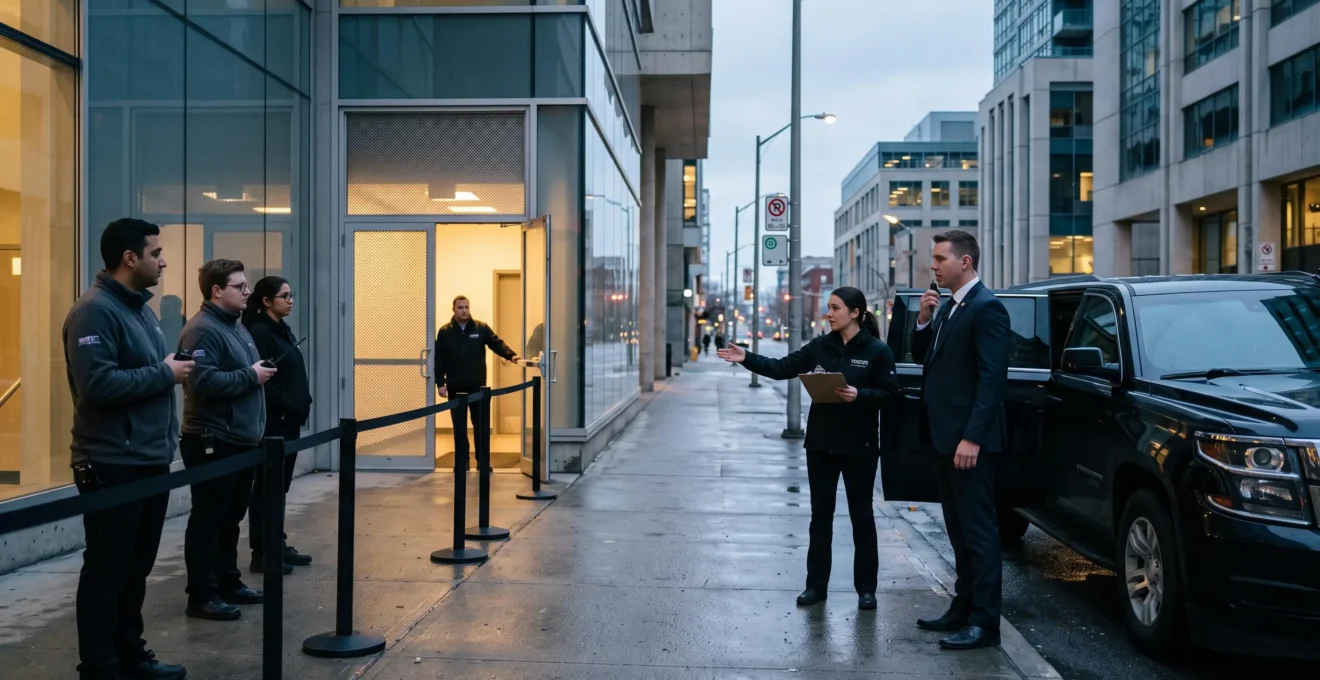
VIP protection at public events works best when security arrangements are integrated into ordinary venue operations rather than imposed as a separate, highly visible process. For Canadian event organizers, this means coordinating arrival times, access permissions, crowd movement, emergency procedures and information sharing before a high-profile guest reaches the venue.
The objective is not to isolate every prominent attendee. It is to reduce foreseeable exposure while preserving the guest’s participation, the audience’s experience and the event’s normal operating rhythm. A corporate executive attending a conference may require different arrangements from a public figure appearing at a crowded festival, even when both events take place in the same building.
Effective planning therefore starts with a proportionate risk assessment and continues through discreet arrivals, suitable escort arrangements, controlled visitor access and coordinated emergency readiness. These measures must also respect the applicable Canadian provincial, municipal, accessibility and privacy requirements.
VIP protection without event disruption: the essentials
- Plan arrival windows, access routes and emergency alternatives before the event, with clear responsibility for each handover.
- Choose personal escorts, dedicated secure areas or a combination according to guest movement, crowd conditions and the assessed risk.
- Restrict sensitive travel information, coordinate with venue operations and verify the qualifications of deployed security personnel.
- Why Do Unplanned Public Appearances Increase VIP Security Risks?
- How Can Event Teams Arrange Discreet VIP Arrivals at Busy Venues?
- Personal Escort or Dedicated Secure Area for Corporate VIP Events?
- Why Sharing VIP Travel Details Widely Creates Avoidable Security Risks
- When Should Event Organizers Conduct a VIP Security Risk Assessment?
- How Can Organizers Set Up Safe Queues Outside Festival Entrances?
- Escorted Access or Temporary Visitor Passes for Corporate Buildings?
- What Training Should Security Personnel Have for High-Risk Canadian Properties?
Why Do Unplanned Public Appearances Increase VIP Security Risks?
Unplanned public appearances increase VIP security risks because protection teams lose control over three essential variables: movement routes, arrival timing and surrounding crowd conditions. When a recognizable guest appears without a coordinated plan, security personnel may have to make immediate decisions in congested spaces, with limited options for maintaining safe movement or responding to an incident.
Unpredictability can arise in two different ways. A VIP may spontaneously decide to meet attendees, visit an exhibition area or enter through a public entrance. Alternatively, the appearance itself may be scheduled while essential logistical arrangements remain uncoordinated. Unconfirmed loading access, unexpected media positions or a changed arrival time can create significant operational uncertainty even when the guest list is known.
The immediate problem is a compressed decision window. A protection detail that has inspected the route can identify appropriate entrances, communicate with venue staff and prepare alternatives. Without that preparation, decisions must be made while people are already moving around the guest.
At Canadian conferences, festivals and civic events, an unexpected appearance can also affect people who are not involved in VIP activities. Attendees may converge toward a recognizable figure, obstruct circulation paths or begin filming. These reactions can complicate emergency access, create congestion and expose other participants to unwanted recording.
For context, the City of Toronto’s event-planning guidance identifies crowding, overcrowding, evacuation and other emergencies as hazards requiring consideration during event planning. It does not establish a measurable incident rate for spontaneous VIP appearances, but it supports integrating foreseeable crowd-related risks into broader event preparations.
Before accommodating a late appearance, organizers can apply a practical four-part test:
- Arrival window: Is there a confirmed period during which the guest can move safely?
- Entry control: Is an appropriate entrance available and coordinated with venue operations?
- Exit readiness: Is there a usable departure or emergency movement option?
- Qualified coverage: Is a trained protection detail present and properly briefed?
If any essential element is unavailable, the appropriate response is to reassess the appearance rather than assume the protection team can improvise successfully.
Once an appearance is confirmed, the next priority is creating an arrival process that remains discreet without interfering with normal venue operations.
How Can Event Teams Arrange Discreet VIP Arrivals at Busy Venues?
Event teams can arrange discreet VIP arrivals by using a pre-approved staging location, selecting an arrival window outside peak pedestrian movement, identifying a suitable secondary entrance and rehearsing the handover between transportation personnel and venue security. Each stage should be inspected and timed in advance, with an alternative procedure available if normal access becomes unavailable.
A practical arrival sequence begins before the vehicle approaches the venue. The protection coordinator confirms that the receiving entrance is ready, checks relevant conditions with the venue operations lead and authorizes the final approach when the designated staff are in position. A short, coordinated handover reduces unnecessary waiting near public circulation areas.
The arrival process can be divided into four operational stages:
- Confirm an authorized off-site staging point where transportation can wait without obstructing public access.
- Choose a flexible arrival window that avoids the venue’s busiest scheduled entry period.
- Inspect the proposed entrance, including visibility from nearby public areas and the route to the destination inside.
- Rehearse the driver-to-venue handover, including communications, access authorization and contingency responsibilities.
Discretion cannot override building safety. In Canadian multi-tenant venues, service entrances and loading facilities may be controlled by property management rather than event organizers. Temporary loading access, elevator permissions and after-hours entry must therefore be confirmed with the responsible building authority.
Alternative routes must also remain compatible with applicable accessibility requirements, fire codes and evacuation procedures. A service corridor that appears suitable on a floor plan may be unavailable for temporary waiting or may form part of a required emergency circulation route.
The Government of Canada‘s emergency evacuation planning guidance emphasizes advance preparation, accessible evacuation arrangements and the need to account for jurisdiction-specific requirements. Accordingly, a private VIP route should never compromise accessible circulation or emergency egress.
Another common weakness is the assumption that an entrance is discreet simply because it is not the main door. Nearby balconies, parking structures and elevated public areas may have direct visibility into a loading zone. A physical site walk should assess these sightlines rather than relying exclusively on architectural drawings.
Information control completes the arrival plan. Exact movement details should remain with personnel who need them; other staff may only require a readiness instruction or approximate operating window. Employees responding to inquiries should use an approved neutral response rather than disclose or speculate about guest movements.
After the guest enters the venue, the organizer must decide whether continuous escort coverage or a protected destination is more appropriate for the activities ahead.
Personal Escort or Dedicated Secure Area for Corporate VIP Events?
Personal escorts are generally better suited to VIPs who need to move between meetings, stages and networking spaces, while dedicated secure areas are more suitable for stationary activities, multiple high-profile guests or scheduled private sessions. The right choice depends on movement patterns, crowd density, length of attendance and the level of protection identified in the event risk assessment.
Corporate events frequently involve competing expectations. Board members, investors and international executives may need to participate visibly in business activities while maintaining privacy during transitions and confidential discussions. Security arrangements should support those objectives without unnecessarily restricting the event.
The following comparison provides a practical starting point for selecting a model.
| Decision criterion | Personal escort | Dedicated secure area |
|---|---|---|
| Crowd size and density | Useful for controlled movement through busy areas when viable routes exist | Useful when a fixed activity needs separation from dense public circulation |
| Number of VIPs | Suitable for individually coordinated movements | Can support several guests sharing meetings or hospitality space |
| Duration of attendance | Requires sustainable personnel coverage for extended movement | Provides a consistent controlled location during longer sessions |
| Movement requirements | More adaptable for frequent transitions | Better for guests remaining primarily in one location |
The models are not mutually exclusive. A guest delivering a keynote may use a low-profile escort between the entrance, preparation area and stage, while a private room provides space for confidential calls, rest or a managed departure. This layered arrangement is justified when the assessment identifies distinct risks during movement and stationary activities.
However, unnecessary layers can make security more conspicuous. A heavily guarded room or visibly restricted corridor may draw attention to a guest whose presence would otherwise attract little interest. The objective is proportionate protection, not maximum separation.
Both models also have less obvious operating costs. Escorts require suitable staffing, shift coordination and relief arrangements to prevent coverage gaps. Dedicated rooms consume venue capacity, may affect occupancy conditions and require authorization from property management.
For corporate hosts, the selection should be documented in the event risk file. That record can explain the identified exposure, chosen controls, responsible personnel and reasons for accepting any remaining limitations. Such documentation supports organized duty-of-care decisions without assuming that one universal protection arrangement meets every Canadian employer’s legal obligations.
Neither model will be reliable if sensitive travel and movement information is distributed more widely than necessary before the event.
Why Sharing VIP Travel Details Widely Creates Avoidable Security Risks
Widely sharing VIP travel details creates avoidable security risks by increasing the number of people, devices and communication channels that can expose sensitive movement information. Flight references, hotel arrangements, vehicle schedules and access instructions may reveal more when combined than when viewed separately. Organizers should therefore distribute only the operational details each person needs to perform their role.
Consider a hypothetical corporate conference where a full travel itinerary is added to a calendar invitation shared with event staff, hospitality suppliers and external contractors. Some recipients may only need to know when a meeting room must be ready, yet the invitation could disclose transportation plans, accommodation details and expected arrival times.
That information does not automatically become publicly searchable. The security concern is that broad distribution increases opportunities for unintended forwarding, unauthorized access or disclosure. If fragments subsequently appear in public posts or searchable information services, they may help someone infer a guest’s location or schedule.
Internal communication discipline is therefore as important as external confidentiality. A tiered briefing model can distinguish between three groups:
- Protection and transportation leads: Receive the precise movement information required for coordination.
- Venue operations leads: Receive relevant arrival windows, access requirements and readiness instructions.
- General event staff and suppliers: Receive only the task-specific instructions necessary for their work.
Information minimization also extends across multiple appearances. Reusing the same hotel, arrival entrance or publicized movement pattern can make future arrangements more predictable. Where operationally feasible, the protection coordinator should assess whether alternatives are warranted, without treating route variation as a substitute for appropriate security controls.
The Office of the Privacy Commissioner of Canada’s PIPEDA principles address limiting personal information collection, disclosure and retention, alongside safeguards appropriate to sensitivity. Their applicability depends on the organization and activity; they should not be interpreted as a universal VIP travel-information rule for every Canadian event.
Before the event, organizers should audit who holds each sensitive detail, why access is necessary, which systems store it and when it should be removed under applicable retention requirements. The result should be a concise, role-specific briefing rather than multiple conflicting itinerary versions.
Determining the appropriate level of information restriction, like selecting escorts or arrival routes, depends on an assessment that remains current as event conditions change.
When Should Event Organizers Conduct a VIP Security Risk Assessment?
Event organizers should conduct an initial VIP security risk assessment during venue selection and revisit it whenever the guest profile, attendance conditions or public exposure changes. Important review points include guest-list confirmation, the addition of a prominent or controversy-associated attendee, increased media attention and changes in crowd expectations. The assessment must remain actionable rather than become a one-time planning document.
An early assessment influences venue suitability, entrance availability and staffing requirements. A later assessment confirms whether the original assumptions remain valid. For instance, a private corporate reception that becomes publicly promoted may require different arrival controls from those planned when attendance was invitation-only.
A proportionate assessment for a Canadian event should examine the guest’s exposure profile, credible threat information where available, expected crowd behaviour, venue access points, external sightlines, vehicle arrangements, emergency routes and coordination with local authorities or existing protection teams.
This is not necessarily a comprehensive security audit of every building system. The aim is to identify the risks materially affecting the guest, event participants and venue operations, then translate those findings into practical decisions.
Each material finding should have a defined control, an accountable owner and a verification point. An exposed arrival entrance might lead to a route review; an extended public-facing schedule might justify additional escort coverage; unclear emergency responsibilities might require a joint briefing.
Five actions for a usable VIP security assessment
- Confirm the operating profile: Record attendance estimates, guest activities and public exposure in a dated event-risk summary.
- Inspect relevant access: Walk proposed arrival, internal movement and departure routes; produce an annotated access map.
- Review threat and crowd conditions: Document relevant concerns and credible information in a restricted risk register.
- Assign controls: Match significant findings to responsible personnel, actions and completion dates in a control matrix.
- Verify readiness: Hold a final coordination review and produce an approved briefing record with outstanding issues clearly identified.
Escalation is appropriate when credible threats emerge, several high-profile guests require simultaneous coordination or a guest arrives with an established protection team whose procedures must be integrated into venue operations.
In those circumstances, organizers should consider engaging a suitably qualified and licensed security provider. Private security rules differ across Canadian provinces, so provider and individual licence requirements must be checked for the jurisdiction where services will be delivered.
Reassessment should also follow material operational changes, including a relocated entrance, altered event capacity or a revised emergency plan. A previously acceptable measure may become inadequate when its underlying conditions no longer exist.
These decisions become particularly visible at festival entrances, where crowd-management infrastructure and VIP movement must function together without compromising public safety.
How Can Organizers Set Up Safe Queues Outside Festival Entrances?
Festival organizers can establish safer entrance queues by separating pedestrians from vehicle movements, arranging suitable crowd barriers, maintaining emergency access and providing a controlled bypass for authorized VIP arrivals. The queue design should accommodate expected demand without obstructing evacuation, accessibility routes or normal public circulation, and it must comply with the event’s applicable municipal approvals.
A festival queue is part of the broader security system, not simply a waiting area. Its layout affects crowd concentration, vehicle exposure, emergency access and the ability of staff to respond to changing conditions. Barriers should therefore be selected and positioned according to the approved site plan and assessed crowd behaviour.
A useful design separates the main queue from public roadways where feasible, preserves sightlines for monitoring and establishes clear points for entry, redirection and assistance. A dedicated VIP bypass can prevent notable guests from waiting in a static, highly visible crowd, provided it remains authorized and does not interfere with other users.
Queue geometry must account for predictable festival pressure points. Attendance can rise sharply before headline performances, while outdoor waiting conditions may create additional difficulties during heat, rain or other severe weather. Staff need a way to recognize accumulating congestion and adjust admissions within the approved operating plan.
Barriers must not create an exit trap. Emergency routes, accessible passage and the ability to release or redirect people during an incident should be assessed before the queue opens, not left to improvised adjustments.
The connection between VIP access and ordinary admission deserves particular attention. Where a bypass joins a controlled entrance, assigned personnel should verify authorization, manage pedestrian conflicts and communicate with the receiving venue team. A nominally separate lane offers limited protection if its final access point becomes congested or unmanaged.
Media arrangements also require advance coordination. Designated filming locations and clear staff responsibilities can help limit interference with entry operations while respecting applicable permissions and avoiding unnecessary confrontations.
Canadian municipal requirements vary. Event permits and approved plans may govern barrier placement, roadway use, accessible circulation and emergency vehicle access. Organizers should confirm local conditions with the relevant municipality or event authority rather than applying a generic national barrier specification.
For corporate venues, the same principle extends beyond outdoor queues into lobbies, reception desks and building access-control systems.
Escorted Access or Temporary Visitor Passes for Corporate Buildings?
Escorted access is generally preferable when a high-profile visitor needs discreet movement through a limited number of controlled areas, while temporary visitor passes can provide documented, time-limited access where building policy permits. A combined arrangement often works well: narrowly scoped credentials for authorized entry, supported by an escort wherever additional supervision or coordination is necessary.
The two approaches serve different operational purposes. An escort can guide the visitor through approved routes, coordinate reception and respond to changes without granting broad independent access. This flexibility consumes staff time and requires suitable coverage during transitions.
A temporary pass can make authorization more consistent and support building access records, but it also creates information that must be managed. A visible visitor badge may identify the individual as an outsider, and access-system records can reveal entry times or movements.
Combining the models avoids an unnecessary either-or choice. For example, a hypothetical visiting executive could receive a short-duration credential restricted to the required meeting area, while a designated host provides escort coverage through other authorized zones. A pass should not be treated as permission to enter areas outside its assigned scope.
Before choosing either model, organizers must establish who actually controls building access. In a Canadian multi-tenant property, lobby personnel may report to the property manager, while individual tenants control internal rooms. After-hours admission, service elevators, loading entrances and reception notifications may involve separate approvals.
The following checks should be resolved before the guest arrives:
- Which entity authorizes lobby and after-hours visitor access?
- Are the proposed elevators and internal routes available for the intended movement?
- Does the security desk require advance registration or identity verification?
- Who can issue, restrict and deactivate a temporary credential?
- How will visitor records and relevant camera footage be accessed and retained?
Visitor logs, access records and security footage may contain personal information. The applicable privacy obligations depend on the organization, jurisdiction and processing activity. Organizers should confirm retention practices, authorized access and safeguards with the building operator rather than assuming that every Canadian facility follows an identical federal privacy regime.
Discretion must also be balanced against emergency accountability. Security staff should know which visitors are present when required by the building’s procedures, even if their names or detailed schedules are not distributed broadly.
Once access responsibilities are established, the remaining question is whether the personnel implementing the plan have the training and coordination skills the assignment demands.
Key considerations before deployment
- Confirm the provider’s and individual personnel’s applicable licensing status before assigning security duties.
- Evaluate practical competence in discreet movement, crowd conditions, communication and emergency coordination—not licensing alone.
- Ensure the protection detail, venue staff and building management understand the same command structure and emergency procedures.
What Training Should Security Personnel Have for High-Risk Canadian Properties?
Security personnel assigned to high-risk Canadian properties should meet applicable provincial licensing and basic training requirements and possess additional skills relevant to the assignment. VIP-focused competencies include discreet escort positioning, crowd awareness, coordinated arrivals, threat recognition, emergency response and clear communications. Organizers should verify practical training evidence and deployment responsibilities rather than relying solely on general security experience.
Canadian private security requirements are established through provincial regulatory frameworks, so licensing and training expectations must be checked for the location of the event. Basic security training provides a foundation for lawful and professional duties, but it should not be mistaken for a specialized executive-protection qualification.
Ontario offers a clear example. Under Ontario’s security guard basic training requirements, new security guards must complete approved training and the required test before applying for a licence. The basic security guard program requires at least 40 hours, including emergency first aid and CPR certification, subject to applicable recognized training arrangements.
40 hours
Minimum duration of Ontario’s basic security guard training program, including emergency first aid and CPR certification. This is a provincial baseline, not a specialized VIP protection qualification or a requirement uniform across Canada.
Government of Ontario, security guard basic training guidance.
For high-profile guest assignments, the protection provider should be able to demonstrate additional scenario-based competence. Relevant exercises include low-profile positioning, safe movement through populated areas, coordinated vehicle arrivals, identifying concerning behaviour and managing operational inquiries without unnecessarily disclosing a guest’s presence.
These subjects are best evaluated through realistic drills and documented exercises rather than presentations alone. The organizer should examine whether personnel have practised the situations they are expected to manage at the specific event type.
Emergency readiness is equally important. Depending on the assignment, security personnel may need appropriate first-aid and AED skills, evacuation leadership and experience communicating with venue operations during crowd-related incidents. Their procedures should complement, not contradict, the property’s emergency response arrangements.
Joint briefings can identify problems that individual training cannot resolve. A protection team may know its preferred departure route while building personnel know that the same passage becomes unavailable during certain emergencies. Coordinating these plans beforehand allows the responsible authorities to establish compatible procedures.
Organizers evaluating a prospective provider should request evidence that can be checked:
- Valid licences for the provider and each deployed guard where required by provincial law.
- Records of relevant practical training and scenario exercises.
- Appropriate emergency response qualifications for assigned duties.
- A documented operational chain of command and communication procedure.
- Confirmation that personnel have been briefed on the event’s approved access and emergency arrangements.
A provider’s reputation can inform procurement, but it cannot replace verification of individual qualifications and the suitability of the proposed deployment. The final staffing model should reflect the assessed risks, expected guest movements and the venue’s operating requirements.
Before confirming a high-profile guest’s attendance, event organizers should approve a concise protection plan with the qualified security lead and venue operator, verify essential responsibilities and ensure the arrangements preserve both guest security and the wider event experience.
Does every high-profile guest at a Canadian event need a personal bodyguard?
No. Protection should be proportionate to the guest’s exposure, credible risks, planned activities and venue conditions. Some appearances may be managed through coordinated access and existing venue security, while others warrant dedicated personnel. The decision should follow a documented assessment rather than public recognition alone.
Can a VIP use a service entrance at a Canadian event venue?
Potentially, provided the entrance is authorized by the venue or building operator and its use complies with applicable safety, accessibility and operational requirements. Organizers should verify access permissions, emergency circulation and any restrictions on loading areas or service corridors before adopting the route.
Should VIP security arrangements be included in the event emergency plan?
Yes. Relevant VIP movement, communication and evacuation procedures should be coordinated with the event’s broader emergency arrangements. Municipal planning obligations vary by location and event type; Toronto, for example, requires an Emergency Action Plan for specified permitted uses of municipal public spaces, not for every event.
Who should be allowed to access a VIP’s travel itinerary?
Access should normally be limited to people who need particular details for legitimate operational responsibilities. Protection coordinators may require full movement information, while venue staff or suppliers may need only arrival windows or readiness instructions. Applicable privacy obligations and retention arrangements should also be confirmed.
How can organizers check whether a VIP security provider is suitably qualified?
Organizers should verify applicable provincial licences, review evidence of training relevant to the event, confirm emergency response capabilities and request a clear chain of command. Where specialized protection or coordination with an existing executive-protection team is required, the provider should demonstrate practical experience appropriate to those responsibilities.