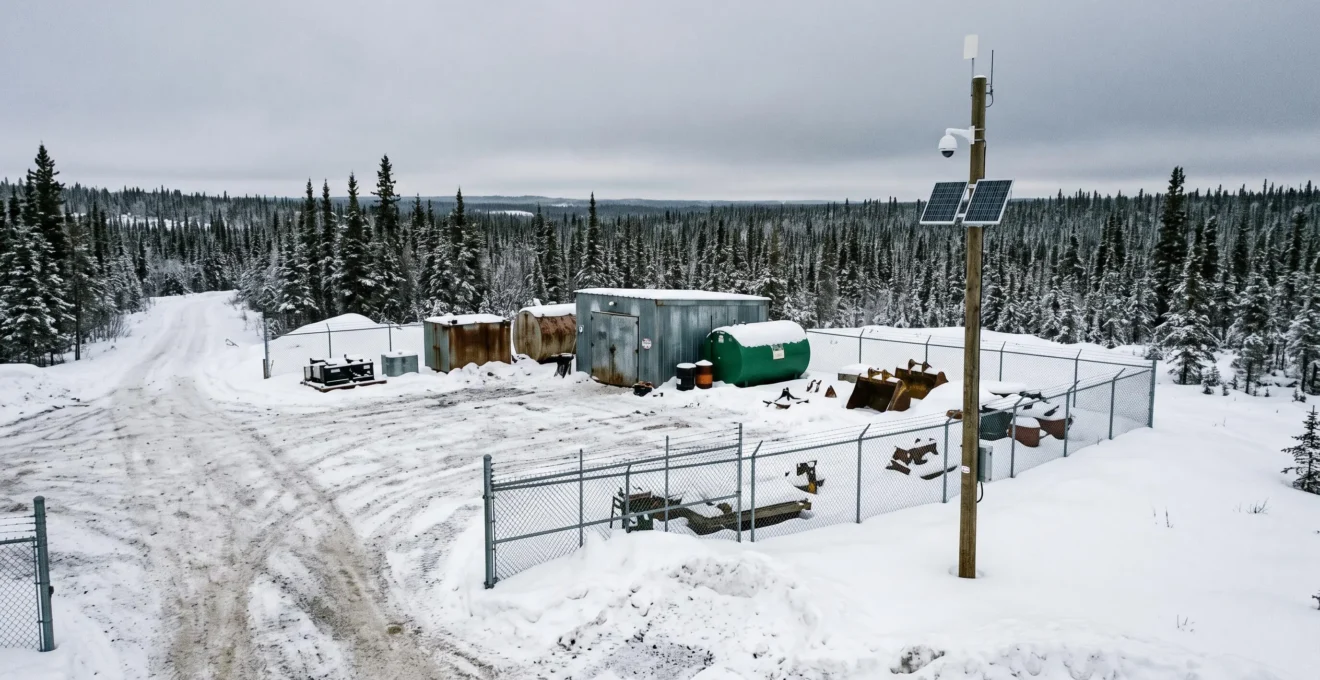
Securing an isolated Canadian mine, energy installation or industrial compound without permanent staff requires more than installing cameras and connecting an alarm panel. A workable security system must detect suspicious activity, transmit alerts despite unreliable connectivity, verify incidents remotely and arrange a response that remains feasible under local access conditions.
Distance changes the consequences of every failure. A communication outage can go unnoticed, a security camera can lose power during a cold spell, and an alarm may reach a monitoring station long before anyone can physically access the property. Winter road closures, limited emergency-service coverage and the departure of regular site personnel can amplify these vulnerabilities.
The practical solution is a layered security arrangement with independent power and communication paths, supervised equipment, controlled video access, verified alarm escalation and documented physical inspections. Each layer should be tested against the site’s worst operating conditions—not merely against normal summer operation.
Remote industrial site security: essential decisions
- Calculate the complete alarm-to-arrival response window, including transmission, verification and seasonal travel delays.
- Use supervised alarm communications, resilient power and secure remote video access to identify failures before an incident occurs.
- Activate documented unattended-site procedures whenever staffing, accessibility or operational conditions change.
- Why Do Isolated Worksites Face Longer Security Response Delays?
- How Can Remote Facilities Maintain Alarm Reporting During Cellular Outages?
- Solar Cameras or Generator-Powered Systems for Off-Grid Industrial Sites?
- The Security Gaps That Expose Industrial Sites During Winter Shutdowns
- When Should Remote Worksites Activate Unattended-Site Security Procedures?
- How Can You Enable Remote Video Viewing Without Publicly Exposing Cameras?
- When Should Canadian Properties Inspect Fences After Freeze-Thaw Cycles?
- How Does a Central Monitoring Station Handle Security Alerts in Canada?
Why Do Isolated Worksites Face Longer Security Response Delays?
Isolated industrial worksites experience longer security response delays because alarms must pass through several stages before help arrives. Detection may be delayed, communication links may be unreliable, and the nearest available responder may be far away. Even when monitoring works correctly, seasonal road conditions and limited local response resources can significantly extend the time before physical intervention.
Total response time consists of three operational delays: the interval before an intrusion is detected and transmitted, the time required to verify and escalate the alarm, and the journey from the responder’s location to the site. Treating these stages separately exposes vulnerabilities that a single response-time estimate can conceal.
At a remote mining compound, for example, a perimeter alarm may activate immediately while its cellular communicator struggles to obtain a connection. Once a signal arrives, a monitoring operator may need to examine video, contact authorized personnel and determine which responder is available. A further delay begins when that responder travels to the property.
Canadian sites may rely on an RCMP detachment, another police service, contracted private security personnel or designated keyholders. Rural police coverage is not equivalent to a guaranteed security patrol response. Availability and priorities depend on local circumstances. A private guard company may offer contractual response commitments, but these must be explicitly documented, including exclusions and accessibility conditions.
Site managers can establish a realistic planning window using a straightforward calculation:
- Measure the time between an alarm event and successful receipt by the monitoring station.
- Measure how long alarm verification, notification and escalation actually take during controlled tests.
- Record travel times from the nearest realistically available responder during normal conditions and during winter access restrictions.
- Add the three intervals to establish representative response scenarios, including a degraded-condition scenario.
For illustration only, suppose alarm transmission takes 3 minutes, verification and escalation take 7 minutes, and winter travel takes 75 minutes. The hypothetical alarm-to-arrival window would be 85 minutes, assuming the responder is available and no additional delay occurs. This is a planning example, not a measured Canadian response benchmark.
Snow-covered roads, reduced winter daylight and freeze-thaw damage can change the travel component without affecting alarm technology. A closed access road may prevent vehicle entry altogether, requiring a separate contingency arrangement.
Once realistic response limitations are established, the next priority is ensuring that an alert can reach the monitoring station under adverse communication conditions.
How Can Remote Facilities Maintain Alarm Reporting During Cellular Outages?
Remote facilities can maintain alarm reporting during cellular outages by combining independently supervised communication paths, such as primary cellular service, another carrier and a compatible satellite backup. Alternative connections must be configured and tested for automatic failover. A backup link provides useful resilience only when it operates independently enough to survive the failure affecting the primary connection.
A typical off-grid communication design uses a primary LTE or 5G communicator where coverage is available. A second cellular carrier can reduce dependence on one network, but different carriers may still share towers, backhaul infrastructure or regional outage exposure. Satellite communication offers another option for transmitting compact alarm messages, provided the equipment, subscription and monitoring receiver support the selected service.
Where geographically practical, a managed radio link or mesh connection to a neighbouring facility can serve as another path. Its reliability depends on terrain, distance, power availability and the neighbouring site’s infrastructure. It should not be assumed to provide resilience without a site-specific radio assessment.
Communication redundancy must be paired with alarm supervision. A panel that reports only when an alarm occurs can remain disconnected without producing an obvious warning. A supervised panel periodically sends test signals, allowing the monitoring station to identify missed reports.
The CANASA Monitoring Station Reference Guide describes supervision polling intervals generally ranging from 24 hours to 30 days, depending on the installation and applicable requirements. Its 2018 guidance also recommends beginning notification efforts within 30 minutes for certain supervisory events. These are industry recommendations, not universal legal response deadlines or automatic technician-dispatch requirements.
24 hours to 30 days
General supervision polling range described in CANASA’s 2018 industry guidance. Higher-security installations and applicable standards may require shorter intervals. This is not a recommended interval for every remote industrial site.
Canadian Security Association, Monitoring Station Reference Guide, September 2018.
Operators should request actual supervision records rather than accepting a statement that an alarm is continuously monitored. Check when the last successful signal arrived, how a missed test was classified, who was notified and whether the failure resulted in corrective action.
Prolonged regional outages caused by severe weather, wildfire-related disruption or damaged telecommunications infrastructure require an additional contingency. The monitoring provider should identify which signals remain deliverable, whether backup communication activates automatically and when the operator is informed that a reporting path has failed.
If all remote reporting becomes unavailable, a temporary monitoring plan might involve scheduled checks by an authorized neighbouring operator or a contracted patrol. Drone inspections may supplement those checks where legally permitted, operationally feasible and safe, but they do not replace immediate intervention capability.
Reliable signal transmission still depends on dependable power, which becomes a separate engineering challenge at facilities without continuous grid electricity.
Solar Cameras or Generator-Powered Systems for Off-Grid Industrial Sites?
Solar-powered cameras are suitable for off-grid sites with manageable electrical loads and sufficient winter energy production, while generator-powered systems are often more practical when continuous high-demand equipment is already supported by site generation. The correct choice depends on the darkest month’s solar availability, camera and heater consumption, battery performance, existing power infrastructure and maintenance access.
A security camera’s advertised power rating is only part of the required load. Cellular or satellite communication equipment, local recording, infrared illumination, battery management, enclosure heating, lens heaters and motorized functions can contribute to total demand. A system designed around summer consumption may not remain operational through a northern Canadian winter.
Solar capacity should be assessed against the worst operating month, not average annual sunshine. Short daylight periods, accumulation of snow on panels and reduced battery performance at low temperatures can coincide. Battery specifications must be checked for both discharge capability and permitted charging temperatures.
Natural Resources Canada‘s solar energy factsheet for northern and remote communities identifies energy storage, snow clearance and hybrid solar-diesel generation as relevant design considerations. It does not prescribe camera-specific battery capacity or guarantee that solar generation will meet any particular site’s winter demand.
The following comparison provides a starting point for site-specific engineering decisions.
| Decision factor | Solar and battery system | Generator-powered system |
|---|---|---|
| Winter energy availability | Depends on worst-month solar yield, panel condition and usable storage | Depends on fuel availability, equipment reliability and starting capability |
| Heated cameras and enclosures | Additional loads may substantially increase required generation and storage | Can support higher loads when generation capacity is sufficient |
| Routine operating requirements | Panel inspection, battery monitoring and eventual component replacement | Fuel delivery, servicing, testing and mechanical maintenance |
| Primary failure exposure | Prolonged low generation, snow obstruction or depleted batteries | Fuel exhaustion, mechanical failure or interrupted maintenance |
| Existing site infrastructure | Useful where continuous generation is unavailable | Potentially convenient where dependable power generation already operates |
Solar power can reduce recurring fuel-related work, but battery replacement and seasonal maintenance must be included in lifecycle costs. Generator power avoids dependence on sunlight but introduces fuel logistics, maintenance exposure and potentially noticeable noise and lighting. Those characteristics can influence intruder behaviour without providing a dependable security benefit by themselves.
A hybrid design offers another approach: solar as the primary energy source, with generator support during extended low-production periods. Where equipment permits, a low-power operating mode can prioritize essential alarm detection and LTE reporting over continuous video streaming. However, reducing camera functions must not disable necessary intrusion verification without an approved alternative.
Remote battery-voltage and state-of-charge histories should be reviewed for downward trends during cold periods. Voltage alone may not accurately represent remaining usable battery capacity, particularly under varying loads and temperatures, so monitoring should follow the battery manufacturer’s specifications.
Even a correctly designed power system needs protection from deliberate shutdown decisions and physical deterioration when a facility closes for the season.
The Security Gaps That Expose Industrial Sites During Winter Shutdowns
Winter shutdowns introduce security vulnerabilities that are different from those encountered during active operations. Equipment may be powered down to reduce expenses, gates can freeze or become inaccessible, snow can obscure surveillance coverage, and familiar keyholders may leave the area. Meanwhile, valuable assets can remain at a predictable, unoccupied location for extended periods.
Fuel, batteries, copper materials, portable generators, tools and heavy equipment may remain attractive theft targets even when production has stopped. The more serious operational issue is delayed discovery: without routine visits, damage or unauthorized activity may remain unnoticed until the next scheduled inspection.
Snow accumulation can undermine several protections simultaneously. Drifts may obscure camera views, cover lower fence sections, interfere with motion detection or provide an elevated route across a barrier. Frozen gates and locks can also delay authorized responders, particularly when the only available keyholder is unfamiliar with winter access conditions.
Before shutdown, the operator should establish which security devices remain powered, what capacity supports them, and how intrusion alerts will be handled after employees leave. Disconnecting nonessential production systems should not inadvertently isolate the alarm panel, communications equipment or security batteries.
Physical visits remain necessary even when automated monitoring is available. The inspection interval should reflect asset exposure, weather conditions, local access, system reliability and any applicable insurance conditions. A fixed schedule should also provide for additional inspections following severe weather or significant changes in site access.
Five pre-shutdown security actions and required records
- Test security power and backup operation; retain a dated test record showing equipment status and any unresolved faults.
- Activate and test intrusion zones, camera verification and alarm communications; save the monitoring station’s confirmation of received test events.
- Confirm winter access instructions, responder contacts and escalation order; issue a dated contact and access sheet to the monitoring provider.
- Remove or secure portable high-value assets, check gates and locks, and photograph exposed equipment; create an updated asset inventory with condition photographs.
- Review inspection and alarm requirements with the insurer and schedule physical checks; retain written coverage clarification and an assigned inspection calendar.
Insurance expectations deserve particular attention. Property policies may impose conditions concerning vacancy, inspections, heating, protective systems or notification of changed occupancy. Requirements depend on the actual policy and insurer; there is no single inspection frequency or alarm-service condition that applies to every Canadian industrial property.
Preserve the site’s condition record before departure, including photographs of gates, locks, stored assets, security equipment and accessible routes. These records can support later incident investigation and insurance documentation, although they do not establish coverage by themselves.
The next decision is when to change the site’s operating status formally, rather than simply leaving the normal alarm configuration running after the final crew departs.
When Should Remote Worksites Activate Unattended-Site Security Procedures?
Remote worksites should activate unattended-site security procedures whenever staffing, accessibility or response capability changes enough to invalidate normal operating assumptions. The departure of the last crew, an extended shutdown, seasonal road restrictions or reduced emergency-service availability can all trigger activation. Procedures should be based on operational risk rather than a fixed calendar date alone.
A site may become functionally unattended even while periodic maintenance contractors still visit. The determining question is whether anyone remains responsible and available to detect problems, communicate with responders and provide access when an incident occurs.
Use a tiered unattended-site procedure matched to expected duration and exposure:
- Short-term absence: Inform the monitoring station of the status change, verify alarm activation and confirm the responsible keyholder and backup contact.
- Medium-term absence: Review supervision frequency, test independent communication paths, enable suitable verification settings and arrange documented physical inspections.
- Long-term or seasonal closure: Remove movable assets where practical, verify backup power, review winter access, assign inspection responsibility and establish an escalation plan for equipment failures.
These categories are operational planning levels, not standardized Canadian legal time thresholds. A site manager should define the transition points in a written risk assessment, considering the insurer’s requirements, available personnel and how quickly conditions may deteriorate.
False alarms deserve explicit consideration. Wildlife, moving vegetation, snow accumulation or equipment faults can create repeated nuisance signals. Unnecessary dispatches may incur substantial travel costs, particularly when a contracted responder must cover a long distance. Local police alarm-response policies may also influence how future calls are handled.
Where appropriate, video or audio verification can help distinguish genuine intrusion activity from environmental triggers. However, verification must not become an indefinite delay when camera footage is unavailable. Monitoring instructions should establish how operators escalate credible alarms when visual confirmation cannot be obtained.
A written unattended-site handover should identify the authorized site representative, backup contacts, access permissions, gate and lock arrangements, seasonal hazards, equipment locations and the preferred responder route. It should also identify which parts of the site present particular safety risks, such as unstable ground, restricted industrial equipment or hazardous materials.
Provide the handover to the monitoring station and other authorized response parties through an appropriate secure channel. Review it whenever personnel, road conditions or site infrastructure changes.
Once unattended procedures are active, remote video becomes an important verification resource—but its internet exposure must be controlled as carefully as physical access to the property.
How Can You Enable Remote Video Viewing Without Publicly Exposing Cameras?
Remote video viewing can be enabled securely by keeping cameras and recorders off the public internet and using encrypted access through a properly configured VPN, managed video platform or secure cloud relay. Each user should have an individual account, limited permissions and multifactor authentication. Bandwidth-constrained sites can prioritize event clips and snapshots instead of continuous streaming.
Directly forwarding public internet traffic to a camera’s management or video ports creates unnecessary exposure to automated scanning, credential attacks and software vulnerabilities. A more defensible arrangement places cameras on a protected network and allows approved remote users to connect through a controlled access service.
Depending on the design, a managed video system may establish an outbound encrypted connection to an authorized service, or remote users may connect through a secured VPN gateway. The camera network should remain segmented from unrelated industrial control systems and administrative services wherever feasible.
The Canadian Centre for Cyber Security VPN guidance explains how VPNs protect traffic over untrusted networks and recommends measures including multifactor authentication, controlled external access and monitoring. These are relevant security principles, although a VPN alone does not eliminate vulnerabilities in cameras, recorders or user devices.
Access rights should reflect operational duties rather than providing every authorized employee with administrator privileges. A typical arrangement distinguishes users who may view live video, personnel permitted to export recordings and administrators responsible for device configuration. Contractor access should be time-limited where the platform supports it, with credentials revoked promptly when assignments end.
For isolated Canadian facilities, link capacity may become the limiting factor. Satellite and cellular connections can experience constrained throughput, variable latency or service limitations. Continuous high-resolution streaming may consume substantial bandwidth while adding little value during periods without activity.
A more efficient configuration can upload event-triggered recordings, send scheduled low-bandwidth snapshots and reserve live streams for verified incidents or diagnostic checks. Footage quality, event buffering and transmission priority should be tested against the actual communication path rather than assumed from camera specifications.
Off-site evidence retention addresses another vulnerability: a camera or local recorder may be damaged or stolen during an intrusion. Tamper alarms, protected mounting locations and selective remote upload of critical footage can reduce the chance that locally stored recordings disappear with the equipment.
Retention settings should also reflect operational, contractual and applicable privacy requirements. Camera views should be configured to capture necessary security areas without unnecessarily monitoring neighbouring properties or unrelated activities.
Digital security protects access to footage, but remote monitoring still depends on a physical perimeter that remains intact through seasonal ground movement and snow accumulation.
When Should Canadian Properties Inspect Fences After Freeze-Thaw Cycles?
Canadian industrial properties should inspect perimeter fences after the main spring thaw and before autumn freeze-up, with additional checks following unusual mid-winter thaws or severe ground movement. Repeated freezing and thawing can shift posts, weaken foundations and alter gate alignment. At unattended facilities, these defects may compromise both physical access control and perimeter intrusion detection.
As moisture in the soil freezes and expands, fence posts and adjacent ground may move. Subsequent thawing can leave posts out of alignment, reduce soil support or create gaps beneath fence sections. The effects depend on soil characteristics, drainage, foundation design and local weather conditions.
An inspection immediately after a temporary thaw may not reveal the full condition of foundations that are still partly frozen. For this reason, timing matters: the main spring inspection should occur when enough ground has thawed to make movement and stability problems observable.
The autumn inspection serves a different purpose. It provides an opportunity to repair loose posts, damaged mesh, misaligned gates and ineffective latches before freeze-up restricts maintenance access.
Field personnel should examine:
- Fence-post alignment, movement and visible foundation deterioration.
- Gate alignment, hinge condition, latch engagement and lock operation.
- Openings between the fence and ground created by erosion or frost-related movement.
- Snowbanks or accumulated materials that could provide an unintended crossing point.
- Damage affecting perimeter sensors, sensor wiring or their mounting positions.
Photographs should be taken at consistent locations where practical, allowing changes to be compared across inspection periods. Each defect should be assigned a risk level, corrective action and responsible person, with a record of completed repairs.
If the fence supports intrusion-detection sensors, physical movement can have additional consequences. A displaced sensor or altered tension may affect detection performance or increase nuisance alarms. Repairs should therefore include any necessary sensor testing, rather than treating the fence as an isolated civil-maintenance component.
Inspection frequency must remain responsive to actual conditions. Sites with unstable ground, recurrent drainage problems, heavy snow accumulation or frequent freeze-thaw events may need additional visits beyond the two seasonal milestones.
Even with a secure perimeter, dependable power and working communication links, the security chain remains incomplete unless a monitoring organization can interpret alerts and coordinate a feasible response.
Key takeaways before selecting a monitoring provider
- Evaluate the entire detection-to-arrival process rather than relying on an advertised monitoring or notification speed.
- Require documented procedures for missed supervision signals, unavailable video, failed communication paths and inaccessible winter roads.
- Confirm which response commitments are contractual, which depend on local emergency-service availability and which conditions require direct intervention by the site operator.
How Does a Central Monitoring Station Handle Security Alerts in Canada?
A central monitoring station receives alarm signals, identifies the event and protected site, follows the agreed verification procedure, and notifies designated keyholders or response services according to the site’s instructions. If the initial contact cannot be reached, the station follows its escalation plan. Actual dispatch arrangements depend on the monitoring contract, available responders and applicable local procedures.
The process begins when a monitored device sends an alarm, trouble or supervisory signal. The receiving system identifies the account and event type, allowing an operator or approved automated workflow to apply the corresponding handling instructions.
Intrusion events may require a different response from communication failures, low-battery warnings, tamper signals or fire-related alarms. Operators should understand these distinctions because an event appearing in a monitoring interface does not necessarily mean that a patrol or emergency service has been dispatched.
A typical security alarm lifecycle involves four stages:
- Signal receipt: The station records the originating account, event category, location or zone and receipt time.
- Event verification: The operator uses available video, audio, secondary signals or authorized contact procedures to evaluate the alarm according to the applicable protocol.
- Notification and dispatch coordination: The station contacts authorized keyholders, contracted responders or relevant emergency services as specified by the response instructions and applicable local requirements.
- Escalation and documentation: Unanswered contacts, unsuccessful dispatch attempts and changes in incident status are handled according to the agreed escalation procedure and recorded.
In Canada, ULC-listed monitoring facilities operate within applicable certification frameworks. Where an insurer, contract or project specification requires a particular monitoring certification, operators should verify the provider’s current listing and the scope of the service covered. Not every Canadian monitoring facility is necessarily ULC-listed, and a certification claim should not be inferred from industry association membership.
Video or audio verification can be particularly valuable for remote industrial compounds because unnecessary dispatches may involve substantial travel. For verification to work, the site needs suitable camera coverage, reliable time synchronization, a supported alarm-to-video association and adequate communications to deliver useful evidence.
However, verification-first should not mean verification-only. The site and monitoring provider must agree on how to handle credible events when video is obscured, unavailable or delayed. Local police and other responding agencies may also have their own alarm-response policies.
Before signing an agreement, operators should ask for written answers covering missed test signals, notification timing, escalation when keyholders cannot be reached, support for satellite or dual-path alarm communications, and winter dispatch restrictions. The provider should also explain what happens when the designated responder is unavailable and whether any service level is actually guaranteed by contract.
Controlled alarm tests should validate the complete workflow, from sensor activation to final recorded notification. The resulting reports can reveal gaps between the documented response plan and the service that is actually delivered.
Before leaving a Canadian industrial facility unattended, arrange a joint review with the monitoring provider, responsible keyholders and any contracted response service. Confirm the communication paths, winter access plan, test records, escalation instructions and inspection responsibilities in writing, then correct unresolved gaps before the site changes status.
Can a remote industrial site be monitored without reliable cellular coverage?
Yes, provided a suitable alternative communication system is available. Depending on the site’s location and equipment compatibility, satellite alarm transmission or a managed radio connection may support monitored security. Signal delivery, power requirements, supervision and monitoring station compatibility must be verified before relying on the arrangement.
Does a monitored security alarm guarantee that police will attend a remote Canadian property?
No. Monitoring generally means that designated alarm signals are received and handled according to an agreed procedure. Police attendance depends on jurisdiction, incident circumstances, available resources and applicable response policies. Operators requiring a specific private response arrangement should obtain clearly defined contractual commitments and understand their limitations.
What happens if a security camera loses power during a winter shutdown?
The consequences depend on the system architecture. Camera failure may remove visual verification while other alarm sensors continue operating independently. Suitable designs can generate power-loss or device-offline notifications and use backup electricity to preserve essential functions. Operators should verify which devices remain active during outages and how the monitoring station handles missing video.
Are physical inspections still necessary when a site has remote cameras and alarms?
Yes. Remote systems may not reveal frozen locks, hidden fence defects, snow-covered equipment or developing structural problems. Physical checks complement electronic monitoring and may also be required by the property’s insurance conditions. Inspection intervals should be established according to site exposure, seasonal access, equipment condition and applicable contractual requirements.
Who should receive security alerts if the usual site manager is unavailable?
The monitoring station should have an approved escalation list containing authorized primary and backup contacts, with clear responsibilities and current access instructions. A designated alternative should be capable of making decisions or coordinating an appropriate response. Contact details and availability should be reviewed before demobilization and whenever staffing arrangements change.