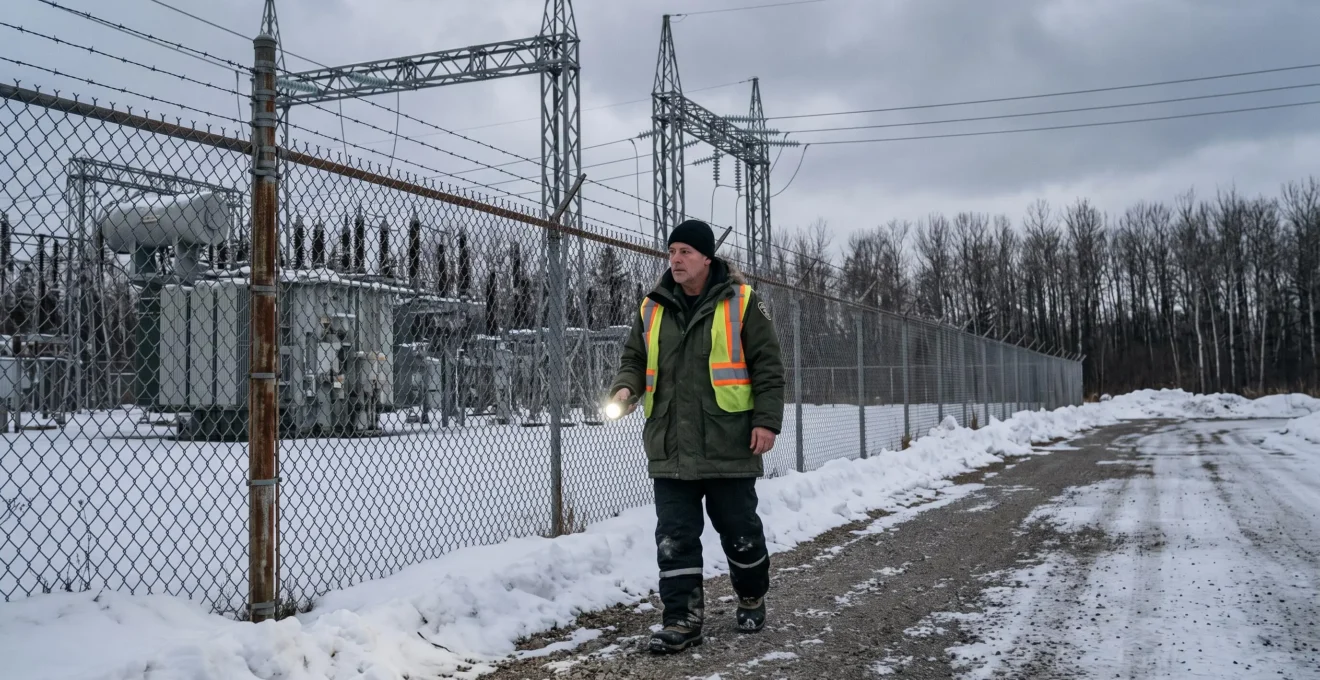
Physical security at Canadian critical infrastructure facilities is ultimately a service continuity responsibility. An unauthorized entry at an electrical substation, water treatment plant, telecommunications installation, or utility service yard may have consequences far beyond the immediate property damage. The operational concern is whether an incident can interrupt an essential function, compromise public safety, or delay recovery.
Strengthening protection requires operators to identify critical assets, assess physical access pathways, verify contractor permissions, monitor vulnerable locations, and integrate security into expansion and maintenance planning. Controls must also remain effective during Canadian winter conditions, emergency repairs, and periods of reduced staffing.
Canada’s critical infrastructure responsibilities are distributed across jurisdictions and sectors. Appropriate measures therefore depend on each facility’s operational consequences, applicable requirements, geographic exposure, and existing safeguards. A risk-based approach connects physical security investments to the services that facilities must continue delivering, rather than relying on a uniform collection of cameras, fences, and access badges.
Essential priorities for Canadian infrastructure security
- Prioritize physical vulnerabilities according to their potential effects on essential services, public health, and recovery capability.
- Combine site-specific perimeter protection, access authorization, contractor supervision, and reliable incident detection.
- Reassess safeguards whenever facilities expand, operating conditions change, or seasonal and emergency activities increase exposure.
- Why Can a Minor Security Incident Disrupt Essential Infrastructure Services?
- How Can Water Treatment Facilities Assess Unauthorized Entry Risks?
- Substation Security or Telecommunications Site Protection: What Risks Differ?
- The Contractor Access Gaps That Expose Essential Utility Facilities
- When Should Critical Infrastructure Operators Reassess Site Security After Expansion?
- The Security Gaps That Expose Industrial Sites During Winter Shutdowns
- How Can Facilities Track Contractors Without Delaying Maintenance Work?
- How Can Businesses Secure Restricted Zones Without Slowing Authorized Staff?
Why Can a Minor Security Incident Disrupt Essential Infrastructure Services?
A minor physical security incident can disrupt essential infrastructure when it affects equipment or access points that support multiple dependent operations. The severity of an intrusion, theft, or vandalism event is therefore determined less by the value of the damaged component than by its operational importance, available redundancy, and the time needed to restore service.
Canadian infrastructure operates through interconnected systems. As described in Public Safety Canada’s overview of Canadian critical infrastructure, services extend across sectors and jurisdictional boundaries. Energy, water, and information and communication technology form distinct but interdependent parts of this environment.
Consider an explicitly hypothetical incident in which copper theft damages an electrical connection serving a utility installation. The immediate loss may involve a relatively inexpensive component, but the resulting equipment outage could interrupt a pumping operation or communications function if effective redundancy is absent. Restoration may then depend on specialist technicians, replacement materials, and coordination between different operators.
This illustrates a critical distinction between asset-level damage and service-level consequences.
| Impact category | Potential consequences | Assessment question |
|---|---|---|
| Direct damage | Equipment repair, stolen materials, replacement components | What must be repaired or replaced? |
| Operational interruption | Lost capacity, emergency maintenance, extended restoration | Which essential functions become unavailable? |
| Secondary consequences | Incident reporting, public communication, reduced confidence | Who else is affected by the interruption? |
| Interdependency | Disruption to connected power, water, or communications services | Which other systems depend on this asset? |
To identify single points of failure, operators can map each essential service to the physical assets, power supplies, communications links, and access-controlled spaces required to operate it. For each dependency, the assessment should document whether alternative equipment exists, how quickly it can take over, and whether recovery requires external resources.
Security investments can then favour locations where a breach creates disproportionate consequences, even if attempted intrusion is considered relatively unlikely. This consequence-based method is a planning recommendation, not a quantified risk model supplied by Public Safety Canada.
Reporting arrangements also require verification. A physical incident does not automatically trigger one universal federal reporting obligation. Depending on the sector, jurisdiction, incident characteristics, and regulated activities, operators may need to notify provincial or federal authorities, sector regulators, law enforcement, or other designated contacts. Where a physical incident also affects cybersecurity, the Canadian Centre for Cyber Security may be a relevant reporting or coordination contact. The applicable legal and operational requirements must be checked individually.
Once critical dependencies are established, the next decision is which physical locations could expose those dependencies to unauthorized interference.
How Can Water Treatment Facilities Assess Unauthorized Entry Risks?
Water treatment facilities should assess unauthorized entry by identifying accessible locations, determining what operations or public health protections an intruder could affect, and evaluating existing detection and response capabilities. The assessment should cover treatment buildings, intakes, wells, reservoirs, chemical storage, and remote installations, with the highest priority assigned to breaches that could affect water safety or continuity.
Unlike a compact industrial facility, a drinking water system may include numerous geographically separated assets. Some locations may operate without continuous on-site staffing, making remote alarms, verified access records, and defined response arrangements especially important. The actual staffing and exposure profile must be established for each system rather than assumed.
Ontario’s drinking water system security best practices recommend assessing potential intruder access and considering protection for treatment and distribution facilities, wells, surface water intakes, and other sensitive locations. Suggested measures include locks, intrusion alarms, fencing, gates, signage, and regular security reviews.
These are provincial best management practices, not a single mandatory security specification applicable throughout Canada.
A practical assessment can follow four stages:
- Inventory exposure points. Record entrances, access hatches, intake structures, reservoirs, chemical handling areas, equipment enclosures, and unmanned locations.
- Identify operational consequences. Determine whether unauthorized entry could affect water treatment, chemical safety, supply availability, or essential monitoring functions.
- Evaluate safeguards. Review physical barriers, alarm coverage, access permissions, inspection arrangements, and the ability to investigate an alert.
- Prioritize corrective measures. Rank vulnerabilities using operational consequence, plausible exposure, and how reliably an incident would be detected.
For smaller municipal systems, a simple qualitative matrix may be more practical than an elaborate scoring exercise. The following is a proposed assessment tool, not an official provincial scoring standard.
| Assessment dimension | Lower concern | Higher concern |
|---|---|---|
| Likelihood or exposure | Controlled access and limited exposure | Accessible or frequently unattended entry point |
| Detectability | Reliable alerting and verification | Unmonitored entry or uncertain alarm response |
| Public health consequence | Limited influence on essential operations | Potential effect on treatment integrity or safe supply |
A location with high public health consequences and weak detection should receive urgent review even when there is no known history of attempted entry. Conversely, a visibly exposed asset with limited operational significance may not justify the same investment.
The assessment should also include people with legitimate but temporary access. Seasonal workers, maintenance contractors, and service providers may be authorized to enter the facility without requiring unrestricted movement through every operational zone.
Reviewing access hours, permitted areas, supervision arrangements, and credential expiration helps distinguish a legitimate visit from a control failure. Operators should also reassess their findings after security incidents or material operational changes, consistent with Ontario’s recommendation for regular reviews.
The same principle applies to other essential infrastructure, although the physical layout and operational consequences can differ substantially between asset classes.
Substation Security or Telecommunications Site Protection: What Risks Differ?
Electrical substations and telecommunications sites require different physical protection strategies because their layouts, critical components, operational dependencies, and recovery requirements differ. Substations often rely on secured equipment compounds and controlled perimeter access, while telecommunications assets may occupy rooftops, towers, shared buildings, or distributed cabinets where conventional perimeter controls are less practical.
At substations, plausible physical threats include vandalism, unauthorized entry, metal theft, and interference with essential equipment. The consequences depend on the installation’s role in the electrical network, its redundancy, and the availability of replacement components.
Telecommunications sites may face equipment theft, unauthorized cabinet access, cable interference, or tampering. Shared building access and geographically dispersed installations can complicate the distinction between authorized maintenance activity and suspicious entry.
| Decision factor | Electrical substations | Telecommunications sites |
|---|---|---|
| Typical physical layout | Equipment compounds, controlled yards, dedicated buildings | Towers, rooftops, cabinets, shared premises |
| Potential consequences | Power supply interruption, equipment damage, system instability depending on network conditions | Communications outage, equipment unavailability, possible exposure of network equipment |
| Protection emphasis | Perimeter integrity, equipment separation, intrusion detection | Cabinet security, equipment access, distributed monitoring |
| Recovery constraints | Specialized components, qualified crews, replacement availability | Site accessibility, spare equipment, network redundancy |
These distinctions mean that a corporate security baseline should establish common outcomes without forcing identical equipment onto every site. The baseline might require verified authorization, detection of unauthorized entry, incident escalation, and documented recovery arrangements. The means of achieving those outcomes should reflect the site.
Operators managing mixed infrastructure must also account for two-way dependencies. Telecommunications facilities require electricity, while some electrical network functions rely on communications for remote monitoring, control, and coordination.
In a hypothetical scenario, an electrical equipment outage could compromise power to a telecommunications installation if backup systems are unavailable or exhausted. Conversely, a communications failure could reduce an operator’s remote visibility into a substation, depending on its architecture and local operating safeguards.
This does not mean every failure propagates between sectors. Redundancy, isolation, backup power, and local control capabilities can limit or prevent escalation.
When resources are constrained, investment decisions should consider four questions:
- Which facility’s failure would interrupt the most consequential essential service?
- Which critical components have the longest credible replacement or restoration pathway?
- Where is existing intrusion detection least dependable?
- Which sites have insufficient redundancy or access for recovery crews?
The resulting priority should be documented at asset level, not inferred from whether a facility belongs to the energy or telecommunications sector.
Even appropriately designed safeguards remain vulnerable when temporary maintenance access is poorly managed, particularly across distributed networks with frequent external interventions.
The Contractor Access Gaps That Expose Essential Utility Facilities
Contractor access creates security exposure when operational permissions outlast legitimate work or extend beyond the areas required for a particular intervention. Utility facilities are especially affected when emergency maintenance, subcontracting arrangements, and rapidly changing crew schedules make credential ownership difficult to verify.
Four recurring gaps deserve specific attention:
- Shared credentials: A reusable badge, access code, or key may permit entry without reliable attribution to an individual.
- Expired relationships with active access: Contractors can retain usable credentials after assignments or service agreements end.
- Subcontractor visibility gaps: A primary vendor may be authorized while individual personnel employed by secondary providers are not independently verified.
- Vehicle-based access: Entry through service yards can obscure which individuals are present when vehicle authorization substitutes for personal identification.
These weaknesses can persist despite written policies because access administration, procurement records, gate operations, and maintenance schedules may be managed in separate systems.
Authorization and supervision solve different problems. Authorization establishes whether a person may enter. Supervision and zoning determine where that person may go and what oversight is required while work is underway.
The RCMP’s Access Management Guide for physical security addresses visitor registration, identification, security zoning, and appropriate escort arrangements. It also identifies inadequate contractor and visitor supervision as a security exposure.
The RCMP guide is primarily intended for Government of Canada facilities. Private utility operators can use its access management principles as a reference without treating all of its provisions as directly applicable legal requirements.
An effective verification method is to reconcile active access records against current contracts, approved personnel lists, and scheduled work orders. This is a proposed operational control rather than a specific audit procedure mandated by the RCMP guidance.
Records should reveal whether credential holders still have a valid work relationship, whether their permissions match assigned zones, and whether access times remain consistent with legitimate activities. Unused badges, unexplained access attempts, and permissions unrelated to current work warrant review.
Storm restoration introduces a different challenge. Utilities may need additional external crews with little notice, making routine onboarding workflows impractical. Pre-approved vendor arrangements, maintained personnel information, defined emergency authorization roles, and verified escorts can reduce the pressure to bypass controls entirely.
Contractor systems should also support rapid revocation once emergency activity or temporary work ends. Entry approval without a corresponding exit and deactivation process leaves residual exposure.
Access controls should remain aligned not only with personnel changes but also with changes in the physical facility itself, particularly after construction or expansion.
When Should Critical Infrastructure Operators Reassess Site Security After Expansion?
Critical infrastructure operators should reassess physical security during the design phase of any expansion that changes site boundaries, access routes, operational equipment, staffing arrangements, or connected systems. A further verification review should occur before the expanded facility enters normal service, followed by reassessment whenever new vulnerabilities or material operating changes emerge.
Expansion frequently changes the relationship between previously protected equipment and its surroundings. A fence that originally defined the security perimeter may become an internal boundary. New buildings can obstruct existing camera coverage, while service roads or public access changes can create approaches that were absent from the original risk assessment.
Specific triggers for reassessment include:
- Expansion of the physical footprint or movement of an existing perimeter.
- Addition of remote, unattended, or lightly staffed assets.
- New vehicle gates, pedestrian entrances, or contractor access routes.
- Changes in surrounding land use, roads, or publicly accessible areas.
- Integration or relocation of operational technology, including physically accessible control cabinets.
The risk becomes more difficult to recognize when expansion occurs in phases. Each construction project may be assessed independently, while the combined facility gradually moves away from the assumptions supporting its original security design.
Operators should therefore compare current facility drawings and operational arrangements with the original threat assessment, perimeter plans, detection coverage, and access-zone definitions.
The timing of this review matters. The RCMP’s 2024 physical security guidance on facility design recommends integrating security considerations early in construction and renovation projects. Although the guide is intended for Government of Canada facilities, its design-stage principle is relevant to infrastructure planning.
Reviewing security before layout decisions are fixed allows project teams to consider gate positioning, equipment separation, surveillance visibility, and movement between restricted areas. Late corrections may require modifying completed works, although the amount of additional cost depends on the project.
Five verifiable checks before commissioning an expanded facility
- Compare the new site footprint with the former protected boundary and produce an updated perimeter drawing.
- Walk new access routes and record any unprotected or obsolete entrances in a signed inspection log.
- Test cameras and intrusion sensors against the revised layout and retain a documented coverage assessment.
- Review access permissions for new rooms, gates, and operational cabinets, producing an approved access-zone matrix.
- Assign corrective actions, responsible owners, and verification dates in a commissioning security register.
A final walk-through should examine the expanded site from the perspective of someone approaching its boundaries without authorization. The purpose is to identify obvious gaps, redundant barriers, and detection blind spots, without conducting unsafe or unauthorized penetration testing.
Once the new configuration is validated, operators must also confirm that its safeguards remain effective under seasonal conditions that can change visibility, access, staffing, and response capability.
The Security Gaps That Expose Industrial Sites During Winter Shutdowns
Canadian winter shutdowns can combine reduced staffing with environmental conditions that weaken normal physical security arrangements. Snow accumulation may obscure cameras or interfere with detection equipment, while ice can affect mechanical gates and locks. At remote facilities, difficult road conditions may also delay verification and response.
These exposures become particularly significant when several controls depend on the same conditions. A site relying on periodic patrols, visible fence lines, and road access may experience simultaneous weaknesses during severe weather.
Operators should distinguish between two situations. Planned shutdowns, including scheduled maintenance turnarounds and holiday closures, allow security teams to arrange temporary monitoring, adjust patrol routines, and confirm emergency contacts in advance. Forced slowdowns caused by severe weather can remove this preparation window while also affecting staff availability.
Winter security planning should therefore address both preparation and contingency response.
Before a planned closure, responsible teams can verify:
- That cameras, alarms, and outdoor detection equipment operate within their specified environmental conditions.
- That snow clearing preserves essential lines of sight, access routes, and safe equipment operation.
- That remote monitoring remains available while regular personnel are absent.
- That emergency access arrangements account for locked gates, winter road conditions, and responder coordination.
- That valuable materials and portable equipment are stored in appropriately secured locations.
The last point is important because a dormant-looking site can present an opportunity for opportunistic theft. Copper, tools, spare parts, and other valuable materials should not be left exposed merely because production is temporarily suspended.
This does not establish a quantified seasonal theft pattern; it is a foreseeable vulnerability that operators should examine against their own incident records and local conditions.
Winter preparedness should also include a response threshold. If an essential gate freezes, an alarm becomes unreliable, or the access road is impassable, the team needs to know whether temporary surveillance, repair, or restricted operations are required.
Measures must remain compatible with personnel safety. Snow clearing, patrol access, and emergency maintenance should not expose staff to avoidable hazards simply to preserve routine surveillance arrangements.
When winter conditions force urgent repairs, maintaining service continuity also depends on bringing contractors through site controls without creating unnecessary delays.
How Can Facilities Track Contractors Without Delaying Maintenance Work?
Facilities can track contractors efficiently by completing identity verification, required training, access approval, and credential preparation before scheduled work begins. On arrival, the process should confirm that the individual is expected, authorized for the assigned location, and linked to an active work order, rather than repeating the entire onboarding process at the gate.
The operational challenge is real: a control that adds substantial waiting time can delay maintenance affecting essential service availability. Conversely, eliminating verification to improve traffic flow removes accountability for who has entered and where they are permitted to work.
Pre-clearance is the most useful way to separate administrative preparation from physical arrival. For recurring contractors, the process can include verified personnel information, completed site induction, approved work categories, and access permissions aligned with their activities.
When the crew arrives, security staff or a suitable access system should need to confirm identity, work authorization, and current validity. Any changes to the approved personnel list should receive explicit review rather than automatic acceptance.
Technology can simplify this process, but each option has operational limitations.
| Method | Potential advantage | Limitation to manage |
|---|---|---|
| Mobile credentials | Pre-issued permissions and reduced physical badge handling | Device availability, compatibility, adoption, and credential recovery |
| QR-based check-in | Rapid retrieval of an approved visit record | Code sharing or copying unless identity is independently verified |
| Geofenced sign-in | Location-assisted arrival recording | Positioning accuracy, connectivity, privacy, and identity verification |
| Attended gate verification | Human review and handling of exceptions | Staffing requirements and possible queues during crew arrivals |
None of these methods independently proves that the correct individual is entering. Digital convenience should complement appropriate authentication and access supervision, not substitute for them.
A fallback procedure is essential. If connectivity fails or a credential application becomes unavailable, authorized personnel should be able to use a documented, controlled alternative such as attended identity verification, confirmation against an approved work order, and supervised temporary access.
Emergency repairs require a separate operating model. A utility restoring critical service after a storm may need rapid admission of personnel who were not individually pre-cleared through the routine workflow. A designated decision-maker can verify the contractor relationship, document the exceptional authorization, and assign escorts or limited access appropriate to the work.
Operators can evaluate whether the process is balanced by tracking arrival-to-clearance time, unresolved identity exceptions, credential errors, and unauthorized access events. These indicators help determine whether workflow changes improve throughput without weakening control effectiveness.
Once arrival is streamlined, the remaining challenge is to keep authorized personnel moving efficiently inside the facility without exposing its most sensitive operational spaces.
Key takeaways for operational decisions
- Separate routine movement from access to spaces where interference would have serious service or safety consequences.
- Use stronger identity verification at sensitive boundaries instead of imposing identical controls on every doorway.
- Measure both access efficiency and security performance so that controls can be adjusted without weakening essential protections.
How Can Businesses Secure Restricted Zones Without Slowing Authorized Staff?
Businesses can secure restricted zones without slowing authorized staff by assigning access controls according to the consequences of unauthorized entry. Routine work areas should support efficient movement, while critical spaces such as control rooms, chemical storage areas, and operational technology cabinets may justify stronger authentication, additional supervision, or controlled entry arrangements.
The central design principle is risk-based security zoning. A facility should not treat every internal doorway as equally sensitive, because excessive verification at low-risk boundaries can create delays and encourage workarounds.
Instead, operators can classify spaces by their function, the consequences of interference, and the individuals who genuinely need access. Permissions should follow operational responsibilities rather than job titles alone.
For example, a maintenance technician may need routine access to general service corridors but only temporary, work-order-specific entry to an electrical control room. A chemical storage area may require additional authorization and safety procedures even for employees who enter other operational buildings regularly.
Authentication technology should reflect the same distinction. Standard credentials may be appropriate for lower-consequence areas, whereas sensitive doors may justify additional identity checks, such as multifactor access or biometrics where legally appropriate.
These measures do not automatically make access faster. Their effectiveness depends on installation design, credential reliability, user acceptance, accessibility, privacy obligations, and suitable contingency procedures.
Restricted-zone design must also address tailgating: an unauthorized person following an authorized individual through a controlled entrance. Badge authentication alone does not necessarily prevent this behaviour, since a valid credential can open a door for more than one person.
Appropriate countermeasures may include visible no-tailgating rules, staff awareness, door monitoring, and controlled-entry vestibules at especially sensitive boundaries. Interlocked doors or similar arrangements require careful assessment of emergency egress, accessibility, throughput, and applicable safety requirements.
Management behaviour matters as well. When supervisors consistently follow the same access rules as other personnel, the organization reduces ambiguity about whether convenience exceptions are acceptable.
To find the right balance, each restricted zone should be assessed against three practical questions:
- What operational, safety, or security consequence could result from unauthorized entry?
- How frequently do legitimate personnel enter, and what delays or access difficulties occur?
- Would an additional control meaningfully improve prevention, detection, or accountability?
The objective is not to eliminate every inconvenience. Some critical spaces legitimately require slower, more deliberate access. The objective is to ensure that additional friction delivers a proportionate reduction in risk.
Periodic reviews should compare access incidents, operational changes, authorization exceptions, and staff feedback. Where controls cause unnecessary delays, adjustments may be possible without weakening the boundary itself.
A useful next action is to select one high-consequence zone, verify who currently has access, examine how entry is monitored, and document whether the existing process adequately protects essential operations without obstructing legitimate work.
Is there one physical security standard that applies to all Canadian critical infrastructure operators?
No. Applicable obligations depend on the sector, jurisdiction, facility characteristics, regulatory framework, and contractual requirements. Federal physical security guidance can provide useful principles, but requirements developed for Government of Canada facilities should not automatically be treated as mandatory for privately operated utilities.
How often should a critical infrastructure facility review its physical security?
There is no single review interval established by the supplied guidance for every Canadian infrastructure facility. Operators should define a documented review schedule appropriate to their risks and reassess protection after security incidents, major site changes, new operational dependencies, or changes in the surrounding environment. Ontario’s drinking water guidance specifically recommends regular reviews and reassessment following security-related incidents.
What should an operator prioritize when its physical security budget is limited?
Start with assets whose loss or compromise could have the greatest consequences for essential service continuity, public safety, or recovery. Evaluate existing barriers, detection capability, operational redundancy, and response arrangements. Correcting weak access permissions or ineffective alarms at a critical location may be more valuable than adding uniform protection to lower-consequence areas.
Can remote monitoring replace security personnel at unattended infrastructure sites?
Remote monitoring can improve visibility at unmanned facilities, but it is not a complete replacement for physical protection and response capability. Its effectiveness depends on dependable sensors, communications, alert verification, power availability, and personnel who can respond safely. Operators should assess how the site remains protected if remote communications or monitoring equipment fails.
What records should facilities retain to demonstrate contractor access control?
Useful operational records include approved contractor identities, relevant work orders, credential assignments, permitted access zones, authorization periods, visitor or escort records where applicable, and credential revocation confirmations. Retention periods, privacy safeguards, and recordkeeping requirements should reflect the operator’s applicable obligations and documented policies.