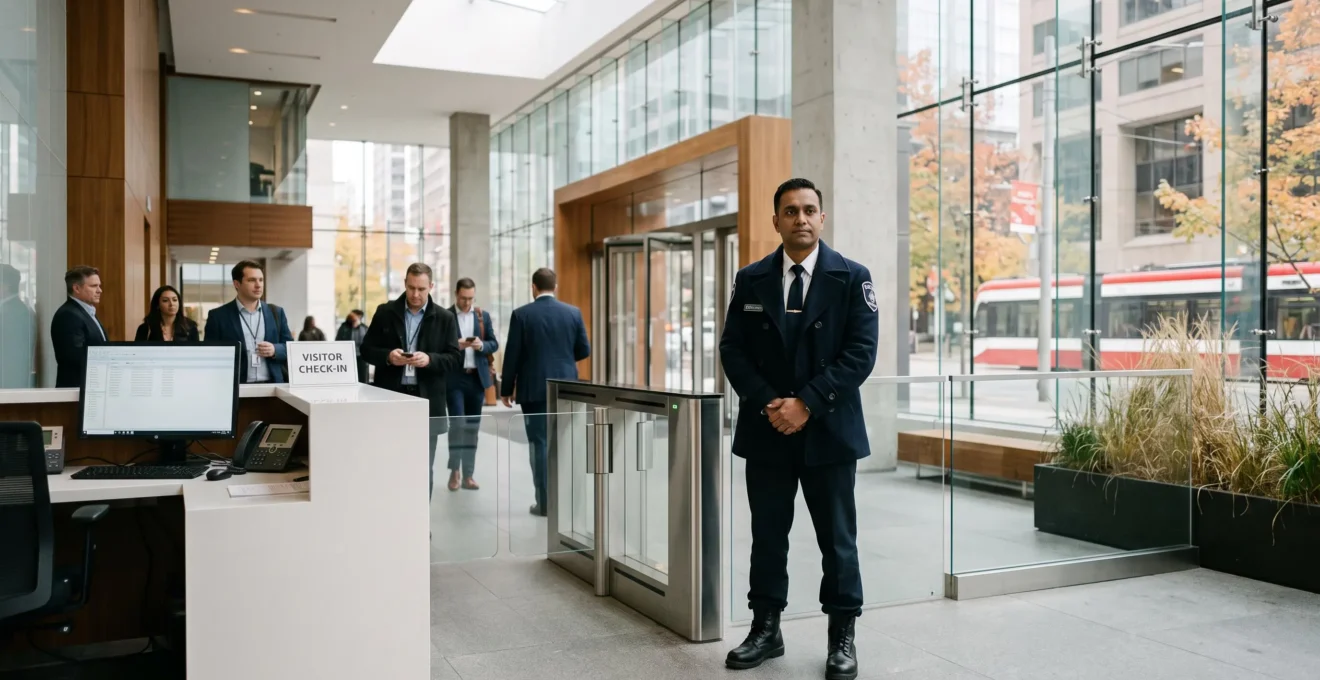
A security officer stationed at a Canadian commercial property can control authorized access, observe and report suspicious activity, enforce applicable property rules, respond to emergencies within their training, and request police assistance. Certain statutory arrest powers may also apply. However, working in security does not automatically grant police powers, and an officer’s practical responsibilities must remain consistent with applicable law, authorization, training and site procedures.
For employers and property managers, the critical distinction is between what an officer is legally permitted to do and what the property has actually equipped that officer to accomplish. A guard assigned to a corporate lobby, for example, may be expected to manage visitors, handle alarms, document incidents and respond to emergencies. Those expectations can conflict when only one person is on duty.
Effective fixed-post guarding therefore requires more than a general job description. Property managers need defined authority, operational priorities, reliable documentation, realistic staffing, clear escalation procedures and demonstrable site-specific competency. Provincial differences must also be considered before applying the same security procedures across multiple Canadian properties.
Security Officer Responsibilities: Key Points for Canadian Property Managers
- Security officers may exercise delegated property-related authority and specific statutory powers, but they do not possess general police authority.
- Written post orders should define access control, incident reporting, emergency response, escalation and the limits of each assignment.
- Staffing, visitor management and training should reflect documented property risks rather than generic assumptions about building size or security coverage.
- Why Security Officers’ Powers Differ From Police Powers in Canada
- How Security Officers Should Record Incidents During Overnight Shifts
- Concierge Security or Dedicated Guarding for a Corporate Lobby?
- The Duty-of-Care Risks of Assigning Unclear Tasks to Security Officers
- When Should a Commercial Building Add a Second Security Officer?
- Escorted Access or Temporary Visitor Passes for Corporate Buildings?
- When Security Guards Should Disengage and Request Additional Assistance
- What Training Should Security Personnel Have for High-Risk Canadian Properties?
Why Security Officers’ Powers Differ From Police Powers in Canada
Canadian security officers do not acquire general police powers through employment. Their routine authority generally involves enforcing property rules on behalf of an authorized occupier, while federal and provincial legislation provides certain additional powers under defined conditions. The distinction matters because an officer may lawfully refuse entry or direct someone to leave without having general authority to investigate, search or detain people.
At a commercial building, an authorized officer may verify entry permissions, communicate access restrictions and direct unauthorized individuals to leave where applicable law permits. In Ontario, the Trespass to Property Act recognizes directions issued by an occupier or a person authorized by that occupier.
The same Ontario legislation also establishes a specific warrantless arrest power for occupiers and authorized persons when its statutory conditions are met. This is not equivalent to unrestricted authority to hold anyone who refuses a request.
Federal law creates a separate framework. Under section 494 of Canada’s Criminal Code, any person may make an arrest in certain defined circumstances. Property owners, lawful possessors and persons authorized by them have additional arrest authority concerning offences committed on or in relation to the property, subject to statutory conditions.
Section 494 also requires a non-police person making an arrest under that provision to deliver the arrested individual to a peace officer forthwith. These arrest powers do not create general police authority to demand identification, conduct investigative detention or perform unrestricted searches.
| Action | Ordinary security responsibility | Important limitation |
|---|---|---|
| Refuse entry | Apply authorized access restrictions | Subject to applicable law, authorization and lawful rights of access |
| Direct someone to leave | Communicate a lawful property-related direction | Requires appropriate authority and circumstances |
| Request identification | Apply an authorized visitor verification policy | Does not generally create a statutory power to compel identification |
| Inspect belongings | Request compliance with a lawful screening policy | No general unrestricted power to search a person or their possessions |
| Make an arrest | Act only where a specific legal power applies | Statutory requirements, safety and prompt police transfer remain relevant |
Provincial regulation adds another layer. Licensing, training, conduct and employer requirements vary across Ontario, British Columbia, Alberta and other jurisdictions. A national property portfolio should not assume that identical post orders will satisfy every province’s requirements.
Liability is similarly fact-dependent. Depending on the circumstances, an officer’s conduct may expose the individual, employer or property operator to legal claims. Contractual allocation, supervision and the applicable legal duties require separate consideration.
Once those boundaries are established, the next operational safeguard is a reliable record of what the officer observed, decided and communicated.
How Security Officers Should Record Incidents During Overnight Shifts
Overnight security officers should document incidents promptly, chronologically and objectively, distinguishing what they personally observed from what others reported or what they inferred. Each report should identify relevant times, locations, people, conditions, actions, notifications and outstanding issues. Accurate documentation becomes particularly important when an officer works alone and no manager directly witnesses the event.
An overnight report is more than a shift summary. It can help supervisors reconstruct events, evaluate whether post orders were followed, identify unresolved hazards and respond to subsequent investigations or claims.
Ontario’s security guard study guide emphasizes factual observations, chronological notebook entries, reliable records and the possibility that officers may later testify about incidents they handled.
For a night-shift incident, a useful reporting structure includes:
- Event identification: record the date, exact location, incident type and relevant occurrence times.
- Direct observations: describe observable conduct, physical conditions and what the officer personally saw or heard.
- Statements and sources: identify witnesses and distinguish their accounts from the officer’s observations; quote significant words accurately when reliably recalled.
- Officer response: document actions taken, instructions communicated, assistance requested and decisions not to intervene where relevant.
- Resolution and follow-up: identify remaining hazards, people notified, evidence preserved and tasks transferred to the next shift.
The distinction between observation and interpretation is essential. “The visitor struck the reception counter twice” records behaviour. “The visitor intended to attack staff” asserts an intention that the officer may not be able to establish.
Night shifts introduce practical difficulties. Fatigue can affect attention, supervisors may be unavailable, and an officer may need to manage an ongoing incident before completing a detailed account. Recording essential observations when safe to do so, then completing the report promptly, reduces reliance on later recollection.
Reports should also identify when they were created and when subsequent information was added. Corrections should preserve the integrity of the original record rather than silently replacing it. Any associated photographs, video references or physical evidence should follow the organization’s authorized preservation and access procedures.
For example, in a hypothetical incident involving an unauthorized visitor at 2:15 a.m., the report should distinguish the initial access attempt, the officer’s instructions, the visitor’s observed response, the time police or a supervisor were contacted, and the final disposition. It should also record whether the lobby post remained continuously covered.
A reliable incident history also supplies the information needed to determine whether the officer’s assigned role genuinely matches the building’s daily operating conditions.
Concierge Security or Dedicated Guarding for a Corporate Lobby?
Concierge security is generally better suited to corporate lobbies where visitor assistance, tenant service and orderly reception are the main priorities. Dedicated guarding is more appropriate when access enforcement, suspicious activity monitoring and incident response dominate the role. A hybrid position can work, but only when competing responsibilities are explicitly prioritized and the officer has adequate support.
The difference is not simply whether the officer appears welcoming or authoritative. It concerns the outcome the property needs from the position.
A concierge-oriented post may emphasize greeting visitors, confirming appointments, communicating with tenants and issuing credentials under an approved process. A dedicated guarding post may prioritize monitoring entrances, responding to alarms, challenging unauthorized access safely and preserving the integrity of restricted areas.
| Building factor | Concierge-oriented security | Dedicated guarding |
|---|---|---|
| Visitor profile | Predominantly expected guests and routine appointments | More uncertain or security-sensitive access activity |
| Primary objective | Efficient reception and tenant experience | Enforcement of access rules and security response |
| Access arrangements | Controlled entry and clear visitor workflows | Active monitoring or intervention in access decisions |
| Incident history | Limited documented enforcement demands | Recurring unauthorized access or significant security concerns |
| Typical workload conflict | Reception duties interrupted by security events | Security priorities interrupted by service requests |
Property managers should also assess lease-related service expectations, visitor volumes, the location of alternative entrances and differences between business-hours and after-hours demand. A lobby may require reception-focused coverage during the day and more enforcement-oriented procedures overnight.
A hybrid arrangement depends on supporting controls. Credential readers, approved visitor lists, documented access decisions and clear escalation scripts can reduce the amount of judgment demanded at reception. These controls do not eliminate the need for an officer to recognize when a situation exceeds their responsibilities.
The principal failure mode is apparent coverage without operational capability. A concierge-profile officer may be highly effective at tenant relations yet lack the preparation, instructions or support to handle recurring access violations. Conversely, an unnecessarily enforcement-heavy approach can create avoidable friction in a low-risk, service-oriented building.
Before combining the roles, managers should identify which responsibility takes precedence when an alarm, visitor queue and unauthorized entry occur simultaneously.
Whatever model is chosen, ambiguity in the officer’s instructions can create a separate problem: uncertainty about which services the property has undertaken to provide.
The Duty-of-Care Risks of Assigning Unclear Tasks to Security Officers
Unclear security assignments can create duty-of-care risks because officers, employers and property managers may develop conflicting expectations about who is responsible for a hazard or response. The applicable legal duty and standard of care depend on the circumstances, not simply a job title. Written post orders, appropriate training and documented responsibilities help demonstrate what an officer was expected and authorized to perform.
Instructions such as “watch the parking garage” or “handle whatever happens overnight” do not establish operational boundaries. They leave unanswered whether the officer must conduct patrols, monitor cameras, respond personally, call another service provider or merely report observed conditions.
Consider three hypothetical situations:
- Parkade monitoring: an officer is instructed to keep an eye on an underground garage, but no patrol frequency, camera responsibility or response expectation is defined.
- Mechanical-room access: a guard receives keys for emergency contractor entry, but staff disagree about whether the guard is responsible for technical equipment checks.
- Medical assistance: an officer is told to help with any medical situation without a defined first-aid role, emergency-call procedure or training verification.
These examples do not establish negligence automatically. They illustrate how vague assignments can complicate subsequent assessments of reasonable precautions, actual conduct and organizational responsibility.
A useful post-order audit applies three tests to every task: Is the task documented? Is the assigned officer competent and equipped to perform it? Is the task within the officer’s lawful authority?
Five Actions for Auditing Security Post Orders
- Inventory every routine and exceptional responsibility, producing a task register for each security post.
- Match each task to written authorization and applicable legal limits, producing an authority-and-restrictions matrix.
- Compare required tasks against individual training and available equipment, producing a documented competency gap list.
- Define incident thresholds, escalation contacts and handover responsibilities, producing a site-specific response procedure.
- Review the revised orders with property management and the security contractor, producing an approved version with a review date and named responsibility holders.
Written instructions should also distinguish security duties from maintenance, clinical care, emergency-service functions and unrelated tenant requests. Duties that cannot be performed safely or lawfully should be reassigned or redesigned rather than left as informal expectations.
Contractual responsibility among the property owner, security provider and officer cannot be conclusively determined by post orders alone. Applicable law, the contract, supervision and the facts of an incident may all matter. Nevertheless, clear written assignments create a more reliable basis for operational accountability.
Once the duties are explicit, managers can evaluate whether the number of officers assigned to the property makes those duties achievable.
When Should a Commercial Building Add a Second Security Officer?
A commercial building should consider a second security officer when its documented risks or duties cannot be handled reliably by one person. Relevant indicators include overlapping incidents, prolonged loss of lobby coverage, unsafe lone-working conditions, delayed alarm responses and frequent escort demands. Building size alone does not establish staffing needs, and no universal Canadian square-footage rule determines when a second officer is necessary.
The key operational constraint is simultaneous availability. A single officer cannot remain physically stationed at reception while personally escorting a visitor to another floor. Similarly, an active emergency may prevent that officer from responding to another alarm elsewhere in the building.
For a hypothetical example, suppose an officer leaves a fixed lobby post to accompany an after-hours contractor upstairs. During that period, a second visitor arrives requiring credential verification. The problem is not necessarily poor officer performance; it is a conflict between assigned duties.
Repeated instances of this conflict justify a review of staffing, access systems and response arrangements.
The CCOHS guidance on working alone identifies security guards among workers potentially exposed to lone-working hazards. It recommends evaluating the risks of the specific workplace, providing appropriate communication and emergency arrangements, and considering assistance for higher-risk activities.
Property managers can assess staffing pressure through:
- Incident records showing two tasks requiring attention at the same time.
- Alarm response delays and the reasons recorded for those delays.
- Periods when essential access points lack the required coverage.
- Risk assessments involving isolated locations, violence or delayed assistance.
- After-hours visitor and contractor requirements that remove officers from their primary posts.
Adding another full-time position is not the only option. A building might assign a second officer during identified high-demand periods, arrange contracted mobile backup or automate routine credential verification.
Each alternative has limitations. Mobile support is not continuously present, automation cannot handle every unpredictable interaction, and part-time coverage only addresses the periods in which it operates.
A staffing recommendation should therefore describe the uncovered duty, its frequency, the consequences of delayed response and the extent to which each proposed option addresses the risk. A single overlap incident can be useful evidence of a coverage conflict, but does not automatically establish a legal obligation to hire another officer.
Visitor access procedures deserve particular attention because they can create substantial demands on the same officer expected to maintain fixed-post coverage.
Escorted Access or Temporary Visitor Passes for Corporate Buildings?
Escorted access is generally appropriate when visitors require continuous supervision or have not been cleared for independent movement in a sensitive area. Temporary passes are better suited to visitors whose identity, purpose and permitted destinations have already been verified. The choice should reflect access risk, host responsibility and available staffing, rather than applying one approach to everyone entering the building.
Escorting and temporary passes are different controls. An escort provides ongoing human supervision during movement through a property. A pass authorizes a defined level of access through a documented approval process, often supported by electronic entry controls.
For routine commercial operations, visitor classification can help determine the appropriate procedure.
| Visitor category | Potential control | Verification priority |
|---|---|---|
| Recurring approved contractor | Time-limited pass for authorized areas | Current authorization and permitted work locations |
| One-time service provider | Host confirmation, with escort where risk requires | Purpose, destination and applicable restrictions |
| Scheduled meeting guest | Temporary visitor credential | Host approval and access duration |
| Unscheduled unknown visitor | Verification before access; escort only if authorized and appropriate | Identity, purpose and host authorization |
| Visitor entering a sensitive area | Controlled access with escort where required | Area-specific authorization and supervision |
These are suggested operational classifications, not a legislated visitor-access matrix. Each building must account for its applicable rules, tenant commitments, accessibility obligations and privacy requirements.
Escort policies also affect staffing capacity. When a fixed-post officer must accompany someone beyond reception, managers need to specify who maintains the post, whether the escort can be performed by an authorized tenant representative, and what happens if another security event occurs.
Temporary passes reduce some movement-related demands but introduce their own controls: authorization records, expiry settings, permitted access areas, credential return or deactivation, and procedures for lost or misused passes.
Consistency is important. An approved visitor policy that staff routinely bypass may be less reliable than a simpler procedure that is actually followed. Likewise, informal escort decisions without authorization criteria can create inconsistent treatment and gaps in the access record.
Managers should document exceptions, identify who approves them and ensure collected visitor information is handled under the property’s applicable privacy and retention requirements.
Even carefully designed access procedures cannot prevent every confrontation. Officers also need clear criteria for recognizing situations that require outside assistance.
When Security Guards Should Disengage and Request Additional Assistance
Security guards should disengage or request assistance when the danger, complexity or required response exceeds their authority, training, equipment or available support. Warning signs include weapons, multiple threatening individuals, serious medical emergencies, escalating violence and situations where maintaining contact would expose the officer or others to unreasonable risk. Disengagement should follow a documented emergency or escalation procedure.
Disengaging does not mean ignoring an incident. Depending on the circumstances, an officer may withdraw to safety, maintain observation from a protected location, restrict access where lawful and safe, notify emergency services, or guide others away from danger.
It is also important not to overstate legal restrictions. The statutory arrest powers discussed earlier can permit certain physical interventions under defined circumstances. The existence of those powers does not mean an officer must attempt an arrest or that every physical intervention is justified.
For property operations, observable escalation thresholds are more useful than vague instructions to “use judgment.” Examples include:
- A weapon is seen or credibly reported.
- Several aggressive individuals confront an officer working alone.
- A person requires emergency medical assistance beyond the officer’s training.
- An access dispute develops into an apparent criminal incident.
- Remaining in direct contact would require unsafe physical intervention.
- The officer cannot control the situation while maintaining essential coverage elsewhere.
Escalation procedures should distinguish the appropriate recipient. Immediate threats to life, serious violence or urgent medical emergencies generally warrant emergency services. Routine operational disagreements may call for a supervisor or property representative instead. Police involvement should follow the nature and urgency of the incident.
A useful assistance call identifies the exact location, the observed behaviour, the number of people involved where known, any weapons or injuries, the immediate danger and the assistance required. Officers should avoid speculation and communicate changes as the situation develops.
Requesting backup and physically withdrawing are separate decisions. An officer may sometimes maintain safe observation while waiting for assistance. In other situations, immediate withdrawal is the safer response.
Isolated overnight officers may hesitate to escalate because they believe they are expected to resolve every disturbance independently. Supervisors should make clear that a justified request for assistance is compliance with an established safety procedure, not evidence of poor performance.
After an event, incident records should identify the triggering conditions, notification times, actions taken and whether the escalation plan operated as intended.
Those thresholds only become dependable when officers have practiced recognizing them, communicating their decisions and applying the property’s actual response procedures.
Key Takeaways Before Reviewing Security Training
- Training requirements should follow the actual risks and duties documented for each post, not just the officer’s job title.
- Access enforcement, incident documentation and emergency escalation need distinct, verifiable competencies.
- Property managers should check whether the security provider can demonstrate current site-specific preparation for the people assigned to the building.
What Training Should Security Personnel Have for High-Risk Canadian Properties?
Security personnel at high-risk Canadian properties should have the licensing and foundational training required by their jurisdiction, supplemented by instruction specific to the site and their assigned duties. Relevant competencies may include lawful authority, access enforcement, de-escalation, emergency response, incident documentation, lone-worker safety and communication with first responders. The required training should be verified against actual responsibilities.
Licensing establishes an important regulatory baseline, but it does not demonstrate that an officer understands the emergency systems, access arrangements or threat profile of a particular commercial property.
A security officer assigned to a financial institution, critical infrastructure location or complex commercial tower may encounter responsibilities not adequately addressed through generic initial instruction alone.
Site-specific preparation should begin with a documented assessment of those responsibilities.
| Training area | Operational competency | Suggested verification |
|---|---|---|
| Legal authority | Recognize lawful actions, prohibited practices and jurisdictional limits | Scenario-based assessment |
| Access control | Apply site-specific credentials, visitor approval and refusal procedures | Observed workflow exercise |
| Incident reporting | Produce factual, chronological and complete records | Reviewed sample incident report |
| De-escalation | Recognize warning signs and communicate without unnecessarily intensifying conflict | Supervised scenario exercise |
| Emergency response | Follow alarm, evacuation, notification and responder coordination procedures | Site drill or documented practical assessment |
| Lone-worker safety | Use check-in, backup and emergency communication arrangements | Communication and escalation test |
These are recommended competency checks, not a uniform mandatory curriculum for every Canadian province or security assignment. Statutory training requirements and any additional role-specific obligations must be verified locally.
Training should connect directly to predictable operational failures. Documentation exercises can expose unclear reporting practices. Access-control scenarios can reveal uncertainty about an officer’s lawful authority. Disengagement drills can test whether the officer recognizes danger before attempting an unsafe intervention.
Property managers reviewing security contracts should request evidence relating to the people and posts actually covered: licence verification where required, initial site orientation, completed competency assessments, emergency drill participation and records of refresher training.
Refresher frequency should reflect relevant legal requirements, changing site procedures, identified risks and contractual expectations. An officer’s valid licence alone does not prove familiarity with recently modified access technology or revised emergency arrangements.
Training weaknesses may first become apparent through inconsistent visitor screening, incomplete reports, hesitant escalation or unnecessary conflict, before any serious incident occurs. Routine supervision and document reviews therefore help identify gaps that might otherwise remain hidden.
Property managers should make the next step a joint review with the security provider: compare current post orders, incident history, staffing arrangements and individual competency records, then document the corrections needed to deliver the level of protection the building actually requires.
Can a security officer require someone to show identification before entering a commercial building?
An authorized security officer may request identification as part of a lawful building access policy and, where legally permitted, refuse entry when verification requirements are not met. That does not create a general police-like power to compel identification. The person’s legal entitlement to enter, applicable human rights obligations and relevant provincial rules must be considered.
Can security officers detain someone for trespassing in Canada?
Specific arrest powers may apply. In Ontario, section 9 of the Trespass to Property Act authorizes qualifying arrests by occupiers and persons authorized by them, subject to statutory conditions and prompt police involvement. Federal Criminal Code arrest provisions may also apply in defined circumstances. Neither framework gives security officers an unrestricted power to detain people for investigation.
Who should approve changes to a commercial property’s security post orders?
The property manager and security contractor should use an agreed approval process consistent with their contract and applicable responsibilities. Changes affecting legal authority, emergency procedures, staffing or technical duties should receive appropriate operational and specialist review. The approved document should identify its effective version and how officers are informed and trained.
Does every commercial building need two security officers overnight?
No universal Canadian requirement establishes two overnight security officers for every commercial building. Staffing decisions should consider applicable provincial occupational safety rules, foreseeable hazards, lone-worker arrangements, simultaneous duties, response requirements and the property’s actual incident history. A documented risk assessment can help identify whether additional coverage or alternative safeguards are appropriate.
What records should a property manager request from a security contractor?
Relevant records may include current post orders, proof of required licensing, site orientation and training records, incident and activity reports, escalation procedures, patrol verification records where applicable, and evidence of supervisory reviews. Access to personal or incident-specific information should respect contractual, confidentiality and applicable privacy requirements.