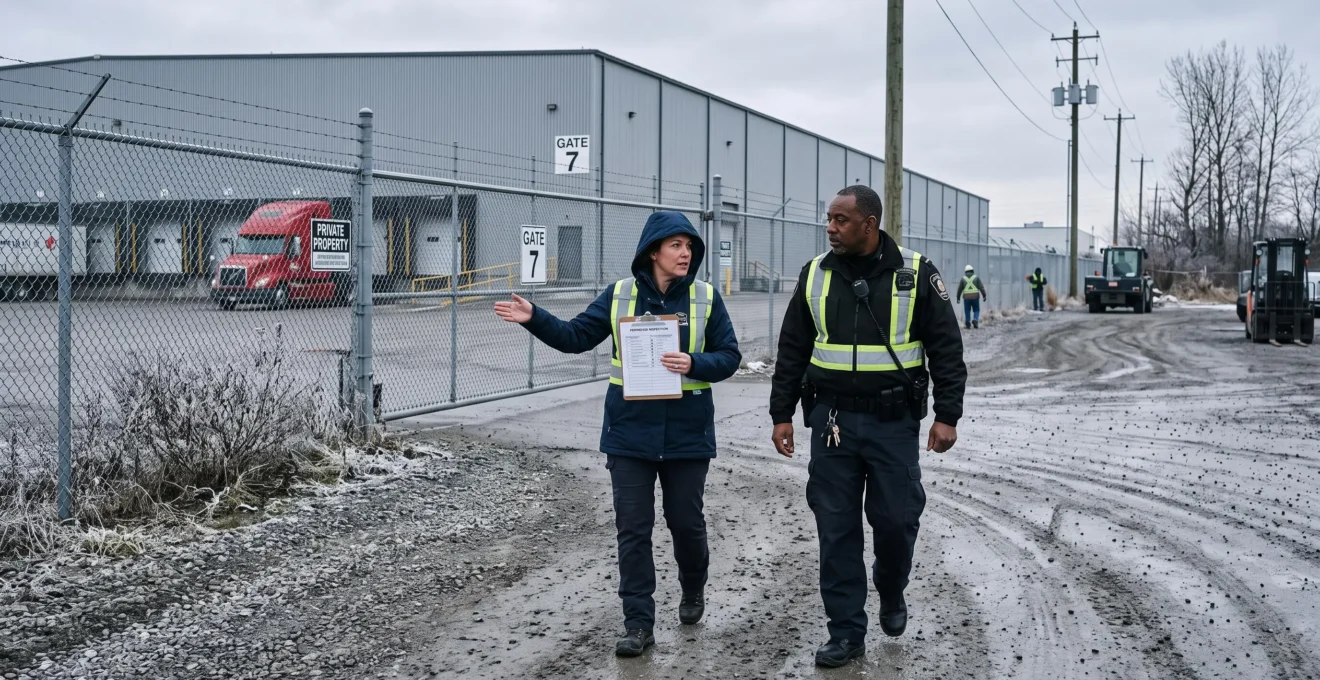
A security guard’s licence is a starting point, not proof that the person is ready to protect a demanding commercial or industrial property. High-risk assignments require competencies matched to the actual environment: awareness of site hazards, controlled access, emergency response, incident reporting, communication and sound decisions under pressure. The appropriate combination depends on the property’s operations, the guard’s responsibilities and the time available to obtain assistance when something goes wrong.
For Canadian security managers, the challenge is to distinguish baseline qualifications from operational readiness. A guard assigned to a warehouse with heavy vehicle movements faces different demands from someone monitoring a restricted commercial building or an isolated industrial perimeter. Training must therefore connect general security knowledge to the site’s specific procedures, risks and legal boundaries.
A reliable staffing decision starts with a documented risk assessment, continues through a structured assignment briefing and remains subject to refresher training. It also requires managers to verify applicable provincial or federal requirements rather than assuming that one security licence or training certificate covers every assignment.
Security training priorities for high-risk properties
- Match guard competencies to the site’s hazards, operating environment, access requirements and emergency response constraints.
- Verify practical readiness through site-specific briefings, scenario exercises, communication protocols and emergency equipment familiarization.
- Maintain legal and operational competence through appropriate licensing checks, clear escalation procedures and event-driven refresher training.
- Why Situational Awareness Matters for Guards Working Alone at High-Risk Sites
- How to Prepare Guards to Respond to Medical Emergencies at Work
- General Security Guards or Specialized Personnel for Industrial Facilities?
- The Assignment Briefing Errors That Leave Guards Unprepared for Incidents
- When Should Security Personnel Receive Refresher Training?
- Verbal Aggression or Imminent Threat: When Should Guards Seek Backup?
- Why Long Travel Distances Reduce Mobile Patrol Response Reliability
- What Can Security Officers Legally and Practically Do at Canadian Commercial Properties?
Why Situational Awareness Matters for Guards Working Alone at High-Risk Sites
Situational awareness is particularly important when a security guard works alone because there is no colleague available to notice an overlooked change, confirm an observation or intervene when the guard becomes distracted. At a high-risk property, managers should train guards to scan their environment systematically, recognize deviations from normal activity and communicate anomalies promptly. The objective is not simply to remain alert, but to make observation a repeatable operational skill.
A lone guard cannot rely on informal team awareness. Training should establish a consistent observation routine covering the property’s physical layout, access points, movement patterns and expected activities. This includes understanding what normal operations look like at different times of day and recognizing when an apparently ordinary situation deserves closer attention.
**Recognizing deviations from normal activity**
The first competency is the ability to establish a baseline. Guards should know which entrances are normally used, when contractors are expected, which areas should remain restricted and how vehicle or pedestrian movements typically occur.
Training scenarios can introduce controlled variations to test whether the guard identifies:
- An unfamiliar vehicle parked near a restricted entrance.
- A gate or access door left open outside its normal operating period.
- Unexpected contractor activity or an unverified visitor.
- Unusual movement around storage areas or perimeter fencing.
- A change in lighting, equipment condition or site activity that may indicate a developing security concern.
The emphasis should remain on accurate observation rather than assumptions about intent. A guard should record what was seen, where it occurred, when it happened and what action followed. This creates a usable incident record and helps supervisors distinguish a genuine operational deviation from an observation that requires further verification.
**Training observation as a deliberate routine**
Practical exercises should reproduce the conditions of the actual assignment. A supervisor can ask a guard to patrol a designated route, identify relevant access points, observe activity and report selected anomalies. The exercise should assess both detection and communication: noticing a problem is not sufficient if the information never reaches the person responsible for responding.
A structured training programme can include:
- Patrol observation exercises using realistic site layouts and operating conditions.
- Recognition and recording of unusual activity without unsupported conclusions.
- Radio communication drills that test the clarity and completeness of incident reports.
- Scheduled check-ins and confirmation procedures for isolated posts.
- Scenario-based exercises involving missed check-ins, unexpected access or changing site conditions.
The check-in system should define who receives the communication, how a missed contact is identified and what escalation follows. Its timing should be determined by the assignment’s risk assessment rather than an invented universal frequency.
**When is a lone deployment inappropriate?**
A lone post is not automatically unsuitable, but neither should it be treated as an economical default. The decision must account for the type of work, exposure to hazards, physical remoteness, communication reliability and the time needed for assistance to arrive.
The Government of Canada’s guidance on workers working alone at a work place under the control of the employer explains that federally regulated workplaces must assess individual circumstances and consider appropriate preventative measures. Examples include personal alarms and scheduled check-ins. This guidance applies within its federal occupational health and safety framework; it must not be presented as a universal rule governing every provincially regulated security assignment.
For a property manager, the practical question is whether the guard can perform the required duties safely while alone and whether the available communication and backup arrangements are adequate for the identified hazards. Where the answer is no, the staffing model should change rather than expecting training alone to compensate for an unsuitable deployment.
The same principle applies to medical emergencies, where an isolated guard may need to recognize a problem, activate assistance and guide responders without a colleague nearby. Situational awareness is therefore not a standalone patrol skill: it is part of a wider emergency-readiness system.
How to Prepare Guards to Respond to Medical Emergencies at Work
Preparing security guards for medical emergencies requires more than checking whether they hold a first aid certificate. They must understand the emergency arrangements of the property, locate relevant equipment, communicate accurate information and guide emergency responders to the incident. Their actions should remain within their training and assigned responsibilities. A guard who knows where the AED is, how to access the building and whom to notify is better prepared to translate general knowledge into an effective site response.
A medical incident can occur in a loading area, reception space, isolated office, warehouse or restricted operational zone. Each location creates different access and coordination requirements. A certificate does not automatically demonstrate familiarity with those arrangements.
**Distinguishing certification from operational readiness**
First aid training provides a foundation for responding to medical emergencies. However, a guard must also understand the property’s actual emergency infrastructure before starting the assignment.
Managers should verify that personnel know:
- Where first aid kits and automated external defibrillators (AEDs) are located.
- Which routes emergency vehicles can use to reach the relevant building or operational area.
- How responders can enter restricted areas, including applicable key, access-card or lockbox procedures.
- Which site representative or emergency contact must be notified.
- How to communicate the incident location and relevant access information to emergency services.
These details should be covered during the site induction and reinforced through practical familiarization. A guard should not have to search unfamiliar corridors or telephone several departments to discover how emergency responders can reach an injured person.
**Understanding the limits of first aid responsibilities**
Training requirements depend on the applicable occupational health and safety framework and the responsibilities assigned to the workplace’s first aid personnel. Managers should distinguish between the qualifications required of designated first aid attendants and the competencies expected of security personnel who may be the first to encounter an incident.
For federally regulated workplaces, the Canada Occupational Health and Safety Regulations on first aid identify subjects covered by basic and standard first aid training. Basic first aid includes emergency scene management, cardiopulmonary resuscitation, medical emergencies, shock, unconsciousness, anti-contamination procedures, wounds and bleeding. Standard first aid includes additional subjects such as fractures, chest injuries, head and spinal injuries, burns, toxicological emergencies and casualty evacuation.
These provisions are a federal regulatory reference, not proof that every security guard at every Canadian commercial property must personally hold the same certificate. Provincial occupational health and safety requirements and the site’s actual staffing arrangements must also be checked.
Operational training should reinforce four responsibilities:
- Recognize and report: identify the apparent emergency and activate the appropriate response process.
- Provide assistance within training: follow applicable first aid instruction without attempting unfamiliar or unauthorized interventions.
- Protect the scene: maintain safe access, coordinate movement around the incident and avoid creating additional hazards.
- Document and communicate: record relevant observations, notifications and actions according to site procedures.
This approach prevents a misunderstanding of the guard’s role. Security personnel should not be expected to replace paramedics or qualified medical professionals. Their value lies in initiating the response, providing assistance within their competence and helping responders reach the affected person.
**Testing the property’s emergency arrangements**
A site-specific exercise can assess whether the guard can locate the AED, identify the first aid supplies, explain the emergency access route and contact the appropriate site representative. A practical walkthrough is more informative than simply asking whether the guard has read an emergency procedure.
Managers should also verify that equipment locations and contact information remain current. Changes to building access, construction work or restricted-area arrangements can make previously accurate instructions unreliable.
Medical emergency readiness also has a human dimension. Employees, tenants and visitors may form an important impression of a property’s security arrangements during an incident. Calm communication, prompt notification and appropriate assistance demonstrate professional conduct, although the supplied regulatory sources do not establish a quantified effect on tenant trust or staff retention.
Once medical readiness has been established, the next staffing decision is whether the property’s wider operational risks require general security personnel, additional specialist competencies or a combination of both.
General Security Guards or Specialized Personnel for Industrial Facilities?
The choice between general security guards and specialized personnel should depend on the facility’s operational hazards, security exposure and access requirements. A standard provincial security licence may establish baseline eligibility for security work, but it does not automatically demonstrate competence in industrial traffic management, hazardous-area awareness, complex perimeter control or sector-specific procedures. Many facilities benefit from combining general guards with personnel trained for their most demanding posts.
**Assessing the facility before selecting personnel**
A security manager should begin with a site risk assessment rather than a job title or staffing budget. The following factors help identify where additional competencies may be necessary.
| Site risk factor | General security competencies | Additional specialized competencies |
|---|---|---|
| Hazardous materials | Access monitoring, visitor verification and incident reporting. | Hazard recognition, site-specific safety induction and emergency coordination. |
| Heavy vehicle traffic | Gate monitoring and basic movement awareness. | Loading dock coordination, forklift awareness and vehicle-pedestrian separation procedures. |
| Large perimeter | Routine patrols and access control. | Extended perimeter assessment, coordinated patrol coverage and remote-access procedures. |
| High-value assets | Observation, documentation and controlled entry. | Asset-specific protection procedures, enhanced verification and incident escalation. |
| Additional regulatory requirements | Compliance with applicable provincial security licensing requirements. | Sector-specific screening, authorization or technical qualifications where required. |
This framework is a management tool, not a statutory classification of security guards. The presence of hazardous materials or valuable assets does not automatically create a universal specialist licence requirement. It indicates that managers should investigate the actual risks and competencies needed.
**What specialized industrial security competence involves**
Specialization is not simply a more advanced certificate. It should translate into observable capabilities relevant to the facility.
For example, personnel assigned to an industrial warehouse may need to understand:
- How to control access across several vehicle and pedestrian entrances.
- How to recognize unsafe interactions between pedestrians, forklifts and delivery vehicles.
- How contractor identification and visitor authorization work at the property.
- Which areas require additional safety induction or restricted access.
- How to report a suspected security incident without interfering with industrial operations.
- Which emergency contacts and site representatives are responsible for different operational areas.
A guard’s ability to apply these procedures should be verified during site familiarization. General security training does not automatically establish competence in a facility’s equipment, production processes or occupational hazards.
**When do additional screening requirements apply?**
Some assignments involve access restrictions beyond ordinary security employment requirements. Airport operations provide a clear example. Transport Canada’s Transportation Security Clearance Program requires employees who need unescorted access to restricted airport areas to hold a valid Transportation Security Clearance. The process includes security and background verification involving federal authorities.
The important distinction is that a Transportation Security Clearance is an access and personnel-screening requirement, not a universal professional qualification for industrial security guards. It should not be generalized to warehouses, manufacturing plants, energy facilities or every commercial property.
Managers should identify the actual access conditions and duties before deciding which additional screening or qualifications apply.
**Balancing operational capability and staffing costs**
An all-specialist workforce may be unnecessary when most posts involve routine access control and observation. A hybrid model can allocate personnel according to exposure and operational complexity.
For example, a hypothetical industrial facility could assign general security guards to routine reception and perimeter observation while reserving personnel with additional industrial safety and access-control competencies for loading areas, restricted zones and higher-risk operational periods.
This arrangement can improve resource allocation without treating every guard as interchangeable. However, it depends on clearly defined responsibilities, sufficient coverage and reliable communication between personnel.
The distinction should also appear in recruitment documents, assignment instructions and performance evaluations. A specialist designation is meaningful only when the required competencies are documented and assessed.
The staffing model alone cannot guarantee effective protection. Even appropriately qualified personnel may be unprepared if they receive incomplete assignment instructions or do not understand when to act, report or request assistance.
The Assignment Briefing Errors That Leave Guards Unprepared for Incidents
An assignment briefing is effective only when it prepares the guard to perform specific duties in the actual working environment. Providing a generic post order without a walkthrough, explaining site procedures without escalation thresholds or overlooking the contractor and tenant landscape can leave important operational gaps. Before the first shift, the guard should understand the property, the risks, the reporting structure and the limits of their authority.
A security licence and previous experience do not guarantee familiarity with a new property’s access arrangements or emergency procedures. Managers must therefore treat the briefing as a practical readiness assessment rather than an administrative handover.
**Common briefing failures**
Several recurring mistakes can undermine an otherwise well-designed security programme.
- Generic documentation without a walkthrough: a written post order may describe patrol duties but fail to show where entrances, restricted areas, emergency equipment and access controls are located.
- Incomplete operational context: explaining the building layout without identifying tenant activities, contractor movements, delivery schedules and sensitive operational areas leaves the guard without a useful baseline.
- Unclear escalation thresholds: telling guards to report incidents without explaining when to notify a supervisor, request backup or contact police creates uncertainty during developing situations.
- Unverified emergency contacts: providing an outdated telephone number or an unclear chain of responsibility can delay communication.
- No confirmation of understanding: asking whether the guard understands the instructions does not establish whether they can apply them under pressure.
The last issue is particularly important. A briefing is not complete merely because the manager has delivered the information. The guard must demonstrate an adequate understanding of the assignment.
**Building an incident-ready briefing**
A useful briefing should connect operational information to decisions the guard may need to make.
The manager should cover the following subjects:
| Briefing element | Information to communicate | Expected guard understanding |
|---|---|---|
| Site layout | Entrances, exits, restricted zones and emergency access routes. | Ability to identify key locations and explain the relevant routes. |
| Operational environment | Tenant activities, contractor arrangements, deliveries and sensitive areas. | Ability to distinguish normal activity from deviations requiring attention. |
| Incident response | Reporting channels, emergency contacts and notification procedures. | Ability to identify whom to contact for different incidents. |
| Escalation thresholds | Conditions requiring independent action, supervisor notification, backup or police assistance. | Ability to select an appropriate response to a realistic scenario. |
| Role boundaries | Assigned responsibilities, permitted actions and limits of authority. | Ability to explain when to observe, report, disengage or seek assistance. |
The briefing should also identify known site hazards. A loading dock, isolated perimeter, chemical storage area or restricted operational zone may require different precautions. Guards must know which risks are relevant to their assigned post rather than receiving a generic warning about industrial hazards.
**Use scenario questions to test understanding**
A short verbal assessment can reveal whether information has transferred from the briefing to practical decision-making.
Managers can ask a standing guard on the second day of an assignment to explain how they would respond to three situations:
- Medical emergency: Where are the first aid supplies and AED, whom should the guard notify, and how can emergency responders access the location?
- Unauthorized entry: What should the guard observe and document, which access procedure applies, and when should the supervisor or police be contacted?
- Aggressive visitor: Which de-escalation measures are appropriate, when should the guard disengage and who provides backup?
These questions are not a substitute for practical training. They are a straightforward way to identify misunderstandings before a real incident exposes them.
**Why briefing quality matters to property managers**
An inadequately briefed guard may overlook a site-specific hazard, delay a notification or misunderstand an access restriction. Such failures can create operational and potential liability exposure for the property owner and security provider, depending on the circumstances.
A documented briefing helps demonstrate that the assignment’s expectations were communicated. However, documentation alone is not proof of competence. The manager should retain evidence of the walkthrough, relevant instructions and the guard’s demonstrated understanding.
Five actions to verify assignment readiness
- Conduct a site walkthrough and provide a completed location checklist identifying entrances, exits, restricted areas and emergency equipment.
- Identify the site’s operational hazards and provide a written list of the risks relevant to the assigned post.
- Confirm the reporting structure and provide a verified contact sheet identifying who receives each category of notification.
- Explain escalation thresholds and obtain a recorded briefing confirmation covering the guard’s authority and limitations.
- Conduct three scenario-based questions covering a medical emergency, unauthorized entry and aggressive visitor, then retain the assessment results.
Once a guard can explain the post’s requirements, managers must ensure that this knowledge remains current. Site conditions, procedures and individual competencies can change after the initial briefing.
When Should Security Personnel Receive Refresher Training?
Security personnel should receive refresher training when their qualifications approach expiry, when applicable regulatory requirements demand renewal or when changes in the assignment create new competency needs. A fixed calendar schedule alone is insufficient. A new post, an incident, a near-miss, modified access procedures or declining performance during practical exercises can all indicate that additional training is necessary.
For high-risk properties, refresher training should operate on two complementary schedules: the formal renewal requirements associated with applicable certifications and licences, and the operational training needed to maintain readiness for a particular site.
**Calendar-based and event-driven training**
Calendar-based training is useful for monitoring formal qualification and renewal dates. It helps managers identify certificates that are approaching expiry and arrange any required recertification before the relevant deadline.
However, a guard may hold valid qualifications and still be unfamiliar with a recently modified assignment. Event-driven training addresses that gap.
Relevant triggers include:
- Post changes: a transfer from reception to an isolated industrial perimeter may require different observation and emergency-response competencies.
- Incidents and near-misses: a security breach, medical emergency or communication failure may reveal weaknesses in existing procedures.
- Modified access arrangements: new access cards, gates, restricted areas or contractor procedures can make previous instructions incomplete.
- Seasonal risk changes: winter conditions, reduced daylight or changes in operating schedules may affect patrol and site-access requirements.
- Observed competency gaps: repeated errors during radio exercises, patrol assessments or scenario questions indicate that further practice may be required.
A refresher should address the identified gap rather than repeat an entire training programme without considering the reason for the intervention.
**Separate mandatory renewal from site-specific reinforcement**
Managers should distinguish between formal requirements and operational decisions.
| Training category | Primary purpose | Management responsibility |
|—|—|—|
| Licensing and regulatory renewal | Maintain compliance with applicable requirements. | Monitor relevant provincial or federal rules and expiry dates. |
| First aid recertification | Maintain the required first aid qualification where applicable. | Verify the certificate against workplace requirements. |
| Site-specific refresher | Reinforce familiarity with the assigned property’s risks and procedures. | Schedule training following relevant changes or identified gaps. |
| Scenario-based reassessment | Test whether skills transfer to operational situations. | Record results and address weaknesses. |
Not every category has the same legal status. The applicable licensing and occupational health and safety framework must be checked for each assignment. Managers should not describe an internally established annual refresher as a universal statutory requirement unless the relevant rule actually imposes it.
**A practical refresher training audit**
A structured review can help property managers identify where training needs attention.
First, review the records for each guard’s applicable licences and certificates. Record their validity dates and identify any approaching renewal requirements.
Second, compare each guard’s recent deployment history with their current assignment. A person who has not recently worked on an industrial perimeter may need a practical reassessment before returning to that post.
Third, review operational changes. New emergency contacts, revised access procedures, modified site layouts and changes in contractor arrangements should trigger an assessment of whether existing instructions remain suitable.
Finally, use scenario spot-checks to evaluate practical competence. The assessment should establish whether the guard can recognize the situation, communicate appropriately and follow the correct escalation procedure.
**Why a valid licence is not enough**
Provincial licensing establishes a baseline within the applicable regulatory framework. It does not automatically prove that a guard is prepared for every property type or every operational risk.
A security manager hiring personnel for a sensitive commercial property should therefore verify both formal eligibility and demonstrated assignment competence. This is particularly important for organizations managing properties across multiple provinces, where requirements and training expectations may differ.
A consistent internal training record can help coordinate these responsibilities without assuming that the same renewal schedule or legal rule applies everywhere.
Maintaining competence also means knowing when a situation has moved beyond the guard’s ability to manage it alone. Escalation and backup decisions should be reinforced through training rather than left to improvisation under pressure.
Verbal Aggression or Imminent Threat: When Should Guards Seek Backup?
Security guards should seek backup when behaviour escalates beyond what they can safely manage within their assigned responsibilities. Verbal aggression may call for calm communication and observation, while escalating behaviour can require greater distance, supervisor notification and preparation to disengage. An imminent threat requires an immediate response through the site’s emergency procedures, including backup and police notification where appropriate. Guards should be trained to recognize these stages before facing them in real situations.
The decision to request assistance should not depend solely on a guard’s confidence or willingness to handle confrontation. Clear escalation thresholds help personnel recognize when a situation is changing and when continued engagement is no longer appropriate.
**Recognizing the stages of escalation**
A graduated response framework gives guards a practical structure for evaluating behaviour.
| Situation | Observable indicators | Appropriate operational response |
|---|---|---|
| Verbal aggression | Raised voice, insults, repeated complaints or hostile language without an immediate physical threat. | Use calm communication, maintain awareness and monitor changes in behaviour. |
| Escalating behaviour | Increasing agitation, threatening language, refusal to respect boundaries or movement that increases confrontation risk. | Maintain safe positioning, notify the supervisor, prepare to disengage and request assistance where necessary. |
| Imminent threat | Immediate indications of potential physical harm, an attempted assault or another urgent threat to safety. | Prioritize personal and public safety, activate emergency procedures, request immediate backup and contact police as appropriate. |
These categories are operational guidance, not a substitute for a formal threat assessment or a universal legal classification. Behaviour must be evaluated in context, and guards should avoid treating every angry interaction as an imminent physical threat.
**Training the decision to disengage**
One of the most important competencies is recognizing that maintaining control of a conversation is not always the right objective. A guard who continues arguing with an increasingly aggressive visitor may expose themselves and others to unnecessary risk.
Training should therefore include realistic role-play exercises that test whether the guard can:
- Recognize changes in tone, posture, distance and behaviour.
- Use calm, clear and non-provocative communication.
- Maintain appropriate positioning and avoid unnecessary physical confrontation.
- Recognize when to stop engaging and move to a safer position.
- Communicate the situation accurately and request backup without delay.
The scenarios should include both manageable verbal disputes and situations in which disengagement is the appropriate response. Supervisors should assess the guard’s decision-making, not simply whether the exercise ends with the visitor complying.
**Understanding the legal limits of intervention**
Security guards should not assume that their employment gives them general police powers. Canadian law recognizes limited circumstances in which a person may make an arrest without a warrant, but these powers are conditional.
Section 494 of the Criminal Code permits a property owner, a person in lawful possession of property or a person authorized by them to make an arrest in specified circumstances involving an offence on or in relation to the property. The provision also requires a person other than a peace officer who makes such an arrest to deliver the arrested individual to a peace officer forthwith.
The distinction matters because a verbal disagreement, an aggressive attitude or a suspected access violation does not automatically justify detention. Guards should understand the specific conditions governing any intervention and avoid treating detention as a routine response to difficult behaviour.
The appropriate course will often be observation, reporting, de-escalation and assistance from police or authorized backup. Training should make this clear so that guards do not interpret restraint as a failure to perform their duties.
**Why backup arrangements matter on isolated posts**
Escalation procedures are only practical when the guard knows who will respond and how assistance can be obtained. A lone guard should have clear instructions identifying the backup contact, communication method and actions to take while waiting.
For higher-risk properties, managers should test whether the response arrangement is realistic. A backup resource that cannot reach an isolated post within a suitable period may not provide adequate operational protection.
The reliability of this response also depends on the distance between the property and the available support. For organizations using mobile patrols, geographical separation can significantly affect how confidently managers should rely on a promised intervention time.
Why Long Travel Distances Reduce Mobile Patrol Response Reliability
Long travel distances reduce mobile patrol response reliability because they increase the time between detecting an incident and reaching the property. Traffic, weather, competing calls and predictable patrol schedules can further affect operational coverage. A mobile patrol may provide useful visibility across several locations, but its value depends on realistic travel times and the level of risk the property can tolerate while waiting for assistance.
For security managers, the important distinction is between deterrence through periodic visibility and the ability to respond quickly to an active incident. These are different service outcomes and should not be presented as interchangeable.
**How distance affects response performance**
A mobile patrol covering several properties must divide its available time between travel, inspections, reporting and other assignments. As geographical separation increases, the time available for each site becomes more difficult to predict.
Several factors influence reliability:
- Travel time: the distance between the patrol’s previous assignment and the property affects how quickly personnel can arrive.
- Traffic conditions: congestion, road closures and local traffic patterns may delay arrival.
- Weather: snow, ice and reduced visibility can affect travel in Canadian operating environments.
- Competing calls: another incident may require the patrol resource to change its planned route.
- Predictable schedules: repeated visits at similar times may make patrol activity easier for observers to anticipate.
A patrol schedule should therefore be evaluated against actual operating conditions rather than relying exclusively on a provider’s advertised coverage.
**Deterrence and incident response are different objectives**
A vehicle passing a property periodically may increase visible security presence and support routine inspection. However, it does not provide the same immediate coverage as a guard physically stationed at a high-risk location.
For a large industrial property, periodic patrols may be appropriate when the principal objective is perimeter observation, scheduled checks or support across several lower-exposure locations.
By contrast, a property with sensitive operations, frequent access activity or a need for immediate intervention may require personnel on site during its highest-risk periods.
The distinction should be reflected in the service specification. A manager should know whether the contract provides scheduled visits, incident response, access monitoring or a combination of these services.
**Evaluating a mobile patrol contract**
A useful evaluation should examine the provider’s actual operating evidence.
Managers should request documented patrol logs showing visit timestamps and the relevant property checks. These records help establish whether the contracted service is being delivered as described.
The review should also examine:
- The distance between the patrol’s operating base and the property.
- The expected travel window under realistic traffic and weather conditions.
- The relationship between scheduled patrol visits and the property’s periods of highest exposure.
- How the provider handles simultaneous incidents or competing calls.
- Whether the response-time commitment is consistent with the site’s operational requirements.
A useful distinction is between the time promised in a service agreement and the time demonstrated by actual operational records. Managers should not assume that a stated response commitment guarantees identical performance under every condition.
**Choosing between mobile, on-site and hybrid coverage**
The following comparison can help managers determine which deployment model is appropriate.
| Coverage model | Operational advantages | Main limitation | Suitable considerations |
|---|---|---|---|
| Mobile patrol | Can cover multiple properties and provide periodic visible presence. | Arrival depends on distance, availability and travel conditions. | Large rural sites or properties where periodic checks are sufficient. |
| On-site security | Provides personnel physically present at the property. | Requires dedicated staffing and associated operating resources. | Sites needing continuous access monitoring or immediate on-site observation. |
| Hybrid coverage | Combines scheduled patrol support with personnel at selected posts or peak-risk periods. | Requires coordination between on-site staff and mobile resources. | Properties needing additional support during specific operational periods. |
A hybrid arrangement can be a practical compromise when continuous specialist coverage is unnecessary but mobile patrol alone cannot meet the property’s response expectations.
For example, a hypothetical industrial property might use an on-site guard during busy delivery periods and mobile patrols for additional perimeter checks outside those periods. The arrangement would need to reflect the property’s actual risk assessment, staffing availability and response requirements.
**Measure the service against the property’s geography**
Property managers should compare the patrol provider’s proposed service with the site’s actual location and operating conditions. This includes examining the distance between sites, likely travel disruptions and the availability of alternative assistance.
A service that appears economical may be unsuitable if its response arrangements cannot meet the property’s needs. Conversely, mobile patrols can remain a reasonable option where periodic checks and broader geographic coverage are more important than immediate intervention.
The choice of deployment model ultimately depends on more than availability and response time. Property managers must also understand what security personnel are legally permitted to do once they arrive, particularly when access disputes, suspected offences or confrontational situations arise.
Key decisions before defining security officers’ authority
- Match the required intervention level to the property’s actual risks and the availability of on-site or external support.
- Verify that staffing and training arrangements distinguish operational responsibilities from legal powers.
- Establish clear procedures for access control, incident reporting, escalation and referral to police when necessary.
What Can Security Officers Legally and Practically Do at Canadian Commercial Properties?
Security officers at Canadian commercial properties can generally perform assigned observation, reporting and access-control duties, subject to applicable law and the authority granted by the property operator. They do not acquire general police powers through employment. Any detention or intervention must be assessed against the specific legal conditions that apply. Property managers should therefore distinguish between what a guard is legally permitted to do and what the site’s procedures authorize them to perform.
This distinction is particularly important when managing several commercial properties across different provinces. A guard’s responsibilities must be consistent with the applicable licensing framework, the property’s rules and the specific circumstances of an incident.
**Understanding the legal and operational framework**
Two separate considerations determine what a security officer can do.
The first is the applicable legal framework. Provincial and territorial requirements govern important aspects of private security licensing and employment, while federal criminal law establishes certain powers that apply across Canada.
The second is the authority and responsibility associated with the specific property. Site instructions may define access procedures, reporting obligations, restricted areas and the circumstances in which a guard should contact a supervisor or police.
A site procedure cannot create legal powers that the guard does not possess. Similarly, a general legal power does not mean that a guard should exercise it whenever a situation becomes difficult.
**What security officers can generally do**
Within the applicable legal framework and their assigned responsibilities, security personnel may perform activities such as:
- Observe people, vehicles and activities within their assigned areas.
- Record relevant incidents, observations and access-control events.
- Monitor entrances and apply authorized access procedures.
- Request that visitors comply with applicable property rules.
- Report suspected offences or safety concerns to supervisors and police.
- Support emergency communication and coordinate access for authorized responders.
These activities must be performed within the applicable laws, contractual responsibilities and site instructions.
For example, a guard may be instructed to prevent unauthorized entry through an access-control point. That responsibility does not automatically authorize the guard to search a visitor or use physical force simply because the visitor refuses to cooperate.
**Understanding citizen’s arrest limitations**
Section 494 of the Criminal Code is particularly relevant to property-related security assignments. It sets out circumstances in which a property owner, lawful possessor or person authorized by them may make an arrest without a warrant in relation to an offence on or involving the property.
This is a conditional statutory power, not a general authority to detain people who appear suspicious or refuse to follow property rules.
The legal provision also requires a person other than a peace officer who makes such an arrest to deliver the arrested person to a peace officer forthwith.
The practical implications for property managers are significant:
- A suspected access violation does not automatically justify detention.
- A verbal confrontation does not independently establish the conditions for citizen’s arrest.
- Any proposed arrest must be assessed against the specific statutory conditions and other applicable legal considerations.
- Guards must understand the distinction between reporting an incident and physically intervening.
The official Section 494 of the Canadian Criminal Code provides the primary statutory reference for these conditions. It should be read in its full legal context rather than treated as a standalone authorization for routine detention.
**Why searching and the use of force require particular caution**
Property managers should not assume that a security officer has a general right to search individuals, their belongings or vehicles simply because they are entering a commercial property.
Access conditions, consent, applicable law and the circumstances of the situation must be considered separately. A guard’s assignment does not create unrestricted search powers.
The same caution applies to physical intervention. Security personnel should not assume that their uniform or professional role permits force beyond what the law allows. Any intervention must be justified by the applicable legal circumstances, and the guard’s training should cover the relevant boundaries.
In operational terms, observation, documentation, communication and appropriate referral to police will often be preferable to unnecessary physical confrontation.
**Provincial variation and national property portfolios**
Security managers operating in multiple provinces should not assume that training and licensing requirements are identical throughout Canada.
Provincial and territorial frameworks may differ in their licensing, training and operational expectations. A qualification or training arrangement accepted for one assignment should therefore be checked before personnel are transferred to another jurisdiction.
A national property portfolio should maintain a jurisdiction-specific compliance review covering:
- The licensing requirements applicable to each deployment location.
- Any relevant training and renewal obligations.
- Applicable rules governing intervention and use of force.
- Site-specific responsibilities and reporting arrangements.
- Any additional access screening or authorization required for the property.
This review should distinguish between general security employment requirements and additional conditions attached to particular assignments. For example, airport restricted-area access may involve federal personnel screening requirements that do not automatically apply to other commercial facilities.
**Making legal competence part of the hiring decision**
The hiring process should verify more than a candidate’s possession of a licence. Managers should establish whether the provider’s training covers the legal boundaries relevant to the assignment and whether guards can explain when they should observe, report, request assistance or disengage.
A provider should also be able to explain how legal and operational instructions are updated when assignments change or personnel move between jurisdictions.
The objective is not to turn security officers into legal specialists. It is to ensure they understand the limits of their role and can recognize situations requiring supervisory or police involvement.
For a high-risk Canadian property, the next step is to compare the site’s documented risks with the qualifications, practical competencies and deployment arrangements of the proposed security workforce. That review gives managers a defensible basis for deciding whether existing personnel are ready, additional training is needed or a different staffing model is required.
Not necessarily. First aid requirements depend on the applicable occupational health and safety framework, workplace arrangements and assigned responsibilities. Federal regulations specify training requirements for designated first aid attendants in federally regulated workplaces, but this does not establish a universal requirement for every security guard to hold an identical certificate. Property managers should verify the applicable provincial or federal rules and the property’s emergency staffing needs. A lone assignment should depend on an individual assessment of the work, hazards, location, communication arrangements and anticipated emergency response. Federal occupational health and safety guidance does not establish a universal prohibition on working alone. However, where the risks cannot be adequately controlled through suitable preventative measures and assistance arrangements, the staffing model should be reconsidered. A security licence establishes eligibility under the applicable provincial or territorial licensing framework. Specialized industrial competence refers to additional skills relevant to the assignment, such as industrial access control, contractor screening, loading-area awareness and familiarity with site-specific safety procedures. These competencies should be verified against the property’s actual risks rather than assumed from a job title. Refusing to leave does not automatically authorize detention. Section 494 of the Criminal Code provides conditional circumstances for arrest without a warrant, including specific provisions concerning offences on or in relation to property. A person exercising this power must comply with the applicable statutory conditions and deliver the arrested individual to a peace officer forthwith. Guards should understand these limits and seek police assistance when appropriate. Managers can review applicable licences and certificates, verify site induction records, observe patrol and communication exercises, and use scenario-based assessments. Questions involving medical emergencies, unauthorized access and aggressive visitors can reveal whether guards understand their responsibilities and escalation procedures. Training records should demonstrate practical competence rather than merely document attendance.Does every security guard in Canada need first aid certification?
Can a security guard working alone be assigned to a high-risk industrial property?
What is the difference between a licensed security guard and a specialized industrial security guard?
Can security guards detain someone who refuses to leave commercial property?
How can property managers verify that security training is effective?