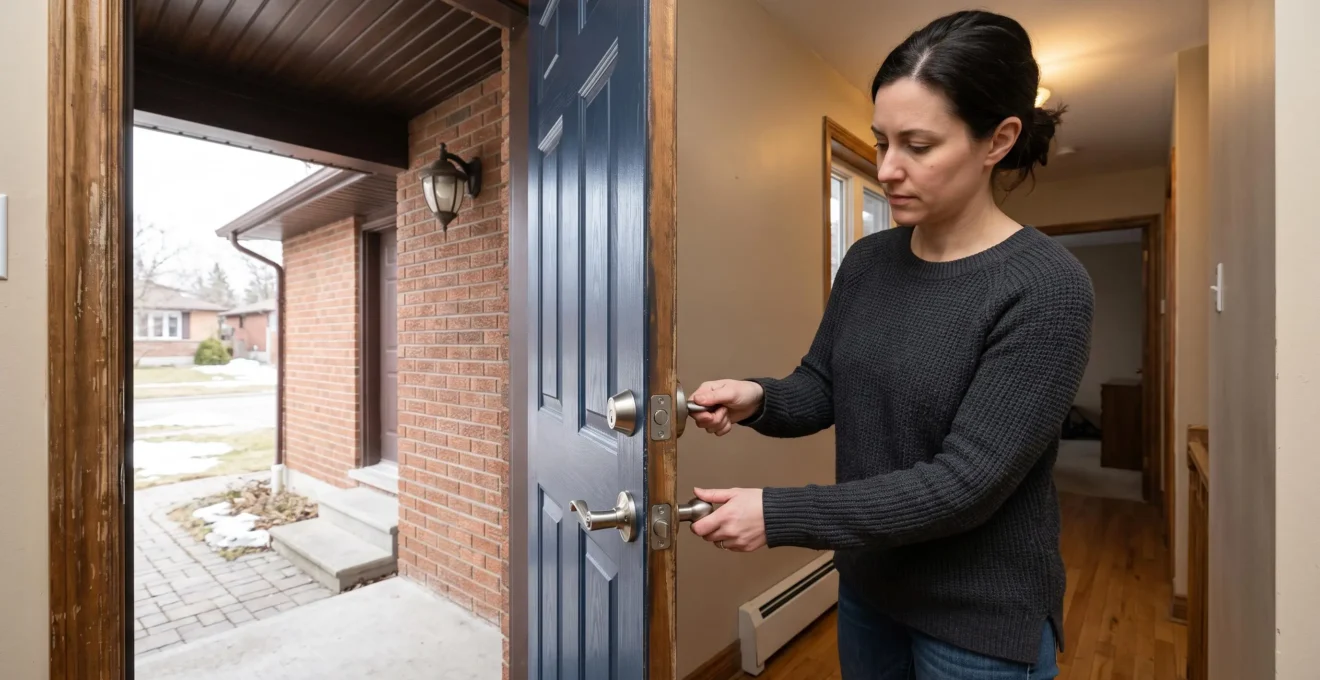
The most effective residential security measures for Canadian homes combine strong physical entry points, reliable intrusion detection, outdoor visibility and a realistic response plan. Reinforced doors and windows make unauthorized entry more difficult. Alarms help identify a possible intrusion, while cameras provide visual information. None of these measures guarantees that a burglary will be prevented.
Choosing where to invest starts with identifying how someone could access the property. A detached house with accessible basement windows faces different vulnerabilities from a rented apartment with shared entrances. Seasonal conditions also matter: snow can reveal prolonged absences, freezing weather can interfere with exterior equipment, and winter heating may contribute to unwanted sensor alerts.
Rather than purchasing every available security device, homeowners should examine existing weaknesses and address the most consequential ones first. This means checking doors, windows, keys, visibility and household routines before deciding whether additional technology will provide meaningful protection.
Essential Home Security Priorities
- Secure entry points first: Check doorframes, deadbolts, accessible windows and basement openings before investing heavily in electronic equipment.
- Reduce visible opportunities: Maintain outdoor lighting, manage deliveries, protect access credentials and arrange property care during extended absences.
- Connect detection to a response: Choose alarms, cameras and monitoring arrangements according to who can assess and respond to a security notification.
- Why Do Predictable Household Routines Increase Burglary Risk?
- How Can You Secure Basement Windows in a Canadian Detached House?
- Portable Alarms or Smart Locks for Canadian Apartment Renters?
- The Vacation Security Mistakes That Make Empty Homes Easier to Target
- When Should You Upgrade Home Security After a Household Change?
- Motion-Activated Lights or Warning Signs for Dark Property Entrances?
- Why Do Heating Vents Trigger False Motion Alerts in Winter?
- How Can Surveillance and Alarm Systems Work Together to Protect Canadian Properties?
Why Do Predictable Household Routines Increase Burglary Risk?
Predictable household routines can increase burglary risk when repeated, externally visible activities reveal when a home is likely to be empty. Regular departure times, consistently dark rooms and unattended deliveries may provide clues about occupancy. The practical solution is to reduce obvious vacancy signals while maintaining dependable habits such as locking doors and activating security systems.
A household does not need to change its work schedules or school runs to improve security. Instead, residents can evaluate what is visible from public areas during a typical weekday. For example, an empty driveway, uncollected packages and the same lights remaining off every evening may collectively suggest that nobody is home.
These observations should not be treated as proof that burglars routinely study individual households. They are potential indicators of vacancy, and their significance varies with the property and surrounding environment.
A useful occupancy-signal audit involves examining the driveway, entrance, visible windows and delivery area at different times. Residents can identify simple improvements, such as arranging package collection or adjusting lighting in rooms visible from the street.
Automated lighting helps reduce the appearance of an unoccupied property, but a timer that follows precisely the same schedule every day may itself become predictable. Selected lighting periods can be varied without abandoning consistent security practices.
The Vancouver Police Department home security recommendations include using indoor light timers and maintaining the appearance of occupancy. These are practical preventive measures rather than guarantees against burglary.
Digital information deserves attention as well. Public travel announcements, visible schedules and unnecessary sharing of connected-device activity can reveal absences. Reviewing account privacy settings and limiting public disclosures can complement physical protection.
Consistent locking habits should never be confused with predictable occupancy. Doors should be secured every time residents leave, regardless of how long the absence will last.
Occupancy cues are useful supporting measures, but strong entry points remain essential when someone attempts to access the property.
How Can You Secure Basement Windows in a Canadian Detached House?
Basement windows can be secured by improving their locks, reinforcing vulnerable glazing, maintaining sturdy frames and protecting accessible openings against forced entry. However, security improvements must not obstruct emergency escape. In Canadian detached houses, window wells also require seasonal inspection because accumulated snow, ice and debris can interfere with drainage, maintenance and safe evacuation.
Basement openings deserve particular attention because some are accessible from ground level or positioned inside recessed window wells. A window that appears small from indoors may still be vulnerable when its latch is deteriorated or the surrounding frame is weak.
Begin by examining each opening for:
- Ground-level accessibility and areas where vegetation provides concealment.
- Loose frames, damaged seals, deteriorating hardware or unreliable latches.
- Windows that can be lifted, forced open or manipulated because existing protection is inadequate.
- Window wells affected by standing water, blocked drainage, snow or debris.
- Any emergency escape function that additional security hardware could compromise.
Different reinforcement products address different weaknesses. A stronger window lock can improve resistance to opening, while security film or compatible protective glazing may make glass penetration more difficult. Security bars introduce a separate physical barrier but require particularly careful consideration where emergency escape is necessary.
| Security measure | Primary benefit | Important limitation |
|---|---|---|
| Reinforced window locks | Improves resistance to unauthorized opening | Does not necessarily strengthen weak glazing or frames |
| Compatible security film | May improve resistance to glass penetration | Performance depends on the glazing, frame and installation |
| Protective glazing | Can improve resistance to glass damage | May require more extensive replacement work |
| Security bars or grilles | Adds a physical obstruction to entry | Can create an evacuation hazard if incorrectly selected or installed |
Emergency escape must remain usable. Before installing bars, grilles or other restrictive hardware, confirm whether the window serves as a required emergency exit and check applicable provincial and local building and fire requirements. Where suitable and permitted, hardware that occupants can release from inside without special tools may help reconcile security with evacuation needs.
Canadian seasonal conditions make maintenance especially important. Snow accumulation can block an opening, freezing water can interfere with moving components, and poor drainage can damage surrounding materials. Inspections after significant winter weather and during the spring thaw can reveal problems before they become urgent.
Any reinforcement should be evaluated as part of the complete window assembly. Stronger glazing offers limited protection if a deteriorated frame or defective latch remains the easiest point of failure.
Once vulnerable openings are identified, the next priority is ensuring that household members can manage authorized access without weakening existing doors or evacuation routes.
Portable Alarms or Smart Locks for Canadian Apartment Renters?
Portable alarms are generally more practical for Canadian apartment renters seeking reversible intrusion alerts, while smart locks are more useful when managing authorized access for several occupants or visitors. They solve different problems: an alarm detects a possible opening, whereas a smart lock controls entry credentials. Neither necessarily improves the physical strength of a weak apartment door.
A portable door or window alarm may be suitable when the renter cannot modify existing locks. Depending on the model, installation may use removable mounting methods, allowing the equipment to be taken to another property.
Smart locks can provide additional access-management features, such as individual codes or temporary permissions. However, they may require lock replacement, compatible door hardware and permission from the landlord or building operator.
| Decision factor | Portable alarm | Smart lock |
|---|---|---|
| Primary function | Detects a possible opening or disturbance | Controls authorized entry |
| Installation | Often reversible, depending on the device | May require alteration of existing locking hardware |
| Recurring costs | Depends on notification or monitoring features | Depends on connected features and subscriptions |
| Battery dependence | Requires attention to power and alert operation | Requires a reliable method of maintaining access |
| End of tenancy | Often removable | May require authorization and restoration of original hardware |
Tenancy restrictions must be checked before replacing a lock. Under section 35 of Ontario’s Residential Tenancies Act, 2006, tenants covered by the legislation cannot alter the locking system on an entrance to a rental unit or residential complex without the landlord’s consent.
British Columbia uses a different statutory framework. Section 31 of British Columbia’s Residential Tenancy Act generally requires the landlord’s written agreement or a director’s order before a tenant changes the lock or other means of access to a rental unit. Separate restrictions address common areas.
These provincial provisions should not be generalized to every Canadian rental arrangement. Applicable legislation, lease conditions, building access systems and fire-safety requirements all warrant review.
Before purchasing, renters should also consider failure scenarios. A depleted battery, lost phone, compromised access code or unavailable network connection may interrupt a device’s expected operation. Check whether the equipment supports offline use, how authorized users regain access and which backup methods remain available during an outage.
The best device is the one that addresses the apartment’s actual weakness while remaining compatible with its existing hardware and tenancy requirements.
Whatever equipment a renter selects, the security plan should also account for periods when nobody is present to notice a problem.
The Vacation Security Mistakes That Make Empty Homes Easier to Target
Vacation security mistakes often involve leaving visible evidence that a home is unoccupied. Accumulated parcels, uncollected mail, consistently dark rooms and snow-covered walkways can reveal an absence. Preventing these signals requires more than activating an alarm: homeowners also need dependable property care, careful information sharing and a response arrangement that remains functional while they are away.
Short absences and extended vacations create different concerns. During an ordinary workday, a closed garage or empty driveway may reveal little on its own. Over several days, however, missed deliveries and neglected outdoor maintenance can make inactivity more apparent.
Winter introduces a particularly Canadian consideration. An unshovelled walkway after snowfall may make an extended absence easier to notice. Indoor light timers cannot compensate for every external sign that nobody is maintaining the property.
Homeowners should arrange for a trusted person to perform specific tasks rather than relying on a vague agreement to watch the house. These responsibilities can include collecting mail, managing deliveries, checking visible damage and arranging seasonal maintenance.
Five Actions to Complete Before Leaving Home
- Inspect entry points: Test exterior locks and accessible window latches; create a short list confirming which openings were checked.
- Assign a property contact: Agree on mail collection, delivery management and exterior checks; record the responsible person’s name and tasks.
- Arrange seasonal maintenance: Confirm who will handle snow removal or other necessary upkeep; retain the agreed maintenance arrangement.
- Verify alert response: Test the relevant alarm notification method and confirm who can respond; save an updated emergency contact list.
- Review absence requirements: Check insurance provisions and planned public communications; keep a departure checklist identifying completed arrangements.
Remote cameras can supplement these arrangements by providing visibility into selected areas. However, a video feed does not collect packages, remove snow or repair a damaged entrance. Physical inspections and electronic surveillance perform different functions.
Travel information also deserves careful handling. Public social media posts, accessible itineraries and automatic replies that disclose exact travel dates can unnecessarily reveal when a property may be empty. Sharing essential information privately with trusted contacts is different from publishing it widely.
Insurance conditions need individual verification. Home insurance policies may contain provisions concerning vacancy, extended absences or property inspections. Requirements can differ by insurer, coverage and circumstances, so homeowners should check their actual policy rather than assume a universal Canadian rule.
The previously cited Vancouver and Durham police guidance supports maintaining an occupied appearance during vacations, including managing deliveries and snow removal. These measures address observable vulnerabilities without establishing a guaranteed level of protection.
A well-prepared absence also depends on keeping access permissions current, especially when household circumstances have changed.
When Should You Upgrade Home Security After a Household Change?
Home security should be reassessed whenever a household change affects who can enter the property, how occupants use its entrances or whether existing protection remains appropriate. Moving, separation, lost keys, roommate changes and the departure of authorized visitors are important triggers. Upgrades should address the specific access risk created by the change rather than follow an arbitrary equipment replacement schedule.
A new resident may inherit unknown access permissions from previous occupants. Someone who moves out might retain a physical key, an alarm code or an active smart-lock account. These situations do not necessarily indicate weak hardware; they may indicate that access remains available to someone who is no longer authorized.
Start with an access-permission reset that covers every relevant entry method:
- Identify the exterior doors, garages and other controlled entrances.
- Account for physical keys and determine whether any copies are missing or unaccounted for.
- Review keypad codes, temporary guest credentials and smart-lock user accounts.
- Remove access permissions that are no longer required, and update alarm users and emergency contacts.
- Test authorized entry and emergency exit arrangements after changes are completed.
Rekeying or replacing a lock may be more appropriate than merely changing a digital code when physical keys remain unaccounted for. A code reset does not invalidate a working mechanical key unless the specific locking system provides that capability.
Household needs may change in other ways. Young children, older relatives or new residents may require simpler operating procedures, clearer emergency exit arrangements or more reliable methods of entering without a smartphone.
Added complexity is not automatically better protection. A system that residents struggle to operate can create avoidable lockouts or lead to inconsistent use.
The decision to upgrade should therefore distinguish between access control, forced-entry resistance and detection. If the existing door and lock remain suitable but a former occupant still has credentials, resetting access may be more important than purchasing additional cameras.
After authorized access has been addressed, homeowners can examine whether the surrounding entrance environment makes suspicious activity easier to conceal.
Motion-Activated Lights or Warning Signs for Dark Property Entrances?
Motion-activated lights generally offer more direct practical value than warning signs at a poorly illuminated entrance because they improve visibility when movement is detected. Warning signs merely communicate that security measures may be present. Neither option strengthens a weak lock, so physical entry protection should come first, followed by appropriate lighting and any supplementary signage.
Dark side doors, recessed entrances and poorly visible approaches can make activity harder for residents or neighbours to observe. Motion-activated lighting can illuminate these locations when the sensor detects movement within its operating range.
Placement matters more than simply choosing a high-output fixture. Examine the routes someone might take toward the entrance and identify areas hidden by walls, porches or landscaping.
Position the light so that it illuminates the relevant approach and door area without directing excessive glare toward nearby windows, neighbouring properties or surveillance cameras. A poorly aimed light may create bright hotspots while leaving the intended entry point inadequately visible.
Canadian weather introduces additional performance considerations. Snow and ice can obstruct fixtures or sensors, while cold temperatures may affect equipment that is not rated for the expected conditions. Animals and passing traffic can also cause unwanted activation depending on sensor placement.
Check the manufacturer’s specified operating-temperature range and installation requirements. After installation, test the actual coverage at night by approaching the entrance along normal access paths and observing whether useful areas become illuminated.
Warning signs serve a narrower purpose. A notice identifying an alarm may communicate the presence of security equipment, but a sign does not detect an attempted entry or provide physical resistance. Nor should it be presented as proof that an operational alarm system exists when that has not been established.
A sensible purchasing sequence is to repair weak locks and reduce major concealment opportunities, improve lighting where visibility is inadequate, and only then consider signage as a supplementary measure.
Where lighting is combined with motion detection and surveillance, homeowners should also understand how environmental conditions influence the reliability of automated alerts.
Why Do Heating Vents Trigger False Motion Alerts in Winter?
Heating vents can contribute to false motion alerts when warm airflow changes the thermal patterns detected by passive infrared sensors. Moving curtains near a heat source may also affect what a detector observes. These conditions can become more noticeable during Canadian winters, when heating systems operate frequently, although repeated alerts alone do not prove that a nearby vent is responsible.
Passive infrared, or PIR, sensors respond to changes in infrared radiation across their detection zones. They do not simply recognize a person entering a room. Environmental changes can sometimes produce signals that resemble the thermal variation associated with movement.
A detector positioned near a forced-air outlet, radiator or sunlit window may encounter changing conditions. Warm airflow passing across surfaces, combined with moving curtains or other materials, can create unwanted detection events depending on the sensor’s design and configuration.
Diagnosing the issue requires a controlled approach. Record when alerts occur, which detector reports them and whether the timing coincides with heating cycles. Then observe whether curtains or objects move near the detector’s field of view.
Correlation is a diagnostic clue, not proof of causation. Alerts that happen while the furnace is running may justify investigating airflow, but other potential causes should remain under consideration.
Once a plausible source is identified, consider repositioning the detector away from direct heat sources or modifying its mounting orientation within manufacturer instructions. Sensor sensitivity may also be adjustable, but reducing it excessively risks making genuine movement harder to detect.
After any adjustment, perform the detection tests specified by the manufacturer. Confirm that movement along relevant access paths still produces the expected response, including while the heating system operates normally.
Where environmental interference continues, a different detection arrangement may be more appropriate. Door and window contact sensors identify relevant opening events rather than relying on the same room-level thermal detection mechanism, so they can provide complementary perimeter coverage.
A reliable configuration should detect meaningful intrusion activity while minimizing unnecessary alerts that could distract residents or monitoring personnel.
The final objective is not merely to reduce false alerts but to connect reliable detection with visual assessment and an appropriate response.
Key Takeaways Before Choosing a Complete Security System
- Start with vulnerabilities: Determine which doors, windows and access permissions create the most significant exposure before selecting electronic equipment.
- Evaluate detection quality: Choose sensor coverage that addresses actual entry risks and remains dependable during normal seasonal conditions.
- Plan the response: Establish who will review notifications, assess camera footage and take appropriate action when an alert occurs.
How Can Surveillance and Alarm Systems Work Together to Protect Canadian Properties?
Surveillance and alarm systems work together by combining intrusion detection, immediate notification and visual assessment. Door and window sensors identify relevant opening events, alarms signal a possible breach, and cameras provide footage that helps occupants evaluate what happened. Effective protection also requires secure physical entrances and someone who can respond; recording activity alone does not prevent unauthorized entry.
A layered residential security system assigns a different responsibility to each measure. Reinforced locks, doorframes and windows help delay forced entry. Intrusion sensors detect particular events, while audible alarms draw attention to a possible problem.
Security cameras add information about the surrounding area. Depending on their placement and capabilities, they may show activity at entrances, driveways or other vulnerable locations.
These functions are complementary rather than interchangeable. A camera may record someone approaching a door without detecting whether the door was forced. Similarly, an alarm sensor may indicate that an entrance opened without identifying who caused the event.
A coordinated response can follow a straightforward sequence:
- A door or window sensor detects an opening event and activates the configured notification process.
- A resident or designated monitoring provider receives the alert.
- Available camera footage or other information is reviewed to assess the event.
- The responsible person follows a predetermined response procedure appropriate to the available evidence.
- Emergency services are contacted when warranted, following applicable procedures rather than assuming every automated notification requires dispatch.
An automated alert is not the same as a verified intrusion. Nor does professional monitoring automatically guarantee that emergency personnel will be dispatched or arrive within a particular period.
The choice between self-monitoring and professional monitoring depends partly on response availability. Someone who frequently travels, works where notifications cannot be checked or lacks a nearby contact may need a different arrangement from a household with dependable access to alerts.
| Consideration | Self-monitored system | Professionally monitored system |
|---|---|---|
| Alert assessment | Resident or designated contact | Monitoring provider according to service procedures |
| Recurring costs | Depend on equipment and connected services | Generally include a monitoring service charge |
| Response availability | Depends on the resident or contact | Depends on contracted monitoring capabilities |
| Connectivity | Varies by equipment and notification method | Varies by equipment and available communication paths |
| Power disruption | Backup capabilities depend on the system | Backup capabilities depend on installed equipment and service arrangements |
Canadian winter conditions make outage planning particularly relevant. During a power failure, battery-backed alarm components may continue operating if the equipment is designed and maintained for that purpose. However, internet routers, cameras and communication equipment may have separate power requirements.
Some systems support alternative communication paths, but homeowners should verify the actual equipment capabilities, backup duration and notification method rather than assume that every alarm will remain connected during an outage.
Camera placement also requires a privacy assessment. Coverage should focus on legitimate security needs around the property. When neighbouring homes, shared apartment corridors or common areas could be recorded, review the applicable privacy obligations and building rules before installation.
For purchasing decisions, prioritize improvements in a logical sequence: first address weak physical entry points, then add useful intrusion detection, position cameras where visual context matters, and establish a dependable alert-response arrangement.
The previously cited Durham Regional Police guidance supports combining entry-point security, outdoor lighting, alarms and surveillance. It does not establish that any particular combination guarantees protection or that purchasing more devices necessarily produces better results.
Begin with a property-specific security assessment: identify vulnerable entrances, test existing locks and sensors, determine what each proposed device will improve, and confirm who can act on an alert. This produces a more practical investment plan than choosing equipment solely by its features or advertised capabilities.
Should Canadian homeowners install an alarm before replacing weak locks?
Weak locks, damaged strike plates and deteriorated frames should generally be addressed before treating an alarm as the principal protection measure. Alarms detect or signal potential intrusion events, but they do not necessarily prevent a vulnerable door from being forced open. The appropriate sequence depends on the property’s existing condition and the specific vulnerabilities identified.
Can a security camera replace a monitored alarm system?
A camera can provide useful footage and, depending on its features, notifications. However, it does not automatically provide the same detection, audible signalling or response arrangements as a monitored intrusion alarm. Homeowners should compare actual equipment functions and establish who will review and respond to alerts.
What should homeowners check after a winter power outage?
Check whether the alarm panel, cameras, network equipment and communication methods have returned to normal operation. Review any battery or connectivity warnings and follow manufacturer instructions for testing. A device that appears powered on may still require verification of notifications or communication with its monitoring service.
Are additional window locks suitable for every basement bedroom?
Not necessarily. A basement bedroom window may have an important emergency escape function. Additional locks, bars or other hardware must not compromise applicable evacuation requirements. Homeowners should check the relevant provincial and local building and fire rules before installing restrictive security measures.
How often should a Canadian household review its security arrangements?
A review is especially useful after moving, losing keys, changing occupants, experiencing equipment problems or discovering new entry vulnerabilities. Seasonal checks can also identify snow-related obstructions, damaged outdoor fixtures and unreliable sensors. There is no universal replacement interval that makes every otherwise functional security device obsolete.