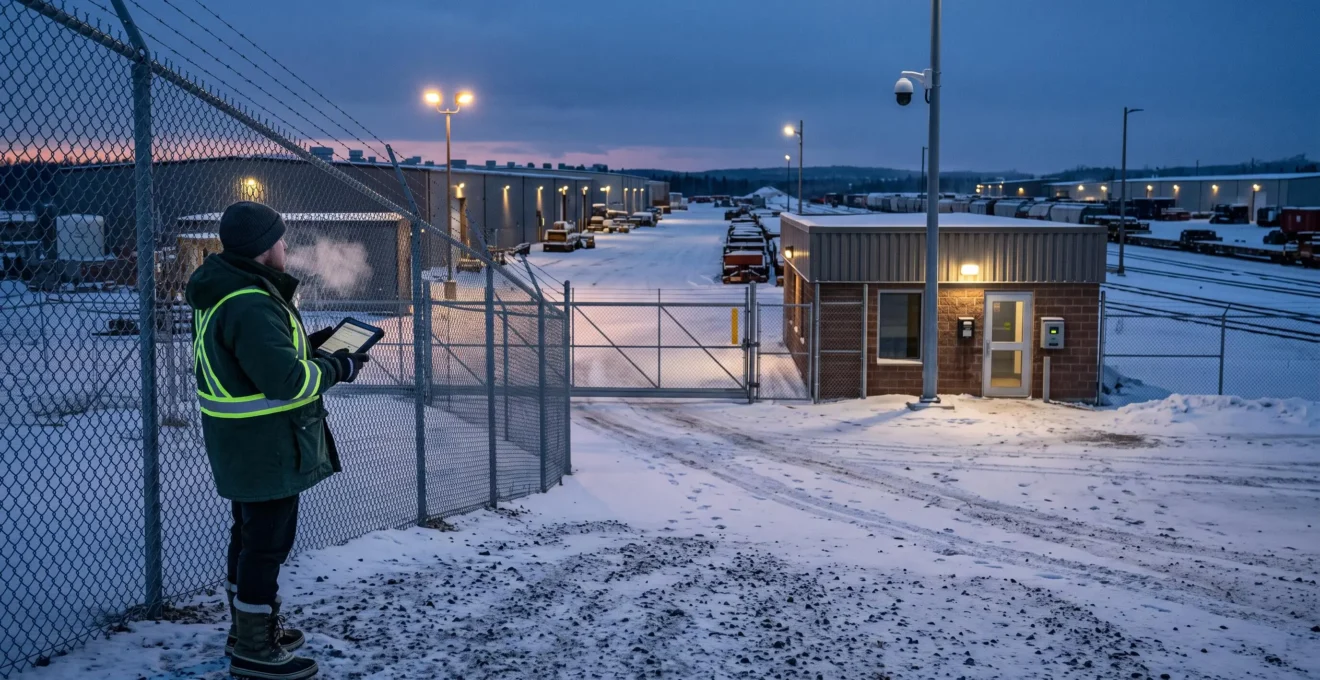
A perimeter fence can discourage trespassing, but it cannot verify an alarm, protect a network cabinet or guarantee that someone responds to an intrusion. For Canadian property managers overseeing commercial buildings, industrial yards or multi-building facilities, these limitations become more serious when physical and digital vulnerabilities overlap.
A layered security approach reduces dependence on any single protective measure. It combines perimeter controls, access restrictions, intrusion detection, surveillance, operational procedures and coordinated incident response. Each component serves a distinct purpose, while the connections between components determine how effectively the property can identify and manage threats.
Canadian operating conditions introduce additional challenges. Snow accumulation can change effective fence heights, freezing temperatures can affect equipment, and renovations can create access routes that existing monitoring arrangements do not cover. Shared responsibilities among tenants, property managers, security contractors and IT teams further complicate protection.
The practical objective is to create a security system in which failures are detected, responsibilities are clear and successive controls continue protecting people, facilities and information assets.
Layered Property Security: Key Principles
- Combine deterrence, detection, delay and response so that defeating one control does not automatically expose the entire property.
- Map security coverage across buildings, access routes and operational responsibilities, including seasonal vulnerabilities.
- Connect alarms, surveillance, access controls and incident-response procedures so security personnel can verify threats and take appropriate action.
- Why Does a Single Security Barrier Fail to Stop Coordinated Intrusions?
- How Can You Map Security Layers Across a Multi-Building Property?
- Perimeter Controls or Internal Monitoring: Which Should You Prioritize First?
- Why Disconnected Security Systems Create Dangerous Response Gaps
- When Should You Reassess Security Layers After Renovations or Expansion?
- How Can Security and IT Teams Coordinate During a Building Intrusion?
- How Can You Assess Fence Weak Points on a Large Property?
- How Can Surveillance and Alarm Systems Work Together to Protect Canadian Properties?
Why Does a Single Security Barrier Fail to Stop Coordinated Intrusions?
A single security barrier fails against coordinated intrusions because its effectiveness depends on one control remaining intact. Once an intruder bypasses that fence, lock or monitoring point, there may be nothing left to detect movement or delay access. Layered security addresses this weakness by requiring successive controls to be overcome while creating additional opportunities for detection and response.
Consider a commercial property protected by fencing but with limited monitoring around its loading docks. The fence may discourage opportunistic trespassing, particularly when someone encounters an unexpected physical obstacle. However, a planned intrusion presents a different challenge.
Someone who has observed the property’s routines may already understand when deliveries arrive, which entrances receive the most traffic and where supervision is limited. A barrier that successfully discourages spontaneous entry may offer much less protection when its weaknesses have been identified in advance.
Canadian winters can complicate the situation. Accumulated snow may reduce a fence’s effective height, while long periods of darkness make reliable illumination and surveillance especially important. These conditions do not automatically make a site vulnerable, but they can change the performance of controls designed for different conditions.
The alternative is defence in depth: an arrangement where several different measures contribute to protection.
- Deter: Discourage unauthorized access through visible boundaries, lighting and controlled entrances.
- Detect: Identify suspicious activity using intrusion sensors, cameras and access-event monitoring.
- Delay: Restrict further movement through secured doors, protected areas and appropriately selected physical barriers.
- Respond: Enable trained personnel to assess the incident and initiate the appropriate intervention.
The Canadian Centre for Cyber Security physical and environmental protection guidance describes intrusion alarms as complementary to physical barriers, access-control systems and security personnel. Its PE-06 control also addresses physical-access monitoring and coordination with incident-response capabilities.
This establishes a useful distinction: additional hardware is not necessarily an additional effective layer. Two devices that depend on the same vulnerable power supply, communication connection or monitoring process may share a common point of failure.
The objective is not to make intrusion impossible. It is to increase the likelihood that unauthorized activity will be identified and contained before it develops into a more serious incident. Establishing that protection requires understanding how the layers are distributed across the property.
How Can You Map Security Layers Across a Multi-Building Property?
Map security layers by documenting every building, access route, existing control and responsible party on a current site plan. Then classify each control according to whether it deters, detects, delays or supports response. This reveals areas where protection is incomplete, responsibilities overlap or an apparently protected route lacks a working detection mechanism.
Begin with a property-wide inventory rather than a building-by-building equipment list. A facility may have individually secured buildings while leaving shared yards, connecting corridors and service routes insufficiently monitored.
For each building, identify pedestrian doors, vehicle entrances, loading docks, service entrances, roof-access routes and connections to neighbouring structures. Include supporting infrastructure such as electrical rooms, network cabinets and access-control equipment where unauthorized access could affect security operations.
Plot the existing protective measures against these routes. A practical map should distinguish physical barriers from monitored zones, access-controlled areas and response coverage.
Layer ownership is equally important. For example, a tenant may administer access credentials for its premises, the property manager may maintain exterior lighting, and a third-party contractor may monitor alarms outside normal business hours.
Without this information, an area can appear protected even when nobody is accountable for maintaining or responding to its security controls.
A useful planning matrix separates the protective function from the party responsible for it.
| Property area | Existing protection | Assessment priority |
|---|---|---|
| Main vehicle gate | Barrier, controlled access and surveillance | Check credential management, camera visibility and response procedures. |
| Shared loading yard | Lighting and periodic patrols | Identify unmonitored access routes and responsibility for alerts. |
| Tenant service entrance | Electronic locking and door-contact sensor | Confirm who manages credentials and receives alarms. |
| Inter-building passage | Limited access restrictions | Assess movement between buildings and possible detection gaps. |
| Network equipment room | Locked door and access records | Verify restricted access, log review and IT escalation. |
The matrix is illustrative, not an assessment of a particular Canadian facility. Each site’s actual risks depend on its layout, occupancy, operations and threat exposure.
Mapping should also account for seasonal changes. Snow storage can obstruct camera views or alter access to fences. Ice may interfere with doors and gates. Vegetation can block sightlines during summer while leaving areas exposed in winter.
Maintaining both summer and winter observations helps distinguish permanent infrastructure weaknesses from seasonal operating issues. Responsibility assignments, alarm-zone references and site drawings should be updated together so they remain consistent.
Once the map identifies the most consequential gaps, the next decision is where limited resources should be invested first: at the property boundary or closer to valuable assets.
Perimeter Controls or Internal Monitoring: Which Should You Prioritize First?
Prioritize perimeter controls when boundary protection can meaningfully delay unauthorized entry and support timely detection. Prioritize internal monitoring when the perimeter is extensive, difficult to secure or unlikely to provide sufficient delay. For many Canadian properties, the strongest initial investment is targeted detection at likely access routes, followed by improvements to vulnerable physical barriers.
The choice is a risk-management decision rather than a universal design rule. A compact facility with a limited number of controlled entrances may benefit considerably from perimeter improvements. By contrast, an industrial complex adjoining public roads and multiple shared boundaries may face substantial costs without achieving the same level of control.
Municipal restrictions, neighbouring properties, shared access arrangements and operational requirements can further limit fencing or lighting options. Property managers should confirm the rules applicable to the specific site before approving construction.
Delay value offers a practical way to compare investments. Ask whether a proposed barrier is likely to slow unauthorized movement long enough for detection, verification and a realistic response.
If an exterior control provides only limited delay, spending the available budget exclusively on that feature could leave essential areas exposed. Interior door controls, monitored service rooms or intrusion detection near valuable assets may provide a more useful second line of defence.
The comparison below illustrates the trade-off.
| Decision factor | Perimeter controls | Internal monitoring |
|---|---|---|
| Primary objective | Discourage or delay entry at the property boundary | Identify unauthorized activity within designated areas |
| Most suitable conditions | Defined boundaries and manageable entry points | Long, shared or operationally open perimeters |
| Typical limitation | A compromised boundary may expose internal areas | Detection may occur after someone has entered the site |
| Operational dependency | Maintenance, access management and complementary monitoring | Reliable sensors, communications, verification and response |
A phased strategy can address both requirements. Initial work might concentrate on monitoring high-risk doors and loading areas. Later phases can strengthen gates, improve fence condition and add further detection coverage where the risk assessment supports it.
Insurance requirements deserve attention before procurement. Commercial insurers may consider security controls when evaluating property risks, but requirements and potential pricing effects depend on the insurer, policy and insured activity. A monitored system should not be assumed to qualify automatically for a discount or any particular coverage benefit.
Request written clarification from the insurer or broker about relevant security conditions. This avoids making expensive improvements that do not meet the policy’s actual requirements.
Whichever area receives the first investment, its value can be undermined if the installed devices cannot communicate with monitoring personnel and other security systems.
Why Disconnected Security Systems Create Dangerous Response Gaps
Disconnected security systems create response gaps because alarm events, video footage, access records and equipment-status information remain separated. Operators may have to examine several platforms before understanding what happened and deciding how to respond. Integration can reduce unnecessary manual checks, improve incident verification and reveal equipment failures that otherwise remain unnoticed.
Imagine a loading-dock alarm activates outside operating hours. The monitoring provider receives a sensor notification, but the camera system is administered through a separate interface and the access-control records are available only to the building manager.
The operator must obtain information from multiple sources to determine whether the event involves an authorized delivery, an equipment fault or a possible intrusion.
This scenario is hypothetical, but the operational problem is straightforward: information that cannot be accessed together is harder to evaluate together. The consequences depend on the systems, staff availability and procedures involved; no fixed response-time penalty should be assumed.
Alarm verification can also affect police dispatch. The York Regional Police Verified Alarm Response Program requires verification before dispatching officers to alarm calls. Its published criteria allow monitoring companies to use information such as video, audio or multiple alarm activations.
CAD 240 + HST
Published attended false-alarm charge under the York Regional Police program. This is a jurisdiction-specific amount, not a Canadian national fee or average.
York Regional Police, Verified Alarm Response Program. Confirm current fees and dispatch requirements directly before making operational decisions.
Other Canadian police services may apply different verification policies, dispatch priorities or false-alarm charges. Property managers therefore need to understand their local requirements instead of assuming a national standard.
Before purchasing equipment, ask vendors how their products exchange events and operational data. Commonly supported interfaces, documented APIs or tested integrations can make future expansion easier, but compatibility must be demonstrated for the intended configuration.
Integration should also include equipment-health monitoring where supported. A camera that loses connectivity, a sensor that reports a fault or a communication path that becomes unavailable should generate information that reaches the party responsible for corrective action.
Connected systems still need independent testing, cybersecurity safeguards and fallback procedures. Integration must not introduce a common failure that disables several protective functions simultaneously.
A connected security design provides a stronger foundation for incident handling, but it must remain aligned with the property itself. Renovations, tenant changes and building expansion can invalidate otherwise sound coverage plans.
When Should You Reassess Security Layers After Renovations or Expansion?
Reassess security layers whenever construction or operational changes affect access routes, surveillance coverage, alarm zones, infrastructure or responsibility for security controls. Critical review points include project planning, temporary construction arrangements, commissioning and final handover. A follow-up assessment after seasonal changes may also be necessary, particularly when Canadian winter conditions could alter visibility or access.
A renovation can create security weaknesses without directly modifying a fence or alarm panel. Adding a loading dock changes traffic patterns. Relocating an electrical room introduces new access requirements. Reconfiguring a corridor can create an unmonitored route between previously separated zones.
Temporary arrangements require particular attention. Construction projects frequently involve temporary entrances, repositioned fencing, interrupted camera views and expanded contractor access permissions.
These arrangements may be justified while work is underway, but they should have documented owners, compensating controls and an agreed end condition. Otherwise, temporary exceptions can remain active after the operational need disappears.
A controlled project-closeout process should confirm that changes have been incorporated into both physical security and monitoring arrangements.
Five Security Checks Before Project Handover
- Reconcile access points: Walk every new, modified and retained entrance and produce an updated access-point register.
- Verify protective devices: Function-test affected cameras, contacts and intrusion sensors, recording results in a signed commissioning checklist.
- Confirm monitoring coverage: Check that modified zones and contact instructions appear correctly in the monitoring provider’s account, retaining written confirmation.
- Close temporary permissions: Review contractor credentials, temporary doors and construction overrides, producing an exceptions-closure record.
- Update emergency documentation: Distribute revised site plans and response instructions to authorized teams, retaining a document version and distribution record.
Where occupancy approval or project completion depends on particular security measures, applicable requirements should also be verified with the responsible authorities and project professionals. The checklist is a practical management tool, not a substitute for statutory inspections or permit conditions.
Canadian winter conditions may warrant additional post-construction checks. Changes to grading can redirect snow accumulation or drainage. New structures may obstruct floodlighting, and seasonal snow storage may interfere with camera sightlines or vehicle-gate operation.
A project completed in autumn should therefore be reviewed under relevant winter conditions once those conditions occur. The assessment can then identify problems that commissioning during warmer weather would not reveal.
Physical changes can also affect network-connected access systems and equipment rooms. This makes the relationship between facilities personnel, security operations and IT an essential part of incident preparedness.
How Can Security and IT Teams Coordinate During a Building Intrusion?
Security and IT teams should coordinate through a predefined incident-response protocol that assigns decision-making authority, establishes shared communications and protects critical evidence. Physical security personnel manage access, immediate safety and on-site observations, while IT personnel assess affected systems, preserve technical records and contain digital risks. Both responses should proceed in parallel when the incident involves connected infrastructure.
A building intrusion does not automatically constitute a cybersecurity incident. However, unauthorized access to a network cabinet, server room or access-control controller creates a potential connection between physical compromise and digital security.
For example, tampering with an access-control cabinet may affect the reliability of electronic door permissions. Unauthorized access to network equipment may expose devices or information assets, depending on their configuration and protections.
The response plan should establish who can declare an incident, who contacts emergency services when necessary, and who authorizes actions affecting network connections, electronic locks or building operations.
Safety and continuity requirements must be considered together. Isolating a compromised system might be appropriate, but an improvised shutdown must not compromise emergency egress, life-safety systems or essential building functions.
The Canadian Centre for Cyber Security incident response guidance addresses documented responsibilities, coordinated incident handling, information gathering and evidence preservation. Its incident-response controls provide a framework for connecting physical-access information with technical observations and recovery procedures.
A joint response protocol should identify four operational responsibilities:
- Incident command: Determine who coordinates decisions, external contacts and overall response priorities.
- Physical containment: Secure affected areas, protect occupants and control personnel movement without interfering with emergency requirements.
- Technical containment: Evaluate potential system compromise, preserve relevant logs and isolate affected components where authorized and safe.
- Evidence management: Document observations, restrict access to relevant records and follow established preservation and handling procedures.
Evidence handling often creates competing priorities. Property operations may need systems restored quickly, while IT specialists or investigators may require records or devices to remain undisturbed.
The protocol should specify who can authorize equipment resets, what information must first be preserved and when outside investigators or specialists should be consulted. Decisions should reflect the circumstances of the incident rather than a blanket prohibition on touching equipment.
Cross-training closes another operational gap. Security officers should understand which equipment cabinets and access devices require immediate reporting if tampering is suspected. IT staff should know how physical access events are monitored and whom to contact when technical alerts indicate a possible on-site problem.
Joint exercises can test whether contact information, escalation authority and evidence-handling instructions remain usable under realistic operating conditions. Findings should feed into updated procedures rather than remain isolated training observations.
Coordination protects the response process, but the physical environment still requires systematic maintenance. Long perimeter boundaries are particularly important because localized fence weaknesses may create access opportunities beyond the reach of routine monitoring.
How Can You Assess Fence Weak Points on a Large Property?
Assess fence weaknesses through a documented inspection of the entire boundary, recording structural defects, access vulnerabilities and gaps in surveillance coverage. Examine gates, corners, changes in ground elevation and utility crossings, then assess how weather affects each location. Rank findings by exposure and consequence before deciding whether to repair the fence, reinforce the area or add detection.
Large Canadian commercial and industrial properties may have extensive perimeter boundaries. Informal inspections can miss sections or produce inconsistent findings, particularly where the terrain changes or several gates and service routes divide the fence line.
A structured approach uses a current site plan with identifiable inspection segments. Inspectors should follow the fence in a consistent direction, record the location of observed conditions and check relevant sections from both sides where lawful, accessible and safe.
Inspection priorities include:
- Gate assemblies: Alignment, locking hardware, hinges, closure and access-control operation.
- Corner posts and elevation changes: Evidence of movement, lifting, sagging or abnormal tension.
- Utility crossings: Openings, damaged materials and changes around pipes or cables.
- Fence foundations: Ground movement, erosion, frost heave and undermined supports.
- Detection coverage: Whether nearby lighting, cameras or sensors provide usable information about the area.
Winter introduces specific conditions that should be considered in the inspection. Frost heave can alter post alignment, while road salt may accelerate corrosion around vehicle entrances. Snow accumulation may load fencing or create elevated ground beside it.
A snowbank against a boundary can effectively reduce the height that a person would need to overcome. This problem is not necessarily visible during warm-weather inspections and may require changes to snow-storage arrangements rather than fence replacement.
Structural condition is only one part of the assessment. A fence segment in good physical condition can still represent a vulnerability if it lies outside effective camera coverage or is poorly illuminated during the hours when detection matters most.
Overlay inspection results with the existing camera fields of view, sensor locations and lighting plan. This distinguishes a barrier defect from a detection gap and shows where several weaknesses coincide.
A practical severity ranking can consider the ease of unauthorized access, proximity to valuable assets, likelihood of detection and available response measures. High-priority findings should receive a named owner, corrective action and verification requirement.
The appropriate treatment is not always a stronger fence. Damaged posts may require structural repair, while a sound but poorly monitored location may justify better lighting, a repositioned camera or another detection method. Some locations require both.
The resulting inspection records should inform the broader security map. They also provide valuable input for the final integration decision: how surveillance and alarms can verify incidents across the property’s most exposed areas.
Key Takeaways Before Integrating Surveillance and Alarms
- Design monitoring around identified access and asset risks, rather than selecting camera positions solely for broad visual coverage.
- Confirm that alert information reaches an authorized operator who can assess it and follow a documented escalation procedure.
- Test the combined system under relevant operating conditions, including winter weather, network interruptions and equipment faults.
How Can Surveillance and Alarm Systems Work Together to Protect Canadian Properties?
Surveillance and alarm systems work together by connecting intrusion alerts with relevant visual evidence and an established response process. When a sensor activates, the monitoring operator can review the corresponding camera view, assess available evidence and determine the appropriate next action. Effective integration improves situational awareness, supports alarm verification and helps identify recurring security weaknesses.
The relationship begins with the alarm zone. A door-contact sensor may indicate that an entrance opened unexpectedly, but it cannot independently establish who entered or whether the event represents an intrusion.
A camera positioned to observe the same area can provide useful context. Depending on image quality, camera placement and the event itself, the operator may be able to distinguish authorized activity, an environmental trigger or behaviour requiring intervention.
Alarm-triggered video verification should therefore be considered during surveillance design rather than added as an afterthought.
For every priority alarm zone, property managers should identify the camera view that can provide relevant verification. Loading docks, controlled entrances and vulnerable perimeter sections may need different camera angles or supplementary detection methods.
Coverage should be judged by whether the required activity can actually be observed, not simply whether a camera is installed nearby.
Canadian weather complicates that assessment. Equipment temperature ratings must suit local conditions. Lens icing, snow reflection, condensation and long periods of darkness can affect image usability. Lighting should be tested for glare and shadows, particularly where reflective snow surfaces change the scene.
Surveillance design must also account for privacy obligations. The Office of the Privacy Commissioner guidelines for overt video surveillance recommend defining the surveillance purpose, documenting camera locations and fields of view, limiting unnecessary coverage, protecting recordings and providing appropriate notice.
These guidelines concern the stated private-sector surveillance context and do not replace the legal requirements applicable to employee monitoring, covert surveillance or specific federal and provincial jurisdictions. Property managers should confirm which privacy rules govern their operations.
Integration becomes operationally useful through a defined sequence:
- Detection: An alarm sensor generates an event linked to a specific monitored zone.
- Verification: The monitoring operator reviews available camera footage and other relevant event information.
- Classification: The operator assesses whether the event appears routine, uncertain or potentially threatening.
- Response: Authorized personnel follow the applicable procedure, which may involve site contacts, private security response or police notification where appropriate.
- Review: The event is recorded and assessed for recurring faults, exposure patterns or required security improvements.
This workflow does not guarantee that every alarm can be visually verified. Cameras may be obstructed, footage may be inconclusive and communication failures may prevent immediate access to video. Procedures must define how operators handle uncertain events and unavailable systems.
Routine testing should cover sensor-to-camera associations, video availability, notification delivery and equipment-health alerts. Results should be recorded so unresolved faults are assigned for correction.
The integration also creates a useful feedback mechanism. If repeated events occur at a specific gate, the property manager can review whether the issue concerns access procedures, sensor configuration, physical damage or a persistent vulnerability.
Security performance can then be improved through evidence-based adjustments rather than repeated purchases of unrelated equipment.
As a next step, select one priority building or access route and conduct a joint review with the property manager, monitoring provider and relevant technical staff. Document its barriers, detection coverage, verification procedure and response responsibilities, then test the workflow before extending the same assessment across the remaining property.
How many security layers does a commercial property need?
There is no universal number of security layers suitable for every commercial property. The appropriate arrangement depends on identified threats, asset value, building layout, occupancy and available response capabilities. A useful starting point is to verify that deterrence, detection, delay and response are all addressed, without relying on a single device or process for several essential functions.
Can a Canadian property use security cameras without continuous on-site guards?
Yes, cameras can support remote monitoring arrangements, provided the system has an appropriate operating model. Property managers should establish who reviews alerts, how events are verified and which response services are available. Surveillance alone cannot physically intervene in an intrusion, and any video monitoring must comply with applicable privacy requirements.
Who should maintain security controls shared by several commercial tenants?
Responsibilities should be assigned through the relevant leases, service agreements and property-management procedures. A shared security register can identify who administers access credentials, maintains equipment, receives alerts and authorizes corrective actions. The property manager should confirm that responsibilities are documented and that shared controls have clear arrangements for maintenance and incident escalation.
What should happen when an integrated security system loses network connectivity?
The response depends on the system design and the functions affected. Appropriate measures may include fault notifications, supported local operation, backup communications and temporary protective procedures. Property managers should determine in advance which capabilities remain available during an outage, ensure emergency safety functions are preserved and verify recovery through documented testing.
How can property managers tell whether layered security improvements are working?
Effectiveness can be evaluated through documented control testing, completed corrective actions, alarm-verification outcomes, equipment availability, access-permission reviews and incident exercises. Comparing these observations over time can identify unresolved weaknesses. Fewer reported incidents alone do not establish that protection has improved, because threat exposure and reporting practices may also change.