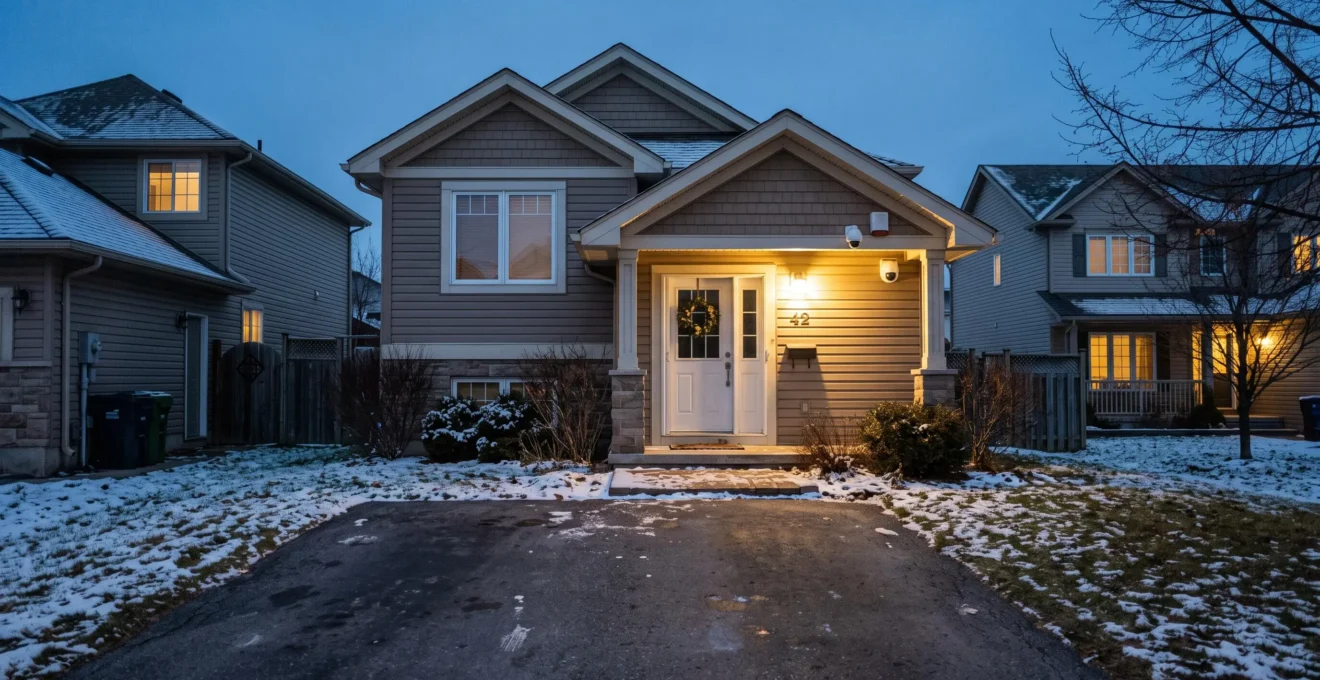
Visible security equipment can make a Canadian home or business less attractive to opportunistic intruders by increasing the perceived likelihood of detection. Outdoor cameras, functioning alarm systems, motion-activated lighting and clear warning signs communicate that a property is monitored rather than unprotected. Their value, however, depends on more than appearance: equipment must work, cover relevant access points and trigger a credible response.
Visual and audible deterrents serve different purposes. Cameras and warning signs communicate risk before an intrusion attempt, lighting exposes movement around entrances, and sirens draw attention when an alarm event occurs. Used together, these measures can create a layered security environment without requiring occupants to confront an intruder.
Canadian property owners also need to account for seasonal darkness, snow, neighbouring residences and local noise regulations. A system that repeatedly activates without a genuine security event can become a nuisance rather than a reliable warning. Effective deterrence therefore requires a balance between visibility, detection, appropriate alerts and practical follow-up.
Key principles of effective property deterrence
- Visible, functioning security equipment increases perceived detection risk, particularly for opportunistic intruders, but does not physically prevent entry.
- Motion-activated lighting and warning signs serve complementary purposes: one exposes movement, while the other communicates security precautions before someone approaches.
- Reliable alarms, appropriate positioning and remote verification help preserve the credibility of security alerts while limiting unnecessary noise and false activations.
- Why Does Visible Security Equipment Sometimes Deter Opportunistic Theft?
- How Can You Position Security Sirens to Limit Neighbour Complaints?
- Motion-Activated Lights or Warning Signs for Dark Property Entrances?
- Why Repeated False Sirens Can Weaken a Property’s Security Response
- How Can Lighting and Audible Warnings Respond to the Same Intrusion Event?
- The Vacation Security Mistakes That Make Empty Homes Easier to Target
- The Siren Installation Mistakes That Can Create Noise Complaints
- How Can Surveillance and Alarm Systems Work Together to Protect Canadian Properties?
Why Does Visible Security Equipment Sometimes Deter Opportunistic Theft?
Visible security equipment can discourage opportunistic theft because it increases the perceived likelihood that an intruder will be noticed, recorded or interrupted. A camera mounted near an entrance, a functioning external siren or clearly visible security lighting can make an otherwise accessible property appear less predictable. For someone choosing between several potential targets, that uncertainty may be enough to favour an easier opportunity.
The mechanism is primarily psychological. Opportunistic intruders generally have limited time to assess a property’s apparent security. They may look for accessible entrances, concealed approaches, poor lighting and signs that nobody is monitoring the premises. Visible equipment introduces another consideration: whether entering the property could trigger an alarm or attract attention.
The perception of detection, however, should not be confused with physical protection. The Royal Canadian Mounted Police distinguishes psychological barriers from physical security measures in its government physical-security guidance. CCTV cameras and functioning security lighting can increase perceived detection risk, but they do not physically prevent entry. Their effectiveness also depends on appropriate detection and response.
This distinction matters when selecting equipment. A camera that is clearly visible but does not record reliably, or an alarm siren that has been disconnected, may create an appearance of protection without providing the corresponding security function. A dummy camera should not be treated as equivalent to a working surveillance system.
Canadian weather adds another practical consideration. During winter, prolonged darkness can reduce natural visibility around entrances, garages and side access points. Visible equipment and functioning exterior lighting can therefore help communicate that these areas receive attention, particularly when daylight hours are limited. Nevertheless, snow, ice and cold temperatures can affect equipment operation and maintenance.
« A psychological barrier is a deterrent only, as it does not hinder or stop an event if the adversary decides to attack. »
For homeowners and business operators, the practical conclusion is to make security visible without relying on appearance alone. Cameras should cover relevant access areas, lights should illuminate approaches, and alarms should remain operational. A visible deterrent is most credible when it forms part of a functioning security arrangement.
Visible security measures are therefore best understood as an initial layer rather than a complete solution. Their greatest value comes from making opportunistic intrusion less attractive while supporting the detection and response measures that follow.
How Can You Position Security Sirens to Limit Neighbour Complaints?
Security sirens should be positioned to communicate an alarm without unnecessarily directing sound towards neighbouring homes. Their placement should account for the property’s layout, nearby residences, shared walls and the intended protected area. The objective is to make an alert noticeable while avoiding excessive or repeated noise that could undermine neighbour relations and the credibility of future warnings.
An external siren offers an obvious advantage: people outside the property may hear an alarm, making the event more noticeable. However, this visibility comes with a practical responsibility. A siren mounted high on a wall and facing directly towards neighbouring windows may expose nearby occupants to unnecessary noise, particularly in densely populated Canadian neighbourhoods.
An internal siren provides a different balance. Depending on the building’s construction and the alarm’s location, its sound may also be audible outside. It can therefore provide an audible warning without necessarily requiring an external unit. However, its effectiveness depends on the property’s layout, insulation and the specific security objective.
Before installation, assess the surroundings rather than selecting a location solely for maximum sound projection.
- Identify neighbouring houses, apartment windows and shared residential walls.
- Consider how sound travels through courtyards, narrow passages and enclosed spaces.
- Assess whether the siren needs to alert people outside or primarily occupants inside.
- Consider the direction of the speaker and the possibility of unnecessary sound exposure.
- Test the proposed configuration before permanently fixing the equipment.
Testing should take place at different times, including during quieter evening conditions. A sound level that seems acceptable during the day may be considerably more disruptive at night. The objective is not to establish a universal decibel threshold, since the available Canadian sources do not establish one for all residential sirens.
Municipal requirements also matter. Canadian alarm regulations are not uniform across the country. For example, the City of Québec‘s intrusion-alarm regulation R.A.V.Q. 601 limits the continuous operation of covered external audible alarms to ten consecutive minutes. That provision applies within the Québec City agglomeration, not nationally.
Consequently, property owners should consult their own municipality before choosing an alarm configuration. They should also check the manufacturer’s specifications and any applicable monitoring-service requirements.
Ultimately, the best siren is not necessarily the loudest or most exposed. It is the one that delivers a useful warning, operates reliably and remains compatible with the surrounding residential environment.
Motion-Activated Lights or Warning Signs for Dark Property Entrances?
Motion-activated lights and warning signs discourage opportunistic intruders in different ways. A warning sign communicates that a property has security precautions before someone approaches, while a motion-activated light exposes movement when someone enters its detection area. For dark entrances, lighting provides an immediate physical change in visibility; signage provides an earlier psychological warning. Combining both can improve coverage when entrances are concealed or difficult to monitor.
Motion-activated lighting is particularly useful around garages, side doors, rear entrances and long driveways. When movement triggers the light, an area that was previously difficult to observe becomes illuminated. This can make approaching or remaining near an entrance less discreet.
Warning signs work earlier in the decision process. A visible notice indicating that a property is protected by an alarm or surveillance system can communicate potential consequences before an individual reaches the entrance. However, a sign does not establish that equipment is functioning, and the available RCMP guidance does not demonstrate that warning signs independently prevent intrusions.
The choice depends on the property’s configuration.
| Property condition | Motion-activated lighting | Warning signs |
|---|---|---|
| Long or poorly illuminated driveway | Useful for revealing movement along the approach. | Communicates security precautions before arrival. |
| Concealed side entrance | Helps expose movement near the access point. | Provides an advance warning but does not illuminate the entrance. |
| Entrance clearly visible from the street | Provides additional illumination when movement occurs. | Can communicate the presence of security measures. |
| Multiple access points or dense landscaping | Can be installed to cover individual approaches. | Can reinforce awareness of security measures at relevant locations. |
Lighting calibration is essential. A detector that activates whenever a vehicle passes, an animal moves or environmental conditions change may produce frequent unnecessary activations. Over time, repeated illumination can become ordinary background activity rather than a meaningful indication of movement near the property.
Canadian winters require particular attention to installation and maintenance. Snow accumulation, changing environmental conditions and prolonged darkness can affect how outdoor detection equipment performs. A detector should be checked after significant seasonal changes, especially if snow, vegetation or other obstacles alter its field of view.
The RCMP recommends tamper-resistant motion-sensor lighting around residential property perimeters. Its guidance supports lighting as a residential security measure, although it does not provide a controlled comparison proving how much lighting reduces burglary rates.
The strongest approach is usually complementary: signage communicates risk in advance, while correctly positioned lighting makes movement more visible when someone approaches. Both should support, rather than replace, functioning detection and alarm equipment.
Why Repeated False Sirens Can Weaken a Property’s Security Response
Repeated false sirens weaken property security because they reduce confidence in the alarm and make people less likely to respond seriously when it activates. Neighbours may begin to ignore the sound, occupants may disable the system to avoid disruption, and unnecessary police responses can create additional administrative consequences. A reliable alarm must therefore distinguish genuine security events from technical or accidental activations.
The problem begins when an alarm becomes an unreliable source of information. A siren is intended to communicate that an event requires attention. If it sounds repeatedly without a credible reason, people may stop treating it as an urgent warning.
This creates a practical vulnerability. An intruder may benefit from the fact that surrounding residents have become accustomed to the noise, while occupants may be less attentive because previous activations proved unnecessary. Although the available sources do not quantify this neighbourhood habituation effect, it is a relevant operational risk when evaluating alarm reliability.
False alarms can also generate administrative costs. The North Vancouver RCMP identifies maintenance-related malfunctions, accidental activation and system testing as common causes of unnecessary alarm reports. It reports receiving more than false alarm reports received annually 1,000 reports in its jurisdiction at the time of publication. This figure applies specifically to North Vancouver and should not be extrapolated to all Canadian police services.
More than 1,000
False alarm reports received annually by North Vancouver RCMP at the time of the published information. This is a local figure, not a nationwide Canadian statistic.
North Vancouver RCMP, False Alarm Reduction Program.
In the City and District of North Vancouver, municipal fees can apply to police attendance following repeated false alarms. Other municipalities may have different requirements. Monitoring companies may also impose contractual conditions, but these must be checked individually rather than assumed to be universal.
Reducing unnecessary activations starts with identifying their actual causes. Property owners should review system maintenance, accidental activation and testing procedures. The RCMP also recommends keeping monitoring contact information current and arranging for verification with the owner or a designated representative before police are contacted.
Rather than replacing an entire alarm system immediately, investigate the component responsible for the repeated activation. The source does not identify every possible technical cause, so troubleshooting should follow the equipment manufacturer’s instructions and, where necessary, involve a qualified installer.
An alarm that activates only when a meaningful event occurs is more useful than one that creates constant disruption. Reliability protects the confidence of occupants, neighbours and the people responsible for responding to alerts.
How Can Lighting and Audible Warnings Respond to the Same Intrusion Event?
Motion-activated lighting and audible alarms can respond to the same intrusion event through a coordinated, layered security arrangement. Lighting can illuminate an approach when movement is detected, while a siren can provide a more prominent warning when the system identifies an event requiring escalation. The two signals should not necessarily activate together for every movement; their triggers should reflect the type and credibility of the detection.
The distinction between the two devices is important. Lighting changes the physical environment by making movement more visible. A siren communicates that the property has registered a security event and may attract attention from occupants or people nearby.
A practical configuration can distinguish between different levels of activity. For example, a motion detector registering movement near a driveway could activate a light without sounding an alarm. If another sensor subsequently detects activity at a protected entrance, the system could escalate to an audible warning, subject to its programmed configuration.
This approach reduces the risk of unnecessary siren activations. Animals, passing vehicles or other harmless movement may justify illumination without necessarily indicating an intrusion. Differentiating the response helps preserve the meaning of the audible alert.
Conversely, an audible alarm without suitable lighting can leave occupants and neighbours uncertain about what is happening. A coordinated lighting response may improve visibility around the entrance and help people understand where the event is occurring.
However, automatic integration should not become unnecessarily complicated. If every sensor triggers every device simultaneously, the system may produce the same response to a minor movement and a potentially serious intrusion. That reduces the informational value of each signal.
Video surveillance can provide an additional verification layer. A connected camera may allow an owner or authorised operator to review an event remotely and decide whether further action is appropriate. This is particularly useful when an alarm is triggered while occupants are away.
The RCMP’s physical-security guidance describes the integration of intrusion detection, alarms, CCTV and security lighting as part of a layered approach. Although its guidance concerns Government of Canada facilities rather than private homes, the underlying distinction between detection, deterrence and response provides a useful framework for understanding coordinated security systems.
For residential properties, the precise activation sequence should be designed around the available equipment, property layout and monitoring arrangements. There is no universal sequence established by the supplied sources.
A well-designed system makes each alert meaningful. Lighting reveals activity, surveillance helps verify it, and an audible warning communicates an event that warrants attention. This layered response is more useful than treating every device as an interchangeable deterrent.
Key considerations before combining surveillance and alarms
- Ensure that cameras cover relevant entrances and provide useful footage rather than relying on visible equipment alone.
- Choose an activation sequence that allows detection and verification without unnecessary alarm escalation.
- Account for privacy requirements, equipment reliability and winter operating conditions when selecting and maintaining the system.
The Vacation Security Mistakes That Make Empty Homes Easier to Target
Empty homes become more attractive to opportunistic intruders when several visible signs suggest that occupants are away for an extended period. Accumulated mail, unmaintained outdoor areas, consistently dark interiors and uncleared winter snow can make a property appear unattended. Maintaining ordinary household routines and arranging trusted local oversight helps reduce these visible indications of absence.
One common mistake is suspending normal security arrangements during a holiday. A property that usually has illuminated entrances, maintained outdoor spaces and regular activity may suddenly appear inactive for several days. The change can be more noticeable than any single sign of absence.
Canadian winters make property maintenance particularly important. Snow accumulating on a driveway or entrance can indicate that nobody has recently attended the home. The RCMP specifically recommends arranging for someone to shovel snow or mow the lawn while occupants are away. Where possible, it also suggests arranging house-sitting.
Indoor lighting can help maintain an ordinary appearance. The RCMP recommends using timers on indoor lights and tamper-resistant motion-sensor lighting around the home’s perimeter. These measures can support the appearance of occupancy and improve visibility around the property.
Other visible indicators deserve attention:
- Mail and deliveries accumulating near the entrance.
- Snow remaining uncleared on driveways and access paths.
- Outdoor lighting remaining inactive throughout the evening.
- Property maintenance visibly stopping during an extended absence.
- Changes in ordinary household routines that make the home appear consistently unoccupied.
Public announcements can also expose unnecessary information about a property’s absence. Publishing exact holiday dates on social media makes departure and return information available beyond the intended audience. The RCMP advises against publishing vacation plans on social networks.
A more cautious approach is to share holiday photographs and updates after returning, rather than announcing departure dates in advance. Information about extended absences should also be limited to people who genuinely need to know.
Visible alarms and motion-activated lighting remain useful during a holiday, but they should not be expected to manage the property independently. An alarm that sounds without anyone checking the situation may not result in an appropriate response. A trusted neighbour, designated representative or professional monitoring arrangement can help bridge that gap.
The important distinction is between maintaining a security signal and ensuring that someone can respond to it. A visible siren may communicate risk, but its practical value depends on the reliability of the system and the arrangements made for handling an alert.
Maintaining ordinary routines, limiting public travel information and arranging trusted oversight create a more consistent security presence. These precautions are particularly relevant when prolonged winter conditions make an unattended property easier to recognise.
The Siren Installation Mistakes That Can Create Noise Complaints
Poor siren positioning can create unnecessary noise complaints when sound is directed towards neighbouring homes, shared walls or nearby residential spaces. Installing an external alarm solely to maximise its audible range may expose other occupants to excessive disruption. A suitable configuration considers speaker orientation, building construction, local regulations and the intended warning area before the equipment is permanently installed.
One frequent installation mistake is placing a siren high on an exterior wall facing directly towards the street or neighbouring properties. While this arrangement may make the alarm easier to hear, it can also concentrate sound around nearby homes that have no direct connection to the security event.
In closely spaced Canadian residential areas, this issue becomes particularly relevant. Detached houses with narrow side passages, semi-detached properties and townhouses may have limited separation between neighbouring living spaces. In apartment buildings, sound can also travel through shared structural elements.
The consequences can extend beyond an initial complaint. Repeated disturbances may create friction with neighbours, prompt requests for intervention and undermine confidence in the alarm system. If a property owner eventually disables the siren to avoid further complaints, an entire layer of audible warning is lost.
Testing before permanent installation is therefore essential. A practical assessment should include:
- Checking the proposed location in relation to nearby residential windows.
- Considering the direction in which the speaker projects sound.
- Evaluating the difference between internal and external siren configurations.
- Testing the alarm at different times of day where permitted.
- Reviewing the applicable municipal requirements before finalising the installation.
Building configuration should influence the choice between indoor and outdoor sirens. An internal unit may provide sufficient audible warning for occupants while reducing direct outdoor sound exposure. An external unit may be more appropriate when public notification is an important security objective. Neither configuration is universally preferable.
Regulatory requirements should be checked before installation rather than after a complaint occurs. The City of Québec provides a specific example of local regulation through R.A.V.Q. 601, which limits continuous external audible intrusion alarms covered by the regulation to ten minutes. It also requires users to maintain proper system operation and provides for additional requirements following repeated unnecessary activations.
These provisions illustrate why municipal verification matters. They should not be treated as a general Canadian standard or as a universal rule for all siren installations.
In shared residential buildings, owners should also consider building management requirements and applicable tenancy or condominium arrangements before mounting external equipment.
Ultimately, effective siren installation is a balance between making an alert useful and preventing avoidable disruption. Correct placement, appropriate equipment and compliance with local requirements help preserve the long-term usefulness of audible security.
How Can Surveillance and Alarm Systems Work Together to Protect Canadian Properties?
Surveillance cameras and alarm systems protect Canadian properties through complementary functions: cameras help detect, document and verify activity, while alarms provide an immediate warning when a configured security event occurs. When integrated appropriately, they allow owners to assess an alert before deciding what action is necessary. Their effectiveness depends on suitable camera coverage, reliable detection, privacy compliance and equipment capable of operating under local weather conditions.
A camera and a siren should not be considered competing security devices. A camera provides visual information about an event, while an audible alarm communicates that the system has registered activity requiring attention. Combining the two can help owners distinguish between a genuine security concern and an unnecessary activation.
For example, a homeowner receiving a remote alarm notification may be able to review camera footage before contacting a trusted neighbour, a monitoring provider or the police. This verification process can make the response more informed than relying on an audible signal alone.
The order in which devices activate also deserves attention. If a camera begins recording when movement is detected, it may capture useful footage before an audible alarm causes someone to leave the area. However, this is a system-design consideration rather than a universally established requirement. Recording capability, detection delays and the configuration of the alarm determine what evidence is actually available.
Camera placement should focus on meaningful access points rather than simply maximising the number of devices. Entrances, garages and vulnerable approaches may require different coverage angles. Owners should also consider lighting conditions, obstructions and whether the equipment can maintain useful image quality at night.
Canadian privacy requirements are another important part of the design. Video surveillance may involve personal information, particularly when cameras capture identifiable individuals or areas beyond the owner’s property. The applicable rules depend on the province, the nature of the property and whether the surveillance occurs in a private residential, rental or commercial context.
Property owners should therefore review the privacy legislation and guidance applicable to their circumstances. Cameras should be positioned with attention to neighbouring private spaces, shared areas and the rights of people who may be recorded. A camera should not automatically be directed towards a neighbour’s windows or private outdoor living space simply because that angle is technically possible.
Weather resistance is equally important. Canadian winter conditions can affect exterior cameras, motion sensors and other electronic equipment. Cold temperatures may affect battery performance, snow can obstruct the camera’s field of view, and accumulated ice or moisture can interfere with equipment operation. Regular inspection and maintenance should therefore be part of the system design.
Power supply, network connectivity and recording arrangements also matter. A camera that loses its connection or an alarm that cannot communicate with its monitoring service may provide less protection than expected. Equipment should be selected and installed according to the property’s actual operating conditions.
Installation should be treated as a coordinated process rather than a collection of independent purchases. The following checklist provides five practical actions and a verifiable result for each.
Five steps to assess a property’s integrated security system
- Map the vulnerable access points. Prepare a property plan identifying doors, garages, side entrances and other areas requiring security coverage.
- Check camera visibility and recording. Document the camera locations, coverage areas and confirmation that each device records as intended.
- Test lighting and motion detection. Record which areas are illuminated and whether movement triggers unnecessary activations.
- Verify alarm operation and contacts. Document the system’s testing results, current monitoring contacts and arrangements for designated representatives.
- Review privacy and local compliance. Keep a record of the applicable provincial privacy requirements, municipal alarm rules and any relevant building restrictions.
These checks help identify gaps before an actual intrusion occurs. They also make it easier to determine whether a problem originates from camera coverage, motion detection, alarm configuration or the response arrangements.
For Canadian homeowners and business operators, the objective is a system that remains visible, functional and appropriate to its surroundings. Cameras should provide useful verification, alarms should communicate credible events, and lighting should improve visibility without generating unnecessary activations. A coordinated and maintained arrangement offers a more practical approach to non-confrontational property deterrence than relying on any single device.
Do visible security cameras actually discourage burglars?
Visible security cameras can discourage opportunistic intruders by increasing the perceived likelihood of detection. However, their presence does not physically prevent entry or guarantee that a determined intruder will abandon an attempt. Cameras are most useful when they function correctly, cover relevant access points and form part of a wider security arrangement.
Are motion-activated lights more effective than security warning signs?
They serve different purposes. Motion-activated lights expose movement around an entrance, while warning signs communicate that security precautions may be present before someone approaches. A combination can be useful for concealed entrances and poorly illuminated properties, although neither measure independently guarantees protection against intrusion.
Can a security siren create noise complaints in Canada?
Yes. Repeated or unnecessarily disruptive alarm activations can create complaints, particularly in densely populated neighbourhoods and shared residential buildings. Municipal requirements differ across Canada. For example, Québec City’s R.A.V.Q. 601 limits covered external audible alarms to ten consecutive minutes. Property owners should verify the regulations applicable to their municipality.
How can homeowners reduce false security alarm activations?
Regular maintenance, correct system configuration and updated monitoring contact information can help reduce unnecessary activations. The North Vancouver RCMP identifies maintenance-related malfunctions, accidental activation and system testing as common causes. It recommends regular maintenance and verification with the owner or a designated representative before police are contacted.
Should security cameras and sirens activate simultaneously?
Not necessarily. A camera may begin recording when movement is detected, while lighting can activate to reveal the area. An audible siren can be reserved for events that meet a more specific alarm condition. This differentiated response helps limit unnecessary noise and preserves the usefulness of audible warnings. The appropriate configuration depends on the property’s layout and the capabilities of its security system.