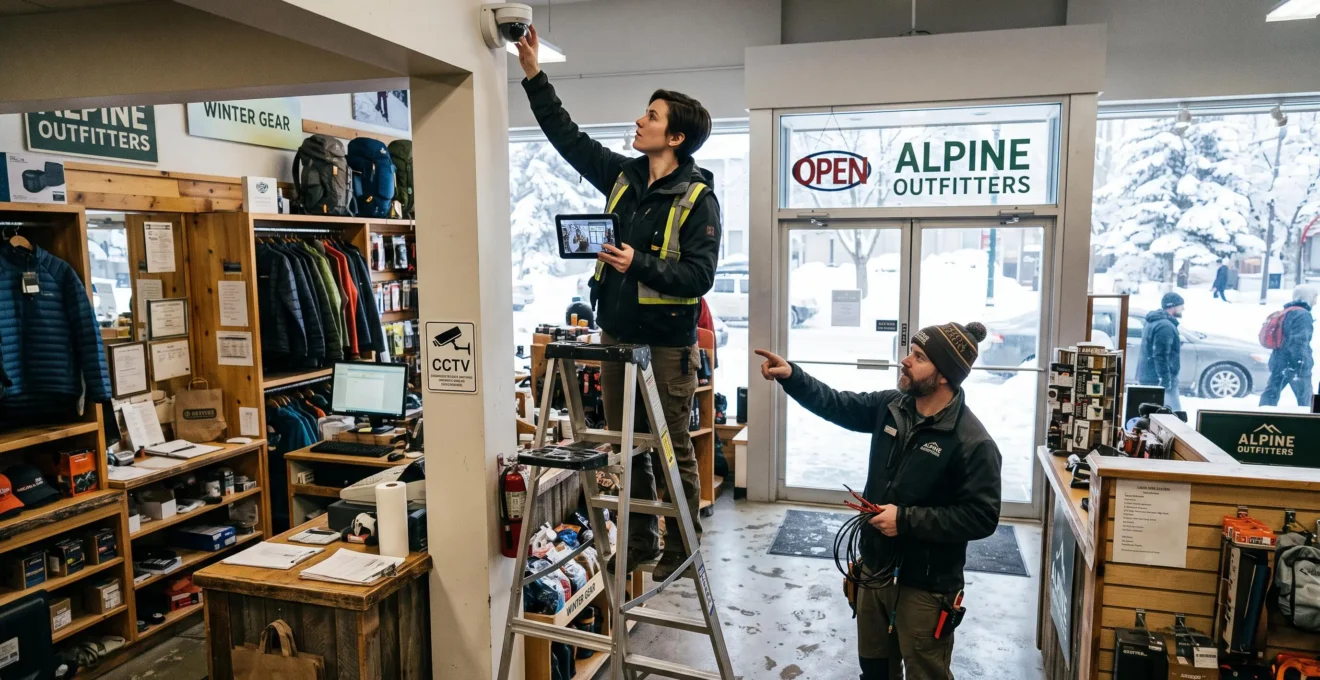
Useful CCTV coverage depends less on how many cameras a Canadian business installs than on what each camera can actually record. A wide view of a retail floor may reveal movement without capturing identifiable faces. A warehouse camera may overlook the precise loading-door activity it was purchased to monitor. Even a technically effective installation can create privacy concerns when its field of view extends beyond a legitimate security purpose.
For retailers, offices and commercial property managers, effective placement starts with identifying specific security needs: monitoring entrances, documenting transactions, observing goods movements and preserving usable footage after incidents. Camera height, lens selection, lighting and obstructions determine whether those objectives can be met.
Canadian privacy expectations also belong in the design process. Surveillance should be justified, proportionate and appropriately documented, with applicable federal and provincial requirements considered before installation. The following practical approach connects camera positioning, image quality, evidence handling and alert configuration so that recorded footage remains useful without collecting unnecessary personal information.
CCTV placement essentials for Canadian businesses
- Map entrances, transaction points, storage areas and physical obstructions before deciding how many cameras to install.
- Use camera angles, lenses and lighting suited to the evidence required; wide coverage alone does not guarantee identification.
- Limit surveillance to documented security purposes, test footage under real conditions and review coverage whenever the site changes.
- Why Do More CCTV Cameras Sometimes Fail to Reduce Security Blind Spots?
- How Can You Position CCTV Cameras Around Retail Checkout Areas?
- Fixed CCTV Cameras or PTZ Models for Warehouse Surveillance?
- The CCTV Placement Mistakes That Raise Privacy Concerns in Canada
- When Should CCTV Coverage Be Reviewed After Store Renovations?
- How Can You Estimate Camera Pixel Density at a Warehouse Entrance?
- The Export Mistakes That Can Compromise Security Video Evidence
- How Can an Intelligent Surveillance Network Reduce Security Alert Overload?
Why Do More CCTV Cameras Sometimes Fail to Reduce Security Blind Spots?
Adding CCTV cameras does not necessarily eliminate blind spots because cameras can repeatedly capture the same areas while leaving critical locations unmonitored. Poor mounting angles, shelving, pillars and inappropriate lenses can undermine coverage regardless of camera quantity. A site survey that assigns each camera a specific security purpose is usually more valuable than simply installing additional units.
Consider a hypothetical retail store with several ceiling cameras aimed across its main sales floor. Their recordings may overlap extensively, yet a merchandise aisle concealed by tall shelving remains invisible. Adding another camera facing the same direction increases recording capacity without correcting the original coverage problem.
A practical planning exercise begins with a floor plan. Mark entrances, exits, checkout stations, receiving doors and locations where valuable goods are handled. Identify obstructions, including storage racks, structural columns, displays and hanging signs. Then decide what each proposed camera must accomplish:
- Deterrence: make surveillance visible around legitimate security-sensitive locations.
- Detection: reveal that a person, vehicle or event has entered a monitored area.
- Identification: capture enough facial or other relevant detail to support the intended investigation, subject to actual image quality.
Mounting height creates an important trade-off. A high camera may oversee a larger area and be harder to tamper with, but a steep downward view can mainly capture the tops of people’s heads. A lower or more horizontal camera may produce better facial detail at an entrance while requiring protection against obstruction and interference.
Canadian winter conditions complicate the exercise. Snowbanks can obstruct outdoor views, reflective snow can affect exposure, and seasonal changes may alter both visibility and lighting. Coverage should therefore be tested under conditions representative of the location, rather than evaluated only during a favourable installation day.
Five actions to validate a CCTV placement plan
- Draw the monitored premises and mark security-sensitive zones; produce an annotated floor plan.
- Record shelving, pillars, signage and seasonal obstructions; produce a blind-spot map.
- Assign every proposed camera a detection, deterrence or identification purpose; produce a camera-purpose schedule.
- Test proposed mounting angles using representative people and activities; save labelled test images.
- Compare actual recordings against required coverage and privacy boundaries; approve a revised installation map.
Once each camera has a clearly defined job, positioning can be refined for locations where security footage needs to show more than general activity, particularly retail checkout counters.
How Can You Position CCTV Cameras Around Retail Checkout Areas?
Retail checkout cameras should capture the cashier-customer interaction, the relevant transaction area and identifiable views where justified, without unnecessarily recording payment information or unrelated activity. A slightly angled view of the counter can document cash handling and scanning more effectively than a camera mounted directly overhead. Complementary views are often needed because no single angle captures every detail reliably.
Three distinct recording objectives should guide checkout surveillance. The first is observing the person involved in an incident. The second is documenting relevant transaction activity, such as cash changing hands or goods being scanned. The third is establishing how merchandise moves across the counter.
A downward camera can show counter activity but may reveal little facial information. Conversely, a camera directed toward the checkout queue might capture people clearly while concealing actions behind a raised display or payment terminal.
Position a transaction-focused camera at a modest oblique angle so the counter, scanner and relevant cash-handling area remain visible. Check that ceiling lighting does not wash out the recording and that bright POS displays do not dominate exposure. Avoid framing sensitive card details, PIN entry or unrelated customer information when these are not necessary for the stated purpose.
Validation should reproduce ordinary checkout behaviour. Ask staff members of different heights to simulate merchandise scanning, cash payment and card payment. Review recordings at normal playback quality, rather than relying on a live preview alone. Check whether relevant people and actions are distinguishable and whether banknotes can be assessed when this is genuinely necessary for the security objective.
The Office of the Privacy Commissioner of Canada‘s video surveillance guidelines recommend minimizing unnecessary collection, limiting camera viewing ranges and providing clear surveillance notices. In practice, checkout cameras should not unnecessarily include neighbouring storefronts, unrelated seating areas or locations with heightened privacy expectations.
The same principle applies in larger facilities, although warehouses introduce another choice: whether continuously monitored fixed cameras or movable PTZ models are better suited to each security zone.
Fixed CCTV Cameras or PTZ Models for Warehouse Surveillance?
Fixed CCTV cameras are generally preferable for warehouse entrances, aisles and loading doors that require continuous monitoring. Pan-tilt-zoom (PTZ) cameras can help operators inspect larger or less predictable areas, but they record only the direction they face at a given moment. For many facilities, the strongest practical arrangement combines fixed coverage of critical points with selective PTZ capability.
A fixed camera provides a consistent view of a defined area. This predictability is valuable when investigators need to reconstruct the movement of goods through a receiving door or establish when someone entered a restricted aisle.
PTZ cameras offer a different advantage: operators or configured controls can rotate the lens, tilt it and zoom toward a subject. That flexibility may be useful across expansive open yards or irregularly occupied warehouse spaces.
However, PTZ movement creates a coverage trade-off. While a camera follows a vehicle across one part of a yard, it cannot simultaneously maintain the same detailed view in another direction. Preset patrols do not eliminate this limitation.
The following comparison helps match the equipment to warehouse activity.
| Decision factor | Fixed CCTV cameras | PTZ cameras |
|---|---|---|
| Predictable activity | Well suited to entrances, aisles and docks | Possible, but movement may be unnecessary |
| Continuous recording | Maintains the same monitored direction | Changes as the camera pans, tilts or zooms |
| Large open areas | May require several complementary views | Can inspect different locations sequentially |
| Operational complexity | Typically simpler to configure and monitor | May require presets, control rules and operator training |
| Maintenance considerations | Fewer camera movement mechanisms | Moving components introduce additional maintenance considerations |
Cold Canadian warehouses deserve particular attention. Unheated docks, moisture, condensation and temperature changes can affect equipment suitability. PTZ units have moving mechanisms, making manufacturer-specified environmental ratings and maintenance requirements important. Fixed cameras must also be selected for the actual operating environment.
Compare total cost of ownership rather than unit price alone. Include installation, mounting, recording capacity, configuration, network requirements, maintenance and the possibility that a PTZ will still need fixed cameras protecting critical routes.
Equipment selection becomes more defensible when the surveillance purpose is explicit. In Canada, that purpose also determines how narrowly cameras should capture people and surrounding property.
The CCTV Placement Mistakes That Raise Privacy Concerns in Canada
Canadian businesses can create privacy risks by filming beyond a legitimate security purpose, overlooking surveillance notices, retaining recordings unnecessarily or allowing excessive access to footage. Placement decisions should minimize unnecessary personal information collection while preserving appropriate security coverage. The applicable obligations depend on the organization, province, type of surveillance and individuals being recorded.
Under Canada’s Personal Information Protection and Electronic Documents Act (PIPEDA), where applicable, and relevant provincial private-sector privacy legislation, organizations must assess the legitimacy and appropriateness of collecting personal information. CCTV recordings containing identifiable people can fall within these requirements.
Privacy law is not identical across Canada. Alberta, British Columbia and Quebec have private-sector privacy legislation recognized as substantially similar to PIPEDA. Federal legislation can nevertheless remain relevant for federally regulated organizations and certain interprovincial or international information activities. The OPC explanation of provincial privacy laws and PIPEDA helps businesses identify these jurisdictional distinctions.
Common placement and governance errors include recording neighbouring premises or excessive sidewalk activity, pointing cameras toward washrooms or windows, failing to display appropriate notices, allowing broad staff access to recordings and keeping footage without a defined retention rationale.
Employee monitoring requires separate scrutiny. Cameras installed to protect a stockroom or document a specific safety concern should not automatically become tools for measuring employee productivity. Employee privacy requirements vary across jurisdictions and employment contexts, while the federal regulator’s guidance on overt public-area surveillance does not directly resolve employee monitoring questions.
A useful governance method is a one-camera-one-purpose audit. For every camera, document its location, security rationale, exact field of view, authorized viewers, recording arrangements and retention procedure. Ask whether masking or reframing could eliminate unnecessary recording without compromising that purpose.
Retention should follow applicable legal requirements and genuine operational needs rather than an assumed nationwide number of days. Businesses should also establish secure deletion procedures and document any preservation exception for relevant incidents.
These records should remain current as store layouts, staffing arrangements and security risks change. Renovations are a particularly important trigger for reviewing both coverage and compliance documentation.
When Should CCTV Coverage Be Reviewed After Store Renovations?
CCTV coverage should be reviewed during renovation planning and tested again before the renovated premises reopen. New shelving, relocated checkouts, altered entrances and different lighting can create blind spots even when every camera remains operational. A post-renovation inspection should also verify recording, network connectivity, privacy notices and the continued justification for each camera’s field of view.
Renovations affect surveillance in several ways. A newly installed partition may block an entrance previously visible from the ceiling. Taller display shelving can obstruct aisle coverage. Moving a checkout desk can leave cameras pointing at empty counter space rather than actual transaction activity.
Lighting changes matter too. Replacement fixtures, new windows or repositioned displays can produce glare, shadows or contrast that reduces usable image detail.
A practical review starts by comparing the original coverage plan with the revised floor layout. Walk through every security-sensitive route and examine live feeds. Then record representative activity and inspect playback, because a camera image that appears acceptable on a small monitoring screen may reveal inadequate detail when reviewed later.
Connectivity and recording tests are essential. Renovation work can disturb power supplies, Ethernet cabling, network switches or camera mounts. A camera may display a live image yet have incorrect recording settings, intermittent connectivity or a shifted field of view.
Check that every required recording channel is functioning, timestamps are accurate and footage can be retrieved from the recorder. Reconfirm the available recording period after any changes to storage configuration.
Surveillance notices and internal records should also be reviewed. A relocated entrance may require moving a notice, while changes to camera angles may warrant updating the camera inventory, privacy documentation or authorized access arrangements.
The federal regulator recommends periodically reassessing whether surveillance remains necessary, although its guidance does not prescribe a specific post-renovation deadline. Completing testing before reopening is therefore a practical operational recommendation, not a universal statutory deadline.
Once sight lines are restored, the next question is whether each image contains enough detail for its intended security task, especially at warehouse entrances where viewing distances vary.
How Can You Estimate Camera Pixel Density at a Warehouse Entrance?
Camera pixel density can be estimated by dividing the image’s horizontal pixel resolution by the width, in metres, of the scene captured at the target location. The result, expressed in pixels per metre (px/m), helps evaluate whether footage may support detection, recognition or identification. The calculation is a planning tool, not a guarantee of usable evidence.
A camera’s advertised resolution describes its image dimensions, not the amount of useful detail captured on a person’s face. A high-resolution camera covering an extremely wide entrance can distribute its pixels across so much space that individual features become difficult to distinguish.
The basic calculation is:
Pixel density (px/m) = horizontal image resolution (pixels) ÷ horizontal scene width at the target (metres).
For example, consider an explicitly hypothetical camera delivering 1,920 horizontal pixels across a warehouse entrance view measuring 8 metres wide at the relevant distance.
Its estimated pixel density is 1,920 ÷ 8 = 240 px/m. This calculation assumes the full horizontal pixel count covers that width at the selected target plane. It does not establish that a person’s face will be identifiable in the recording.
Technical guidance distinguishes four DORI categories: detection, observation, recognition and identification.
| Operational objective | Approximate pixel density | General interpretation |
|---|---|---|
| Detection | 25 px/m | Determine whether a relevant subject is present |
| Observation | 63 px/m | Observe general subject characteristics and activity |
| Recognition | 125 px/m | Recognize a familiar or previously observed subject under suitable conditions |
| Identification | 250 px/m | Support more detailed visual identification under suitable conditions |
These values are described in an Axis Communications white paper on CCTV pixel density, drawing on the IEC 62676-4:2014 framework. They are technical planning benchmarks, not Canadian legal minimums or guaranteed identification thresholds. The publication also discusses limitations of the simplified model.
Lens focal length, field of view, mounting position and distance to the subject all influence the effective pixel density. A camera angled steeply toward the floor may produce a different practical result from one viewing the same person more directly. Image compression, motion blur, exposure and lighting further influence identifiable detail.
At a Canadian loading dock, test both daytime and low-light conditions. Record someone walking naturally through the entrance and review the saved footage at its actual recording quality. Look for facial detail, unwanted backlighting from the open door and blur during movement.
Obtaining clear footage is only part of the process. If an incident occurs, businesses must also preserve recordings in a way that does not unnecessarily compromise their evidentiary usefulness.
The Export Mistakes That Can Compromise Security Video Evidence
Security footage can lose evidentiary usefulness when it is exported through screen recordings, unnecessarily re-encoded, stripped of timestamps or separated from important contextual material. Businesses should preserve the original recording, use an appropriate recorder export method and document how copies were created and handled. Export quality matters in investigations, insurance reviews and disputes.
Network video recorders and other surveillance systems may store recordings in different file formats. Some provide exports containing video, metadata and a compatible playback tool. Others offer standard video files with varying amounts of associated information.
A frequent mistake is recording a security monitor with a phone or capturing its screen instead of exporting the underlying footage. Such copies can introduce visual artefacts, lose detail or omit associated data. They may still provide information, but they are less suitable as the primary preserved record when a direct export is available.
The US National Institute of Standards and Technology explains in its research on digital CCTV video exchange standards that incompatible formats and video conversion can degrade image quality, remove metadata and delay forensic analysis.
The research concerns technical interoperability rather than Canadian evidence law, but its findings illustrate why preserving source information is important.
For incident preservation, a practical approach is to:
- Identify the relevant cameras and recording period before footage is overwritten.
- Preserve the original recording wherever technically and operationally possible.
- Use the recorder’s appropriate export function, retaining associated metadata and verification files when available.
- Include relevant footage before and after the incident to preserve context.
- Record who exported the files, when they were exported, the source system and subsequent transfers.
Where practical, keep a protected working copy separate from the preserved original. Verify that exported files can be opened and that timestamps correspond to the incident. If technical personnel calculate file hashes or use system-supported integrity checks, their results should be documented consistently.
Overwrite schedules require particular attention. Surveillance storage is finite, and older recordings may be automatically replaced. A business should understand its actual retention and overwrite configuration instead of assuming footage will remain available indefinitely.
There is no universal police or insurance submission deadline established by the technical source cited above. Any applicable preservation or disclosure requirements should be determined from the circumstances, relevant law and legitimate requests.
Preserving useful recordings becomes easier when surveillance generates meaningful events rather than an overwhelming stream of routine movement alerts. That makes camera positioning central to intelligent surveillance configuration.
Key takeaways before configuring intelligent CCTV alerts
- Build monitoring rules around documented security objectives and camera views that have already passed real-world coverage tests.
- Separate expected activity from potentially actionable events using relevant detection zones and operating schedules.
- Evaluate alert quality through recorded outcomes, not simply the total number of notifications generated.
How Can an Intelligent Surveillance Network Reduce Security Alert Overload?
An intelligent surveillance network can reduce alert overload by filtering routine movement, applying rules to relevant zones and distinguishing different kinds of detected activity. The objective is to help staff notice meaningful security events without repeatedly responding to harmless triggers. Effective filtering depends on suitable camera placement, careful configuration and ongoing evaluation of missed events and false alerts.
Conventional motion detection may react to changes in pixels rather than meaningful security activity. Passing vehicles, animals, shifting shadows, snowfall and changes in artificial lighting can all generate notifications that do not require human intervention.
When staff repeatedly receive irrelevant alerts, they may delay reviewing notifications or become less attentive to them. Increasing detection sensitivity indiscriminately can make this problem worse.
Intelligent analytics can help organize alerts by characteristics such as detected people or vehicles, although classification accuracy varies with equipment, lighting, scene complexity and configuration.
Zone-based rules are especially useful. A warehouse camera may cover both an authorized vehicle route and a restricted loading area. Instead of alerting on every movement, the system can prioritize activity inside the restricted zone.
Time-based rules offer another layer. Movement near a receiving dock may be routine during scheduled deliveries but warrant review when the area is expected to be unoccupied. Exceptions should accommodate legitimate cleaning, maintenance and after-hours operations.
Camera positioning remains fundamental. An analytics system cannot reliably evaluate activity hidden behind shelving or outside the recorded field of view. Cameras aimed primarily at irrelevant public traffic may also generate avoidable detections even when their software is sophisticated.
A practical calibration process begins by reviewing alert logs weekly during the initial deployment period. Categorize false alerts, identify recurring sources and adjust relevant detection zones, schedules or sensitivity settings. Continue monitoring after seasonal changes and operational adjustments.
One useful performance measure is the proportion of alerts that warrant investigation:
Actionable alert rate = actionable alerts ÷ total alerts × 100%.
For example, in a hypothetical review, 20 actionable alerts among 100 notifications would yield an actionable alert rate of 20%. This illustrates the calculation, not an expected industry result.
That measure should never be considered alone. A quieter system is not necessarily safer if it misses genuine incidents. Review known events, test detection scenarios and examine whether potentially significant activity was overlooked.
For Canadian businesses, intelligent analytics also require privacy consideration. Detection rules, recording practices and access privileges should remain consistent with the legitimate surveillance purpose and applicable privacy obligations. Reducing unnecessary monitoring may be preferable to collecting additional footage simply because advanced processing is available.
As a practical next step, select one high-priority area, verify its recorded coverage, document its privacy boundaries and review a sample of recent alerts. Use the findings to refine the camera view and detection rules before extending the configuration across the premises.
Is CCTV signage required for Canadian businesses?
Canadian privacy guidance generally recommends clear, visible notices before individuals enter monitored premises, including appropriate contact information. Specific legal requirements depend on the applicable federal or provincial privacy framework and the circumstances of surveillance. Signage does not, by itself, make otherwise inappropriate surveillance lawful.
Can a security camera record part of a public sidewalk?
Incidental capture may occur when monitoring a business entrance, but the field of view should be limited to what is necessary for the legitimate purpose. Canadian federal privacy guidance discourages unnecessary recording of people outside retail premises. Reframing or privacy masking may reduce excessive collection.
How long should a Canadian business retain CCTV footage?
There is no single retention period established by the cited federal surveillance guidance for every Canadian business. Organizations should define a justified retention policy consistent with their purpose, applicable law and operational needs, securely delete footage when no longer required and preserve relevant recordings when a legitimate incident or legal obligation warrants it.
Does a higher-resolution camera always produce better identification footage?
No. Resolution must be considered alongside the width of the monitored scene, distance, lens, lighting, viewing angle, compression and subject movement. Pixel density provides a useful planning estimate, but real recorded footage should be tested at the location and under representative conditions before identification capability is assumed.
Who should be authorized to view business CCTV recordings?
Access should be limited to personnel who need recordings for documented, legitimate purposes. Businesses should establish clear authorization rules, secure storage and procedures for reviewing or disclosing footage. Access permissions should be reassessed when responsibilities or surveillance purposes change.