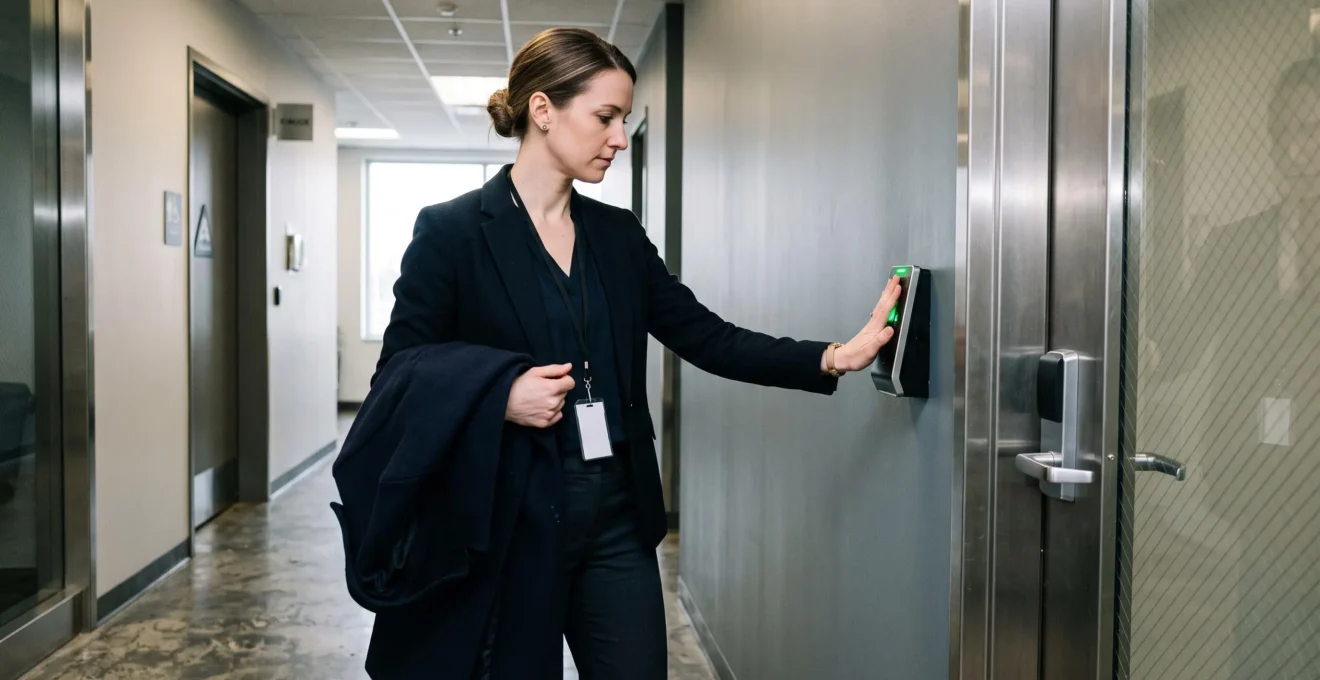
Biometric verification can strengthen access security in restricted Canadian facilities, but its reliability depends on more than the recognition technology itself. Fingerprint and facial recognition systems can distinguish legitimate users from unauthorized individuals, yet they can also reject authorized employees, produce incorrect matches or remain vulnerable to presentation attacks. Their effectiveness therefore depends on capture quality, matching thresholds, environmental conditions, system configuration and the procedures surrounding authentication.
For security leaders, the central question is not whether biometrics are inherently reliable. It is whether a particular implementation delivers an acceptable level of identity assurance without creating operational, privacy or discrimination risks. A well-designed deployment combines representative performance testing, alternative authentication methods, appropriate access permissions and safeguards for sensitive biometric information. Canadian organizations must also consider the applicable federal or provincial privacy framework, particularly when employee biometric information is collected, stored or shared with a technology provider.
Biometric verification: the essential considerations
- Biometric reliability depends on capture conditions, enrollment quality, matching thresholds and demographic performance, not simply the sensor specification.
- Restricted facilities should combine biometric verification with appropriate credentials, presentation attack detection and documented fallback procedures.
- Canadian privacy requirements influence whether biometric collection is justified, how information is protected and what alternatives must be available.
- Why Do Biometric Systems Sometimes Reject Legitimate Users?
- How Can You Balance Biometric Accuracy and User Convenience?
- Biometrics or Multi-Factor Authentication for Sensitive Workplace Access?
- Why Compromised Biometric Templates Require Special Incident Procedures
- When Should Biometric Users Be Re-enrolled After Recognition Problems?
- Why Basic Fingerprint Sensors Need Presentation Attack Detection
- Employee Numbers or Randomized Identifiers for Security Systems?
- How Can Canadian Organizations Structure Access Permissions by Employee Role?
Why Do Biometric Systems Sometimes Reject Legitimate Users?
Biometric systems sometimes reject legitimate employees because they cannot capture a sufficiently usable biometric sample, their matching algorithms apply thresholds that are too restrictive, or environmental conditions interfere with recognition. These failures are generally described as false non-matches or false rejections. Identifying their actual cause is essential because changing a matching threshold will not necessarily resolve a defective sensor, poor enrollment record or unsuitable installation.
Three categories of problems deserve particular attention.
1. Sensor-level capture errors. Fingerprint readers require a sufficiently clear representation of the fingerprint presented. Dirty sensors, moisture, damaged skin, incomplete contact and poor finger positioning can reduce capture quality. A facial recognition camera can experience similar difficulties when it captures an inadequately illuminated or poorly positioned face.
2. Algorithmic matching thresholds. Biometric software compares a newly captured sample with an enrolled template and calculates a similarity score. If the acceptance threshold is too restrictive, legitimate variations may produce a rejection. This is a configuration decision with security consequences, rather than an unavoidable characteristic of every biometric system.
3. Environmental and physical conditions. Gloves, changing lighting, camera positioning, workplace conditions and seasonal skin changes can influence recognition. NIST‘s facial recognition evaluations demonstrate that image quality, inadequate lighting and camera positioning can affect false rejection performance. These effects can also vary between demographic groups.
Enrollment quality is another important operational consideration. A rushed registration session can produce an incomplete or unsuitable reference template. Organizations should therefore establish controlled enrollment procedures, check capture quality and repeat inadequate captures before activating an employee’s credentials. The available Canadian federal guidance supports accuracy testing and operational monitoring, although it does not establish that enrollment quality is universally the largest cause of false rejections.
Demographic performance also requires attention, particularly when facial recognition is used to make decisions affecting employees’ access to their workplace. NIST research identifies differences in recognition errors across demographic groups. Image quality, lighting, camera positioning and algorithm characteristics can contribute to these variations. This does not mean every system performs poorly for every demographic group, but it makes representative testing an essential procurement and governance requirement. Canadian organizations should consider the potential human rights implications of systematically preventing legitimate employees from entering their workplace.
The Office of the Privacy Commissioner of Canada‘s biometric processing guidance recommends evaluating accuracy under operational conditions, monitoring demographic performance and providing alternative identifiers when recognition errors occur. Although this guidance addresses federal government institutions rather than establishing universal private-sector requirements, it offers a relevant framework for evaluating biometric reliability.
Every restricted facility should define a fallback procedure before deployment. Depending on the security requirements, this may involve an alternative credential, supervised identity verification or another approved authentication method. Fallback events should be recorded and reviewed because repeated failures, unusual override activity or systematic rejection patterns can reveal operational or security weaknesses.
The objective is not to eliminate every rejection by making authentication more permissive. It is to preserve appropriate security while ensuring legitimate employees have a reliable, documented way to establish their identity.
How Can You Balance Biometric Accuracy and User Convenience?
Organizations can balance biometric accuracy and user convenience by configuring recognition thresholds according to the risk of each access zone, testing performance with representative employees and measuring entry throughput. A restricted server room requires a different security configuration from a general office entrance. The appropriate balance therefore depends on the consequences of unauthorized entry and the operational impact of rejecting legitimate users.
Two performance measures are particularly important:
- False Match Rate (FMR): the frequency with which a biometric system incorrectly accepts an impostor as a legitimate user under defined comparison conditions.
- False Non-Match Rate (FNMR): the frequency with which the system fails to recognize a legitimate enrolled user.
These metrics describe different failure types. A system configured to reduce false matches may reject more legitimate users, depending on the biometric modality, matching algorithm and operating conditions. Conversely, relaxing the acceptance threshold can improve convenience while increasing the possibility of incorrect acceptance.
The National Institute of Standards and Technology provides technical performance criteria in its Special Publication 800-63B. Its guidance specifies a false match rate of one in 10,000 or better under defined comparison conditions and recommends a false non-match rate below 5%. These figures are useful technical reference points, but they are not universal Canadian legal requirements or guarantees for physical access-control installations. NIST explicitly excludes physical building access from the direct scope of this publication.
Configuration should reflect the sensitivity of each area rather than applying one threshold throughout the facility. A practical risk-based approach distinguishes ordinary workplace access from areas containing critical infrastructure, confidential information or sensitive assets.
| Access zone | Security priority | Operational consideration |
|---|---|---|
| General office entrance | Reliable identification with controlled rejection rates | Maintain efficient employee movement during peak arrival periods. |
| Restricted administrative area | Stronger identity assurance and appropriate credential checks | Provide documented fallback verification. |
| Server room or sensitive storage | Strict authentication, additional factors and presentation attack resistance | Control access without creating unsafe queues or encouraging workarounds. |
Throughput is a security consideration, not merely a convenience metric. If a single high-security reader cannot process employees efficiently during shift changes, queues may encourage tailgating, door propping or informal credential sharing. A restrictive system that creates operational pressure can undermine the security controls it was intended to strengthen.
Organizations should estimate peak arrival volumes, measure authentication time and evaluate the number of readers required at each entrance. Pilot testing should include employees with different biometric characteristics and representative workplace conditions. Useful measurements include rejection rates, repeated attempts, enrollment duration, fallback frequency and average entry time.
A pilot should also distinguish technical failures from usability problems. If many employees experience rejection at the same reader, the installation or configuration deserves investigation before individual records are changed. If a particular modality consistently performs poorly under actual working conditions, changing the sensor or authentication method may be more appropriate than relaxing the security threshold.
1 in 10,000
NIST’s false match rate benchmark for the specified digital biometric authentication conditions. It is not a guarantee against targeted attacks or a universal performance requirement for physical facility access.
National Institute of Standards and Technology, Special Publication 800-63B.
Ultimately, a biometric deployment is successful when its security performance and employee experience remain acceptable under real operating conditions. Thresholds should be reviewed when those conditions or the facility’s threat profile change.
Biometrics or Multi-Factor Authentication for Sensitive Workplace Access?
Biometrics and multi-factor authentication should not be treated as competing security solutions. A biometric is an authentication factor based on something a person is, while a badge or security token provides something the person has. For sensitive workplace access, combining appropriately selected factors can strengthen identity assurance and reduce dependence on a single credential or recognition mechanism.
The distinction matters because successful biometric recognition does not automatically establish that an employee is authorized to enter every area of a facility. It verifies a characteristic associated with an enrolled identity. Access permissions must still determine which doors, rooms and resources that identity can use.
Biometric and conventional credentials also have different compromise and revocation characteristics.
| Factor | Security benefit | Compromise response |
|---|---|---|
| Access badge | Provides a physical credential associated with an authorized identity. | Deactivate the credential and issue a replacement. |
| Password or PIN | Provides a knowledge-based authentication factor. | Change the secret and review potentially affected access records. |
| Biometric | Connects authentication to a physical characteristic of the individual. | Invalidate affected templates, assess exposure and consider protected or cancellable biometric alternatives. |
A stolen badge can generally be deactivated and replaced. A compromised password or PIN can be changed. A fingerprint or facial characteristic cannot simply be replaced after exposure. This difference makes biometric data protection particularly important.
For sensitive zones, a badge-plus-biometric arrangement can provide a practical architecture. The badge identifies the credential being presented, while biometric verification checks whether the person presenting it corresponds to the enrolled identity. This approach can also support more controlled matching workflows, although its privacy benefits depend on the actual system architecture and how biometric information is stored and processed.
Organizations should examine where biometric templates reside, whether matching occurs locally or centrally, which parties can access the records and what information is transmitted between readers and access-control infrastructure. The existence of a badge does not automatically prevent biometric database exposure.
NIST Special Publication 800-63B recommends combining biometric authentication with a physical authenticator and providing a non-biometric alternative within its digital authentication framework. Its scope does not directly cover physical building access, so Canadian facility managers should treat these recommendations as technical design references rather than binding physical-security requirements.
Privacy and liability must also influence procurement decisions. Canadian organizations should identify the applicable federal or provincial privacy legislation, evaluate the necessity of collecting biometric information and establish clear retention and access controls. In Quebec, the Commission d’accès à l’information provides specific guidance for organizations using biometric identification and authentication processes. Its requirements should not be generalized to every Canadian province.
The strongest approach is not necessarily the system with the greatest number of authentication factors. It is the architecture that provides proportionate identity assurance, manageable credentials, appropriate alternatives and clearly documented responsibility for every access decision.
Why Compromised Biometric Templates Require Special Incident Procedures
Compromised biometric templates require special incident procedures because biometric characteristics are difficult to replace, unlike passwords or access badges. If an attacker obtains sensitive biometric information, changing an employee’s fingerprint or facial characteristics is generally not a practical recovery option. Organizations must instead contain the exposure, invalidate affected records where possible, assess the consequences and strengthen the protection of future biometric processing.
The first step is understanding what was actually exposed. Biometric information can exist in different forms, including raw images, fingerprint captures and coded templates. An encrypted or otherwise protected representation may reduce certain exposure risks, but encryption alone does not establish that a system is resistant to every form of compromise.
Organizations should ask technology providers specific questions:
- Are raw fingerprint or facial images retained after enrollment?
- Are biometric templates encrypted or otherwise protected at rest and during transmission?
- Where does biometric matching take place: on the reader, a local server or a central platform?
- Can an affected template be invalidated without deleting unrelated employee credentials?
- Does the system support cancellable biometrics or other privacy-enhancing technologies?
- Which subcontractors can access biometric records, and how are retention and destruction controlled?
The distinction between raw samples and coded templates is important. Quebec’s Commission d’accès à l’information explicitly recognizes that biometric information can exist in raw form, such as a fingerprint or image, or in coded form, such as an encrypted template. Organizations should therefore evaluate the actual representation and protection mechanisms rather than relying on a vendor’s general statement that biometric information is secure.
The Office of the Privacy Commissioner of Canada recommends considering encryption, cancellable biometrics and other privacy-enhancing technologies. It also identifies sensitive biometric information breaches as having a high likelihood of meeting the threshold of a material privacy breach within the federal institutional context. This is an important warning, but its federal institutional procedures must not be presented as automatically applicable to every private Canadian employer.
A dedicated incident response process should distinguish between containment, credential recovery and privacy obligations.
- Identify the affected biometric records, systems and individuals.
- Contain the incident and restrict access to compromised biometric records.
- Invalidate affected enrollment records where technically possible and assess appropriate re-enrollment or alternative authentication measures.
- Review access records for the relevant exposure period and investigate suspicious authentication activity.
- Assess applicable breach notification, contractual and regulatory obligations, documenting the decisions and corrective actions.
Revocation deserves particular attention. Some biometric architectures support cancellable templates or protected representations that can be replaced without changing the underlying physical characteristic. However, these capabilities are not universally available, and their effectiveness must be verified with the vendor. A conventional biometric template should not be assumed to be safely replaceable simply because the access-control software allows administrators to delete and recreate an enrollment record.
There is also a secondary privacy risk: biometric information collected for workplace access could potentially be misused in another context if exposed. Purpose limitation, restricted access, data minimization and contractual restrictions on secondary use therefore matter before deployment, not just after a breach.
Retention policies should specify when biometric records are deleted, how backups are handled and what happens when an employee leaves the organization or changes roles. The Office of the Privacy Commissioner recommends retaining biometric information only for as long as necessary for the stated purpose and applicable legal obligations within its federal guidance framework.
A biometric incident cannot always be resolved through a conventional credential reset. Effective recovery depends on limiting the exposure, understanding the technical protection architecture and ensuring that affected individuals retain an appropriate means of authentication.
When Should Biometric Users Be Re-enrolled After Recognition Problems?
Biometric users should be re-enrolled when their original template is demonstrably unsuitable, their biometric characteristics have materially changed, or a verified technical change makes the existing enrollment incompatible. Re-enrollment should not be the automatic response to every authentication failure. First determine whether the problem affects one individual, multiple users or a particular reader, because those patterns point to different underlying causes.
Three situations commonly justify considering a new enrollment.
Physical changes: Finger injuries, scarring or other changes can alter the characteristics captured by a fingerprint reader. Facial recognition may also be affected by changes in appearance or capture conditions. Whether a new enrollment is necessary depends on the modality and the system’s ability to recognize the existing user.
Inadequate original enrollment: An incomplete or poorly captured biometric sample can produce repeated recognition problems. Before re-enrolling, administrators should review the original enrollment conditions and available quality information. If the same flawed procedure is repeated, the replacement template may reproduce the original problem.
Technical changes: Hardware replacements, matching algorithm upgrades and changes in template formats can affect compatibility. Organizations should establish whether the existing records remain suitable before requiring employees to register again.
A diagnostic sequence helps avoid unnecessary re-enrollment.
- Check the scope. Determine whether the failure affects one employee or multiple users. Widespread problems suggest an installation, hardware or configuration issue.
- Compare readers. Check whether the employee experiences the same problem across different devices. A failure limited to one reader may indicate local equipment or environmental conditions.
- Review capture conditions. Inspect sensor cleanliness, finger positioning, lighting and other operational factors relevant to the biometric modality.
- Examine the enrollment record. Review available template quality information and determine whether the original capture was adequate.
- Re-enroll only when justified. Use a controlled enrollment procedure and verify the resulting record before restoring normal access.
Periodic template quality reviews can also help organizations detect problems before employees experience repeated rejection. However, the frequency should be determined by actual system performance, technology changes and operational requirements. The available Canadian federal guidance recommends ongoing accuracy monitoring but does not establish a universal mandatory re-enrollment interval.
Organizations should also distinguish template ageing from algorithm drift. An employee’s biometric characteristics may change, while recognition software can evolve through updates to matching models or capture processing. These are different technical issues and should not automatically trigger the same response.
Re-enrollment procedures should be documented, especially when biometric authentication controls access to critical infrastructure or sensitive workplace areas. The documentation should identify the reason for the change, the affected credential, the enrollment quality checks and the date on which the replacement record becomes operational.
Alternative authentication must remain available during legitimate enrollment or recognition difficulties. In Quebec, the Commission d’accès à l’information identifies the availability of an alternative identification method for individuals who do not consent to biometric collection as part of its guidance.
The objective is to correct the underlying problem rather than repeatedly replacing biometric records. Controlled re-enrollment, combined with performance monitoring, preserves both operational continuity and the integrity of access credentials.
Why Basic Fingerprint Sensors Need Presentation Attack Detection
Basic fingerprint sensors need presentation attack detection because a sensor that captures a fingerprint does not necessarily establish that the presented finger belongs to a live, genuine person. Depending on the technology and its protections, a reader may be vulnerable to artificial fingerprint replicas or other attempts to imitate a legitimate biometric sample. Presentation attack detection helps distinguish genuine biometric presentations from attempted spoofs.
Fingerprint presentation attacks can involve copied impressions obtained from surfaces, silicone replicas or gel-based materials. A basic capacitive or optical sensor that relies primarily on fingerprint pattern capture may not have sufficient mechanisms to identify these artificial presentations.
This is why sensor specifications should be evaluated separately from anti-spoofing capabilities. A reader can provide high-quality fingerprint images while remaining insufficiently resistant to presentation attacks.
Presentation attack detection (PAD), sometimes described as liveness detection, evaluates whether the biometric sample appears to originate from a genuine living subject rather than an artificial representation. Depending on the technology, this can involve different types of analysis:
- Software-based detection: examines characteristics of the captured sample, including texture and other measurable signals that may help identify artificial presentations.
- Hardware-assisted detection: uses additional sensing capabilities, potentially including multiple sensing wavelengths or other physical characteristics, to assess whether the presentation is genuine.
These approaches should not be assumed to provide identical protection. Their effectiveness depends on the sensor, detection algorithms, tested attack materials and operational conditions.
During procurement, security teams should request documented presentation attack testing and ask vendors about relevant ISO/IEC 30107 testing methods. NIST’s digital authentication guidance also addresses presentation attack detection, including recommendations for fingerprint and iris modalities and requirements for facial recognition within its defined scope. The publication’s scope excludes physical building access, so its technical provisions should be used as a reference rather than treated as a direct Canadian building-security standard.
The relevant technical reference is the National Institute of Standards and Technology’s Special Publication 800-63B. Within its digital authentication framework, NIST discusses presentation attack detection and provides an impostor attack presentation accept rate recommendation below 0.07. This measure is distinct from the false match rate: it concerns the acceptance of tested presentation attacks, not ordinary comparisons between biometric identities. It should not be interpreted as a universal guarantee against every spoofing technique.
The need for PAD also depends on the facility’s threat model. A general office entrance facing opportunistic misuse presents a different risk from a sensitive facility targeted by a knowledgeable insider with time and resources to prepare an attack. Security leaders should evaluate the likely attacker, the value of the protected assets, the reader’s exposure and the consequences of successful unauthorized entry.
Another important weakness is the fallback channel. An attacker may find it easier to exploit a poorly protected override PIN, a shared credential or a door left open after repeated authentication failures than to defeat the biometric sensor itself. PAD must therefore be evaluated as one element of the complete access-control architecture.
Vendor demonstrations are not sufficient evidence of resistance. Procurement documentation should identify the attack methods tested, the relevant testing conditions, the detection performance and the limitations of the equipment. Testing should also consider how the reader behaves when PAD is unavailable or uncertain.
Biometric recognition is only as strong as the complete entry process. A sensor that resists spoofing but relies on a weak override procedure can still leave a restricted facility exposed.
Employee Numbers or Randomized Identifiers for Security Systems?
Randomized, non-sequential identifiers are generally preferable to employee numbers for security systems that expose identifiers through access logs, badge data or biometric indexes. Sequential employee numbers can reveal organizational patterns and make it easier to enumerate potentially valid identifiers. Separating security identifiers from human resources numbering also reduces unnecessary connections between identity records across organizational systems.
Employee numbers often follow a predictable sequence. Depending on the organization’s practices, an identifier may reveal approximate headcount, recruitment patterns or the relative age of an employment record. When exposed through access-control interfaces or logs, predictable identifiers can also help attackers construct lists of possible accounts for social engineering or credential-related attacks.
Randomized identifiers reduce this predictability. They can provide a separate reference for each enrolled person without exposing the internal HR numbering structure to every access-control component.
A practical architecture separates two functions:
- Human resources identity: maintains the employee’s official organizational record, employment status and associated administrative information.
- Security identity: uses a distinct identifier to associate credentials, biometric templates and access permissions within the security infrastructure.
This separation does not eliminate every privacy risk. A randomized identifier is still a form of pseudonymization, not anonymization. If an organization maintains a mapping between the security identifier and an employee’s identity, the records remain linkable by authorized parties or anyone who obtains the mapping.
The distinction is particularly important for biometric information. Biometric records are sensitive personal information, and linking them to easily guessable employee identifiers can increase the consequences of an access-log or database breach. Organizations should limit the information exposed in routine logs and restrict access to identity-mapping records.
Security identifiers should also be designed for operational reliability. A migration from sequential employee numbers to randomized identifiers can affect existing biometric templates, badges, permissions and historical access records. The organization must preserve the correct relationships between these records throughout the transition.
Before implementation, administrators should define identifier uniqueness, collision handling, revocation behaviour and the process for linking historical logs to the appropriate employee. These controls are particularly important when an employee changes roles, leaves the organization or is subsequently rehired.
A migration should be tested against representative records before production deployment. The security team should verify that existing credentials remain associated with the correct identities, that duplicate identifiers cannot be introduced and that revoked credentials cannot regain access through an outdated mapping.
In Quebec, the Commission d’accès à l’information’s biometric guidance provides a relevant reminder that organizations must justify biometric collection and manage the information according to the applicable privacy framework. Identifier design should form part of that broader data-protection architecture rather than being treated as an isolated IT configuration decision.
Randomized identifiers cannot replace encryption, access restrictions or retention controls. Their value lies in reducing unnecessary exposure and making security records less directly revealing when individual databases or logs are accessed.
Key considerations before structuring employee access
- Identity verification and access authorization must remain separate decisions, even when both are managed through the same security platform.
- Access permissions should reflect actual job responsibilities and the sensitivity of each physical zone.
- Biometric enrollment, alternative authentication and credential revocation must be governed throughout the employee lifecycle.
How Can Canadian Organizations Structure Access Permissions by Employee Role?
Canadian organizations can structure access permissions by employee role through role-based access control (RBAC), which connects job responsibilities to predefined access rights. Biometrics can verify that the person presenting a credential is the enrolled individual, but RBAC determines which areas that individual is authorized to enter. Separating these functions prevents successful biometric authentication from becoming an automatic grant of unrestricted facility access.
For example, an employee may successfully authenticate at a facility entrance without having permission to enter its server room, records archive or sensitive storage area. The biometric system establishes identity assurance, while the access-control policy evaluates authorization.
This distinction can be expressed simply:
- Authentication: Is this the person associated with the presented credential?
- Authorization: Is this person permitted to enter this particular zone at this particular time?
RBAC provides a governance structure for managing these decisions consistently. Rather than assigning access permissions individually without a common framework, organizations define roles based on job functions and associate those roles with approved physical zones.
A practical role matrix should consider the following categories:
| Role | General areas | Restricted offices | Critical infrastructure |
|---|---|---|---|
| General employee | Authorized | Only when assigned | Not authorized by default |
| IT administrator | Authorized | According to responsibilities | Specific technical zones only |
| Security personnel | Authorized | According to operational duties | According to approved security responsibilities |
| External contractor | Limited and approved | Only for assigned work | Specific authorization and conditions required |
| Visitor | Designated visitor areas | Normally restricted | Not authorized by default |
This is an illustrative framework, not a prescribed Canadian regulatory matrix. Each organization must adapt it to its operational responsibilities, facility layout and security classification.
The principle of least privilege should guide every role assignment. Employees should receive only the access necessary to perform their duties. Contractors and visitors should have explicitly defined permissions rather than inheriting employee-level access through a shared or generic credential.
Organizations operating in federally regulated environments or Quebec should also consider their communication and documentation obligations, including appropriate language practices where applicable. Access procedures, employee notices and privacy information should be understandable to the individuals affected by biometric processing.
Privacy governance is particularly important when biometrics are involved. Under the federal Privacy Act, the Office of the Privacy Commissioner of Canada provides guidance for federal institutions. Private organizations must assess the legislation applicable to their activities and jurisdiction rather than assuming that federal institutional recommendations apply universally.
In Quebec, the Commission d’accès à l’information’s biometric guidance identifies several specific requirements. Organizations using biometric processes to verify or confirm identity must disclose this use to the Commission. The creation of a biometric database must be disclosed at least 60 days before the database is put into service. The guidance also addresses necessity, proportionality, express and informed consent, and the availability of an alternative identification method for individuals who do not consent.
These requirements make early privacy assessment important. Biometric collection should serve an important, legitimate and real objective, and the information collected should be proportionate to that objective. Convenience alone does not establish that biometric collection is necessary.
Access governance must also cover the entire employment lifecycle. Role changes, contract endings and employee departures should trigger timely reviews and revocation of permissions that are no longer justified. Where operationally possible, access revocation and biometric enrollment suspension should be coordinated with HR status changes rather than relying on manual requests that may be overlooked.
Regular reconciliation between employment records and active security credentials can help identify orphaned accounts, outdated permissions and biometric records that should no longer remain operational. The organization should also retain an auditable record of authorization changes, credential suspension and relevant access decisions.
Five actions to strengthen biometric access governance
- Map workplace zones: Produce a facility access inventory identifying general, restricted and critical areas, with each zone assigned a documented risk classification.
- Define employee roles: Create an RBAC matrix linking job functions, employees, contractors and visitors to explicitly approved access permissions.
- Document authentication requirements: Record which zones require biometric verification, additional credentials and alternative authentication arrangements in an approved security configuration document.
- Complete the privacy assessment: Document the purpose, necessity, proportionality, consent arrangements, retention controls and applicable federal or provincial requirements for biometric processing.
- Establish lifecycle reviews: Produce a credential de-provisioning procedure covering role changes, contract endings, employee departures and periodic reconciliation between HR records and active access permissions.
These governance controls are more effective when supported by clear ownership. HR should communicate relevant employment changes, security administrators should implement authorization changes, and privacy or compliance personnel should oversee the applicable data-protection requirements.
For security leaders evaluating a biometric deployment, the next step is to assess each restricted zone against its actual threat profile, privacy obligations and operational requirements. A combination of proportionate biometric verification, protected identifiers, documented alternatives and disciplined access governance provides a stronger basis for sensitive facility access decisions than biometric recognition alone.
Are biometric systems 100% accurate?
No. Biometric systems can produce false matches, false non-matches and unsuccessful captures. Their performance depends on the modality, sensor quality, enrollment conditions, matching thresholds, demographic characteristics and operating environment. Canada’s federal privacy regulator explicitly states that biometric systems cannot ensure 100% accuracy and recommends operational testing and regular monitoring.
Should biometric authentication be mandatory for every employee?
Not automatically. Organizations should establish whether biometric collection is necessary and proportionate to a legitimate security objective. In Quebec, the Commission d’accès à l’information requires organizations to consider the applicable biometric framework, including consent and alternative identification arrangements. Requirements elsewhere in Canada must be assessed under the relevant privacy legislation.
Can biometric templates be replaced after a data breach?
Conventional fingerprints and facial characteristics cannot simply be replaced like passwords. However, certain systems support cancellable biometric approaches or protected templates that can be invalidated and replaced. Their availability and effectiveness depend on the technology. Organizations should investigate the affected records, contain exposure and assess appropriate alternative authentication measures.
Does Canadian law require biometric access control to use multi-factor authentication?
The supplied Canadian guidance does not establish a universal multi-factor authentication requirement for physical workplace access. NIST Special Publication 800-63B recommends combining biometrics with a physical authenticator in its digital authentication framework, but explicitly excludes physical building access from its direct scope. Canadian organizations should determine their requirements from applicable legislation, sector-specific rules and facility risk assessments.
What biometric security requirements should organizations consider in Quebec?
Organizations should assess necessity and proportionality, provide appropriate information about biometric processing and obtain consent that meets the applicable legal requirements. The Commission d’accès à l’information also requires disclosure of biometric identification or authentication processes. Creating a biometric database requires disclosure at least 60 days before it enters service. An alternative identification method must be available for individuals who do not consent, in accordance with the applicable framework.