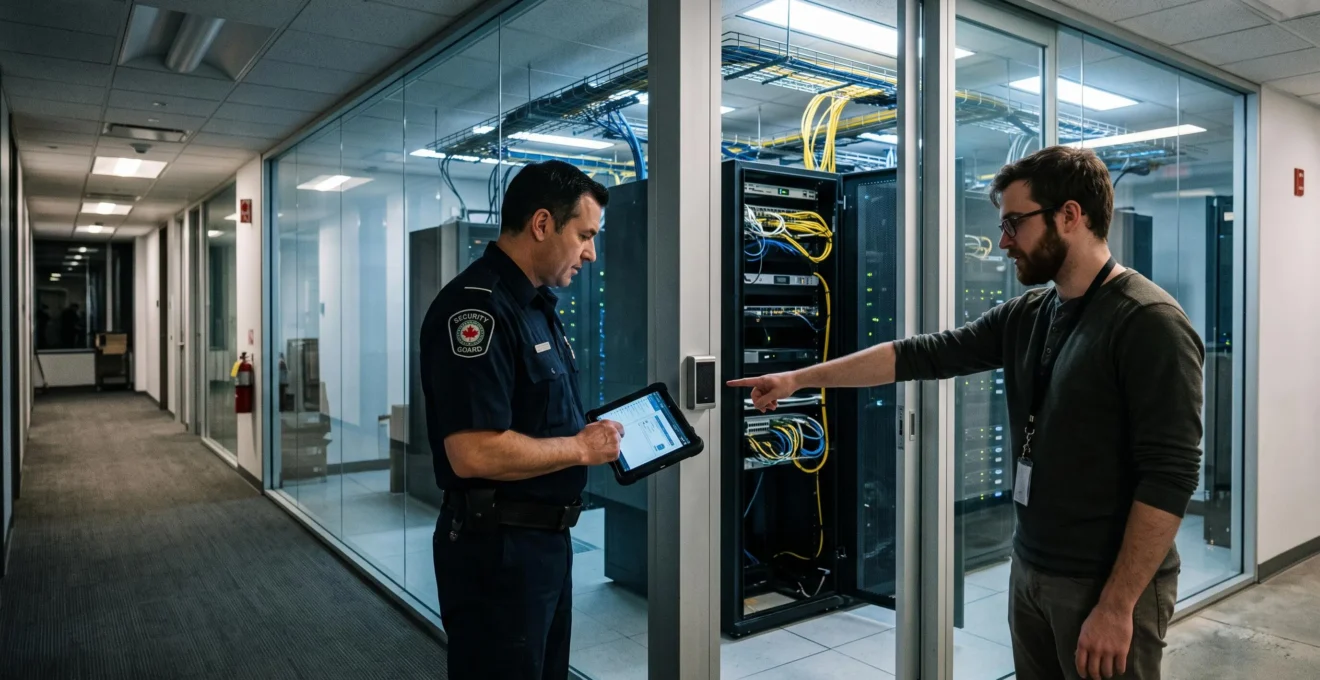
A locked server room cannot protect corporate information if an intruder can connect an unauthorized device to its network. Similarly, sophisticated cybersecurity monitoring offers limited protection when nobody tells the IT team that a restricted door has been forced open.
For Canadian businesses operating connected buildings, physical security and cybersecurity are no longer independent disciplines. IP cameras, electronic locks, building management systems, remote maintenance platforms and corporate networks frequently rely on interconnected infrastructure. A weakness in one environment can create exposure in another.
Effective security alignment requires shared accountability, controlled network connections, coordinated incident response and consistent access management. That does not necessarily mean merging security departments or replacing existing equipment. It means identifying where physical and digital risks intersect, assigning clear responsibilities and verifying that protective measures work together.
The following framework helps organizations assess those intersections while accounting for Canadian privacy obligations, emergency egress requirements and the operational realities of multi-site facilities.
Key principles for integrated physical and digital security
- Protect server rooms and building technology as potential entry points into corporate information systems.
- Connect physical alarms, cybersecurity investigations and escalation responsibilities through shared procedures.
- Manage access credentials, remote connections and emergency door behaviour throughout their operational lifecycle.
- Why Can Unauthorized Server Room Access Lead to a Cybersecurity Incident?
- How Can Security and IT Teams Coordinate During a Building Intrusion?
- Unified Security Governance or Separate Teams for Multi-Site Businesses?
- Why Poorly Segmented Building Devices Can Expose Corporate Networks
- How Can Shared Incident Reporting Reveal Hidden Security Patterns?
- Why Incorrect Lock Fail Modes Can Create Emergency Exit Hazards
- How Can You Enable Remote Video Viewing Without Publicly Exposing Cameras?
- How Can Canadian Organizations Manage Digital Access Credentials as Staff Changes?
Why Can Unauthorized Server Room Access Lead to a Cybersecurity Incident?
Unauthorized server room access can become a cybersecurity incident because physical proximity may allow someone to connect an unapproved device, interfere with network infrastructure or access sensitive equipment directly. Even strong software security controls cannot fully compensate for unrestricted physical access. The severity depends on the equipment exposed, its configuration and the intruder’s actual capabilities.
Consider a hypothetical intrusion in which someone follows an employee through a poorly monitored door. Once inside, the person might connect a malicious USB device to an accessible console, replace a network component or use an exposed Ethernet port. These actions could create opportunities for unauthorized access, disruption or further investigation of the network.
The room’s contents determine how serious the exposure could become. A practical inventory should identify domain controllers, network switches, backup media, communications cabinets and building management controllers. Facilities teams should also inspect adjacent cabling closets, since a network connection outside the main server room may offer an alternative access path.
The Canadian Centre for Cyber Security’s physical and environmental protection controls address physical access authorization, entry monitoring, access records and the coordination of investigations with incident response capabilities. Its guidance specifically recognizes the importance of enhanced monitoring around concentrated computing infrastructure.
Canadian privacy requirements can also become relevant. Under the Personal Information Protection and Electronic Documents Act (PIPEDA), where applicable, unauthorized access involving personal information requires assessment. A physical intrusion does not automatically constitute a reportable privacy breach; the organization must establish what happened and evaluate the applicable reporting threshold. Quebec organizations must also consider their provincial private-sector privacy obligations, including requirements introduced through Law 25.
A useful diagnostic exercise is to follow an authorized route from the nearest publicly accessible corridor to each sensitive console or network connection. Record the doors encountered, authentication steps, surveillance coverage and approximate time needed to reach the equipment. This identifies opportunities for unauthorized access without assuming that every intrusion will lead to compromise.
Physical access controls establish an important protective boundary, but their effectiveness also depends on whether suspicious entry events reach the people responsible for protecting the network.
How Can Security and IT Teams Coordinate During a Building Intrusion?
Security and IT teams can coordinate during a building intrusion by using predefined escalation rules, named decision-makers and a shared incident communication channel. Physical alarms should reach technical responders when network infrastructure may be affected, while cybersecurity anomalies should prompt physical verification when appropriate. Coordinated action reduces the chance that each team investigates only its own portion of the incident.
A security guard may discover a forced server room door without knowing whether connected systems require isolation. Meanwhile, IT analysts may observe unusual authentication activity without knowing that someone entered the same building. Neither observation establishes malicious activity by itself, but together they could justify a faster, more focused investigation.
Organizations should define a joint escalation matrix before an incident occurs.
| Observed event | Physical security action | IT or security operations action |
|---|---|---|
| Forced server room door | Verify the alarm, secure the area and preserve relevant footage. | Review connected-system activity and determine whether containment is necessary. |
| Repeated failed badge attempts | Check the affected access point and investigate authorization. | Examine related authentication or device alerts where relevant. |
| Unknown device detected | Verify whether equipment installation or maintenance was authorized. | Identify the device, restrict its connectivity where justified and preserve evidence. |
| Camera or access-controller tampering | Inspect the device and implement appropriate alternative monitoring. | Check network connectivity, configurations and related security logs. |
The matrix should identify who receives notifications, who can authorize network containment and who communicates with management. Guards should not be expected to disconnect critical infrastructure without appropriate training and authorization. Likewise, IT responders should not independently override emergency access controls.
A shared classification system can prevent misunderstandings. Instead of recording only a « door issue, » staff could classify an event as « unauthorized restricted-area entry, » with linked physical and digital observations. Joint exercises and post-incident debriefs can then test whether the terminology and escalation process are effective.
The Canadian Centre for Cyber Security’s physical protection guidance supports coordination between physical security investigations and incident response functions. Organizations can adapt this principle to their own operational structures rather than assuming that every business requires a combined security operations centre.
Reliable coordination does not depend on every team using the same technology. It depends on clear decision rights, timely communication and an accountable owner for incidents that cross departmental boundaries.
Unified Security Governance or Separate Teams for Multi-Site Businesses?
Unified security governance can improve accountability across multiple buildings, but separate physical and cybersecurity teams can also work effectively when they follow shared policies and escalation rules. The appropriate model depends on organizational scale, technical interdependence and available expertise. A hybrid structure often provides a practical balance between centralized oversight and specialized operational execution.
For Canadian companies operating several offices, distribution centres or mixed-use facilities, the organizational chart should reflect where security risks overlap. Sites using IP cameras, access controllers and building systems connected to enterprise networks generally require closer technical coordination than facilities with largely independent infrastructure.
Three governance models deserve consideration:
| Criteria | Unified governance | Hybrid governance | Separate teams |
|---|---|---|---|
| Accountability | One leadership structure oversees physical and cyber risks. | Shared executive accountability with specialized teams. | Separate executives or department heads. |
| Policy consistency | Centralized policy development. | Common standards with local execution. | Requires deliberate cross-team coordination. |
| Specialist expertise | Must protect distinct physical and technical capabilities. | Preserves specialist functions. | Maintains existing departmental specialization. |
| Principal weakness | One discipline may dominate budgets and priorities. | Shared decisions can stall without clear authority. | Disconnected policies may create control gaps. |
| Practical fit | Organizations able to support integrated leadership. | Multi-site operators seeking coordination without a full merger. | Organizations with limited system overlap and reliable coordination processes. |
A unified department is not automatically more secure. If cybersecurity dominates investment decisions, door maintenance, guard training and physical infrastructure may receive insufficient attention. Conversely, separate departments may develop incompatible rules, such as visitor access procedures that overlook temporary network permissions.
A practical hybrid approach assigns one accountable executive, such as a Director of Security or Risk, to oversee shared priorities. A cross-functional committee can include facilities, IT, physical security, human resources and privacy representatives. It should review changes affecting connected infrastructure, significant incidents and relevant obligations under PIPEDA and applicable provincial privacy legislation.
The Cross-Sector Cyber Security Readiness Goals Toolkit recommends defined leadership accountability, coordination across IT and operational technology where applicable, and documented response plans. Developed for critical infrastructure operators, its recommendations can inform other Canadian organizations without becoming universal legal requirements.
Budget authority offers a useful governance test. If facilities controls physical security spending while the CIO controls network investments, who approves a project requiring both? If the answer is unclear, formal policy alignment may not translate into operational decisions.
The strongest governance arrangement is the one that consistently resolves cross-functional decisions. That becomes particularly important when building devices and corporate networks share technical infrastructure.
Why Poorly Segmented Building Devices Can Expose Corporate Networks
Poorly segmented building devices can expose corporate networks because a compromised camera, access controller or building management component may communicate with systems beyond its intended function. When building technology shares unrestricted network access with corporate devices, attackers may gain opportunities for lateral movement. Effective segmentation limits these communication paths and reduces the potential impact of a single compromised device.
Modern facilities may operate IP cameras, HVAC controllers, electronic access systems and digital signage over Ethernet or wireless networks. Some equipment also relies on external maintenance services. Security exposure can arise from unchanged default passwords, outdated firmware, excessive network permissions or remote connections that bypass normal administrative controls.
For example, a compromised camera on a flat network might be able to communicate with a business application server. That possibility does not prove that the attacker can access the server, but it creates an unnecessary pathway that properly enforced network restrictions could remove.
A dedicated VLAN can support segmentation, but a VLAN label alone does not enforce complete isolation. Firewall rules, routing policies and access controls must restrict traffic between building devices and sensitive corporate systems.
For business environments with connected building technology, a practical segmentation design should establish dedicated device networks, prohibit unnecessary connections to user and server subnets, restrict outbound communications and monitor authorized traffic. Physically separate infrastructure may be appropriate when technical constraints or risk assessments justify it.
Remote maintenance deserves particular attention. A Canadian business may outsource access control and surveillance servicing to a systems integrator. The integrator’s remote access must be inventoried, authenticated, limited to necessary functions and disabled when no longer justified. Otherwise, a well-segmented internal network may still contain an overlooked third-party entry path.
Five checks to verify building network isolation
- Inventory IP cameras, access controllers, building automation equipment and their network locations; produce a device register with assigned owners.
- Document permitted connections between building networks and corporate subnets; produce an approved network communication diagram.
- Test whether an authorized camera or building device can reach a restricted corporate subnet; retain a documented test result.
- Review default, shared and vendor credentials; produce an exception list identifying accounts that require correction.
- Check logging and external maintenance access; produce a list of monitored connection points and approved third-party users.
These checks provide an initial diagnostic, not a complete penetration test. Testing should be authorized and coordinated to avoid disrupting cameras, building controls or operational systems.
Network isolation reduces the paths an attacker might exploit. The next challenge is recognizing when seemingly minor physical and digital events collectively indicate an emerging threat.
How Can Shared Incident Reporting Reveal Hidden Security Patterns?
Shared incident reporting can reveal security patterns by connecting physical events, such as failed badge attempts or doors left open, with digital indicators such as unusual authentication activity. Events that appear insignificant in separate records may warrant investigation when correlated by location, time and affected infrastructure. A consistent reporting method helps teams distinguish recurring weaknesses from isolated operational incidents.
Consider a hypothetical facility where employees repeatedly report a propped server room door. During the same periods, IT monitoring identifies unexpected login attempts against systems associated with that site. Neither observation establishes an attack. Together, however, they provide a reasonable basis for examining whether the events are related.
Without coordination, guards might record the door events in a paper logbook while cybersecurity analysts retain authentication data in a separate monitoring platform. No one necessarily reviews both records.
Organizations do not need an advanced security information and event management platform to begin correlating observations. A shared incident register can capture:
- Event date and time using a consistent timestamp standard.
- Facility, entrance, device or network location.
- Common event category and severity classification.
- Related physical or digital observations.
- Assigned owner, investigation outcome and corrective action.
A monthly cross-functional review may help smaller organizations identify patterns involving particular sites, devices or working hours. Higher-risk environments may require automated alerts and substantially faster analysis. Review frequency should reflect operational exposure rather than an arbitrary reporting schedule.
Useful indicators include repeated after-hours door alarms accompanied by authentication anomalies, recurring access failures involving restricted equipment or unexpected device connections following maintenance visits. Each pattern should generate a testable investigation question, not an automatic assumption of malicious intent.
Combining security records also increases privacy responsibilities. Badge holder identities, recorded footage and authentication logs may contain personal information. Canadian organizations should define legitimate purposes for correlation, restrict access, establish justified retention schedules and apply the privacy requirements relevant to their jurisdiction and activities.
Under PIPEDA, applicable breach recordkeeping duties concern breaches of security safeguards involving personal information; they do not create a universal requirement to retain every routine physical security alert.
Incident analysis should improve both cybersecurity and physical protection. Corrective action may involve access procedures, network controls or even electronic door configurations that must remain safe during emergencies.
Why Incorrect Lock Fail Modes Can Create Emergency Exit Hazards
Incorrect electronic lock fail modes can create emergency hazards when door behaviour during power loss or system failure conflicts with safe evacuation requirements. Fail-safe hardware generally unlocks when power is removed, while fail-secure hardware generally remains locked from the secured side. However, safe egress depends on the complete door assembly, including independent release mechanisms, not simply the lock’s fail mode.
When physical security systems become network-connected, teams may focus on centralized monitoring and remote access decisions without reviewing how doors operate during electrical failures, fire alarms or access-control outages.
The distinction between two common locking behaviours is important:
- Fail-safe locking: The locking mechanism releases when its operating power is lost. This may support certain life-safety arrangements but can also permit unauthorized entry into restricted spaces during an outage.
- Fail-secure locking: The mechanism remains secured from the controlled side without power. Depending on the door assembly, independent mechanical hardware may still permit occupants to exit safely.
Neither classification, by itself, determines compliance. An electronically controlled exit might require specific release arrangements or fire alarm integration, depending on its configuration and applicable local requirements.
The National Building Code of Canada 2025, Volume 1 provides a national model framework addressing building safety and emergency egress. Its provisions must not be treated as automatically applicable in every province or territory. Adoption, amendments, occupancy classification and the precise door function all matter.
Before modifying electronic locking hardware, facility operators should consult the locally applicable building and fire codes and involve a qualified technician and, where appropriate, the authority having jurisdiction.
A structured door audit should record each electronic lock, its location, intended security function and emergency egress role. The audit should also specify expected behaviour under normal operation, power failure, fire alarm activation and access-control system failure.
Potential conflicts require explicit resolution. A door protecting critical infrastructure must resist unauthorized entry without preventing required evacuation. A centrally managed system must also account for failures in the network or controller controlling that door.
Life-safety validation should remain a separate approval step within an integrated security project. Once doors and building controls are correctly configured, organizations must also consider the risks introduced when personnel access surveillance equipment remotely.
How Can You Enable Remote Video Viewing Without Publicly Exposing Cameras?
Canadian businesses can enable remote video viewing without directly exposing cameras or recording equipment to the public internet by using a properly secured VPN, an authenticated video management platform or a controlled remote access gateway. These approaches should combine encrypted communications, individual user accounts, multi-factor authentication and restricted permissions. Their effectiveness depends on correct configuration and ongoing maintenance.
One particularly risky configuration is forwarding a router’s public-facing ports directly to a camera or network video recorder. This can expose the equipment’s authentication interface to automated login attempts and exploitation of known software vulnerabilities.
Remote access should instead pass through a managed security boundary. A business might use a VPN for authorized administrators, a video management service with encrypted connections or a vendor-operated gateway that supports appropriate authentication and monitoring.
The choice depends on whether viewing access is needed by employees, security operators, external integrators or management. Each group should receive only the cameras and functions required for its responsibilities.
Access configuration should include individual credentials, multi-factor authentication where supported, encrypted transport and timely removal of permissions when responsibilities change. Administrative rights should be limited separately from ordinary viewing rights.
Small Canadian businesses using consumer-grade surveillance products should pay particular attention to default settings. Convenience features, automatic port configuration or inherited installer accounts can create exposures that were never deliberately approved.
Organizations can perform a limited exposure assessment by reviewing firewall rules and checking authorized public IP addresses using a reputable internet-wide device indexing service. Such checks should be restricted to infrastructure the organization owns or is authorized to assess. A device not appearing in a search result is not proof that it is inaccessible.
Vendor-managed cloud connections also require scrutiny. Confirm which organization operates the service, how users authenticate, what information is processed, and how access can be revoked if the service relationship changes.
Remote viewing remains secure only while permissions are maintained. As employees, contractors and service providers change, access management must cover both the surveillance platform and every other connected building system.
Key takeaways before implementing access lifecycle controls
- Make HR departure and role-change notifications the trigger for coordinated physical and digital access reviews.
- Prioritize revocation according to the sensitivity of systems and the actual end of authorized access, rather than relying on separate departmental schedules.
- Require named owners and periodic verification of privileges across badges, networks, video platforms and building systems.
How Can Canadian Organizations Manage Digital Access Credentials as Staff Changes?
Canadian organizations can manage access credentials more consistently by treating physical badges, network accounts, VPN access and building system permissions as one coordinated lifecycle. Employee departures and role changes should trigger defined actions across every relevant platform. Individual credentials, documented ownership, timely revocation and periodic recertification reduce the risk of forgotten or unnecessarily persistent access rights.
Many businesses still use separate processes for issuing and withdrawing permissions. Human resources may notify IT about an employee departure, while facilities receives the information later. Meanwhile, a contractor’s surveillance login may remain active because it was created directly by an external integrator.
One employment or contract event should initiate all relevant access changes. The workflow should identify each credential category, its administrator and the deadline for removal or modification.
For example, departing employees may hold office badges, server room permissions, network accounts, VPN credentials, camera viewing rights, parking access and building management privileges. An effective offboarding process verifies each entitlement rather than assuming that disabling an email account removes the rest.
The Canadian Centre for Cyber Security’s readiness toolkit recommends an enforced departure process that retrieves physical access credentials and disables user accounts by the employee’s departure date. This provides a useful baseline for coordinated offboarding.
Revocation timing should reflect risk and authorization. Highly sensitive access, including privileged network accounts and restricted infrastructure permissions, should end when authorization ends. Administrative tasks such as recovering equipment or settling payroll matters should not justify leaving unnecessary system privileges active.
Some lower-risk arrangements may have separately authorized end dates, but these should be defined and documented rather than treated as automatic grace periods. Where immediate access removal is required, administrative convenience should not override the security decision.
Contractors and seasonal workers introduce additional complexity, especially in Canadian construction, retail and logistics operations. Individual credentials with predetermined expiry dates can reduce reliance on shared accounts and prevent indefinite access after short assignments. Temporary access should also be limited to the locations and functions needed for the contract.
Periodic access recertification addresses changes that departure procedures cannot capture. A quarterly or semi-annual review may be suitable for some organizations, with more frequent verification for critical privileges. Managers should confirm whether each person’s access remains necessary, while system owners verify that approved changes have actually been implemented.
This approach also supports privacy accountability. The Office of the Privacy Commissioner’s guidance on mandatory breach reporting explains that organizations subject to PIPEDA must assess breaches involving personal information, report those presenting a real risk of significant harm and maintain records of breaches of security safeguards. These obligations reinforce the importance of knowing who had access to sensitive information and when, without making every credential anomaly a reportable incident.
A practical next step is to select one facility, map every physical and digital credential issued to its employees and contractors, and test whether a single departure notification produces complete, documented revocation. Findings from that pilot can guide an organization-wide access lifecycle policy.
Does every Canadian business need a unified security operations centre?
No. Smaller organizations can coordinate physical security and IT through shared escalation procedures, named responsibilities and regular incident reviews. A unified security operations centre may be appropriate for complex or high-risk environments, but organizational integration is not a universal requirement.
Is a physical security incident automatically a reportable privacy breach in Canada?
No. Reporting depends on the applicable privacy legislation, whether personal information was affected and the relevant legal threshold. Under PIPEDA, where applicable, breaches presenting a real risk of significant harm must be reported, while records of breaches of security safeguards involving personal information must be maintained. Provincial requirements may differ.
Can existing access control and cybersecurity systems be integrated without replacing them?
Often, yes. Organizations can begin with common incident classifications, coordinated procedures, shared inventories and controlled information exchange. Technical integration may subsequently involve supported application interfaces or monitoring connections, subject to compatibility, vendor support and security assessment.
Who should approve security changes affecting both buildings and corporate networks?
A designated accountable leader or formal cross-functional approval group should coordinate decisions involving both environments. Technical approval should include the appropriate facilities, IT and security specialists, with privacy or life-safety expertise involved when relevant. The approval process should identify who owns the resulting operational risk.
How can a business measure whether its physical and digital security controls are aligned?
Useful measures include the proportion of critical areas with verified access controls, the completeness of network device inventories, the time required to escalate cross-functional incidents, the percentage of terminated users whose credentials were revoked as required, and the number of unresolved exceptions from joint security reviews. Measures should reflect the organization’s own risks and established objectives.