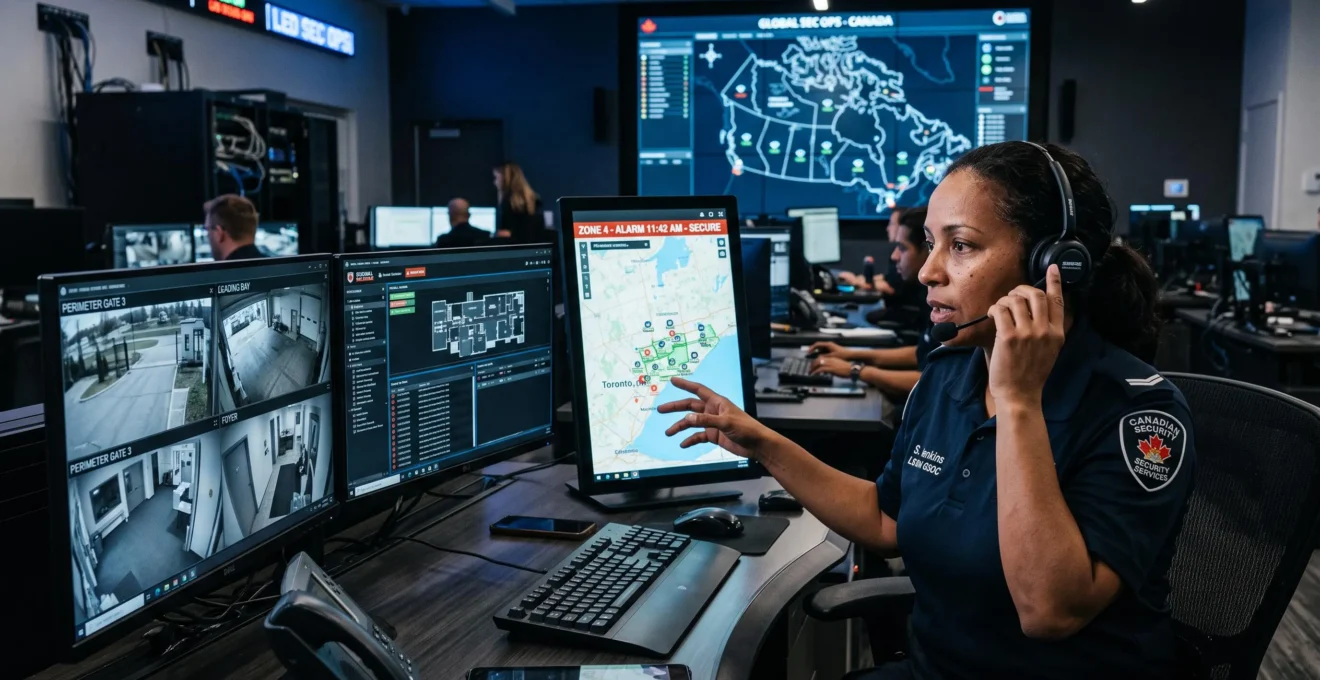
When an intrusion alarm activates in a Canadian commercial building, the central monitoring station does more than receive a notification. Its operators assess the incoming signal, review the property’s response instructions, determine whether verification is necessary, contact authorized representatives and escalate the event according to applicable police policies.
That process matters because an alarm signal is not automatically evidence of a break-in. An unexpected door opening, an equipment malfunction and a confirmed intrusion can require different responses. Monitoring operators must distinguish between them without overlooking a genuine emergency.
Canadian alarm response practices also depend on location. Police services in Toronto and Calgary, for example, publish different operational conditions for responding to monitored alarms. Building owners therefore need to evaluate both their monitoring provider’s procedures and the requirements of the police jurisdiction serving their property.
An effective monitoring arrangement combines reliable detection, clearly defined verification rules, reachable emergency contacts and accurate site information. Each element influences whether an alert can be assessed and escalated appropriately.
Central Monitoring Station Response: Key Points
- Intrusion alerts are assessed using available signal information and applicable verification methods before an escalation decision is made.
- Emergency contact authority, reliable passcodes and accurate site instructions are essential to effective alarm handling.
- Police dispatch eligibility varies by municipality, while false alarms and outdated access permissions can undermine a property’s response arrangements.
- Why Must Monitoring Operators Verify Certain Intrusion Alerts Before Dispatch?
- How Can You Create an Effective Emergency Contact List for Alarm Monitoring?
- Dedicated Monitoring or Shared Alarm Receiving Services for Small Facilities?
- Why Incorrect Site Instructions Can Delay a Security Response
- When Should Monitoring Instructions Be Updated After Tenant Changes?
- Why Do Unverified Intrusion Alerts Create False Dispatch Problems?
- When Should Contractor Access Be Revoked After a Project Ends?
- What Training Should Security Personnel Have for High-Risk Canadian Properties?
Why Must Monitoring Operators Verify Certain Intrusion Alerts Before Dispatch?
Monitoring operators verify certain intrusion alerts because a sensor activation alone may not establish that an actual security incident is occurring. Verification helps distinguish credible threats from accidental or technical activations, limits unnecessary police requests and supports compliance with local dispatch policies. The required evidence and handling procedure depend on the alarm category and police jurisdiction.
A central station typically begins by examining the electronic information available from the alarm system. This may include the originating zone, detector type, activation sequence, event timestamps and associated system status. An alarm involving several independently activated zones may provide stronger evidence of intrusion than an isolated detector activation.
The operator then follows the applicable verification procedure. Depending on the equipment and local requirements, this can involve reviewing audio or video, interpreting multiple-zone activity, contacting authorized representatives or obtaining confirmation from someone at the premises. These methods are not necessarily consecutive mandatory stages: some jurisdictions accept particular electronic evidence as verification without requiring an additional telephone or video confirmation.
The CANASA Monitoring Station Reference Guide endorses Enhanced Call Verification for intrusion alarms, including telephone attempts to at least two contact points before requesting police assistance. This is an industry recommendation, not a single nationwide legal requirement. Applicable municipal policies and other requirements take precedence.
Intrusion alarms and personal emergency alarms must also be distinguished. The Toronto Police Service accepts audio, video, eyewitness information and multiple-zone activations as verification for burglar alarms. Its official alarm response policy exempts panic, hold-up and duress activations from the burglar-alarm verification requirement.
Verified burglar alarms and panic alarms receive high-priority treatment under Toronto’s policy, but actual attendance still depends on competing calls and available police resources. An unverified intrusion alarm, by contrast, may not qualify for dispatch at all. Skipping verification can therefore fail to produce the faster response a property owner expects.
Unnecessary dispatch can also create financial and operational exposure. Local false alarm provisions may impose penalties, although the party responsible for a penalty and any contractual recovery of costs depend on the jurisdiction and monitoring agreement. Operators must follow the applicable rules rather than assume that every alarm authorizes immediate police attendance.
The next operational requirement is ensuring that someone with appropriate authority can answer the station’s call and provide useful information when verification or site access is needed.
How Can You Create an Effective Emergency Contact List for Alarm Monitoring?
An effective emergency contact list identifies who can answer an alarm call, verify their identity, make authorized decisions and arrange access to the property. Contacts should appear in a defined escalation order, with accurate telephone numbers, suitable availability and clear responsibilities. A list of reachable people is insufficient if none can act when an incident occurs.
Begin by distinguishing the roles assigned to each person. A property owner or designated manager may have authority to approve operational changes, while a security supervisor may be responsible for investigating an activation. A keyholder may be able to open a secured entrance but lack authority to modify monitoring instructions.
Not every authorized representative can override a verification requirement. Local police policies and monitoring procedures may still require specified evidence before dispatch, regardless of a contact’s position within the organization.
The station should receive a structured contact record containing:
- Priority and availability: the order in which contacts should be called and the periods during which they are available.
- Decision authority: the actions each person may authorize, including valid alarm cancellation or changes to site instructions.
- Site attendance: whether the person holds suitable access credentials and can physically attend when requested.
- Identity verification: the approved passcode or other authentication method associated with the contact.
- Escalation expectations: when the operator should continue to the next available representative.
Individual verbal passcodes, where supported by the monitoring provider, offer an additional accountability measure. Shared passcodes can establish knowledge of a common secret, but they do not necessarily identify which particular person answered. Individual credentials make it easier to revoke access or investigate disputed instructions.
Canada-specific dispatch arrangements make the distinction between a contact and a keyholder particularly important. Calgary Police Service requires alarm companies to attempt to contact at least two keyholders before requesting police assistance. This does not mean that both must answer or that a keyholder must physically attend every verified event.
The property manager should establish practical attendance expectations with the monitoring provider rather than assume that a person living far away can perform the same role as someone located nearby. Telephone availability and physical access capability are different operational resources.
A useful escalation plan specifies the call sequence and the conditions for advancing to another person. It also identifies a backup representative if the primary contact is travelling, unavailable overnight or unable to enter the building.
Contact data should be reviewed whenever responsibilities change. The central station’s controlled record, rather than an informal spreadsheet kept by a single employee, should be treated as the operational version used during an incident.
Even an excellent contact list depends on the monitoring provider’s ability to apply the right instructions. That raises a separate purchasing decision for owners of small commercial facilities: how much customization does their monitoring service actually provide?
Dedicated Monitoring or Shared Alarm Receiving Services for Small Facilities?
Small Canadian facilities can often use shared central monitoring effectively when the provider supports property-specific instructions and reliable escalation. Dedicated monitoring may be worth evaluating when a site has complex access patterns, elevated consequences of missed incidents or unusual response requirements. The decisive distinction is the quality of the agreed procedures, not simply whether operators serve multiple customers.
Shared alarm receiving services typically use common monitoring infrastructure and operator resources to handle events from numerous accounts. This model can provide professional coverage without allocating an exclusive team to one property.
Dedicated arrangements can take different forms, from additional site-specific procedures to more extensive operator familiarization or specially assigned resources. The term does not automatically guarantee faster dispatch, a dedicated physical control room or a particular service level.
Facility owners should compare providers against actual operating conditions:
| Decision Factor | Shared Monitoring | Dedicated or Highly Customized Monitoring |
|---|---|---|
| Predictable occupancy hours | Standard schedules may be sufficient. | May offer limited additional value. |
| Frequent after-hours activity | Requires accurate schedules and exceptions. | May support more detailed contextual procedures. |
| Consequences of a missed event | Evaluate verified response and escalation capabilities carefully. | Consider specialized handling and documented service commitments. |
| Complex access arrangements | Confirm support for multiple contacts, zones and instructions. | Assess whether deeper site familiarization improves handling. |
| Monitoring budget | Compare included features and additional charges. | Request a detailed explanation of added services and costs. |
Consider a hypothetical warehouse where authorized employees regularly work late during inventory periods. A standardized after-hours alarm workflow may initiate callbacks whenever movement is detected. If temporary schedules and approved access details are properly configured, a shared monitoring service may handle these events appropriately.
Without that customization, the same site could experience unnecessary verification calls or inconsistent handling of legitimate activity. The problem would not be shared monitoring itself; it would be the mismatch between the site’s operations and the instructions available to operators.
Pricing should be evaluated against documented service commitments. Higher fees may reflect additional reporting, specialist procedures, account management or operator training. They should not be interpreted as proof of shorter response times unless the provider defines measurable performance expectations.
Before signing, ask how instructions are updated, whether multiple-zone information is available to operators, how escalation is audited and which services carry additional charges. Request written examples of the monitoring protocol proposed for the building.
Whatever service model is selected, its performance still depends on the accuracy of the building information supplied to the central station.
Why Incorrect Site Instructions Can Delay a Security Response
Incorrect site instructions can delay a security response because central station operators rely on documented information to interpret alarms, reach authorized contacts and coordinate appropriate action. Outdated telephone numbers, misleading zone descriptions or inaccessible entrances introduce uncertainty precisely when decisions must be made. The result can be slower verification, unsuccessful contact attempts or an ineffective site attendance request.
Monitoring instructions should accurately describe the premises as they operate today, not as they were configured when the alarm system was installed. Renovations, staffing changes and new access controls can all invalidate previously correct information.
Three common categories of errors are particularly disruptive:
- Contact errors: disconnected telephone numbers, former employees still listed as keyholders or missing after-hours representatives.
- Detection errors: zone descriptions referring to rooms, doors or partitions that have been relocated or renamed.
- Access errors: obsolete entry codes, removed locks, closed entrances or instructions directing responders to inaccessible areas.
These errors can affect more than the speed of a callback. Suppose a monitoring operator receives an alarm from a zone labelled “rear loading door,” but a recent renovation has converted the area into a secured storage room. The operator may contact the wrong department or provide an attending keyholder with misleading information.
Incorrect instructions do not automatically change a verified alarm into an unverified alarm. If the police service accepts electronic verification, such as multiple-zone activations, the evidence may remain valid even when contacts are unreachable. However, where confirmation depends on a callback or eyewitness information, obsolete contacts may prevent the operator from obtaining the evidence needed for dispatch.
Building owners should therefore audit instructions following material operational changes. The review should compare monitoring records with the current floor plan, authorized personnel list, alarm zone configuration and access arrangements.
Testing is preferable to merely asking whether the information appears correct. Phone numbers should be checked, passcode authentication should be confirmed through an approved process, and keyholders should verify that the documented entrance and access method actually work.
Five Actions for a Verifiable Monitoring Instruction Audit
- Export or request the active site instructions from the provider and produce a dated baseline copy.
- Contact each listed emergency representative and record a verified telephone number, role and availability status.
- Compare all monitoring zone descriptions with the current building layout and produce a corrected zone register.
- Validate authorized passcodes and site access arrangements through an approved provider procedure, recording exceptions without exposing secrets in the audit report.
- Submit corrections and obtain written confirmation that the monitoring station has activated the revised instructions.
Keep an audit record showing who approved the changes, what was modified and when the provider confirmed implementation. Any controlled alarm test should be coordinated with the monitoring station to prevent unnecessary escalation.
One of the most important occasions for this review is a tenant transition, when responsibilities, access permissions and emergency contacts can change at the same time.
When Should Monitoring Instructions Be Updated After Tenant Changes?
Monitoring instructions should be updated whenever a tenant change affects access rights, authorized contacts, passcodes or occupancy schedules. Updates should be coordinated with the actual transfer of responsibility, rather than postponed until lease paperwork is complete. Incoming representatives must have the required access before outgoing credentials are withdrawn, without leaving former occupants with continuing authority.
In a multi-tenant commercial building, the property manager may control the shared alarm system while individual tenants manage access to their own premises. The monitoring provider needs an unambiguous record of which party can authorize changes to each protected area.
Operational triggers include changes in key possession, alarm panel users, verbal verification credentials, authorized after-hours activity and the people permitted to attend an alarm. A former tenant’s telephone number should not remain on a live escalation list merely because the number still works.
Credential transition requires coordination. Valid credentials for incoming authorized users should be established and tested before legacy credentials are disabled, where continuity requires that sequence. The changeover should be completed within a controlled handover window, with outgoing permissions revoked at the agreed termination of authority.
This does not mean retaining former tenant access after possession has formally transferred. Instead, the owner should prepare replacement credentials in advance and make the activation and revocation steps part of the same documented process.
A practical lease-transition workflow includes:
- Before occupancy, identify the incoming tenant’s authorized contacts, access requirements and permitted hours.
- Agree which monitoring instructions are controlled by the landlord and which require tenant authorization.
- Configure and test new panel users and verification arrangements through the provider’s approved procedures.
- At handover, revoke outgoing credentials and recover or replace physical access devices as appropriate.
- Confirm that the central station has received the final contact list, zone details and instructions.
Where an alarm system supports event logging, review access and configuration records to confirm the intended changes. A deactivated local panel code should no longer be accepted by the panel; whether it generates a separate event at the monitoring station depends on system configuration.
Conflicting instructions can create particular difficulties when a former tenant, building manager and new occupant all believe they retain decision authority. A single approved change-control process should identify whose instructions govern each protected area and how authority is verified.
Maintaining accurate instructions also reduces the chance that routine activity or a misinterpreted alarm will lead to an unnecessary police request.
Why Do Unverified Intrusion Alerts Create False Dispatch Problems?
Unverified intrusion alerts create false dispatch problems when police resources are requested without sufficient evidence of an actual incident. Unnecessary responses can lead to penalties, consume emergency resources and affect future dispatch eligibility under local policies. Verification reduces avoidable requests while helping monitoring operators identify incidents that warrant police attention.
False alarms can arise from several operational and technical conditions. Heating and ventilation movement may affect poorly positioned detectors, environmental activity can trigger exposed sensors, and aging equipment may generate unreliable activations. Incorrect panel programming or communication faults can also leave operators with incomplete or confusing event information.
However, incomplete signal information is not proof that an alarm is false. A genuine intrusion can produce limited electronic evidence. Monitoring personnel must apply the agreed verification process rather than dismiss an event solely because one detector activated.
Municipal rules illustrate why this distinction matters. The Calgary Police Service alarm response and false alarm rules state that police may decline dispatch for single-zone activations, alarms without valid permits, suspended permits and certain other circumstances.
Calgary also requires alarm companies to attempt contact with at least two keyholders before requesting police assistance. Its published penalty framework places false alarm penalties on the licensed alarm company requesting police attendance. This illustrates why a building owner should not assume that every municipality fines the property owner directly.
2 keyholder contact attempts
Calgary requires alarm companies to attempt to contact at least two keyholders before requesting police assistance. The requirement concerns attempts, not successful conversations with both individuals.
Calgary Police Service, Responding to Alarms and False Alarms.
Permit requirements, penalty structures and suspension or reinstatement procedures must be checked locally. A history of unnecessary dispatch can create compliance or service problems, but it does not establish that every Canadian police service automatically reduces the priority of subsequent genuine incidents.
Prevention starts with historical evidence from the monitored property. Owners should request an annual event and false alarm review showing which detectors, zones and operating periods generate recurring problems.
Patterns can guide corrective work: repeated motion activations during HVAC startup may justify examining detector placement, while intermittent communication events warrant equipment and network diagnostics. Any changes should be completed by qualified personnel and tested under controlled conditions.
Another preventable source of confusion is the continued use of valid access credentials by people whose work at the property has already ended.
When Should Contractor Access Be Revoked After a Project Ends?
Contractor access should be revoked when the legitimate need for that access ends, with timing determined by the type of credential and the final authorized activity. Alarm panel codes, physical keys, temporary access schedules and monitoring permissions require separate closeout actions. Waiting until administrative project closure can leave unnecessary access active after work is finished.
Contractors may receive several forms of access during construction, repairs or maintenance. A technician might have a temporary alarm code, a scheduled after-hours disarming window and knowledge of instructions used to contact the monitoring station. These permissions are not interchangeable and may be managed by different systems.
Alarm panel credentials should be disabled when authorized use ends. Physical keys should be recovered at handover or affected locks managed appropriately if recovery cannot be confirmed. Temporary schedules should be removed as soon as the final authorized visit is complete.
Monitoring-specific permissions deserve particular attention. If a contractor remains on the emergency contact list or retains a valid verification passcode, the operator may still treat that person as an authorized representative. This could lead to inappropriate alarm cancellation or disclosure of operational information, depending on the station’s authentication rules.
A hypothetical example illustrates the risk: a maintenance contractor finishes a building retrofit, but their former verification credential remains active. During a subsequent intrusion alert, someone using that credential might be authenticated under the old instructions. The scenario demonstrates a potential authorization weakness, not a documented security incident.
Project closeout should therefore include a credential reconciliation signed by the responsible property representative. The record should identify all issued keys, cards, codes, remote access accounts and special monitoring permissions, with their withdrawal status.
Where the system supports safe credential testing, verify that a revoked code is rejected by the alarm panel. Coordinate any related signal testing with the monitoring provider. A code rejected locally will not necessarily generate a transmission to the station, so confirmation should use the appropriate system logs and configuration records.
Commercial maintenance and construction agreements can support this process by making access return and credential deactivation documented closeout deliverables. These provisions should be agreed contractually rather than presented as a universal Canadian legal requirement.
Credential controls provide a reliable foundation, but higher-risk premises also need personnel who understand how to interpret alarms, communicate with monitoring operators and act safely when a threat may be real.
Key Takeaways for Building Owners
- Assess monitoring effectiveness through documented verification methods, escalation authority and police dispatch compatibility rather than advertised response speed alone.
- Treat contact records, alarm credentials and site instructions as controlled operational information that must change with occupancy and access rights.
- For higher-risk properties, define the qualifications, site knowledge and incident communication skills expected of everyone participating in the response.
What Training Should Security Personnel Have for High-Risk Canadian Properties?
Security personnel at high-risk Canadian properties should have the applicable provincial qualifications and additional training matched to the site’s threats, alarm system and emergency procedures. Essential competencies include safe incident assessment, accurate communication with the central station, access control, identity verification and timely escalation to police or emergency services when circumstances require it.
High-risk properties may include critical infrastructure, jewellery retailers, cannabis facilities or commercial premises with a documented history of targeted intrusion. These examples have different threat profiles, so there is no single monitoring or training package that automatically fits all of them.
The first requirement is regulatory compliance. Security guard licensing and training are governed by applicable provincial or territorial rules, and the obligations may differ according to the person’s work and role. Property owners should verify the relevant requirements before assigning security duties.
For example, Ontario‘s security guard training syllabus specifies a minimum basic program of 40 hours including emergency-level first aid certification, or 33.5 hours excluding that certification component. Its subjects include communication, security procedures, emergency response preparation, situational awareness, access control and legal responsibilities.
These are Ontario-specific basic training requirements, not a universal Canadian curriculum or a separate certification for every high-risk facility.
Property managers should supplement applicable baseline training with practical, site-specific preparation covering:
- Alarm interpretation: understanding zone maps, detector locations, entry routes and permitted access schedules.
- Safe verification: assessing observable conditions without entering a potentially dangerous area or confronting an intruder.
- Central station communication: reporting relevant observations clearly and using approved identity verification procedures.
- Emergency escalation: recognizing when circumstances require police or other emergency services rather than further on-site investigation.
- Incident documentation: preserving relevant observations, access records and other evidence in accordance with site procedures.
A security guard should not be expected to enter a building where an intrusion may be in progress simply to validate an alarm. If an immediate threat is suspected, personnel should follow their emergency procedures, maintain a safe position and obtain assistance from the appropriate authorities.
Site familiarization should include practical exercises involving the property layout, alarm panel terminology, communication procedures and fallback arrangements. Training should also clarify which decisions guards can make independently and which remain with designated property representatives or emergency responders.
Accurate reports from trained personnel can help a station establish the nature of an event and communicate useful evidence. However, faster responses from guards do not independently guarantee higher police dispatch priority. The local police service’s verification criteria and operational capacity still govern attendance.
Training records should identify the individual’s qualifications, completed site-specific instruction and any exercises used to confirm competence. Refreshers are appropriate when the site’s risks, access arrangements or monitoring instructions change.
Before finalizing or renewing a monitoring agreement, ask the provider to walk through a realistic intrusion scenario using the property’s actual zone map, contact list and authorized response personnel. Document any gaps, assign responsibility for corrections and confirm the revised procedure before relying on it operationally.
Does a monitored intrusion alarm automatically trigger police dispatch in Canada?
No. Police response depends on the alarm category, available verification evidence and policies of the police service responsible for the property. Toronto requires verification of burglar alarms using accepted evidence, while Calgary publishes additional dispatch conditions. Panic and hold-up alarms can receive different treatment. A monitoring contract should specify how applicable local rules are implemented.
Can a central monitoring station cancel an intrusion alarm without contacting the property owner?
Depending on the monitoring agreement and applicable procedures, an alarm may be resolved following receipt of a valid cancellation or abort signal or other authorized confirmation. The property owner does not necessarily need to personally approve every routine cancellation. The station must follow its documented authentication, notification and escalation requirements.
What records should building owners request from an alarm monitoring provider?
Useful records include alarm event histories, available verification and escalation logs, current emergency contact instructions, documented service commitments and reports identifying repeat false alarm patterns. Access to records and retention periods depend on the provider’s systems and agreement. Owners should also request confirmation when monitoring instructions or authorized credentials are changed.
Is video verification required for every commercial intrusion alarm?
No. Video can support verification, but it is not the only accepted method. Toronto Police Service also recognizes audio evidence, eyewitness confirmation and multiple-zone activations for burglar alarm verification. Other jurisdictions may apply different requirements. Whether video verification is appropriate depends on the premises, detection equipment, privacy considerations and applicable response policy.
Who is responsible for false alarm penalties in a professionally monitored building?
Responsibility varies by municipality and contractual arrangement. Calgary’s published procedure applies false alarm penalties to the licensed alarm company requesting police attendance. Other jurisdictions may use different rules, and monitoring contracts may address recovery of costs between the provider and customer. Building owners should review both local bylaws and their service agreement.