A security siren should be loud enough to alert the people who need to respond, but not so loud that it creates unnecessary hearing risks, disturbs neighbouring properties or encourages occupants to disable the alarm. For Canadian homes and commercial buildings, the right level depends on where the sound must travel, how the property is occupied and what happens after an intrusion is detected.
A manufacturer’s decibel rating alone cannot establish whether an alarm will be effective. A siren rated at 105 dB near the device may be readily heard in a hallway yet much less noticeable behind several closed doors or between floors. Conversely, an outdoor siren that sounds powerful on the street may create excessive noise inside neighbouring apartments.
The practical approach is to test audibility at occupied locations, use additional sounders where appropriate, select a suitable automatic shutoff and coordinate audible warnings with monitoring and visual verification. Municipal requirements must also be checked because Canada does not have one universal intrusion-siren volume or duration rule.
Security siren loudness: the essential decisions
- Measure where people are: Confirm that the alarm can be recognized from bedrooms, workstations and other relevant locations, rather than relying on its advertised decibel rating.
- Prioritize coverage over maximum output: Several appropriately positioned sounders may serve a divided or multi-floor property better than one exceptionally loud device.
- Control duration and false alarms: Check municipal requirements, configure automatic shutoff and maintain reliable monitoring contacts.
- Why Do Security Sirens Sound Weak Behind Closed Interior Doors?
- How Can You Assess Siren Audibility Across a Multi-Floor Building?
- Internal Sounders or Outdoor Sirens for Urban Commercial Properties?
- The Siren Installation Mistakes That Can Create Noise Complaints
- When Should an Intrusion Siren Stop Automatically After Activation?
- Why Repeated False Sirens Can Weaken a Property’s Security Response
- When Should Monitoring Instructions Be Updated After Tenant Changes?
- How Can Surveillance and Alarm Systems Work Together to Protect Canadian Properties?
Why Do Security Sirens Sound Weak Behind Closed Interior Doors?
Security sirens can sound weak behind closed interior doors because walls, doors, flooring and the connections between building elements reduce or redirect sound as it travels. A high decibel rating measured near a siren does not guarantee an effective warning in a distant bedroom or office. Actual audibility must be tested along the building’s acoustic paths.
Sound travels through openings and building materials, but not equally well through every route. A closed door can interrupt a relatively direct path through a corridor. Drywall assemblies, insulation and floor construction further influence transmission, while gaps and adjoining structural elements create alternative routes.
The NRC soundPATHS sound-transmission application explains how direct transmission through separating elements and indirect, or flanking, transmission affect sound insulation between rooms. Although the application does not specifically assess intrusion sirens, it illustrates why building construction matters when evaluating audible warnings.
Consider a hypothetical Canadian house with a siren advertised at 105 dB. The rating may have been obtained at a specified measurement distance under manufacturer-defined conditions. It does not tell the owner how loud the alarm will be in a basement bedroom behind a closed door. There is no reliable way to calculate that room’s alarm level from the advertised figure alone without accounting for the intervening construction and measurement conditions.
Source loudness and occupant exposure are different measurements. The first describes the device under stated conditions; the second determines whether someone can recognize the alarm and whether the sound creates an excessive exposure risk.
In Canadian winter conditions, closed windows, insulated partitions and enclosed sleeping areas can further complicate propagation. A basement bedroom or a well-insulated room may have little direct acoustic connection to an upstairs hallway.
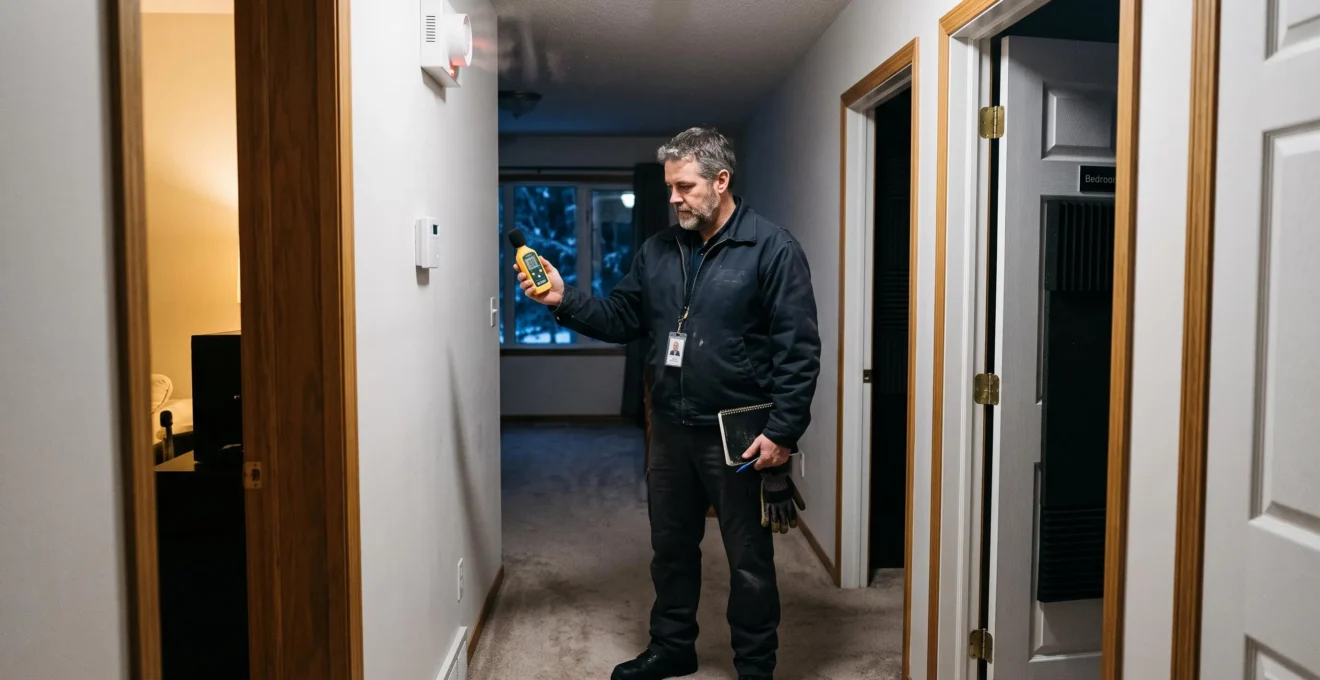
A practical test is to activate the alarm briefly under controlled conditions while another person checks each occupied room with doors in their usual positions. Measure with a suitable sound level meter when quantitative evaluation is required, and record any areas where the warning is unclear. Arrange the test to avoid unnecessary exposure, warn affected occupants and neighbours, and coordinate with the monitoring provider to prevent an unintended dispatch.
If a room receives an inadequate warning, investigate the acoustic path and possible sounder placement before increasing the output of the existing unit. An additional indoor sounder may improve coverage without making the original location uncomfortably loud.
Once individual rooms have been assessed, the next challenge is confirming that the warning reaches every occupied floor, especially where heavy construction separates the spaces.
How Can You Assess Siren Audibility Across a Multi-Floor Building?
Assess security siren audibility across a multi-floor building by testing each occupied level separately, including rooms behind closed doors and areas with substantial background noise. Record where the alarm is clearly recognizable, where it is weak and where it cannot be distinguished. Use those findings to decide whether additional sounders or repositioning are necessary.
Begin with a floor plan identifying bedrooms, offices, meeting rooms, corridors, storage areas and other locations where people may reasonably be present. Include locations that become occupied outside normal business hours, such as an overnight staff room or a residential basement.
Next, identify noise sources that could mask the warning. Mechanical ventilation, heating equipment, commercial machinery and street traffic can change the acoustic environment throughout the day. An alarm that stands out in a quiet office after closing may be less recognizable during normal operations.
Vertical coverage requires particular attention. Concrete slabs, enclosed stairwells, fire-rated doors and service shafts can produce very different sound-transmission conditions. A siren audible across an open floor may provide inadequate coverage one storey above or below. The exact outcome depends on the construction and available transmission paths, not simply the vertical distance.
The test must also distinguish an alarm that someone can hear while awake from one likely to wake a sleeping occupant. These are not equivalent outcomes. Hearing impairment, sleep conditions and some medications may affect recognition or awakening, so a successful daytime listening test should not be treated as proof that every sleeper will respond.
Where sleeping occupants require reliable warning, a qualified specialist should evaluate the notification strategy and any appropriate supplementary devices. An intrusion siren must not be assumed to satisfy the separate requirements for fire alarms or life-safety notification.
Five actions for a documented siren coverage assessment
- Mark every regularly occupied room and sleeping area on a floor plan. Deliverable: an annotated occupancy map.
- Identify closed-door routes, floor separations and major noise sources. Deliverable: a list of likely acoustic obstacles by floor.
- Arrange a short, supervised alarm test in representative operating conditions. Deliverable: a test record stating the date, occupants notified and test configuration.
- Record the alarm’s audibility and, where needed, measured levels at each test location. Deliverable: a coverage table highlighting insufficiently served areas.
- Agree on repositioning or additional sounders, then repeat the affected tests. Deliverable: an updated coverage map with remaining limitations documented.
Retain the results with the building’s security documentation. Renovations, additional partitions, changes in room use or new equipment may justify another assessment even when the alarm hardware itself has not changed.
After confirming indoor coverage, owners of commercial premises must decide whether an external sounder adds meaningful security value or simply extends the disturbance beyond the property.
Internal Sounders or Outdoor Sirens for Urban Commercial Properties?
Indoor sounders are generally better suited to warning occupants directly, while outdoor sirens serve a more public deterrent and notification role. For urban Canadian commercial properties, the best choice depends on occupancy, monitoring arrangements, neighbouring residences and municipal noise restrictions. An external siren should be installed only when its expected benefit justifies the additional noise exposure.
An indoor sounder can alert staff, cleaners or other authorized occupants without broadcasting the same intensity across the surrounding neighbourhood. It also allows the installation to concentrate sound near the spaces where recognition is necessary.
Outdoor sirens may draw attention to a property after an intrusion, but their value depends on whether anyone hears the signal, recognizes its meaning and responds appropriately. On a busy commercial street, traffic and competing noise can make an alarm less distinctive to pedestrians while the same alarm remains intrusive to residents in nearby apartments.
Three considerations help distinguish the options:
| Decision criterion | Indoor sounders | Outdoor sirens |
|---|---|---|
| Occupant notification | Can be positioned close to occupied rooms and work areas. | May be less effective inside enclosed or insulated spaces. |
| External deterrence | Primarily warns people inside the premises. | May attract attention outside when the warning is recognizable. |
| Neighbourhood noise | Usually easier to contain within the building, subject to sound transmission. | Directly exposes neighbouring properties and public areas to the alarm. |
| Monitored premises | Can complement remote notifications and response procedures. | May be supplementary rather than essential to detection and dispatch. |
For a commercial property with continuous professional monitoring, indoor warning combined with remote verification may be sufficient for the intended security strategy. A site where external deterrence matters might instead use a moderately configured outdoor sounder with a flashing visual indicator, provided the installation and settings are permitted locally.
A strobe can make an alarm location more visible, but it is not a universal replacement for an audible warning. Visibility, accessibility, surrounding lighting and the intended audience all affect its usefulness.
Check applicable rules before purchasing an outdoor unit. Municipal regulations, lease terms and condominium or strata requirements may restrict its installation or operation. These obligations vary across Canada.
Confirm also whether neighbouring residential windows face the proposed mounting position. A siren intended to protect a storefront should not create avoidable concentrated exposure in the apartment immediately above it.
That choice leads directly to installation quality: even an appropriately selected device can become a nuisance when its location, direction or output is poorly configured.
The Siren Installation Mistakes That Can Create Noise Complaints
The main siren installation mistakes are choosing excessive output, mounting the device near noise-sensitive rooms, directing sound toward neighbouring properties and failing to configure reliable shutoff. Poorly planned testing and recurring false activations can make matters worse. Avoiding complaints requires suitable placement, measured coverage, documented settings and clear communication with occupants and neighbours.
Oversizing is a particularly tempting mistake. An installer or owner may choose a very powerful siren to compensate for uncertainty about coverage. However, excessive volume at one location does not necessarily solve a weak acoustic path elsewhere in the building.
It can instead make nearby occupied areas uncomfortable and increase the incentive to silence or disconnect the system. The safer approach is to evaluate coverage first, then choose the minimum practical combination of output and sounder locations that meets the intended warning needs without creating excessive exposure.
Positioning also matters. A unit near a sleeping room, adjacent office or shared wall may expose people close to the device to unnecessarily intense sound. Reflective hard surfaces can reinforce sound in some locations, while partitions and enclosed doors may prevent that energy from reaching the rooms that need an alert.
In Toronto, municipal noise assessments can consider the duration, volume, time of day and available alternatives for reducing a disturbance. The City of Toronto noise regulations and enforcement also describe building and equipment alarms as potential sources of unreasonable and persistent noise. This general noise guidance should not be interpreted as a universal decibel limit for private intrusion sirens.
Repeated complaints may lead to municipal follow-up and, depending on the applicable rules and circumstances, enforcement action. A property owner should therefore treat neighbourhood impact as part of system design rather than a problem to address only after an incident.
Communication is another useful preventive measure. Inform directly affected tenants and neighbours that an intrusion siren is installed, describe how authorized testing will be announced and provide an appropriate contact for reporting an accidental activation. This should be done without disclosing access codes, security weaknesses or sensitive response procedures.
For multi-tenant properties, confirm that the landlord, manager and alarm service provider agree on who can authorize changes to sounder settings. An informal request to reduce the volume should not result in an undocumented reduction in protection.
Physical placement determines where the sound travels, but the control panel determines how long the disturbance continues after activation.
When Should an Intrusion Siren Stop Automatically After Activation?
An intrusion siren should stop automatically after an interval that satisfies applicable local rules while supporting the property’s intended security response. There is no single shutoff duration suitable for every Canadian building. Occupancy, professional monitoring, external noise impact and the possibility of repeated activations should determine the configuration, with an authorized manual silencing procedure also available.
A short alarm cycle may be appropriate in an occupied residence where the main purpose is to attract the attention of people already inside and prompt them to follow their security procedures. An excessively short warning, however, may be missed or mistaken for a brief equipment fault.
In an unoccupied business, an audible alarm may have an additional deterrent purpose. Nevertheless, an extended sounding period does not guarantee that anyone will investigate or intervene. The duration should be coordinated with monitoring and response arrangements rather than extended on the assumption that more sound always produces better security.
5 minutes
Section 25 of Vancouver’s Security Alarm System By-law No. 7111 prohibits security alarm systems from generating continuous or intermittent audible sound for more than five minutes after activation. This is a Vancouver-specific provision, not a national Canadian standard.
City of Vancouver, Vancouver Security Alarm System By-law No. 7111, consolidated to January 29, 2013. Confirm the current applicable bylaw and amendments before setting a system.
That example demonstrates why owners should verify municipal requirements before programming automatic shutoff. Other jurisdictions may regulate alarm duration, repeated activations or noise complaints differently. Residential, commercial and strata-related obligations may also need separate consideration.
Automatic shutoff and manual control perform different functions. A timed cutoff prevents a siren from operating indefinitely when nobody attends the property. Authorized manual silencing enables someone who has verified the situation to stop an accidental alarm sooner.
Control panels may also support repeated sounding cycles or reactivation after additional detection events. These settings must be examined carefully so that successive cycles do not defeat a local duration restriction. The availability and behaviour of these functions depend on the system.
Professional monitoring changes the response strategy, not the need for a warning. A monitored system can transmit an activation to a response provider while the siren operates for a controlled period. A standalone alarm relies more heavily on nearby people noticing the warning, which makes the response plan particularly important.
Ask the installer to document the programmed cutoff, reactivation rules and authorized silencing method. Review them after major changes to occupancy, monitoring service or building use.
Even a correctly timed siren can lose its effectiveness when it activates repeatedly without a genuine security incident.
Why Repeated False Sirens Can Weaken a Property’s Security Response
Repeated false sirens can weaken security because occupants and neighbours may become less willing to investigate or respond to an alarm they repeatedly hear without an apparent threat. The problem is behavioural as well as technical. False activations can create complaints, encourage improper silencing and reduce confidence in an otherwise functional intrusion system.
An effective audible alarm depends on recognition and action. Its usefulness diminishes when people begin to assume every activation is accidental. Increasing siren volume does not correct that loss of confidence and may amplify the disturbance.
False alarms can originate from different parts of the installation. Motion detectors positioned near moving curtains, air vents or areas with animal activity may respond to conditions unrelated to intrusion. Some detector technologies can also be affected by environmental changes, depending on their design and installation.
Canadian properties have several seasonal conditions worth investigating. Heating airflow, changing sun exposure near windows, pets moving between rooms and equipment operating differently in winter can all be relevant diagnostic considerations for particular sensor types. None should automatically be identified as the cause without reviewing the event record and installation.
Possible corrective measures include:
- Repositioning: Move a detector when its field of view includes a recurring non-intrusion trigger.
- Sensitivity adjustment: Have a technician calibrate compatible sensors without compromising required detection coverage.
- Detector selection: Consider appropriate pet-tolerant or alternative detection technology where the environment justifies it.
- User training: Review arming, disarming, entry delays and authorized testing procedures to reduce operational errors.
Record each activation with its time, identified sensor, apparent cause and whether monitoring or another response occurred. A log maintained over several weeks can reveal recurring patterns, such as a particular detector activating whenever heating equipment starts.
Do not dismiss an unexplained activation simply because earlier events proved false. Treat it according to the established security procedure until it has been appropriately assessed.
The broader risk is a chain of reactions: repeated accidental sounding causes annoyance, annoyance produces pressure to reduce or disable warnings, and an improperly adjusted system may become less protective without appearing broken.
Detection accuracy is only part of the response process. The alarm must also reach someone who has the information and authority to act, particularly when building occupants change.
When Should Monitoring Instructions Be Updated After Tenant Changes?
Monitoring instructions should be updated whenever a tenant, owner, property manager or authorized alarm contact changes. The update should occur as part of the occupancy transition, not after the next alarm. Current contact information, valid access permissions and clear silencing authority help prevent delayed verification, unnecessary dispatch requests and prolonged sounding.
A monitoring provider may receive an intrusion signal but be unable to verify the situation when its contact list contains an outdated number. Calling a former tenant is not only inefficient; it may also disclose information about a property the person no longer occupies.
Changes that should trigger a review include a new residential tenant, a commercial lease turnover, a different building manager, altered business hours or a change in the people responsible for opening and closing the premises.
Access credentials require attention at the same time. Former tenants or employees should not retain valid alarm codes merely because their phone numbers have been removed from the contact list. Revoke or replace credentials according to the system’s supported procedure and confirm that any new authorized users understand how to operate it.
Responsibility varies by property arrangement. An owner-occupier may control the monitoring contract directly, while a landlord or commercial management company may hold authority for a leased property. The monitoring provider should confirm the authorized account holder before changing instructions.
A practical handover record should identify the primary contact, backup contacts, authorized keyholders, current alarm operating schedule and the person permitted to silence a siren after verification. These details should be stored securely and shared only with parties who need them.
As an example of the importance of contact records, Vancouver’s security alarm bylaw includes provisions concerning current permit information and designated contacts. Owners elsewhere must check their own local arrangements rather than assume the same permit requirements apply.
Silencing authority is especially important. A monitoring provider may successfully notify a new tenant, but the siren could continue sounding if nobody with access knows how to stop it safely. Ensure the updated instructions address both notification and physical access.
Following a tenant transition, arrange a supervised system test and verify that the correct people receive the expected notifications. Coordinate the test with the provider so it is not mistaken for a genuine intrusion.
When contacts and procedures are reliable, surveillance integration can improve the information available to the person deciding what action should follow an alarm.
Key takeaways before integrating surveillance
- A security warning should connect a detected event to a defined response, rather than relying solely on how far the siren can be heard.
- Video can add useful context to an intrusion alert, but camera placement, image quality and privacy protections require separate assessment.
- Monitoring, audible notification and visual deterrence should be configured together so that one component compensates appropriately for the limitations of another.
How Can Surveillance and Alarm Systems Work Together to Protect Canadian Properties?
Surveillance and intrusion alarm systems work together by connecting detection events with visual information that helps an authorized person assess what happened. A siren warns people nearby, while cameras, notifications or professional video verification can provide additional context. When properly integrated, these functions support a more informed response without requiring the siren alone to attract attention.
Different integrations provide different operational capabilities. A basic installation may begin recording when an intrusion detector activates. Another system can send the owner an event notification with an associated video clip. A professionally monitored installation may permit trained personnel to assess available video before following the agreed dispatch procedure.
These arrangements should not be treated as interchangeable. Recording provides evidence for later review, a mobile notification depends on the recipient being available, and professional verification depends on the service agreement, connectivity and usable camera coverage.
| Configuration | Available information | Implication for audible warnings |
|---|---|---|
| Local siren with event recording | Video may be available for subsequent review. | The siren remains important for immediate local notification. |
| Siren with owner video notification | The owner can review an alert when connected and available. | Sound can complement remote awareness but should not depend on an immediate owner response. |
| Professionally monitored alarm with video verification | Authorized monitoring personnel may inspect relevant images and follow response instructions. | Audible output can be designed as one part of a wider response system rather than the sole alerting mechanism. |
The RCMP guidance on physical security detection systems describes how CCTV can be connected to alarm systems so security personnel can inspect an area after a detection event. It also discusses calibration of motion detectors to reduce false alarms and the importance of a response process.
That RCMP document primarily addresses Government of Canada facilities. It supports the principle of integrating detection, assessment and response, but it does not prescribe residential siren loudness or establish that video verification automatically permits a quieter siren.
For Canadian outdoor installations, environmental reliability is another consideration. Snow accumulation, freezing conditions, condensation and winter sunlight can affect whether a camera provides a useful view. Test the relevant angles in realistic seasonal conditions, maintain appropriate equipment and avoid assuming that a camera always captures an identifiable intrusion event.
Privacy also matters. Direct cameras toward the areas needed for property protection, avoid unnecessary observation of neighbouring private spaces and assess applicable Canadian privacy obligations. Residential, commercial and common-area surveillance can raise different compliance questions.
Where video verification and reliable professional monitoring are available, owners may be able to prioritize appropriately positioned indoor warnings and visual deterrence rather than maximizing outdoor sound. However, any reduction in siren output should follow an actual audibility and risk assessment. Cameras do not replace the need to warn people who depend on an audible signal.
For standalone systems without monitoring, document who is expected to hear the alarm and respond. An outdoor siren cannot be considered an adequate response strategy merely because it is powerful; surrounding people may be absent, unable to identify the property or unwilling to intervene.
The next practical step is to have a qualified alarm professional review sounder locations, audible exposure, local noise restrictions, automatic shutoff and the available monitoring or video functions as one coordinated security plan. A documented on-site test will provide a stronger basis for selecting siren loudness than any standalone decibel rating.
Is a 105 dB security siren too loud for a house?
A 105 dB manufacturer rating does not, by itself, establish whether a siren is suitable for a house. The measurement distance, operating conditions, mounting position and exposure of nearby occupants all matter. A siren that sounds excessive near a bedroom may still provide weak coverage elsewhere. Have the installation evaluated at occupied positions, including potential hearing risks, before selecting or adjusting the output.
Is there a nationwide Canadian decibel limit for outdoor security sirens?
The sources reviewed do not establish one nationwide decibel limit for outdoor intrusion sirens. Municipal noise rules, security alarm bylaws and property-specific obligations can differ. Check the current local requirements for the installation address, including any rules for operating duration, permitted placement and complaints. Do not apply limits intended for unrelated noise categories without confirming their scope.
Can a phone sound-level app replace a professional siren test?
A phone application may help an owner make informal comparisons between rooms, but its accuracy depends on the device, microphone and calibration. It should not be treated as a substitute for a suitable calibrated sound level meter when reliable measurements are required. Professional testing is particularly appropriate where hearing exposure, difficult acoustic conditions or compliance obligations need assessment.
Should a security siren continue operating during a power outage?
An intrusion system’s backup-power arrangement should be reviewed according to its design, the property’s security requirements and the manufacturer’s instructions. Battery backup may allow supported alarm functions to continue during loss of mains power, but the available runtime and behaviour vary. Test backup operation with a qualified installer and confirm that a power interruption does not create unwanted audible activations.
Can an intrusion security siren replace a fire alarm sounder?
No. An intrusion siren intended to deter unauthorized entry should not be assumed to provide compliant fire or life-safety notification. Fire alarm systems have separate design, equipment and regulatory requirements. Where both systems exist, their signals and operating procedures should be clearly distinguishable and reviewed by appropriately qualified professionals.