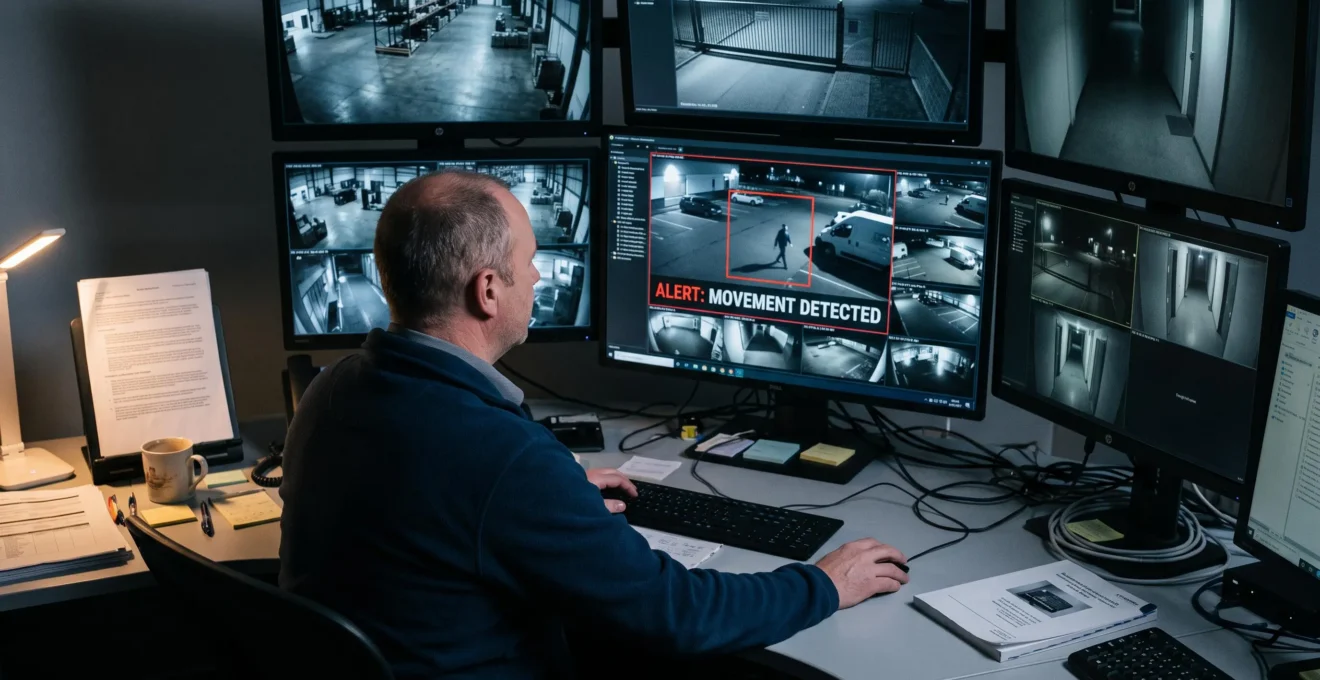
For Canadian businesses managing dozens or hundreds of surveillance cameras, security alert overload is not simply a notification problem. It is an operational risk: when operators receive too many irrelevant detections, identifying a genuine intrusion becomes increasingly difficult. An intelligent surveillance network addresses this problem by combining calibrated video analytics, contextual information and risk-based alert prioritization. Instead of treating every motion detection as equally important, the system evaluates what is happening, where it occurs and whether the event warrants intervention.
The objective is not to generate more alerts or eliminate every false detection. It is to deliver fewer, more meaningful notifications that operators can assess confidently. This requires appropriate camera positioning, detection-zone configuration, suitable analytics architecture and a clearly defined verification process. For organizations monitoring warehouses, industrial facilities, distribution centres and multiple remote locations, improving alert quality can make existing security resources more effective without assuming that additional monitoring staff are the only solution.
How intelligent surveillance reduces alert overload
- Calibrated AI analytics and detection zones distinguish relevant security events from routine operational activity.
- Risk-based alert prioritization directs operators towards incidents with the greatest potential consequences.
- Contextual notifications, visual verification and integrated incident workflows improve decision-making and reduce unnecessary dispatches.
- Why Does Camera Alert Fatigue Cause Security Teams to Miss Real Threats?
- How Can You Create Camera Detection Zones Around Loading Docks?
- Edge AI or Server-Based Analytics for Large Camera Networks?
- Why Poorly Calibrated AI Video Analytics Misclassifies Routine Activity
- How Can Risk-Based Video Alerts Help Operators Respond Faster?
- How Can You Estimate Camera Pixel Density at a Warehouse Entrance?
- Why Must Monitoring Operators Verify Certain Intrusion Alerts Before Dispatch?
- How Can Canadian Businesses Align Physical and Digital Security Without Coverage Gaps?
Why Does Camera Alert Fatigue Cause Security Teams to Miss Real Threats?
Camera alert fatigue occurs when security operators receive so many low-value notifications that their ability to distinguish genuine threats gradually deteriorates. Repeated false alarms encourage habitual dismissal, making it harder to recognize an important event among routine detections. For businesses operating extensive camera networks, the consequences extend beyond missed notifications: operators may respond more slowly, lose confidence in the system and develop working habits that undermine the purpose of continuous surveillance.
The mechanism is illustrated by research published by the National Institute of Standards and Technology (NIST). Its Technical Note 2118, NIST technical note on false-alarm testing, discusses how operators exposed to high false-alarm rates in radiation detection systems may become desensitized and stop responding to valid alarms. This research concerns radiation detection rather than video surveillance, so it should not be interpreted as a direct measurement of camera-operator behaviour. Nevertheless, it illustrates an important monitoring principle: repeated false alarms can weaken confidence in detection systems.
Three different problems commonly produce alert overload, and each requires a different corrective action.
- Excessive detections per camera: Poorly configured sensitivity, unsuitable detection zones or environmental interference generate repeated notifications. This is primarily a camera-configuration problem.
- Simultaneous alerts across multiple cameras: Several cameras generate notifications without a common prioritization mechanism. This is an alert-management architecture problem.
- Insufficient information accompanying alerts: Operators receive a notification without a useful clip, object classification, location or related camera view. This is an information and workflow problem.
These distinctions matter because buying additional analytics software will not necessarily solve an overload caused by poor notification architecture. Similarly, reducing camera sensitivity cannot compensate for the absence of an incident-prioritization process.
For Canadian organizations, the operational challenge can be particularly relevant when a central monitoring team supervises facilities distributed across different regions and time zones. An operator covering several industrial sites overnight may have to assess activity from warehouses, exterior yards, access points and restricted areas simultaneously. Under these conditions, notification quality becomes an important operational resource.
The consequences can accumulate over time. Repeated interruptions increase cognitive pressure, slow the assessment of individual events and make routine dismissal increasingly attractive. Persistent frustration may also contribute to operator dissatisfaction and turnover, although the available NIST source does not quantify these effects in surveillance teams. A further risk is the false impression of security coverage: a system may record thousands of alerts while providing insufficient meaningful human review.
An operator of a radiation detection system that displays a high rate of false alarms may become desensitized to these alarms.
Reducing alert fatigue therefore requires measuring the operational usefulness of notifications rather than simply counting detections. The proportion of alerts that lead to verification, the recurring causes of false positives and the time required to assess high-priority events provide more meaningful indicators of monitoring performance.
The practical objective is a monitoring environment in which operators can recognize exceptional activity without constantly filtering routine events. That begins with configuring individual camera views around the actual activities taking place at each site, particularly in operationally complex areas such as loading docks.
How Can You Create Camera Detection Zones Around Loading Docks?
Creating effective camera detection zones around loading docks requires dividing the monitored area according to operational activity, then assigning detection rules to each part of the scene. Truck movements, dock-door operations, forklift routes and personnel access do not carry the same security significance. Separate zones, exclusion areas and time-based rules help distinguish expected activity from events that require investigation, particularly during overnight or inactive periods.
The first step is to map the physical workflow rather than immediately drawing detection boundaries on the camera interface. A loading dock typically contains several operational areas:
- Vehicle approach and waiting areas.
- Dock doors and trailer connection points.
- Pedestrian access routes and employee entrances.
- Forklift crossing areas and internal loading paths.
- Restricted storage or equipment areas.
Each area should have a defined operational purpose. A vehicle approaching an active dock during a scheduled delivery is normal activity. An unidentified person entering a restricted loading area after operating hours may require immediate attention. Applying the same detection rule to both situations creates unnecessary alerts.
The distinction between inclusion and exclusion areas is equally important. A detection zone identifies where an event should be monitored. An exclusion zone removes a specific part of the image from selected detection rules because activity there is expected or irrelevant. For example, an employee break area visible in the camera frame may be excluded from an intrusion rule while the adjacent restricted storage area remains monitored.
These configuration principles are documented in the AXIS Object Analytics technical manual. The manufacturer describes inclusion and exclusion areas, object classifications, virtual-line crossings and time-in-area scenarios. These capabilities apply to compatible Axis devices and should not be assumed to exist in every video analytics platform.
Time scheduling must also be configured according to the purpose of each zone. A loading dock may experience normal activity during early-morning deliveries but require stricter monitoring overnight. Consequently, each detection rule should specify its own operating schedule, relevant object types and, where supported, thresholds for activities such as loitering.
Object classification can further improve relevance. A vehicle entering a designated trailer area may be expected, while a person remaining near a restricted access point outside scheduled hours may deserve verification. Separating person, vehicle and trailer-related rules prevents one broad motion trigger from treating all movement identically.
Zone configurations must not be treated as permanent. Camera angle changes after maintenance, seasonal lighting variations, temporary contractors and deliveries outside normal operating windows can invalidate previously reliable rules. Strong shadows, headlights and adverse weather may also interfere with object detection. Periodic reviews should therefore follow meaningful operational changes rather than relying exclusively on a fixed annual configuration check.
Once individual camera views have been configured, the next challenge is processing their analytics efficiently. The choice between edge AI and server-based processing determines where detection occurs, how much video data must travel across the network and how reliably the system operates at scale.
Edge AI or Server-Based Analytics for Large Camera Networks?
For large surveillance networks, edge AI and server-based analytics are not necessarily competing alternatives. A hybrid architecture often provides a more practical balance: cameras perform frequent, localized detections while centralized servers handle computationally intensive analysis across multiple feeds. The appropriate design depends on bandwidth availability, processing capacity, latency requirements, resilience, licensing and the complexity of the analytics deployed.
Edge AI processes video near its source, typically within the camera or an associated edge device. This allows supported detection rules to operate without continuously transmitting every video stream to a central server. It can be particularly useful for remote Canadian industrial facilities where backhaul connectivity is limited, expensive or difficult to maintain.
Server-based analytics centralizes processing in dedicated computing infrastructure. This approach can support more demanding workloads, such as forensic searches, cross-camera investigations and complex object classification, depending on the platform. Centralization also offers opportunities to coordinate analytics across different camera locations, although it creates dependencies on network connectivity and available server capacity.
The main architectural differences can be summarized as follows.
| Decision criterion | Edge AI | Server-based analytics |
|---|---|---|
| Processing location | Camera or nearby edge device | Centralized server infrastructure |
| Bandwidth consumption | Can reduce continuous video transmission for supported local analytics | May require substantial video-stream transmission |
| Alert latency | Local processing can reduce dependence on central processing delays | Depends on network, server workload and application design |
| Cross-camera analysis | Limited when processing independently at each device | Can support centralized multi-camera analysis |
| Failure dependency | Local rules may continue operating during some network interruptions | Central processing depends on server and network availability |
| Cost structure | Compatible camera capabilities and per-device licensing may apply | Server hardware, compute capacity, maintenance and licensing may apply |
For many large facilities, a hybrid approach is therefore worth evaluating. Cameras can handle always-on detections such as virtual-line crossings and loitering, while centralized infrastructure performs more demanding tasks. This division reduces the need to route every analytical operation through the same processing environment.
However, server capacity must be assessed using actual video workloads rather than camera count alone. Processing requirements vary with image resolution, frame rate, compression, number of active analytics rules and the number of simultaneous streams. A server that supports 50 cameras under one configuration cannot automatically be assumed to support 100 cameras under another.
A meaningful capacity assessment should consider:
- Resolution and frame rate for every camera group.
- The number of simultaneous streams requiring analytics.
- The processing intensity of each detection or classification rule.
- Expected growth in camera count and future analytical requirements.
- Available compute headroom during peak activity.
- Network capacity and the consequences of temporary connectivity loss.
Remote sites require particular attention. A facility in a northern region may have limited backhaul capacity, making continuous transmission of high-resolution streams an expensive architectural choice. Processing selected events locally and transmitting relevant clips or metadata can reduce the amount of information that must travel across the network, where supported by the platform.
The architecture determines where analytics run, but it does not guarantee that their detections are accurate. Even a well-designed hybrid network can produce excessive notifications if individual cameras interpret routine environmental activity as suspicious behaviour.
Why Poorly Calibrated AI Video Analytics Misclassifies Routine Activity
Poorly calibrated AI video analytics misclassifies routine activity when detection thresholds, scene conditions or object-classification rules do not match the environment being monitored. Shadows, headlights, animals, weather and changes to the physical layout can all produce unwanted detections. Reducing alert volume by lowering sensitivity alone is risky because it may also suppress genuine threats. Effective calibration requires identifying the recurring cause of false positives and correcting the corresponding rule or scene configuration.
One common failure occurs when sensitivity thresholds are too permissive. Small movements, changes in illumination and objects partially entering a camera frame may trigger detections that operators cannot act upon. An outdoor camera facing a vehicle entrance, for example, may interpret headlight reflections combined with heavy rain as activity resembling a person or another monitored object.
Environmental changes introduce another source of error. A camera configuration that performed reliably when first installed may become less accurate after dumpsters are moved, new signs are installed or seasonal foliage changes the appearance of the scene. These changes can invalidate assumptions embedded in detection rules.
Object classification can also struggle with site-specific activity. Forklifts, unusual machinery, wildlife and temporary equipment may behave differently from the scenarios represented in a generic training or configuration environment. The resulting detection errors are not necessarily solved by adjusting a single sensitivity parameter.
AXIS Object Analytics documentation identifies insects, strong shadows, headlights combined with heavy rain and human-sized animals among possible false-alarm sources. It also describes how image noise, insufficient illumination, fog and partial object visibility can impair detection. These are documented limitations of the specific application, not a guarantee that every analytics platform experiences identical behaviour.
A structured diagnostic process is more reliable than making repeated adjustments based on operator complaints. Begin by reviewing a representative sample of notifications over a defined period. Classify each alert into three categories:
- True positive: The system correctly identifies an event that matches the configured detection rule.
- False positive: The system reports an event that did not occur as classified.
- Unactionable detection: The event may be technically correct but does not require intervention under the site’s security policy.
Next, look for recurring patterns. If most false positives occur on one camera, during a particular time window or within a specific zone, the issue is more likely to be associated with that configuration than with the entire network.
The distinction between sensitivity tuning and contextual recalibration is essential. Threshold adjustment changes how readily a system responds to detected activity. Contextual recalibration changes the assumptions governing the scene, such as zone boundaries, object filters, operating schedules and detection conditions.
Repeatedly lowering sensitivity can make a system appear quieter while reducing its ability to detect legitimate activity. A more appropriate correction may be to exclude an irrelevant area, change the object classification, revise the operating schedule or adjust a rule to account for an environmental condition.
Analytics performance should also be validated against known test events where practical. A reduction in total alert volume is not sufficient evidence of improved security. If a system generates fewer notifications because it has become less responsive to relevant activity, its apparent improvement is misleading.
Operational metrics should therefore include detection accuracy, false-positive patterns, missed test events and the proportion of alerts requiring human intervention. These indicators provide a more useful performance baseline than notification volume alone.
Once analytics have been calibrated, the remaining challenge is deciding which notifications deserve immediate attention. Risk-based alerting provides that decision framework by combining the nature of an event with its location, timing and potential consequences.
How Can Risk-Based Video Alerts Help Operators Respond Faster?
Risk-based video alerting helps operators respond faster by prioritizing notifications according to potential consequences and detection confidence rather than simply displaying events in chronological order. An unverified person entering a restricted high-value area overnight should receive more attention than routine loitering in a low-risk location. Combining location, object classification, timing and contextual video information gives operators a clearer basis for deciding what requires immediate action.
The first step is to assess the risk associated with each monitored zone. Not every camera protects an asset of equal importance. A warehouse perimeter, a restricted equipment room and a general parking area have different security implications. The prioritization model should reflect those differences rather than assigning the same urgency to every camera.
A practical risk matrix can combine three considerations:
- Asset value and exposure: What is located in the monitored area, and how vulnerable is it to unauthorized access?
- Event significance: Does the detected behaviour indicate a potential intrusion, suspicious presence or routine movement?
- Detection confidence and context: How reliable is the classification, and is the event consistent with the site’s operating schedule?
The resulting matrix should translate these assessments into clear operational tiers.
| Alert tier | Typical condition | Expected operator action |
|---|---|---|
| Immediate response | High-consequence event with strong supporting context | Prioritize review and initiate the defined response procedure |
| Verify first | Potentially significant event requiring additional confirmation | Review video, related cameras or supporting sensors |
| Log only | Low-risk activity that does not require immediate intervention | Record the event for reference or trend analysis |
These tiers are an operational framework rather than universal security classifications. Each organization should define its own thresholds according to asset exposure, monitoring responsibilities and escalation procedures.
Notification context is equally important. An alert that only states that motion has been detected forces the operator to find the relevant camera, inspect the footage and determine what happened. A more useful notification can include a short video clip, detected object type, zone name, timestamp and related camera views.
This information supports a more efficient verification process. Instead of spending time identifying the source of an alert, the operator can concentrate on evaluating the event and selecting the appropriate response. Faster transmission is useful, but it cannot compensate for missing information that prevents a confident decision.
For example, an alert involving a person near a restricted warehouse entrance at night may be assigned a higher priority than a vehicle moving through an authorized loading area during a scheduled delivery. The distinction depends on the site’s documented rules and the reliability of the available visual evidence.
Risk-based prioritization also creates a bridge between automated detection and human intervention. Low-risk events may only require logging, while ambiguous events require visual verification and higher-consequence incidents may justify guard dispatch under the applicable response procedure.
However, risk prioritization depends on the quality of the underlying image. If a camera cannot capture enough usable detail at the monitored distance, its object detections may be unreliable regardless of how sophisticated the alert-management architecture appears.
How Can You Estimate Camera Pixel Density at a Warehouse Entrance?
Camera pixel density estimates how many image pixels represent a given physical width at a specific target distance. It helps determine whether a warehouse entrance camera captures enough detail for the intended monitoring task. A camera may provide broad recording coverage while still lacking sufficient usable detail for reliable identification or software-based detection. The calculation begins with horizontal image resolution and the width of the scene covered at the target plane.
The basic calculation is:
Pixel density (pixels per metre) = Horizontal image resolution ÷ Horizontal scene width in metres.
Consider a hypothetical warehouse entrance camera with a horizontal resolution of 1,920 pixels covering a scene width of 12 metres at the relevant target distance.
1,920 ÷ 12 = 160 pixels per metre.
This produces a nominal density of 160 pixels per metre at that target plane. It is a mathematical estimate, not a guarantee that the camera can reliably identify a person or support a particular AI detection task.
The distinction matters because image requirements depend on the intended operation. Detecting the presence of a person, recognizing a familiar individual and identifying someone from recorded footage are different objectives. Each requires an appropriate level of image detail and must be evaluated against the requirements of the actual analytics software or operational standard.
The Axis white paper on IEC 62676-4:2025 pixel density describes operational visual-detail categories including overview, outline, discern, perceive, characterize, validate and scrutinize. Its documented model includes values ranging from 20 to 1,500 pixels per metre, depending on the required level of detail.
These categories concern video interpreted by human operators. They must not be treated as universal minimum pixel-density requirements for AI analytics, because software-based analysis follows different application-specific requirements.
Several variables can also reduce the practical usefulness of a simple calculation:
- Wide-angle lenses: Image detail may become less usable towards the edges of the frame.
- Target orientation: A person approaching at an angle may occupy a different effective image area than someone facing the camera directly.
- Compression: Compression artefacts can reduce the detail available in distant or moving subjects.
- Mounting height: A steep downward viewing angle may limit useful facial detail.
- Lighting and optics: Poor illumination and unsuitable optical conditions can reduce image quality even when nominal pixel density appears sufficient.
Camera selection should therefore consider the actual target plane, mounting position and intended analytical task. The horizontal resolution divided by scene width provides an initial estimate, but it does not replace an on-site assessment or the software manufacturer’s documented detection requirements.
Pixel density is therefore an important upstream consideration in alert reliability. A detection system cannot consistently compensate for an image that does not contain enough usable information for the intended task. Checking image detail before deploying analytics reduces the likelihood of relying on unsuitable camera views and then attempting to correct their limitations through increasingly restrictive detection settings.
For entrance cameras, the most useful assessment combines a density estimate, the analytics vendor’s documented requirements and a practical review of the resulting images under representative operating conditions.
Five actions to validate warehouse entrance camera coverage
- Record the camera’s horizontal image resolution and produce a specification sheet for the selected camera.
- Measure the horizontal scene width at the target distance and document the measurement in metres.
- Calculate nominal pixel density by dividing horizontal resolution by measured scene width, retaining the calculation in the camera assessment.
- Compare the resulting image conditions with the intended analytics application’s documented requirements and record any limitations.
- Review the actual footage under representative lighting, target orientation and operating conditions, documenting whether the intended monitoring task can be supported.
Even a well-positioned camera with suitable image detail can generate alerts that require human assessment. The next operational decision is determining when an intrusion notification can be dismissed, when additional verification is necessary and when a responder should be dispatched.
Key considerations before aligning physical and digital security
- Reliable surveillance depends on verified detections, not simply the number of alerts generated.
- Intrusion verification procedures should match the risk level, available evidence and monitoring agreement.
- Camera events become more valuable when they can be correlated with access-control and cybersecurity records.
Why Must Monitoring Operators Verify Certain Intrusion Alerts Before Dispatch?
Monitoring operators should verify certain intrusion alerts before dispatch because an automated detection does not always establish that an unauthorized event has occurred. Verification helps reduce unnecessary response costs, avoidable false alarms and inappropriate escalation. The required level of confirmation depends on the event’s risk, the available evidence, the monitoring agreement and the applicable local requirements. It should not be treated as a universal legal obligation applying identically to every Canadian monitoring situation.
Dispatching a guard or emergency responder based on an unverified false alarm can create direct operational expenses. Depending on the municipality and applicable arrangements, repeated false alarms may also trigger administrative consequences, such as fees or restrictions under local alarm-response bylaws. These requirements are not uniform across Canada, so organizations should confirm the rules applicable to each monitored location rather than assume that one national policy applies.
False dispatches can also undermine confidence in monitoring operations. If responders repeatedly attend incidents that turn out to be routine activity, future notifications may be treated with less urgency. A verification process therefore protects both operational resources and the credibility of the security response system.
The appropriate verification method depends on the type and significance of the alert. A structured hierarchy can include several levels:
- Video review: The operator checks the relevant live feed or recorded clip to assess whether the detection corresponds to suspicious activity.
- Two-way audio: Where the equipment and procedure support it, an operator may issue an audio challenge or request an explanation from someone in the monitored area.
- Multiple-source confirmation: A second camera, access-control event or another sensor may provide supporting evidence.
- Guard dispatch: If the event remains credible and the response criteria are met, the operator initiates the appropriate dispatch procedure.
These methods are not interchangeable in every situation. A second camera may provide useful confirmation in a facility with overlapping coverage, while audio verification may be inappropriate or unavailable in certain areas. The monitoring procedure should define which evidence is acceptable for each alert tier.
There is also an important distinction between industry practice, contractual requirements and legal duties. Monitoring agreements may specify verification steps before dispatch, while local procedures and the nature of the signal can influence what is required. The precise obligation depends on the relevant service contract, provincial context and applicable circumstances.
Businesses should therefore review their monitoring agreements and confirm the escalation requirements with their service providers. Assuming that every intrusion alert must legally be verified through the same procedure would oversimplify the Canadian regulatory and contractual landscape.
Verification must also be proportionate. Excessive confirmation steps can delay an appropriate response to a genuine intrusion. Conversely, dispatching immediately whenever an analytics system detects movement can create avoidable costs and unnecessary interventions.
Well-calibrated analytics and risk-based alert tiers make this balance easier to achieve. High-consequence events can be escalated under clearly defined criteria, while ambiguous detections receive the level of additional confirmation appropriate to their risk. The operator should have enough contextual information to make that decision without searching through unrelated camera feeds or disconnected incident records.
Verification becomes more effective when operators can access the relevant physical and digital evidence together. This requires more than improving the camera platform: organizations must align surveillance events with access-control records, cybersecurity information and incident-management procedures.
How Can Canadian Businesses Align Physical and Digital Security Without Coverage Gaps?
Canadian businesses can align physical and digital security by connecting surveillance footage, access-control records and cybersecurity events through synchronized timestamps, documented investigation procedures and shared incident-management workflows. This approach helps security teams reconstruct incidents that cross system boundaries, such as a stolen credential being used at a controlled entrance while a camera records the associated activity. Integration does not necessarily require replacing existing systems; reliable time synchronization and a consistent correlation process provide a practical starting point.
Physical and digital security are frequently managed through separate departments, technologies and service providers. Surveillance teams monitor cameras, facilities personnel administer access permissions and IT security teams investigate compromised credentials or suspicious network activity. Each group may have useful evidence, but the absence of a shared incident timeline makes it difficult to reconstruct the complete sequence of events.
Consider a hypothetical incident at a distribution centre. A credential is used to unlock a restricted entrance outside normal operating hours. The access-control system records an authorized credential, while a nearby camera captures a person entering the facility. Separately, the IT security team identifies suspicious activity associated with the credential holder’s account.
Individually, these records may appear unrelated. When their timestamps and event details can be correlated, investigators can examine whether the access event, the recorded person and the suspicious digital activity belong to the same incident. This scenario illustrates the value of unified investigation; it does not imply that matching timestamps alone proves who performed an action.
The first practical step is to establish reliable time synchronization across the systems involved. Camera platforms, access-control systems and IT security tools should use appropriately synchronized time sources and consistent time-zone settings. Differences in timestamps can otherwise make it difficult to determine the order of events, especially when reviewing records from multiple facilities.
Organizations should also document how records can be correlated. An incident procedure can identify the information investigators need to collect, such as:
- Camera identifier and recording timestamp.
- Access-control event and relevant credential reference.
- Associated cybersecurity alert or authentication record.
- Relevant facility, entrance or restricted-area identifier.
- Incident reference and documented investigation outcome.
This provides a foundation for a unified incident timeline without requiring an immediate technology replacement. More advanced integration can follow when the organization’s operational needs justify shared dashboards, automated event correlation or centralized incident-management tools.
Canadian privacy governance must also be considered. The Office of the Privacy Commissioner of Canada provides guidance on overt video surveillance by private-sector organizations in publicly accessible areas. Its Office of the Privacy Commissioner of Canada’s video surveillance guidelines recommend documenting legitimate surveillance purposes, limiting camera coverage, protecting recorded images, restricting access and establishing appropriate retention practices.
The guidance also identifies federal and provincial privacy-law considerations. Its stated scope does not cover every form of employee or covert surveillance, so organizations must assess the legislation applicable to their activities and jurisdiction, including PIPEDA where relevant. The guidance does not establish one universal footage-retention period for every business.
Consequently, integrating security records should not mean granting unrestricted access to every camera recording or personal-information system. Access permissions, retention rules, disclosure procedures and investigation responsibilities should be governed according to the organization’s legal obligations and documented policies.
The intelligent surveillance network developed throughout this article becomes one component of a broader security operation. Calibrated analytics identify relevant events, risk-based alerts prioritize them, verification procedures determine the appropriate response and synchronized records allow investigators to reconstruct incidents across physical and digital environments.
For Canadian businesses managing complex facilities, the practical objective is a continuous incident-management process rather than a collection of disconnected security products. Each event should have a defined path from detection to assessment, response, documentation and subsequent review.
Businesses can begin by reviewing how their camera events, access records and cybersecurity alerts are currently timestamped, stored and investigated. From there, a documented correlation process can reveal where operational or governance gaps remain and help determine which integrations would deliver genuine value.
What is the difference between motion detection and AI video analytics?
Motion detection identifies changes within a camera image, while AI video analytics can classify objects and apply rules based on their location or behaviour. Depending on the platform, analytics may identify people or vehicles, detect virtual-line crossings, monitor time spent in an area or filter activity within exclusion zones. These capabilities can make notifications more relevant than undifferentiated motion alerts, but their effectiveness depends on camera conditions and configuration.
How often should surveillance detection zones be reviewed?
Detection zones should be reviewed whenever operational conditions change, including camera maintenance, changes to warehouse layouts, new equipment, seasonal lighting variations and modified delivery schedules. Organizations should also periodically inspect recurring false positives and verify that existing schedules and object classifications remain appropriate. A fixed review frequency should be established according to site activity and security requirements.
Can edge AI reduce bandwidth requirements for remote Canadian facilities?
Edge AI can reduce the need to transmit every video stream continuously when compatible cameras perform analytics locally. Selected alerts, metadata or relevant video clips can then be transmitted to centralized monitoring infrastructure, depending on the system design. Actual bandwidth savings depend on recording requirements, analytics capabilities, video quality and network architecture. Local processing does not automatically eliminate the need for network connectivity or centralized recording.
Does higher camera resolution automatically improve AI detection accuracy?
No. Higher resolution can provide more image information, but detection accuracy also depends on pixel density at the target distance, camera angle, lens quality, illumination, compression and the analytics application’s requirements. A high-resolution camera covering an excessively wide scene may provide insufficient usable detail for a specific monitoring task. Camera positioning and practical image validation remain essential.
Are Canadian businesses legally required to verify every surveillance alert before dispatch?
There is no single verification procedure that can be assumed to apply universally to every surveillance alert across Canada. Verification requirements may depend on the monitoring agreement, the type of signal, applicable provincial or municipal requirements and the circumstances of the incident. Businesses should review their service contracts and confirm relevant local requirements with their monitoring provider and appropriate legal advisers.