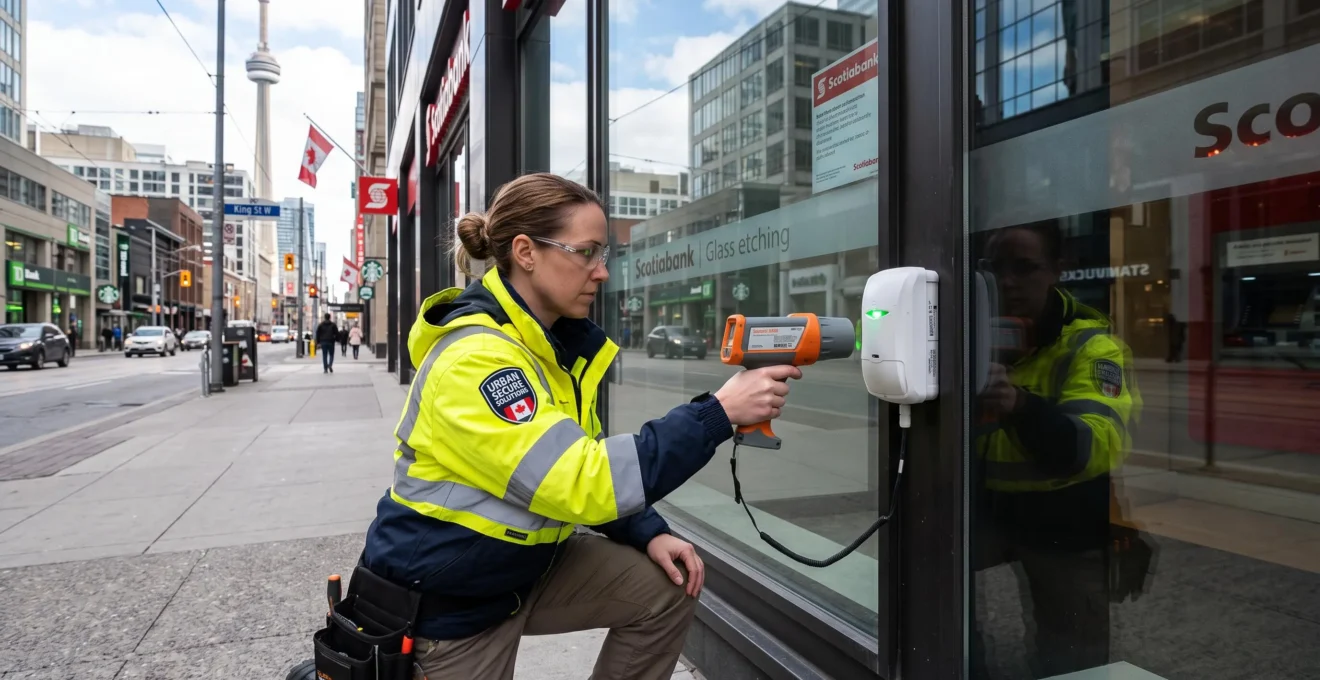
Glass-break detectors should be installed where they can reliably detect an attempted entry through vulnerable glazing without confusing ordinary building activity with breaking glass. In Canadian homes, retail premises and commercial buildings, the best position depends on the glass type, the detector’s approved range, room acoustics, physical obstructions and environmental noise.
An acoustic detector generally belongs inside the protected space, with an unobstructed sound path to the windows specified in its installation instructions. A centrally positioned sensor may protect several panes, but its advertised range is not a guarantee of coverage through partitions, curtains or other obstacles. Some detector technologies instead attach directly to glass or window frames and follow different installation rules.
Reliable placement therefore requires more than measuring distance. Installers must establish whether the glazing is compatible, test the proposed location, evaluate possible nuisance-alarm sources and coordinate the detector with contacts, motion sensors and any available alarm verification system. These decisions are particularly important when Canadian heating systems, seasonal building changes and municipal alarm-response policies affect the installation.
Glass-break detector placement: essential decisions
- Choose a sensor rated for the actual glass type and position it within a manufacturer-approved, unobstructed detection area.
- Verify every protected window with the appropriate simulator and check for environmental noise under realistic operating conditions.
- Use complementary contacts, motion detection and alarm verification where acoustic coverage alone cannot provide adequate protection.
- Why Do Glass-Break Sensors React to Non-Threatening Sounds?
- How Can You Test Glass-Break Coverage in an Open-Plan Office?
- Window Contacts or Glass-Break Sensors for Large Storefront Windows?
- Why Laminated Glass Can Complicate Acoustic Break Detection
- When Should Glass-Break Detection Be Retested After Window Replacement?
- How Can You Secure Basement Windows in a Canadian Detached House?
- How Can You Position Motion Sensors in Narrow Commercial Corridors?
- How Can Surveillance and Alarm Systems Work Together to Protect Canadian Properties?
Why Do Glass-Break Sensors React to Non-Threatening Sounds?
Glass-break sensors can react to harmless sounds when the acoustic patterns reaching their microphones resemble those associated with breaking glass. The risk depends on the detector’s signal processing, the surrounding environment and its installation position. Loud or repetitive background noise does not automatically cause an alarm, but certain combinations of sounds and reflections can confuse acoustic detection.
Many acoustic glass-break detectors analyse a sequence of sound characteristics, including the lower-frequency impact or flexing associated with a pane being struck and the higher-frequency components associated with fragmentation. The precise recognition method varies by model. A detector using multiple acoustic characteristics may reject disturbances that a less selective design would interpret differently.
Jingling keys, dropped dishes and television sound effects are useful examples of environmental noises to investigate, not proven universal triggers. The important question is whether an installation’s particular detector can mistake those sounds, individually or in combination, for its recognized breakage pattern.
The PGP922 Glass Break Detector Installation Guide warns that reflected sounds can duplicate a recognizable glass-break pattern. For this model, the manufacturer recommends maintaining at least 1.2 m of separation from noise sources such as televisions, speakers, sinks and doors.
The following diagnostic grid distinguishes possible sound sources from device characteristics and positioning problems. Its entries are troubleshooting hypotheses rather than measured false-alarm probabilities.
| Possible source | Technology consideration | Installation check |
|---|---|---|
| Keys, dishes or metallic impacts | A detector using limited acoustic discrimination may require closer evaluation; multi-characteristic recognition can improve selectivity. | Identify the sound source and conduct the manufacturer’s environmental test. |
| Televisions and speakers | Acoustic detectors may encounter overlapping or reflected sound patterns. | Check separation distances and evaluate the device with audio equipment operating. |
| Hard-surfaced vestibules | Reflections may affect the sound signature reaching the microphone. | Evaluate alternative mounting positions or technologies. |
| Forced-air heating and mechanical equipment | Environmental noise can interfere with some acoustic installations. | Run the heating equipment during the manufacturer’s noise test. |
| Window-frame noises during cold weather | The cause cannot be established from a sound description alone. | Record the event, inspect the window and verify any correlation before attributing an alarm. |
In Canadian winter operation, furnace blowers and other forced-air equipment deserve particular attention. Pressure changes and noises associated with frost or window movement may also warrant investigation, but they should not be treated as established glass-break alarm triggers without installation-specific evidence.
A practical diagnostic log records the alarm timestamp, heating cycle, nearby equipment activity, occupied status and weather conditions. Repeated alignment with a particular operating condition establishes a reason to investigate; it does not by itself prove the cause.
For monitored properties, unresolved nuisance alarms can also create an operational risk. Occupants may become less willing to rely on the alarm system or may seek to bypass troublesome zones. This is a plausible security-management concern rather than a quantified outcome established by the cited manufacturer guidance.
If manufacturer-approved environmental testing repeatedly identifies an unsuitable acoustic location, moving the detector or selecting another sensing technology is generally more defensible than accepting frequent unexplained alarms.
How Can You Test Glass-Break Coverage in an Open-Plan Office?
Glass-break coverage in an open-plan office should be verified at each protected window using the simulator and procedure approved for the installed detector. An unobstructed floor plan does not necessarily provide unobstructed acoustic coverage. Partitions, meeting pods, curtains, furniture and changes in room use can affect the sound reaching a sensor even when the pane is within its published range.
Begin with the manufacturer’s supported glass types, mounting conditions and maximum detection distance. For example, the Bosch DS1109i Glass Break Detector Installation Guide specifies a maximum detection distance of 3 m for its documented configuration and requires pretesting with the DS1110i Glass Breakage Tester. That distance must not be generalized to other models.
An acoustic coverage map turns those limitations into a practical installation record. Mark every protected window on a scaled floor plan, identify its glass construction, show the detector’s proposed position and indicate the manufacturer’s applicable coverage boundary. Then record which panes passed their individual tests.
Use the following walk-test sequence as a site-documentation framework. The actual simulator positioning, activation method, glass settings and acceptance criteria must come from the applicable manufacturer’s instructions.
- Identify the detector model, its approved simulator and the glazing types permitted by its documentation.
- Prepare a floor plan showing windows, detector locations, partitions, tall furniture, acoustic panels and heavy window coverings.
- Place the system in its authorized test condition and conduct the specified environmental noise checks.
- Apply the simulator near each protected pane in the manner required by the manufacturer, using the appropriate glass setting.
- Record each detector response, investigate failed locations and repeat testing after corrective changes.
Hard office surfaces may produce noticeable reverberation, while carpets, curtains and upholstered furniture absorb sound. Neither condition alone establishes acceptable coverage. Reflections can change the signal reaching a sensor, and absorbing materials can reduce detection range. Actual response testing is more reliable than predicting performance from room appearance.
Where a room changes between business hours and after-hours configurations, compare the relevant conditions. An open office with movable partitions, closed meeting pods or adjustable blinds should be evaluated in the configurations that matter to its security operation.
Five verifiable actions for an acoustic coverage audit
- Inventory every protected opening, recording its location and glass specification in a window register.
- Record each installed detector model and its manufacturer-approved coverage limits on a floor plan.
- Mark potential obstructions and noise sources, producing an annotated acoustic coverage map.
- Complete the approved simulator and environmental tests, producing a dated pass/fail record for each window.
- Correct uncovered locations and update the installation and monitoring documentation with the verified final configuration.
Where individual windows remain outside verified acoustic coverage, adding a suitable detector or using complementary protection is preferable to representing the whole office as protected.
Window Contacts or Glass-Break Sensors for Large Storefront Windows?
Large storefront windows generally require different protection from operable doors and windows. Magnetic contacts detect a change in the position of a monitored opening, while acoustic glass-break sensors respond to qualifying glass-fracture sounds. A contact on a closed storefront door does not independently detect someone breaking an adjacent fixed pane. Combining the technologies addresses different intrusion methods.
The right configuration depends on the storefront’s physical construction. Fixed display glazing cannot be assessed in the same way as an opening sash. A door contact protects against unauthorized opening, but an intruder who breaks a fixed pane may never move that contact.
Acoustic detectors address a different failure mode: qualifying breakage of compatible glass within verified acoustic range. They do not necessarily detect removal of an intact pane, all forms of penetration or damage that does not produce the required sound pattern.
The following comparison shows practical trade-offs without assigning unsupported prices or false-alarm probabilities.
| Decision factor | Magnetic contacts | Acoustic glass-break sensors | Combined configuration |
|---|---|---|---|
| Principal event detected | Opening or displacement of the monitored door or sash | Recognized acoustic signature of compatible glass breaking | Opening and glass breakage as separate events |
| Fixed display panes | Limited usefulness without an appropriate monitored opening | Suitable where glazing and room conditions are compatible | Protects display glazing while monitoring access doors |
| Nuisance-alarm exposure | Depends on alignment, movement and installation condition | Depends on acoustic environment and signal recognition | Allows separate diagnosis of contact and acoustic events |
| Cost considerations | Hardware and installation for each monitored opening | Detector coverage, testing and environmental suitability | Additional equipment and integration, with broader detection functions |
| Detection timing | When the monitored opening changes state | When qualifying breakage occurs | Depends on which protected event occurs first |
A practical arrangement for a Canadian retail unit is to install contacts on operable entry points and appropriate glass-break protection for exposed display panes. Temperature-related frame movement and door alignment should be considered when evaluating contact installation, while nearby traffic, delivery activity and reflective interiors should be evaluated during acoustic testing.
Neither technology should be represented as a guaranteed deterrent. Visible security equipment and signage may communicate that an opening is protected, but contacts and acoustic sensors primarily provide detection. A glass-break alarm is normally associated with breakage already taking place rather than preventing the initial impact.
Monitoring arrangements also matter. The requirements for police response and the handling of unverified alarms differ by municipality. For example, the London Police Service Verified Alarm Response Program describes verification methods including audio, video, eyewitness confirmation and multiple alarm activation points for property-related alarms. Its rules apply to that jurisdiction and are not a nationwide Canadian standard.
Retail owners should therefore ask their monitoring provider which signals can support alarm verification and check applicable local policies before finalizing the system.
A combined installation often offers more complete event coverage, but each component still needs independent testing and a clearly documented role in the alarm response.
Why Laminated Glass Can Complicate Acoustic Break Detection
Laminated glass can complicate acoustic break detection because its interlayer holds fractured glass together and can change how a damaged pane behaves and sounds. However, laminated glazing is not inherently incompatible with every acoustic detector. Reliable coverage depends on the exact glass construction, the detector’s supported specifications and successful manufacturer-approved testing.
Unlike an ordinary pane that may release fragments when it breaks, laminated glass incorporates an interlayer intended to retain fractured pieces. The resulting breakage process can differ acoustically from that of other glazing constructions. Pane thickness, dimensions, mounting method and the specific attack can also affect the event.
This creates an important distinction between glass damage and a recognizable acoustic alarm event. A pane can suffer damage without necessarily producing the sound pattern a particular detector requires. A detector that is powered, connected and armed is therefore not automatically providing verified breakage coverage.
At the same time, some acoustic detectors explicitly support laminated glass. Manufacturer documentation for the Visonic PGP922 and Bosch DS1109i includes laminated glass among their specified testing or supported configurations. The presence of laminated glazing should prompt a compatibility check, not an assumption of detection failure.
Before purchasing or repositioning equipment, identify the glass construction using available building documentation, glazing specifications and any reliable manufacturer markings. Edge construction may provide useful clues where accessible, but a visual inspection alone may not establish the full laminated assembly.
Record the pane’s documented type and thickness, then compare those details with the precise detector model’s supported glazing range. Avoid treating a general statement that a product supports laminated glass as evidence that it supports every laminated security glazing system.
If suitable acoustic coverage cannot be verified, a window- or frame-mounted shock sensor may offer another detection method. Magnetic contacts on operable elements and motion detection inside the premises can add protection against other intrusion paths, although neither should be described as an automatic substitute for detecting damage to fixed glass.
Glass identification belongs at the start of the security design because later testing can confirm a supported installation but cannot make an unsuitable detector compatible with an unsupported pane.
When Should Glass-Break Detection Be Retested After Window Replacement?
Glass-break detection should be reassessed after window replacement whenever the new glazing, frame or surrounding environment could affect the detector’s approved operating conditions. Changes in glass type, thickness, dimensions or acoustic obstructions are particularly relevant. A successful device-status check does not establish that the replacement window remains within verified detection coverage.
Consider a detector originally tested against one supported pane configuration. Replacing that pane with a different glazing assembly may change the acoustic event the detector is expected to recognize. Even if the sensor continues reporting its normal armed status, the previous coverage result may no longer be applicable.
The same reasoning applies when security film is added or curtains, shutters and heavy blinds alter the sound path. New window frames or a changed window position may affect the installation geometry. Recaulking and repainting do not automatically invalidate a detector’s performance, but substantial changes affecting the mounting or acoustic environment justify reassessment.
No universal retesting interval or rule requiring retesting after every cosmetic change is established by the supplied technical sources. The appropriate decision depends on the detector’s installation instructions and the nature of the modification.
A practical post-replacement review should confirm three things:
- Compatibility: the replacement pane’s documented construction remains within the detector manufacturer’s supported glass specifications.
- Verified response: the protected pane passes the applicable simulator procedure, including any required glass-type setting and environmental test.
- Current records: the installation plan, detector coverage description and monitoring provider’s site information reflect the new window configuration.
Where testing fails, investigate whether the cause is glass incompatibility, obstruction, distance, mounting position or another environmental limitation. Correct the cause and retest before recording the window as adequately protected.
For commercial properties with contractors replacing several windows, assigning each opening an identifier helps prevent omissions. A simple register can track the previous glazing, new specification, detector association, test outcome and date of acceptance.
Retesting is a coverage-verification exercise, not merely a confirmation that the sensor still communicates with the alarm panel. This distinction also applies to residential glazing changes, including basement windows.
How Can You Secure Basement Windows in a Canadian Detached House?
Basement windows in Canadian detached houses should be protected through a combination of suitable opening contacts, verified glass-break detection where practical and physical measures that preserve safe emergency escape. Below-grade placement, window wells, nearby obstructions and seasonal snow or ice make these openings different from ordinary above-grade windows. Their acoustic coverage must be tested rather than assumed.
Basement glazing is often close to the ground and may be partly surrounded by a window well. That geometry can affect how sound propagates from the pane into the room. Curtains, storage, insulation materials and interior partitions may further obstruct an acoustic detector’s sound path.
An outdoor window well does not automatically prevent a detector inside the basement from recognizing breaking glass. Likewise, snow outside the window cannot be assumed to block every acoustic signal. The relevant question is how the particular glazing and installation perform under the detector’s specified operating conditions.
Protecting a basement opening is best treated as several related tasks:
- Opening protection: install compatible magnetic contacts on operable windows where practical.
- Breakage protection: use an acoustic or other suitable glass-break technology only where the glazing and installation conditions support it.
- Exterior visibility: assess window-well lighting and surrounding sightlines without assuming that lighting alone prevents intrusion.
- Window-well maintenance: keep drainage and access areas serviceable; gravel may be part of an appropriate drainage design but is not a substitute for electronic detection.
- Physical resistance: consider approved glazing, security films or other protective measures without obstructing required escape routes.
The fire-safety constraint is critical. Basement bedroom windows may form part of the required emergency egress route. Security bars, locked covers or other restrictions must not prevent occupants from opening and using a required escape window. Applicable provincial, territorial and local building requirements, as well as the home’s construction and approval context, must be checked before installing restrictions.
Canadian winters introduce another operational consideration: snow and ice can obstruct access to window wells and affect the physical condition of basement openings. Snow-related attenuation of glass-break sounds is a site-specific possibility, not an established universal sensor failure mechanism.
Seasonal inspection should therefore address both emergency access and detection coverage. Clear unsafe accumulations, inspect accessible glazing and frames, and arrange appropriate testing when physical conditions or modifications create uncertainty about the original coverage.
When the basement’s layout prevents verified acoustic coverage, complementary perimeter or interior detection can provide useful redundancy without compromising the window’s life-safety function.
How Can You Position Motion Sensors in Narrow Commercial Corridors?
Motion sensors in narrow commercial corridors should be positioned so their specified detection pattern intersects likely intrusion routes while avoiding known environmental disturbances. They complement glass-break detectors rather than replace them: the glass-break sensor can indicate an entry event at the perimeter, while a corridor sensor can detect subsequent movement through the building.
Passive infrared motion detectors respond to changes in thermal radiation across their sensing zones. Their coverage depends on lens geometry, mounting height, orientation and the manufacturer’s operating limits. A device designed for a wide room should not automatically be treated as suitable for a long, narrow passage.
Where the detector’s design permits it, positioning the sensor so a person crosses multiple detection zones can produce more reliable coverage than an approach that follows the edge of a detection pattern. The exact placement and angle must come from the model’s coverage diagrams and be verified by walk testing.
Several corridor features deserve inspection before installation: supply-air outlets, heating equipment, doors connecting different temperature zones, loading entrances, moving partitions and the movement of authorized occupants or animals. These conditions can complicate motion detection, although they do not necessarily trigger every detector.
Manufacturer-approved mounting height is essential. There is no justified universal height for all commercial corridor detectors because lens designs and installation requirements differ. Pet-immune configurations, where available, also depend on prescribed installation conditions and should not be assumed effective for every animal or environment.
Joint perimeter and interior coverage creates another benefit: independent alarm events can provide additional context for verification. For example, an acoustic glass-break event followed by a corridor motion event may indicate a more substantial intrusion sequence than either signal alone.
This is not proof of a break-in by itself. An authorized occupant, an environmental disturbance or an unrelated event could produce another signal. The monitoring provider must evaluate available information under its actual response procedures.
A corridor plan should therefore show the protected glazing zone, likely travel paths, motion-detector coverage and any camera verification areas. Testing should establish whether the expected movement route reliably crosses the selected sensor’s pattern.
Reliable coverage depends on the relationship between the entrance point and interior travel routes. This relationship becomes even more valuable when alarm events can be checked against surveillance footage.
Key decisions before integrating detection and surveillance
- Treat each sensor as evidence of a defined event, not automatic proof of an intrusion.
- Make sure the camera can actually observe the opening or travel route associated with the alarm zone.
- Confirm which verification evidence the monitoring provider and relevant local response authority will accept.
How Can Surveillance and Alarm Systems Work Together to Protect Canadian Properties?
Surveillance and alarm systems work together when sensors identify a possible intrusion and cameras provide visual information that helps operators evaluate the event. In Canadian buildings, linking verified glass-break and motion zones with appropriate camera views can improve alarm assessment. The value depends on system compatibility, image quality, monitoring procedures and the requirements of the local responding authority.
An integrated installation begins by assigning a clear security function to every device. A glass-break detector covers compatible glazing, a motion detector covers an interior movement zone and a camera observes the relevant opening or route.
Where supported by the installed equipment, an alarm event can trigger camera recording, preserve associated footage or direct monitoring personnel to an appropriate live view. These functions require actual integration and configuration; installing a sensor and camera in the same room does not automatically establish event-linked recording.
The Canadian Conservation Institute guidance on thieves and vandals identifies glass-break sensors, magnetic contacts and motion detectors as complementary security measures. It also recommends built-in redundancy and describes detection as a process involving event recognition, communication, analysis and the decision whether intervention is necessary. The guidance primarily addresses institutional security, but its layered-system principles are relevant to building security design more broadly.
A practical integrated response chain can operate as follows:
- A glass-break detector reports a qualifying event at a protected window.
- The alarm system transmits the identified zone and event information to the configured monitoring service.
- Where integration permits, the relevant camera view or associated recording becomes available for assessment.
- The monitoring operator checks the available evidence, including any independent motion or contact activations.
- The operator follows the applicable verification and response procedures, which may involve a property contact, security personnel or emergency services.
Alarm verification can help distinguish a genuine intrusion from an ambiguous sensor event, but video does not guarantee a correct decision. Poor lighting, blocked views, unsuitable camera angles or unavailable footage can prevent visual confirmation. Privacy obligations and recording-access controls also need to be considered in commercial and residential applications.
For example, consider a hypothetical street-level retail unit with a large glazed façade and a corridor leading to storage areas. An acoustic detector reports a possible breakage event. A camera covering the façade shows the window intact, while no interior motion event follows. This information may support further investigation rather than immediate assumptions about forced entry. Conversely, footage showing damage alongside a corridor motion event could provide stronger grounds for escalation. Neither scenario represents a documented real incident.
The physical installation should support this verification process. Before commissioning, installers should check that the window protected by each acoustic sensor is visible in an assigned camera view, that corridor cameras capture the relevant movement routes and that recordings can be matched to the correct alarm zone and event time.
Camera-backed verification may change the acceptable operational trade-off between broad acoustic coverage and nuisance alarms, but it does not justify exceeding a detector’s rated range or accepting known false-alarm problems. Properties without dependable video verification should be particularly careful about environmental testing, conservative placement and clear monitoring instructions.
Canadian municipal response requirements must be verified locally. The London Police Service’s verified-response policy provides one example of accepted confirmation methods, but response rules, fees and dispatch practices cannot be inferred for other municipalities.
Before activating a new or modified system, arrange a coordinated commissioning test with the qualified installer and monitoring provider. Confirm the sensor responses, camera associations, event records and escalation instructions so the final installation detects meaningful events without creating avoidable alarm ambiguity.
Should an acoustic glass-break detector be mounted on the window itself?
Not necessarily. Many acoustic detectors are designed to be mounted inside the protected room on a wall or ceiling, positioned according to the manufacturer’s instructions. Other technologies, including certain shock or vibration sensors, may attach to the glass or frame. The correct mounting surface depends on the exact sensor technology and model.
Can one glass-break detector protect several windows?
Yes, if every window uses compatible glazing, remains within the manufacturer’s approved coverage limits and passes the required simulator test. Distance alone is insufficient because partitions, curtains and other sound-absorbing materials can reduce performance. Coverage should be recorded separately for each protected pane.
Does a glass-break sensor detect someone cutting or removing a pane?
Not reliably in every situation. Acoustic detection requires a recognizable breakage event, and some forms of glass removal or penetration may not produce the necessary signal. Where those intrusion methods are relevant, additional contacts, vibration sensors or interior detection may be needed.
Can curtains or blinds reduce glass-break detection coverage?
Yes. Heavy curtains, blinds and other sound-absorbing materials can reduce the sound reaching an acoustic detector. Coverage should be verified in the window-covering configuration that will normally be present while the alarm is armed, following the manufacturer’s testing instructions.
Does passing an electronic sensor test prove that a window is protected?
No. A successful power, communications or panel-status test confirms only the functions that were checked. Demonstrating acoustic coverage requires the appropriate manufacturer-approved simulation procedure at the protected glazing, along with confirmation of detector compatibility and environmental suitability.