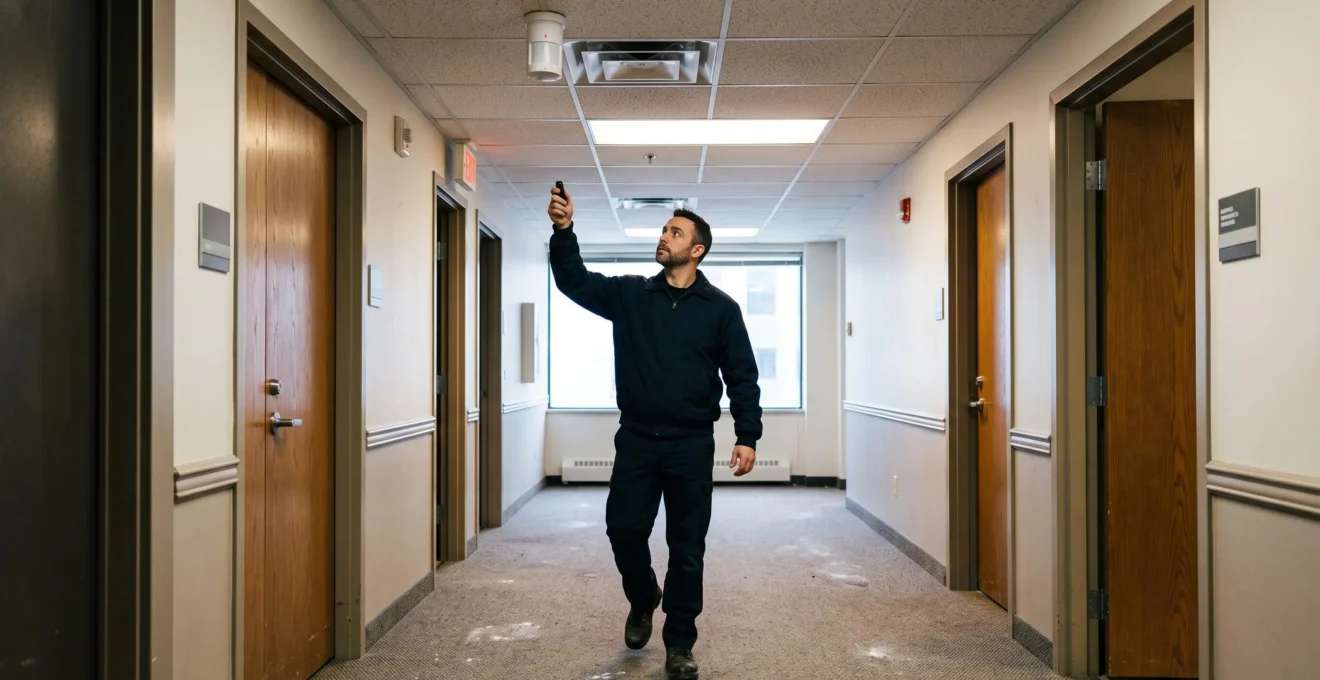
Integrated motion sensors detect intrusions more reliably when their coverage patterns, environmental conditions and alarm-verification rules work together. Instead of treating every movement signal as a confirmed intrusion, a coordinated security system can compare activity across detection zones, correlate it with door or glass-break events, and use surveillance footage to support a response decision.
For Canadian homeowners and facility operators, that coordination matters particularly in occupied buildings. Heating systems, changing furniture layouts, machinery, routine employee movement and seasonal temperature differences can all affect detection performance. An alarm that activates unnecessarily disrupts occupants; a detector with an overlooked blind spot may fail when protection is needed.
Effective intrusion detection therefore requires more than choosing a sensitive device. Sensor placement, appropriate technologies, periodic walk-testing and carefully defined response rules determine whether movement becomes useful security information or simply another nuisance notification.
Integrated Motion Detection: Essential Principles
- Position sensors according to room geometry, heat sources, obstructions and actual movement routes rather than relying on advertised coverage dimensions alone.
- Use complementary detection technologies and cross-zone verification where appropriate, while recognizing that additional confirmation can delay or suppress some genuine alarms.
- Reassess coverage after renovations, equipment changes and seasonal HVAC adjustments, and coordinate cameras, lighting and audible warnings through deliberate alarm-response rules.
- Why Do Heating Vents Trigger False Motion Alerts in Winter?
- How Should Motion Sensors Be Positioned in Narrow Commercial Corridors?
- PIR or Dual-Technology Sensors for Warehouses With Moving Equipment?
- Why Tall Shelving Can Defeat Previously Reliable Motion Detection
- When Should Motion Detectors Be Recalibrated After an Office Redesign?
- Why Do Glass-Break Sensors React to Non-Threatening Sounds?
- How Can Lighting and Audible Warnings Respond to the Same Intrusion Event?
- How Can Surveillance and Alarm Systems Work Together to Protect Canadian Properties?
Why Do Heating Vents Trigger False Motion Alerts in Winter?
Heating vents can cause false motion alerts when moving warm air changes the infrared radiation patterns observed by a passive infrared (PIR) detector. During Canadian winters, heating systems may operate for extended periods, repeatedly exposing poorly positioned sensors to changing thermal conditions. The resulting alerts can resemble moving heat signatures without indicating an actual intruder.
A PIR detector does not directly recognize a person. It detects changes in infrared energy across its sensing zones. As someone moves through those zones, the detector observes a changing thermal pattern. Warm air currents, rapidly changing surfaces and objects moving within heated airflow can sometimes produce disturbances that the detector interprets as movement.
The problem becomes more apparent near forced-air outlets, radiators, baseboard heaters and windows where indoor and outdoor temperatures differ substantially. A curtain moving near a heating outlet may introduce a combination of movement and changing thermal contrast.
Before modifying the alarm configuration, compare alarm activation timestamps with thermostat or HVAC operating cycles. Repeated alerts shortly after heating starts provide a useful diagnostic clue, although timing alone cannot establish the cause.
Next, inspect the detector’s field of view while the heating system operates. Look for airflow crossing the sensing area, moving curtains, nearby reflective surfaces and objects undergoing rapid temperature changes.
The Visonic NEXT CAM PowerG+ installation guidelines specifically advise avoiding heat sources, direct sunlight, air drafts and obstructed detection fields. These are manufacturer instructions for a particular product family, not universal installation dimensions for every PIR device.
Potential corrections include redirecting an adjustable vent, repositioning the detector, changing its aim or applying manufacturer-approved detection-zone masking. Sensitivity adjustments may also help, but excessive reduction can create undetected movement paths. Dual-technology sensing may be considered where environmental interference cannot be eliminated, provided its limitations are evaluated.
Review recurring alerts during each heating season rather than assuming that a previously reliable detector remains suitable under changing thermal conditions. In long corridors, room geometry introduces another important placement challenge.
How Should Motion Sensors Be Positioned in Narrow Commercial Corridors?
Motion sensors in narrow commercial corridors should use detection patterns suited to elongated spaces, with their mounting position and aim verified against actual walking routes. Long-range corridor or curtain-pattern detectors may provide more appropriate coverage than wide-angle room sensors. Effective placement must also avoid nearby airflow, sunlight and architectural obstructions.
A standard wide-angle PIR detector distributes its sensing coverage across a relatively broad area. In a narrow hallway, much of that pattern may fall on walls rather than usable walking space, while the remaining coverage may leave vulnerable sections near doors, intersections or the far end of the corridor.
A corridor-pattern detector concentrates coverage over a longer, narrower region. Depending on the product and its detection geometry, installation at an end wall or another strategic point can improve coverage of the hallway’s length.
Mounting height must follow the selected detector’s specifications. A universal height should not be assumed: lens design, intended range and installation orientation all influence coverage. For some detectors, movement across sensing zones is easier to detect than movement directly towards the device, making the expected approach direction an important part of positioning.
Installers should check whether the proposed coverage includes sunlit doors, stairwell openings, ceiling diffusers or moving objects. Where corridors meet, overlapping patterns need examination to avoid both unnecessary duplicate activations and unprotected transitions.
A practical walkthrough test should include:
- Walking along both sides and the centre of the corridor.
- Approaching from each doorway and connected stairwell.
- Testing transitions between adjacent detection zones.
- Recording the alarm panel’s zone responses against the expected coverage map.
Corridor sensors can also support sequence-based intrusion verification. For example, a hypothetical after-hours event involving activation near an entrance followed by movement through an internal hallway provides more contextual information than an isolated hallway signal.
That sequence should be interpreted within the site’s occupancy and access-control rules. Multiple activations are not automatically proof of unauthorized entry, particularly where cleaners, security personnel or approved overnight workers may be present.
Once hallway routes are verified, the same design principles must be adapted to industrial spaces, where operating machinery introduces additional thermal and movement interference.
PIR or Dual-Technology Sensors for Warehouses With Moving Equipment?
Dual-technology PIR/microwave detectors can be useful in warehouses where machinery, changing temperatures and airflow create nuisance alerts for PIR-only sensors. By requiring confirmation from different sensing technologies, certain models reject disturbances detected by just one channel. However, confirmation requirements can also suppress genuine intrusion events when one technology fails to detect movement.
PIR devices monitor changing infrared patterns. Forklifts, heated equipment, conveyor systems and airflow near loading doors can complicate interpretation, particularly when the protected area contains legitimate operational movement.
Dual-technology detectors add microwave motion sensing, often based on Doppler changes. Some models require both the PIR and microwave channels to register motion before generating an alarm.
The DSC FORCE2 PIR/microwave detector installation instructions describe a specific model that requires the two sensing technologies to detect movement within 10 seconds of one another. That interval is product-specific and should not be generalized to all dual-technology detectors.
This logic illustrates the central trade-off: greater resistance to isolated disturbances may reduce sensitivity to movements that produce incomplete confirmation.
Warehouse selection should therefore be organized by physical zone rather than by a single building-wide sensor preference.
| Warehouse zone | Primary detection concern | Selection and placement approach |
|---|---|---|
| Loading bays and dock doors | Airflow, temperature transitions and frequent authorized traffic | Evaluate environmental exposure and arming schedules; consider dual-technology sensing where both detection patterns can be validated. |
| Racking aisles | Obstructed sightlines and metal-related microwave interference | Use aisle-specific coverage and verify detection from realistic approach paths. |
| Mezzanines | Elevation differences, railings and partial obstructions | Select appropriate mounting geometry and test access routes at each level. |
| Temperature-controlled areas | Thermal conditions and equipment operating limits | Check manufacturer temperature ratings and test sensing performance under actual operating conditions. |
Dual-technology devices do not eliminate environmental interference. DSC’s instructions warn that rotating fans, vibrating metallic surfaces and reflective objects can affect microwave sensing. Large obstructions can also interfere with coverage.
Where the microwave and PIR detection patterns do not align, a person may move through an area without producing the required two-channel confirmation.
A hypothetical warehouse with active conveyors and a frequently opened dock door might benefit from separate sensor zones for the loading area and the adjacent internal passage. That design allows detection rules and operating schedules to reflect each area’s distinct risks, rather than forcing one detector to cover incompatible conditions.
Even a well-chosen detector may become unreliable when warehouse storage arrangements change. New shelving can reshape both infrared and microwave coverage without any alteration to the detector itself.
Why Tall Shelving Can Defeat Previously Reliable Motion Detection
Tall shelving can defeat previously reliable motion detection by blocking sensor coverage and creating concealed walking paths. Racking installed after commissioning may interrupt PIR sightlines, while metallic shelving can change the propagation or reflection of microwave signals. A detector may continue reporting normal operating status even though parts of the protected area are no longer effectively monitored.
Motion detectors are commissioned against a particular physical layout. The original walk-test establishes coverage for the aisles, open spaces and obstructions present at that time.
When storage racks are added, extended or repositioned, they can divide a formerly open area into narrow passages. A detector overlooking the room may retain coverage near the ceiling while losing effective detection at the walking plane behind new obstacles.
This creates detection shadow zones: locations where an intruder’s movement does not adequately intersect the active sensing pattern.
Microwave sensing introduces a different complication. Metallic surfaces can reflect or distort microwave energy, potentially producing an unexpected detection pattern. Depending on the equipment and surroundings, some areas may experience reduced sensitivity while others receive unwanted coverage.
Coverage must therefore be verified after any substantial shelving modification, even when no alarm-system fault is displayed.
Five-Step Security Coverage Check After Racking Changes
- Update the floor plan. Mark all newly installed, removed or repositioned shelving and retain a dated layout drawing.
- Identify affected detection zones. Compare detector positions and expected coverage against the revised layout, producing a list of zones requiring verification.
- Perform controlled walk-tests. Follow realistic movement routes through every affected aisle and record the activation result for each route.
- Correct uncovered areas. Have a qualified installer review aiming, mounting, detector selection or supplementary coverage, and document the approved changes.
- Confirm and archive the results. Repeat the relevant tests and retain an updated coverage map, test log and responsible-person sign-off.
Warehouse operations teams should communicate layout changes to whoever maintains the intrusion system. Treating security coverage as part of facilities change management prevents routine storage decisions from silently invalidating a previously verified installation.
A completed walkthrough establishes practical evidence of coverage under the tested conditions; it does not guarantee performance for every conceivable route or future configuration.
Office environments face a related problem during renovations, where partitions, furniture and heat-producing equipment can alter detection without the obvious visual impact of industrial shelving.
When Should Motion Detectors Be Recalibrated After an Office Redesign?
Motion detectors should be reviewed and, where necessary, re-commissioned whenever an office redesign changes sightlines, temperature conditions, airflow or expected movement routes. Recalibration is not limited to sensitivity settings: it may involve repositioning detectors, revising detection-zone masking, updating alarm configurations and testing linked security responses.
Even a minor redesign can influence performance. A new glass partition may redirect circulation through an office, while a relocated printer or server rack may introduce a heat source into an existing sensor’s detection field.
Changes that warrant a formal coverage review include:
- New, removed or relocated partitions and glass walls.
- Changes to entrances, internal doors or walking routes.
- Moved workstations, tall cabinets and furniture creating concealed access paths.
- New equipment that generates heat or vibration.
- Altered heating outlets, ventilation paths or HVAC operating schedules.
- Modified occupancy patterns, including newly designated after-hours work areas.
Re-commissioning should follow the physical changes, not an arbitrary waiting period. No universal post-renovation calibration interval is established by the provided manufacturer guidance.
Where the alarm configuration includes linked outputs, an installer should review more than the individual detector. Changing the sensor’s purpose may require updates to zone descriptions, monitoring instructions, camera associations, arming schedules or automation rules.
A sensible verification process begins with a revised zone map. Each protected area is then walk-tested under representative occupancy and environmental conditions. Comparing daytime and nighttime operating conditions can reveal problems associated with different heating schedules, lighting patterns or equipment use.
The results should identify any unsuccessful routes and the adjustments required. Testing should also confirm that changes to one device have not unintentionally altered neighbouring detection zones.
Skipping this process can leave operators troubleshooting intermittent nuisance alarms after employees have already occupied the redesigned space. Over time, repeated unexplained alerts may encourage staff to ignore notifications or request that problematic sensors be disabled.
That response can reduce effective protection, making early verification preferable to reactive sensitivity reduction.
Motion sensing is only one layer of an intrusion system. Acoustic glass-break detection also requires careful environmental assessment, particularly in occupied buildings containing frequent non-threatening noise sources.
Why Do Glass-Break Sensors React to Non-Threatening Sounds?
Acoustic glass-break sensors can react to non-threatening sounds because some everyday noises resemble the acoustic patterns associated with breaking glass. Compressors, kitchen activity and other sharp or complex sounds may challenge certain detectors. Proper placement, manufacturer-approved testing and complementary intrusion sensors help limit nuisance alarms without unnecessarily sacrificing detection coverage.
Acoustic detectors analyse sound characteristics associated with glass breaking. Depending on the device, detection may involve recognising an initial lower-frequency impact or flexing event followed by higher-frequency shattering components.
Some products use multi-stage acoustic analysis to distinguish breaking glass from unrelated sounds. However, ordinary noise sources can occasionally approximate the expected pattern, especially in acoustically complex rooms.
Noise from keys or dropped dishes may share certain acoustic characteristics with impact sounds, but that does not establish that these noises reliably activate any particular glass-break detector. Media playback, machinery and other electronic sound sources likewise require device-specific evaluation rather than assumptions.
Placement is particularly important near kitchens, loading areas, mechanical rooms and loudspeakers. Reflections, walls and corners can alter what reaches the detector microphone, potentially affecting both nuisance resistance and detection performance.
The Visonic GB-501 glass-break detector installation guidance identifies compressor noise and acoustically active rooms as potential concerns. For that specific model, the manufacturer recommends separation from noise sources such as speakers, televisions, sinks and doors, as well as maintaining direct line of sight to protected windows.
In certain challenging environments, window or window-frame shock sensors may provide an alternative detection method.
Complementary protection is preferable to indiscriminate desensitization. A window contact, a properly positioned motion detector or another suitable sensor can supply additional context when an acoustic event occurs.
That does not mean all sensors should be placed on one alarm zone. Separate zone reporting often preserves information needed to distinguish an acoustic event from movement or physical opening. The correct arrangement depends on panel capabilities and monitoring procedures.
Testing should use the manufacturer’s prescribed procedure and suitable glass-break testing equipment. Arbitrary audio recordings may not reproduce the acoustic signature required to validate a detector’s actual operating range.
When nuisance alerts recur, identify the environmental sound sources before lowering sensitivity. Otherwise, the change may suppress alerts from both harmless sounds and genuine glass breakage.
Once an intrusion event has been evaluated, the next design question is how the alarm system should coordinate deterrent lighting, warnings and notifications without amplifying an uncertain sensor activation.
How Can Lighting and Audible Warnings Respond to the Same Intrusion Event?
Lighting and audible warnings can respond to the same intrusion event when an alarm controller or compatible integration platform triggers several predefined outputs from a shared event. A verified activation may operate exterior lights, interior strobes, sirens and monitoring notifications together. The response should reflect event confidence, occupancy and local operating constraints rather than activating every output indiscriminately.
Integrated security responses typically involve three distinct decisions: what event has occurred, how confidently it has been classified and which actions are appropriate.
For example, a preliminary signal from one motion detector may warrant recording and an operator notification. Confirmation through a second zone or corresponding camera footage may justify a stronger response, depending on the property’s established security procedures.
A hypothetical after-hours intrusion sequence could be configured as follows:
- A perimeter detector registers unexpected activity, and the event is recorded by the alarm controller.
- A corresponding camera provides footage for verification, while an operator reviews the incident if the service supports that function.
- Following the configured confirmation criteria, exterior lighting activates and designated personnel receive an alert.
- Where appropriate and permitted, an audible warning or interior strobe activates according to the site’s response rules.
This is a design illustration, not a mandatory or universal operating sequence. In some risk situations, immediate warning is more appropriate than waiting for additional confirmation. Life-safety and emergency functions must not depend on intrusion-verification logic that could delay necessary warnings.
Lighting performs two useful functions. It can make unexpected activity more visible and improve the scene available to surveillance cameras. However, lighting performance depends on fixture positioning, exposure settings and conditions such as snowfall or reflective surfaces.
Audible warnings demand additional care in occupied Canadian buildings. Residential streets, mixed-use properties and shared commercial premises may be subject to municipal noise restrictions, while unnecessary sirens can disturb neighbouring occupants.
Before configuring audible outputs, operators should check the applicable municipal requirements and review the duration, operating conditions and cancellation procedures supported by their equipment.
Strobes, remote notifications and monitoring procedures can complement audible deterrence, but they serve different purposes and should not automatically be treated as interchangeable.
Response hierarchies should also distinguish an uncertain single-zone signal from a confirmed multi-sensor event. Otherwise, one detector exposed to HVAC disturbance could trigger lighting, sirens and repeated notifications throughout the property.
A practical integration design records the triggering zone, confirmation evidence, activated outputs and event acknowledgement. This supports troubleshooting while allowing monitoring personnel to make decisions based on the incident rather than the loudness of its warning.
Key Takeaways Before Integrating the Full Security System
- Assign each detector and camera a defined coverage area, then identify where their observations can provide meaningful confirmation.
- Separate initial event detection from response escalation so that uncertain signals do not automatically activate unnecessary site-wide warnings.
- Validate integration under actual Canadian operating conditions, including seasonal environmental changes and the applicable monitoring and police-response practices.
How Can Surveillance and Alarm Systems Work Together to Protect Canadian Properties?
Surveillance and alarm systems protect Canadian properties more effectively when sensors identify potential intrusions and cameras provide visual context for verification. Coordinating perimeter contacts, motion detectors, glass-break sensors and video coverage helps monitoring personnel assess where an event occurred, whether further confirmation exists and which response is appropriate. The reliability of this approach depends on coverage, integration and local response procedures.
Each security layer has a distinct responsibility. Door and window contacts indicate opening activity, PIR detectors identify changes consistent with movement, acoustic devices monitor potential glass-break events, and cameras provide visual evidence when their field of view and recording conditions allow.
These capabilities are complementary rather than interchangeable. A camera does not necessarily provide dependable recording of every concealed aisle, and a motion detector does not establish the identity or intent of a moving person.
A coordinated design associates each alarm zone with an appropriate camera view and an understandable location description. This helps a monitoring operator examine relevant footage without searching unrelated cameras.
Consider a hypothetical Canadian commercial property with a monitored delivery entrance. An after-hours door-contact activation indicates that the opening has changed state. A subsequent interior motion event supplies another observation, while a camera recording may help establish whether someone entered and what occurred.
That sequence supports a more informed assessment than a single motion notification. It does not guarantee that video will be conclusive or that every suspicious incident will produce multiple sensor activations.
The value of verification also depends on local response practices. The Toronto Police Service, for example, identifies video, audio, eyewitness information and multiple alarm-zone activations as possible methods of verifying burglar alarms. These are Toronto-specific operational criteria, not a single national rule governing every Canadian police service.
Property owners should confirm verification and dispatch expectations with their monitoring provider and applicable local police authority. Even a verified alarm does not guarantee a particular response time.
Seasonal conditions require particular attention. Snow accumulation can obstruct exterior views, ice may affect exposed equipment, and seasonal daylight changes can influence camera visibility. Indoor heating, meanwhile, can alter the thermal conditions experienced by motion detectors.
The integrated system therefore needs independent resilience across its components. If a camera view is unavailable, the monitoring procedure should make that limitation visible rather than imply successful verification. If one detector experiences a persistent nuisance condition, its status should be investigated instead of silently disregarding its alerts.
In occupied facilities, zone schedules and authorization rules must also match real building use. Cleaning crews, extended office hours, deliveries and authorized maintenance can generate legitimate activity that resembles an intrusion unless monitoring procedures account for it.
A well-designed system also retains usable event records: which sensor activated, the order of detections, the related video availability, the outputs triggered and the actions taken by monitoring personnel.
Those records support incident review, seasonal troubleshooting and future changes to the detection layout.
For a practical next step, commission a zone-by-zone security review that matches each detector to its physical coverage, identifies the corresponding camera view, documents alarm-verification rules and tests the configured response under realistic occupancy and environmental conditions. Repeat the review whenever building layouts, equipment or operating requirements materially change.
Can integrated motion sensors protect a building while people are inside?
Yes, where the alarm system supports suitable zoning and occupancy-aware operation. Selected interior areas can remain disarmed while other designated zones stay protected. The configuration must reflect legitimate movement routes, access permissions and the equipment’s operating capabilities. Interior detection should be tested for each intended arming mode.
Does a dual-technology detector guarantee fewer false alarms?
No. Requiring agreement between PIR and microwave sensing can reject disturbances affecting only one channel, but results depend on detector design, placement and environmental conditions. Strong airflow, moving machinery, metallic surfaces and mismatched coverage patterns may still cause problems. Additional confirmation can also prevent an alarm when genuine movement is detected by only one technology.
What should be checked before changing motion sensor sensitivity?
First inspect alarm timestamps, environmental conditions, detection-zone geometry, physical obstructions and recent layout changes. Perform controlled walk-tests and check the manufacturer’s installation instructions. Sensitivity adjustments should follow evidence of the actual problem and must be verified to ensure that important intrusion paths remain covered.
Can a security camera replace an indoor motion detector?
Not automatically. Cameras and motion detectors have different detection characteristics and vulnerabilities. Camera visibility may be affected by lighting, weather, obstructions or image quality, while PIR performance depends on thermal contrast and sensor geometry. Combining appropriate technologies can provide complementary evidence, but the design must establish which areas each device actually protects.
Is video verification mandatory for police alarm response throughout Canada?
No nationwide video-verification requirement is established by the sources discussed here. Toronto Police Service accepts several forms of burglar-alarm verification, including video, audio, eyewitness information and multiple zone activations. Other jurisdictions may use different procedures. Property owners should verify local requirements with their monitoring provider and relevant police service.